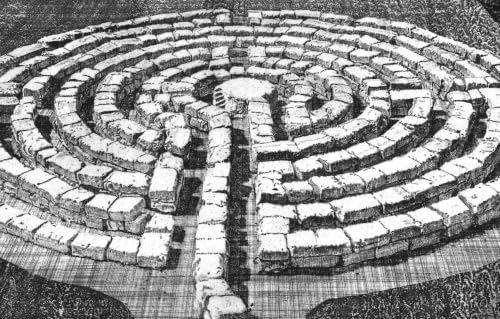
『The Labyrinth』のカバーアート

The Labyrinth

The Labyrinth

著者: Lisa Carley Rich Grego Ph. D.
無料で聴く

An intentional space to navigate life's paradox in the same way that an arrow is shot from the bow where our aim is true but the destination is not known. You are invited into this community as an intrepid explorer of purpose, meaning, and service regarding the open terrain of spirituality, psychology, motherhood, relationships, The Arts, human potential, awareness, education, science and technology as a springboard to societal innovation and evolution. In a cross-collaboration with both Henry Crettela's Alchemical Dialogues podcast, and Joel Lesses' Unraveling Religion podcast, The Labyrinth seeks to further and promote conversations evolving our understanding of the vital topics of spirituality, the humanities, psychology, and The Arts, and we find deepening community in our mutual support. We have begun posting 'Selected, Best of Alchemical Dialogues' and 'Selected, Best of Unraveling Religion' episodes on 'The Labyrinth.'© 2024 アート スピリチュアリティ 哲学 社会科学
エピソード
  • 'What Are We In Service To: The Intrinsic Nature of The Universe as Discordant or Meaningful?' Examining Our Phenomenology and Inner Landscape; Pointers, Roadmaps, and Signs
    2026/07/18

    In this episode of The Labyrinth, Lisa Carley introduces Joel Lesses and Rich Grego and engage in a deeply personal narrative exploring purpose, spirituality, identity, and the role of solitude in living an authentic life.

    Lisa begins by reflecting on a question that has become central to her life: how can she use her time in ways that are meaningful not only in the present moment but also in service of a larger purpose? She explains that while she values mindfulness and presence, she is equally interested in understanding how everyday choices contribute to a deeper calling. As an educator, she extends this question to modern education, asking whether schools prepare students simply for careers or whether they help people discover lives of meaning, purpose, and authentic contribution.

    The conversation turns to Lisa's recent experience with an Akashic Record reading, which confirmed intuitions she already held about her life direction. Rather than predicting the future, the reading encouraged her to trust an emerging sense of purpose as she considers moving into a larger artist community. She describes feeling called to become a gathering place for ideas—a person who brings together diverse perspectives, synthesizes them, and shares them in ways that serve others.

    Joel reflects on his own philosophical journey from a worldview that questioned whether life possessed any inherent meaning to one shaped by years of Buddhist practice and the Dharma. He explains that purpose is not something imposed upon life but something discovered through careful attention to one's inner landscape. As people recognize their natural gifts, passions, and values, they begin to understand how they are uniquely called to contribute. Echoing the familiar saying often attributed to Picasso, Joel reminds listeners that the meaning of life is to discover one's gift, while the purpose of life is to give that gift away in service to others.

    Lisa also shares how her understanding of identity has changed. Much of her life had been shaped by defining herself through close relationships, particularly romantic partnerships. Increasingly, however, she is discovering who she is independent of those roles. This deeper relationship with herself has brought greater clarity to her vocation and a stronger sense of alignment with her own path.

    The conversation explores the value of solitude within spiritual traditions, particularly Buddhism, and questions whether time alone can become an essential part of personal transformation. Rather than viewing solitude as isolation, the speakers suggest it offers space for creativity, self-discovery, and deeper listening. Lisa proposes expanding the idea of relationship itself, suggesting that we can learn to be in relationship not only with other people but with life, the universe, and reality itself. Asking what life is calling us toward becomes just as important as asking what others expect from us.

    Throughout the discussion, the speakers emphasize that purpose is rarely discovered through dramatic moments of revelation. More often, it emerges gradually through self-reflection, meaningful work, community, creativity, and service. Authentic living is less about arriving at certainty than about remaining attentive to the patterns that unfold throughout one's life and choosing actions that increasingly align with one's deepest values.

    Ultimately, this episode invites listeners to reconsider conventional ideas of success and fulfillment. Rather than measuring life solely through achievement or external recognition, Joel, Lisa, and Rich encourage a lifelong exploration of calling, authenticity, and service. Purpose is not simply a destination waiting in the future—it is something revealed through the choices we make, the lives we touch, and the willingness to remain open to the unfolding mystery of our own experience.

    続きを読む 一部表示
    17 分
  • Alchemical Dialogues' 'Perfumes of the World's Traditions of The One Reality: An Examination of the Life and Influence of Paul Brunton with Micha-El (Alan Berkowitz)'
    2026/04/29

    This episode of Alchemical Dialogues features host Henry Cretella in conversation with Micha-El (Alan Berkowitz) on the life and teachings of Paul Brunton, and the intersections of Sufism, Vedanta, and other contemplative traditions. The discussion begins with Henry describing how he first encountered Brunton’s book The Short Path to Enlightenment, which he initially bought simply because of the title but left unread for years. Later, through engagement with Sufi practice and references to figures such as Ramana Maharshi and conversations within his spiritual circle, he returned to the book and found it deeply meaningful.

    Micha-El shares his background growing up in suburban New York in a non-religious Jewish family, where institutional religion felt empty and unengaging. During his time at Cornell University in 1969, amid political and social upheaval, he experienced an existential crisis. Feeling disillusioned with both activism and academic structures, he was directed to the American Brahmin Bookstore in Ithaca, associated with Anthony Damiani. There he encountered a comparative study of spiritual traditions, including Buddhism, Hinduism, Sufism, and Western mystical thought, all presented in a unified way.

    Through Damiani, Micha-El eventually encountered Paul Brunton and later met him personally several times in Switzerland and the United States. Brunton is described as someone who studied and synthesized many traditions and teachers, producing a body of work that includes A Search in Secret India and later The Notebooks of Paul Brunton, a large compilation of teachings organized into thematic categories.

    Micha-El emphasizes Brunton’s approach as both experiential and investigative. Brunton did not present himself as a guru but as a researcher of consciousness. His work draws from direct encounters with teachers, texts, and his own inner experience. He was also interested in integrating scientific inquiry with mystical insight, emphasizing a “scientific attitude” toward spiritual experience.

    A central teaching discussed is Brunton’s idea of “the quest,” which includes four aims: knowing the self, knowing the higher self (or Overself), knowing the universe, and understanding one’s relation to the universe. This framework combines inner realization with understanding of the external world, including modern science, rather than rejecting it.

    The conversation also covers Brunton’s distinctions between different levels of realization, including temporary “glimpses,” personal illumination, and what he called cosmic illumination. Micha-El explains that glimpses are often the initial experiences that draw people into spiritual seeking, but they are not the final stage.

    Meditation is described as a movement beyond thought into a deeper inner emptiness where thoughts cease. In this state, Brunton suggests, communication can occur at a subtler level than language or intellect. Henry connects this to contemplative practices in Sufism and Christianity, while Mikael relates it to similar ideas in Buddhism and Vedanta.

    A significant theme is the role of teachers. Brunton acknowledged that qualified teachers are rare but valuable, yet he did not require students to depend on one. Instead, he emphasized what he called an independent path, where individuals rely on inner guidance and serious study. Books, in this sense, can function as direct transmissions when deeply engaged.

    The discussion also addresses Brunton’s skepticism toward spiritual organizations. He observed that many become entangled in ego, power, and institutional issues. While organizations may preserve teachings, he did not see them as essential for spiritual realization.

    Both Henry and Micha-El reflect on the difficulty of discerning authentic teachers, noting that seekers must rely on experience, patience, and discernment rather than idealized expectations. They also dis...

    続きを読む 一部表示
    1 時間 14 分
  • Part 2 Alchemical Dialogues and Unraveling Religion's Collaboration 'The World As A Garden and, We, The Gardeners; The Relationship of Nature and Human Beings, An Examination of the Question 'What am I?': A Panel Discussion'
    2026/03/24

    Part 2 continues panel discussion by exploring the lived experience of unity, spirituality, and what it means to feel 'at home' in the universe, beginning with reflections on whether healing and awakening dissolve the sense of separation.

    Andy, drawing from his 12-step recovery background, describes spirituality as a relationship with a higher power understood personally, sharing that his connection takes shape through Christian symbolism rooted in his upbringing. He emphasizes that this framework is not exclusive, but a language through which he experiences alignment, meaning, and a sense that everything in existence is placed in right relationship. Central to his path is humility—learning to recognize value in all people and to move beyond ego-driven identity.

    The conversation expands into spiritual awakening as both gradual and sudden, drawing on William James’ distinction between 'educational' awakenings and sudden insight, with participants noting that suffering, hindsight, and breakthrough moments all contribute to a growing awareness of interconnectedness.

    Themes of non-separation emerge across traditions, including Zen and Advaita Vedanta, where suffering is understood as rooted in the illusion of a separate self, and healing arises through re-experiencing unity—both psychologically and physically in the body.

    • Humility as a balance between recognizing higher forces and maintaining personal agency

    • The idea that all relationships—including with the divine—are reciprocal rather than one-directional

    • A Sufi perspective, influenced by Inayat Khan, describing the universe as moving toward love, harmony, and beauty

    • The concept of a 'pull of the future' shaping evolution alongside past causes

    • Parallels to scientific ideas of uncertainty and unfolding potential within the universe

    Joel offers a complementary perspective on karma, rooted in mystical traditions, emphasizing that every thought, action, and intention generates corresponding effects that return 'measure for measure,' shaping future experience. He frames reality as an interplay between seen and unseen dimensions, where intentionality—especially loving-kindness—acts as a generative force.

    The panel reflects on the interplay of karma, grace, randomness, and free will, suggesting that human life unfolds within a dynamic system of influence and choice, where individuals both shape and are shaped by experience.

    Closing reflections highlight the importance of shared inquiry and spiritual community, with participants emphasizing that these conversations create space for meaningful exploration beyond solitary practice.

    The discussion concludes with a Zen teaching offered by Joel, pointing to the enduring challenge of ethical living—avoiding harm and cultivating virtue—not as abstract ideals, but as practices that must be lived moment to moment.

    続きを読む 一部表示
    37 分
adbl_web_anon_alc_button_suppression_t1
まだレビューはありません