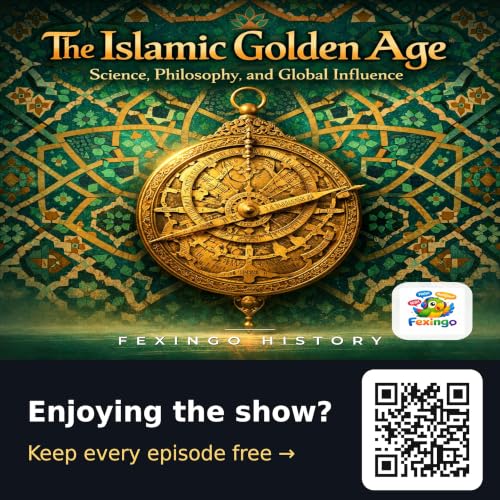
『The Islamic Golden Age: Science, Philosophy, and Global Influence — Fexingo History』のカバーアート

The Islamic Golden Age: Science, Philosophy, and Global Influence — Fexingo History

The Islamic Golden Age: Science, Philosophy, and Global Influence — Fexingo History

著者: Fexingo
無料で聴く

From the 8th to the 13th centuries, the Abbasid Caliphate fostered an unprecedented flourishing of science, philosophy, and culture. In Baghdad's House of Wisdom, scholars like al-Khwarizmi pioneered algebra, while al-Razi advanced medicine and Ibn Sina (Avicenna) synthesized Aristotelian thought with Islamic theology. This era saw the translation and preservation of Greek classics, the development of astrolabes and observatories, and innovations in chemistry, optics, and geography. Philosophers like al-Farabi and Averroes engaged in debates over reason and revelation that echoed through medieval Europe. The show also explores the influence of the Islamic Golden Age on the Renaissance, from the transmission of Arabic numerals to the works of Dante and Thomas Aquinas. Lucas and Luna guide listeners through the courts of Harun al-Rashid, the rise of Sufism, and the eventual fragmentation under the Seljuks and Mongols. Why does this era matter today? Because it challenges the narrative of a clash of civilizations, revealing a period of intense cross-cultural exchange, intellectual courage, and scientific progress that shaped the modern world. This is not a tale of decline, but of legacy. #IslamicGoldenAge #AbbasidCaliphate #HouseOfWisdom #AlKhwarizmi #IbnSina #AlRazi #Averroes #AlFarabi #Baghdad #Algebra #Astrolabe #TranslationMovement #Sufism #SeljukEmpire #MongolInvasion #History #WorldHistory #FexingoHistory Keep every episode free: buymeacoffee.com/fexingo© 2026 Fexingo. All rights reserved. 世界 毎時 社会科学
エピソード
  • Al-Ma'mun's House of Wisdom: Patronage and Translation in Abbasid Baghdad
    2026/07/14
    This episode dives into the intellectual powerhouse of the Abbasid era: the Bayt al-Hikma, or House of Wisdom, in Baghdad. We explore how Caliph al-Ma'mun (r. 813–833 CE) transformed a royal library into a state-sponsored academy and translation center that fueled the Islamic Golden Age. We discuss the translation movement, where works from Greek, Persian, and Sanskrit were systematically rendered into Arabic—particularly the works of Aristotle, Galen, and Ptolemy. We also touch on al-Ma'mun's motivations, including his Mu'tazili theological leanings and his desire to rival the Sassanid and Byzantine courts. The episode highlights key figures like the translator Hunayn ibn Ishaq, the mathematician al-Khwarizmi, and the philosopher al-Kindi. We also address the controversy surrounding the House of Wisdom: was it a real institution or a later literary construct? Listeners will come away with a concrete understanding of how the translation movement shaped not just Islamic thought, but the trajectory of world science and philosophy. #BaytAlHikma #AlMamun #HouseOfWisdom #TranslationMovement #Abbasid #HunaynIbnIshaq #AlKhwarizmi #AlKindi #Mu'tazila #GreekToArabic #Baghdad #IslamicGoldenAge #HistoryOfScience #HistoryOfPhilosophy #ArabicTranslation #Caliph #FexingoHistory #History Keep every episode free: buymeacoffee.com/fexingo
    続きを読む 一部表示
    8 分
  • Al-Jahiz: The Essayist Who Wrote the World
    2026/07/13
    Before the internet, before the essay, there was al-Jahiz — a ninth-century scholar from Basra who wrote about everything from the anatomy of the flea to the politics of the Abbasid court. Born with bulging eyes that gave him his nickname, al-Jahiz (Abu Uthman Amr ibn Bahr al-Kinani al-Fuqaymi al-Basri) turned his sharp tongue and sharper pen into a career as a court writer, theologian, and zoologist. His most famous work, Kitab al-Hayawan (Book of Animals), is a sprawling, digressive masterpiece that mixes biology, poetry, jokes, and philosophy — a vivid picture of how knowledge worked in the early Islamic world. But al-Jahiz wasn't just a naturalist; he was also a fierce Mu'tazili debater, a critic of racism, and a writer who defended the literary superiority of Arabic prose over poetry. In this episode, Lucas and Luna explore the man who once said 'the pen is the tongue of the mind' and who wrote the first known theory of evolution by environmental adaptation — seven centuries before Darwin. From his rivalry with al-Kindi to his influence on later adab (belles-lettres) literature, we uncover why al-Jahiz remains one of the most original thinkers of the Golden Age. #AlJahiz #KitabAlHayawan #AbbasidCaliphate #Mu'tazila #Basra #Adab #ArabicLiterature #IslamicGoldenAge #EvolutionBeforeDarwin #ZoologyInIslam #TheEssay #AbuUthmanAmrIbnBahr #BaytAlHikma #9thCentury #FexingoHistory #History #Philosophy #Science Keep every episode free: buymeacoffee.com/fexingo
    続きを読む 一部表示
    8 分
  • Avicenna: The Canon of Medicine and the Prince of Physicians
    2026/07/13
    Lucas and Luna explore the life and legacy of Ibn Sina, known in the West as Avicenna — a Persian polymath whose Canon of Medicine became the standard medical text across Europe and the Islamic world for over 500 years. They discuss his early education in Bukhara, his encyclopedic output including the Book of Healing and the Canon, his philosophical synthesis of Aristotle and Neoplatonism, his controversial relationship with al-Ghazali, and his impact on Thomas Aquinas and the Scholastics. The episode also touches on his political career as a vizier, his imprisonment, and his final years in Hamadhan. Perfect for listeners curious about the bridges between medicine, philosophy, and faith in the Islamic Golden Age. #Avicenna #IbnSina #CanonOfMedicine #BookOfHealing #GoldenAge #PersianScience #MedicalHistory #Philosophy #Aristotle #Neoplatonism #AlGhazali #Scholasticism #ThomasAquinas #Samarkand #Bukhara #Hamadhan #History #FexingoHistory Keep every episode free: buymeacoffee.com/fexingo
    続きを読む 一部表示
    6 分
adbl_web_anon_alc_button_suppression_t1
まだレビューはありません