エピソード

  • Three Astronauts Died on the Launchpad. NASA Had Been Warned. | Apollo 1
    2026/05/30

    On January 27, 1967, at 6:31 in the evening, a fire broke out inside Apollo 1 on the launchpad at Cape Kennedy. The three astronauts inside — Gus Grissom, Ed White, and Roger Chaffee — were dead within seventeen seconds of the first distress call. The hatch that might have saved them could not be opened from the inside under pressure. The pure oxygen atmosphere that NASA had chosen for the cabin, under pressure, turned the spacecraft into an incinerator.

    The fire was not a surprise. Not to the engineers who had been documenting the spacecraft's problems for months. Not to Gus Grissom, who had hung a lemon on the spacecraft's simulator and told his wife he wasn't sure he was coming back from this one. Not to the NASA inspector who had counted over a hundred open safety items on the vehicle and could not get anyone in authority to treat them as the crisis they were. Not, on some level, to the institution itself — which had been moving so fast, under such pressure, toward a deadline that John Kennedy had set before his assassination, that it had stopped being able to hear the warnings it was generating.

    In this episode of Historical Autopsy, we open the case file.

    We examine the world that built Apollo 1 — the specific institutional atmosphere of NASA in 1966 and early 1967, where the pressure of the lunar deadline, the competition with the Soviet space program, and the organizational complexity of managing a contractor network of unprecedented scale had created conditions in which speed was systematically prioritized over safety in ways that the people inside the institution could feel but struggled to stop.

    We investigate the spacecraft itself — the Block I Command Module, built by North American Aviation, and the long, documented, escalating record of quality control failures, wiring problems, flammable materials, and hatch design decisions that converted a routine ground test into a fatal fire.

    We examine the men. Gus Grissom — the second American in space, the man who almost drowned when his Mercury capsule sank, who had more reason than anyone to understand the specific and personal nature of spacecraft risk. Ed White — the first American to walk in space, whose spacewalk photograph is one of the defining images of the entire Apollo program. Roger Chaffee — the youngest of the three, on his first mission, who died in a spacecraft that never left the ground.

    We examine what happened after. The Congressional investigation. The redesign of the Command Module. The eighteen months during which NASA stopped flying and rebuilt not just the spacecraft but, partially and imperfectly, the institutional culture that had produced the fire.

    And we sit with the question that January 27, 1967 permanently opens: what does it cost when the warnings are there, the people are there, the documentation is there — and the momentum of an institution is greater than the force of the evidence against it?

    The patch they designed for Apollo 1 never flew. It flew on every mission after.

    A companion article expanding the investigation is available on Medium — linked in the show notes.

    Subscribe to Historical Autopsy for new episodes every week. If this episode left something with you, leave a rating on Spotify or Apple Podcasts — it's the primary way we reach new listeners.

    続きを読む 一部表示
    25 分
  • Australia Declared War on Birds — and Lost | The Great Emu War of 1932
    2026/05/30

    In November 1932, the Australian government deployed a detachment of Royal Australian Artillery soldiers to the Campion district of Western Australia. They were armed with two Lewis guns and ten thousand rounds of ammunition. Their mission was to cull a population of emus — large, flightless birds — that had been devastating the wheat crops of soldier-settlers in the region.

    The operation lasted roughly two months, across two separate deployments. The soldiers fired thousands of rounds. The ornithologist overseeing the operation described the emus as able to "face machine guns with the invulnerability of tanks." The Australian parliament debated the campaign's failure with a level of institutional embarrassment usually reserved for military disasters of considerably greater strategic consequence. A motion was made, more than once, to withdraw the soldiers.

    The emus, for their part, continued to exist.

    This episode is about what actually happened during the Great Emu War of 1932 — the tactics, the terrain, the birds, the men, and the specific sequence of events that produced one of the most comprehensively documented failures in military history. But it is also about what the Emu War reveals when you look past the joke.

    Because behind the absurdist headline is a story about the soldiers who were sent to fight it — World War One veterans who had been given farmland as compensation for their service and then abandoned by the government that promised to support them. A story about the gap between imperial agricultural policy and the actual conditions of farming in the Western Australian interior. A story about what happens when bureaucratic decisions made in distant offices collide with ecological reality in a landscape that was never going to cooperate.

    The emus did not care about agricultural policy. They did not care about imperial settlement schemes or soldier-settler programs or the price of wheat on the international market. They were following water and food across a landscape they had inhabited for considerably longer than the European agricultural experiment that was now competing with them for it.

    The Emu War is funny. It is also, if you look at it closely enough, a forensic examination of institutional failure, colonial land policy, and the specific human cost of decisions made by people who had never seen the country they were administering.

    In this episode of Historical Autopsy, we open the case file.

    A companion article expanding the investigation is available on Medium — linked in the show notes.

    Subscribe to Historical Autopsy for new episodes every week. If this episode left something with you, leave a rating on Spotify or Apple Podcasts — it's the primary way we reach new listeners.

    続きを読む 一部表示
    22 分
  • West Africa's Elite Female Warriors Who Made Soldiers Beg for Mercy | The Agojie
    2026/05/29

    In the Kingdom of Dahomey, in what is now the country of Benin in West Africa, there existed for roughly two centuries a corps of female soldiers unlike anything else in the documented history of organized warfare.

    They were called the Agojie. European accounts — the ones that survived, the ones that were believed — called them the Dahomey Amazons. They were the royal bodyguard, the shock troops, the most feared unit in the Dahomean military. They underwent training that broke men who attempted it. They operated under a code of celibacy and institutional discipline that made them simultaneously the most protected and most dangerous people in the kingdom. And when European forces finally faced them in the wars of the 1890s, the accounts that came back described something that the colonial military imagination had no category for.

    Women. Fighting. And not surrendering.

    In this episode of Historical Autopsy, we open the case file.

    We examine the specific world that built the Agojie — the Kingdom of Dahomey's political structure, its relationship with the Atlantic slave trade, and the internal logic that led a West African king to build the most disciplined female fighting force in recorded history. We investigate the training — what it demanded, what it produced, and what it cost the women who underwent it.

    We examine the battles. The raids against neighboring kingdoms. The conflicts with the Yoruba Oyo Empire. And finally, the two Franco-Dahomean Wars of the 1890s, in which the Agojie faced the French Foreign Legion equipped with modern rifles and Maxim guns, and fought them in a way that European soldiers would spend years struggling to describe accurately.

    We investigate the erasure — how colonial historiography systematically minimized, exoticized, and ultimately buried the Agojie's military record, and what it took to begin recovering it.

    And we sit with the specific question that the Agojie force opens: what does it mean that one of the most formidable military institutions in African history was built around women — in a kingdom that also participated in the Atlantic slave trade — and what do we do with the full moral complexity of that history, rather than the simplified version that either condemns it entirely or celebrates it uncritically?

    This is not a story about representation. It is not a story about women proving something. It is a forensic investigation of a military institution that was extraordinary by any historical standard, in a kingdom whose history is too complicated and too important to be reduced to a single moral frame.

    The Agojie were real. They were formidable. And the reasons they were nearly written out of history tell us as much about the people doing the writing as they do about the women themselves.

    A companion article expanding the investigation is available on Medium.

    Subscribe to Historical Autopsy for new episodes every week. If this episode left something with you, leave a rating on Spotify or Apple Podcasts — it's the primary way we reach new listeners.


    https://medium.com/historicalautopsy

    続きを読む 一部表示
    23 分
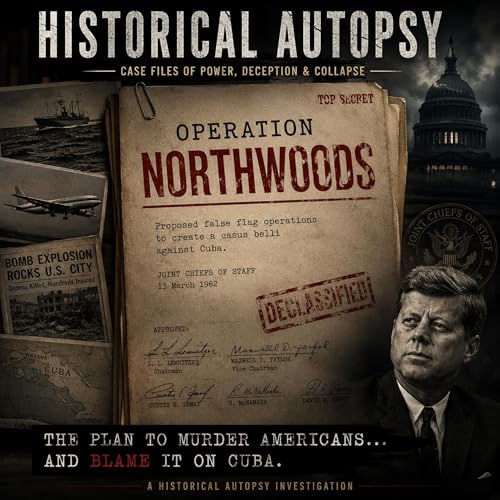
  • The Secret Plan to Stage Terror Attacks on American Soil | Operation Northwoods
    2026/05/29

    In March 1962, the Chairman of the Joint Chiefs of Staff of the United States military presented the Secretary of Defense with a proposal. It had been developed carefully, over months, by senior military planners. It was written on official letterhead. It was signed.

    The proposal recommended that the United States government stage a series of terrorist attacks on American soil — bombings, hijackings, the sinking of a ship, the shooting down of a civilian aircraft — and blame them on Cuba. The manufactured attacks would generate public outrage sufficient to justify a military invasion of the island. The invasion would remove Fidel Castro. The Cold War calculus would shift.

    The proposal was called Operation Northwoods. It was real. It was official. It was approved at the highest levels of the American military establishment.

    President Kennedy rejected it. He removed the general who presented it from his post shortly afterward. The plan was classified and buried for nearly four decades, until the Assassination Records Review Board released it in 1997.

    In this episode of Historical Autopsy, we open the case file.

    We examine the specific world that produced Operation Northwoods — the psychological pressure cooker of 1962, the humiliation of the Bay of Pigs, the institutional terror of losing Cuba permanently to the Soviet sphere, and the specific cast of Cold War military thinkers who had concluded that deception at any scale was not only acceptable but strategically obligatory.

    We investigate the document itself — its operational specificity, its bureaucratic calm, the gap between the language it uses and the things it is proposing. We ask what it means that a plan to murder American civilians was processed through normal institutional channels, signed by the Joint Chiefs, and routed to the Secretary of Defense as a policy option rather than a criminal act.

    We examine the men who wrote it — not as cartoon villains, but as products of a specific ideological and institutional environment that had trained them to think about human life in a particular way, and that had rewarded that thinking for decades.

    We examine Kennedy's rejection — what it cost him politically, what it revealed about the fracture lines running through his relationship with the military, and what the historical record suggests about the atmosphere inside the national security apparatus in the months that followed.

    And we sit with the question that Operation Northwoods permanently opens: if this plan existed, was approved, and was only stopped by one man's decision — what else existed that was never rejected? What plans were implemented that never appeared in a document released forty years later?

    This is not a conspiracy episode. The conspiracy, in this case, is the declassified historical record.

    Operation Northwoods is what institutional thinking looks like when it loses its connection to moral reality. It is what happens when the logic of a system — protect national security, contain communism, win the Cold War — is followed to its conclusion without anyone in the room asking whether the conclusion is human.

    The document exists. You can read it. That is the most unsettling thing about it.

    A companion article expanding the investigation is available on Medium.

    Subscribe to Historical Autopsy for new episodes every week. If this episode left something with you, leave a rating on Spotify or Apple Podcasts — it's the primary way we reach new listeners.

    続きを読む 一部表示
    23 分
  • Americans and Germans Fought Together in a Castle — Against the SS | The Battle of Castle Itter
    2026/05/28

    On May 5, 1945 — two days after Adolf Hitler's suicide and three days before Germany's unconditional surrender — a small group of American soldiers drove a single Sherman tank to a medieval castle in the Austrian Alps.

    They weren't alone. Riding with them were Wehrmacht soldiers. Regular German Army men. Enemies.

    Together, they were going to defend a group of French prisoners — former prime ministers, generals, a tennis champion — from an SS unit that hadn't received the message, or simply refused to accept it, that the war was already over.

    The Battle of Castle Itter lasted six hours. It is, by most measures, the strangest military engagement of the Second World War. And it raises questions about ideology, identity, and institutional collapse that no clean historical narrative has ever fully resolved.

    In this episode of Historical Autopsy, we open the case file.

    We examine the specific, psychologically exhausted world of Austria in the final days of April 1945 — when the Third Reich's command structure was disintegrating faster than any individual could track, when orders from multiple competing authorities were canceling each other out, and when the SS was still executing people for a cause that had functionally ceased to exist.

    We profile the French prisoners held inside Castle Itter — a compressed repository of national trauma. Paul Reynaud, the Prime Minister who had argued that France must not surrender. Maxime Weygand, the general who had said the army was beaten. Édouard Daladier, who had signed Munich. Gustave Gamelin, who had lost France in six weeks. All of them, together, in a twelfth-century castle, watching the regime that imprisoned them burn.

    We investigate Josef Gangl — the German artillery officer who had been feeding intelligence to the Austrian resistance and who would die stepping between a French prisoner and an SS sniper's bullet. And we ask the uncomfortable question that late resistance always generates: what does it mean to make the right choice after years of making the wrong one?

    We examine the American decision — Captain John Lee, twenty-four years old, who accepted an unauthorized alliance with Wehrmacht soldiers and drove toward a castle with no official sanction and no established protocol for what he was about to do.

    And we examine the SS. The men who attacked the castle on May 5th, two days after their Führer's death, for a regime that had already ceased to exist in any meaningful sense. What does it look like when ideology persists past the collapse of everything that produced it? Castle Itter has an answer. It is not a comfortable one.

    This is not a story about the triumph of common humanity over division. It is not a simple redemption narrative. It is a forensic examination of what happens to people — soldiers, prisoners, ideologues, resisters — when the systems they live inside dissolve around them faster than they can process.

    The castle is still standing in Wörgl, Austria. There is no monument on the grounds where the fighting happened.

    Some events resist the tidiness of monuments.

    続きを読む 一部表示
    28 分