エピソード

  • Ep 86: What Every Generation Gets Wrong About Love (with Robin Hamilton)
    2026/11/11
    No matter the generation, the entry point to healthy love is the same: knowing yourself first. Robin Hamilton has spent over 20 years working with couples and individuals across generational lines, and the pattern she sees is consistent: - Gen X latchkey kids who learned self-reliance but not self-examination. - Millennials who raced to check the marriage box before they knew what they wanted. - Gen Z retreating behind screens and AI companions to avoid the real-world friction that builds identity. In this episode, Tess and Robin explore how each generation’s specific pressures produce the same fundamental problem: people bringing unexamined selves and unresolved wounds into relationships and wondering why the same dynamic keeps repeating. They cover attachment wounds, what words actually do to love over time, why couples therapy rarely works without individual work running alongside it, and why self-knowledge is not a destination. It evolves across every decade of a life, and there is always more to find. Follow the Gen Mess with Tess for weekly episodes, where we aren't just fixing the generational mess, we're learning how to live in it. Visit tessbrigham.com/podcast to learn more.
    続きを読む 一部表示
    46 分
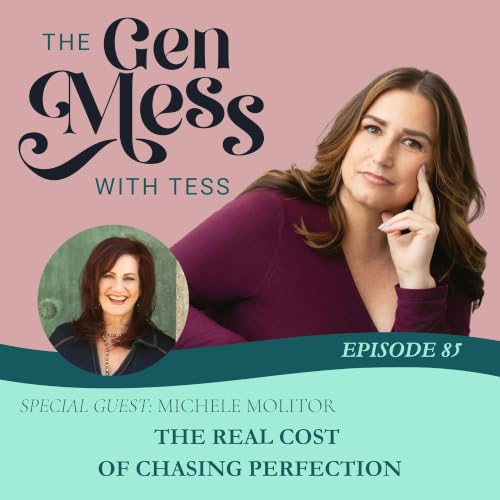
  • Ep 85: The Real Cost of Chasing Perfection (with Michelle Molitor)
    2026/11/04
    Michelle Molitor spent a decade as a creative director before being fired in the dot-com crash, discovered coaching through that experience, and has spent the past 25 years helping accomplished women break free from the subconscious patterns keeping them stuck. In this episode, Tess and Michelle unpack what overfunctioning actually is, why it is so hard to stop, and how perfectionism differs from striving for excellence. They explore identity drift, the kintsugi philosophy of repair as a framework for embracing imperfection, and how combining trauma-informed coaching, hypnotherapy, and nervous system reset work produces change that talk therapy alone often cannot reach. They also examine how technology and AI are amplifying trust issues in clients across generations. Michelle shares where to start if you recognize yourself in the pattern today. TIMESTAMPS 00:01 - From creative director to coach: Michelle’s origin story 05:39 - What clients say when they first walk in 07:17 - What overfunctioning is and why it is so hard to stop 11:43 - Identity drift and how it develops over time 15:29 - How coaching, hypnotherapy, and neuroscience work together 18:51 - What Michelle has observed across generations 24:05 - The book and the kintsugi philosophy of repair 29:46 - Striving for excellence vs. toxic perfectionism 32:19 - How AI is amplifying existing trust issues in clients 43:01 - Where to start if you recognize yourself in this episode Follow The Gen Mess with Tess for weekly episodes. Visit tessbrigham.com to learn more.
    続きを読む 一部表示
    48 分
  • Ep 84: Why You Misunderstand Gen Z at Work (with Danielle Farage)
    2026/10/28
    Danielle Farage graduated from USC in 2020, watched her generation get locked out of entry-level jobs during COVID, and turned that experience into a career translating Gen Z for the rest of the working world. In this episode, Tess and Danielle unpack why organizations keep losing young talent before they ever get started, what the generational divide actually looks like from inside a company, and why curiosity may be the only leadership skill that genuinely bridges it. They explore the economic realities facing Gen Z, a growing “quiet AI revolt” inside the workforce, the cognitive cost of offloading thinking to AI, and Danielle’s framework called frentorship, a mutual cross-generational relationship built on what each person can learn, leave behind, and leverage. Listeners will walk away with a clearer picture of what Gen Z actually wants from leaders and the one move any leader can make this week to start closing the gap. KEY TAKEAWAYS Only 12 percent of Gen Z had a job lined up at graduation this year. For millennials just 10 to 15 years ago, that number was three times higher. The best leaders invest in new team members from day one with specific, personal attention that has nothing to do with workflow. The corporate ladder still exists, but there is far less room on it than Gen Z was promised, and they can see that clearly. Gen Z’s quiet resistance to AI is real and growing. Most organizations are not addressing it. Offloading thinking to AI carries a cognitive cost. Mental capacity works the same way as physical capacity: use it or lose it. When a new hire is not performing, the first question should be whether they ever clearly understood what was expected of them. Leaders who criticize Gen Z for being “too sensitive” are often the same people who raised their own children the same way. Frentorship is a mutual relationship between people of different generations built on three questions: what can I learn, what can I leave behind, and what can I leverage. Saying the next generation will figure out today’s problems is a declaration of retirement, whether the speaker intends it or not. Curiosity is the most accessible and immediate leadership move for closing the intergenerational gap. TIMESTAMPS 00:01 - Why Danielle chose Gen Z at work as her life’s focus 02:07 - Graduating during COVID and the toxic first internship 08:08 - What a genuinely great manager actually does differently 11:04 - How Gen X and Gen Z see the workplace through different lenses 17:10 - What the pandemic revealed about undefined workplace expectations 21:12 - Is the corporate ladder dead? 28:30 - The real numbers behind Gen Z’s job market 30:44 - Gen Z’s quiet revolt against AI 38:20 - Why “Gen Z is too sensitive” is the wrong question 42:35 - What frentorship is and why it belongs in the workplace Find Danielle Farage at https://www.linkedin.com/in/danielle-farage/ Follow The Gen Mess for more weekly content. Visit tessbrigham.com to learn more.
    続きを読む 一部表示
    52 分
  • Ep 83: Why Good Employees in Caring Professions Leave (with Crystal Stokes)
    2026/10/21
    This episode examines why dedicated, compassionate professionals in veterinary medicine and other caring fields burn out and leave, and what leaders should be considering in the modern workplace. Crystal Stokes, a licensed marriage and family therapist and doctoral candidate who founded Full Circle Lab, brings a perspective shaped by her own unexpected path. What are the emotional and systemic forces pushing good people out of caring professions? What do generational differences actually look like inside a veterinary practice? And what specific leadership skills, onboarding systems, and feedback structures determine whether a new hire stays or leaves within the first year? Listeners will walk away with a clearer picture of why culture is a business strategy, not a soft extra, and what well-supported teams actually look like from the inside. KEY TAKEAWAYS Burnout in caring professions The corporatization of veterinary medicine The generational difference in the workplace The Seasons of Life Why onboarding is not an administrative task Why clarity is a leadership obligation How employee assistance programs routinely fail caring profession workers TIMESTAMPS 00:01 - Why a pre-vet student left the field and accidentally became a therapist 03:31 - How volunteering at a hospital led to the origin of Full Circle Lab 05:46 - What is actually burning out veterinary professionals 08:24 - When burnout escalates: suicidal ideation in veterinary medicine 10:13 - Why culture change stalls at the leadership level, not the team level 17:49 - How younger workers approach the workplace differently than older generations 21:39 - Where the mental health awareness pendulum may be swinging too far 25:36 - Why life in seasons beats work-life balance as a framework 30:00 - What younger workers need from leadership that they are not getting 33:07 - How onboarding and performance management directly drive retention Learn more about Full Circle Lab: https://www.fullcirclelab.com/ Follow The Gen Mess with Tess for weekly insights into the modern workplace. Join the free "Dear Gen Mess" community at tessbrigham.com/podcast Visit tessbrigham.com to learn more.
    続きを読む 一部表示
    49 分
  • Ep 81: The Emotional Cost of Surviving Cancer (with guests Hollye Jacobs & Dev Meenagh)
    2026/10/07
    This episode examines what happens after breast cancer treatment ends, and why the emotional, relational, and identity-based damage from a cancer diagnosis often goes unaddressed by the medical system. Tess Brigham, a therapist and breast cancer survivor, speaks with Hollye Jacobs, a nurse, social worker, and resilience coach who was diagnosed at 39, and Dev Meenagh, who was diagnosed at 28. Together they discuss the gap between ringing the bell and actually feeling better, what fear of recurrence looks like years after treatment ends, how relationships shift when a partner becomes a caregiver, and why connecting with people who have lived the same experience can be more useful than clinical support alone. Listeners will also hear practical grounding tools for managing anxiety and why the assumption that survivorship has an end date is itself part of the problem. KEY TAKEAWAYS When genetic testing tells you that you do not have the breast cancer gene, it means you do not have one of the 12 to 15 genes currently being tested, not that the disease is not hereditary in your family. The emotional and relational damage from cancer treatment is just as real as the physical damage, and it often goes unaddressed once active treatment ends. Two people can go through the same cancer treatment and have completely different physical experiences, from working through chemo without missing a day of work to being hospitalized twice. When a partner becomes a caregiver during treatment, the equality and intimacy that held the relationship together can erode in ways that are hard to see in the moment. The hardest part of a cancer diagnosis is often not the treatment itself but the period after it ends, when support disappears and everyone around you assumes you are fine. Fear of recurrence does not go away with time. It can still arrive, without warning, sixteen years after treatment. The 5-4-3-2-1 grounding technique works because the brain cannot simultaneously process a structured sensory sequence and a fear spiral. Name five things you see, four you physically feel, three you hear, two you smell, one you taste. An app or support community made up of people who have been through the same experience provides a qualitatively different kind of support than clinical care or well-meaning friends and family. Survivorship is not a destination. It is an ongoing process that continues for years and sometimes decades after active treatment ends. Choosing to look for what a difficult experience is teaching you, rather than asking why it happened to you, is a learnable approach, not a personality trait. TIMESTAMPS 00:00 - Why cancer opens a club you never wanted to join 01:42 - What treatment looks like when it hits harder than expected 03:37 - Why a negative genetic test does not mean what most people think 09:42 - How the same treatment can feel completely different for different people 14:05 - What happens to a relationship when a partner becomes the caregiver 16:00 - Why finishing treatment can feel like a free fall 19:12 - What the now-what moment looks like from inside 27:28 - How Cancer Buddy helps survivors find people who truly get it 35:17 - Why finding meaning in hard things is different from toxic positivity 39:59 - Three practical tools for managing fear of recurrence
    続きを読む 一部表示
    59 分
  • Ep 80: Reframe Your Relationship With Alcohol (guest: Vedant Pradeep)
    2026/09/30
    For decades, there were two options when your drinking became a problem: a 12-step program or a residential treatment center. Both carries stigma, both requires a label, and neither fits the vast majority of people who weren't maybe physically addicted but were drinking more than they wanted to. In this episode, Tess sits down with Vedant Pradeep, co-founder of Reframe, an app for helping people reduce their alcohol intake or quit drinking altogether. With six million downloads and research partnerships at Emory and Harvard, Reframe was built on a simple but powerful idea: you have agency over your behavior, and the path to change is built through neuroscience, habit loops, and self-efficacy, not shame and labels. Vedant and Tess go deep on the 12-step model's core assumption, that you are powerless, and why it may be the very thing that keeps people stuck. They explore what it actually looks like when you stop avoiding triggers and start rewiring the loops underneath them. They also get into the surprising data on private drinking and loneliness in younger generations, why "Damp January" outperforms "Dry January" for lasting change, and what GLP-1 medications might do for addiction treatment the way SSRIs did for mental health. What listeners will learn: Why the 12-step model's self-efficacy problem may be keeping more people stuck than it helps The difference between the "I can't drink" identity and the "I don't drink" identity, and why one word changes everything What loneliness, boredom, and stress data reveal about why Gen Z is drinking more privately than publicly Why small experiments like Damp January outperform total abstinence commitments for most people, including a stat that may surprise you How to use an app as a diagnostic: what it means if you try to cut back and genuinely can't What the 66-day habit change science says about why 28-day insurance-covered programs often fail Reframe Med: how the app now connects users with naltrexone prescriptions for people whose cravings need more than behavioral change Why Vedant believes GLP-1 medications could do for addiction what Prozac did for depression What listeners will learn: CHAPTER TIMESTAMPS 00:00 Introduction: Who Is Vedant Pradeep and What Is Reframe 01:14 Origin Story: From OCD Research to Spotting a Gap in Alcohol Support 03:27 Why Reframe Chose Neuroscience Over the 12-Step Model 06:23 The Spectrum of Alcohol Use: Mindful Moderation vs. Abstinence 09:56 How Neural Pathways Drive Drinking Habits (And How to Rewire Them) 11:26 The Identity Shift: "I Don't Drink" vs. "I Can't Drink" 12:19 Gen Z, Loneliness, and the Rise of Private Drinking 17:07 The Moment That Starts Change: Relationship Crisis as Catalyst 22:10 Why Damp January Works Better Than Dry January for Most People 28:32 The Insurance Problem: Why 28-Day Programs Fall Short of the Science 35:12 What's Next for Reframe: Peak Human Condition and Reframe Med 43:00 GLP-1 Medications and the Future of Addiction Treatment GUEST AND RESOURCE CREDITS Guest: Vedant Pradeep, Co-Founder, Reframe App: Reframe available on iOS and Android Download/site: reframeapp.com
    続きを読む 一部表示
    49 分
  • Ep 79: Why Gen X Wears Not Caring Like a Badge of Honor
    2026/09/23
    Ask a Gen Xer how they're doing and watch what happens. They'll say they're "fine." Somewhere along the way, a generation turned that into an identity one that prides itself on low maintenance, toughness, and some who is never going to make a big deal out of anything. Host Tess Brigham makes the case that this isn't actually who Gen X is. It's who they had to become. And the real cost isn't the armor itself. It's what happened when they started wearing it like a medal. Drawing on research into latchkey kids, family systems theory, and Trevor Noah's concept that we can only dream in the shape of what we've actually seen, Tess unpacks where the "I don't need anything" posture came from, what it built, and how it impacts the day to day lives of Gen X and the people they care about. What listeners will learn: What the 1984 research on latchkey kids actually found, and why self-reliance wasn't a philosophy Gen X chose Why the "I don't care" posture isn't indifference, it's armor that had a very specific job at a very specific age Murray Bowen's family systems research on over-functioning, and why staying constantly capable is often about managing anxiety, not just being responsible Why Gen Z doesn't actually irritate Gen X The difference between a person who is genuinely at peace and a person who has gotten very good at not showing you the alternative A single reflection question to carry into the week CHAPTER TIMESTAMPS 00:00 Introduction + Dear Gen Mess Newsletter Announcement 01:32 What It Really Means to Say "I'm Fine": The Gen X Identity 02:00 The Research: Latchkey Kids and What Self-Reliance Actually Built 03:42 You Can Only Dream in the Shape of What You've Seen 05:18 The Armor: Why "I Don't Care" Was Never Indifference 06:45 Bowen's Family Systems Theory: Overfunctioning and the Anxiety Underneath It 08:15 Why Gen Z Irritates Gen X (It's Not What You Think) 09:24 What Gen X Actually Cares About — And Never Got Permission to Say 10:15 When Do You Get to Put the Armor Down? 11:00 The Reflection Exercise: A Question to Sit With This Week Listen now, and subscribe to The Gen Mess with Tess for weekly episodes.
    続きを読む 一部表示
    13 分