エピソード

  • Enterprise SEO Is Becoming GEO. Conductor Just Proved It.
    2026/09/25

    Welcome to episode 45 of The GEO Show, the briefing on Generative Engine Optimization and AI visibility. Brought to you by GEOforge.

    In this solo roundup, Paris Childress, founder of Hop AI and co-founder of GEOforge, leads with Conductor's pivot from enterprise SEO into AI search, then covers nine more stories: AirOps, Profound, Writesonic, Google Search Console, BrightEdge, Meta Muse, Spangle, GrowByData, and Searchable.

    In this episode:

    • 🎼 Conductor goes all in on AI search Conductor made AI search the focus of its next phase, promoted CPO Wei Zheng to CEO, and reports 12X year-over-year customer growth for its AI product, with new logo growth tripling quarter over quarter. Paris calls it a major signal that established enterprise SEO is now becoming GEO, and it puts Conductor head-to-head with GEO platform startups.


    • 📢 AirOps launches an AI ads operating layer AirOps now monitors live ChatGPT ads, measures ad load and paid share of voice, and ties spend, clicks, CTR, CPC, and CPM back to market activity. Its own research says ads went from 0% to more than 50% of answers in monitored industries within three months.


    • 🎨 Profound adds image generation Profound's AI marketer can now generate campaign visuals, alongside dynamic bot rendering, Search Console context, and Microsoft 365 grounding. The GEO platform category is growing into a full AI marketing workspace.


    • ⏳ Writesonic launches Citation Decay Cited pages are classified as rising, holding, declining, or recovering. Citations have a short shelf life, so this helps teams decide what to protect, refresh, or replace.


    • 📷 Google Search Console adds multimodal reporting New reporting covers Google Lens, Circle to Search, uploaded images, and Chrome's Search This Image, including generative AI performance. AI visibility is no longer a text-only measurement problem.


    • 📊 ChatGPT drives 95.1% of AI referrals BrightEdge says ChatGPT referral traffic rose 101% from January to August, roughly 22 times Gemini, Claude, and Perplexity combined, even as Comscore shows ChatGPT's share of prompt volume falling from 70% to 50%.


    • 🕶️ Meta turns Muse into a visual shopping agent Muse is coming to Meta's AI glasses with commerce connectors spanning Walmart, Best Buy, Sephora, Wayfair, Instacart, PayPal, and more. Visual agents should be measured as their own discovery surface.


    • 🛒 Spangle launches retail AI discovery Spangle connects AI visibility across ChatGPT, Perplexity, Google, Alexa for Shopping, and Walmart Sparky to traffic, conversion, and revenue for enterprise retailers.


    • 🔍 8 of 12 top AI sources aren't your competitors GrowByData tracked 44 prompts and 4,011 answer observations: 8 of the 12 most-present domains were outside the tracked competitor set. Know the difference between share of voice against competitors and share of voice overall.


    • 🌌 Searchable's Prompt Universe Searchable generates the full question space for a brand (22,442 prompts in its Uber example) and narrows it to a monitoring set. Paris argues the prompt universe is infinite, and that real GEO ROI comes from asking "How did you hear about us?"


    Subscribe to The GEO Show wherever you get your podcasts. Full episode on YouTube: https://youtu.be/D_oI51b-HWM


    💬 Question: Can an enterprise SEO incumbent win in GEO, or do the GEO-native platforms have the edge?

    続きを読む 一部表示
    24 分
  • 86% of AI-Cited YouTube Videos Aren't in YouTube's Top 10
    2026/09/24

    Welcome to episode 43 of The GEO Show, the briefing on Generative Engine Optimization and AI visibility. Brought to you by GEOforge.

    In this solo roundup, Paris Childress, founder of Hop AI and co-founder of GEOforge, leads with Rank Prompt's finding that 86% of AI-cited YouTube videos sit outside YouTube's own top 10, then covers Peec on Meta Muse Spark, ChatGPT Ads in Asia, TechMagnate citation stability, an AI Mode CTR experiment, BrandGhost overlap, Fullspan Health AIQ, RevEO, Trebelino Visibility One, and Ulerity's local OS.


    In this episode:

    • 🎬 Rank Prompt: 86% outside YouTube's top 10
      Almost 30,000 YouTube citations across 13,788 prompts and nearly 1,600 brands. Only 14% of cited videos also ranked in YouTube's top 10 for the equivalent query. Paris calls this the top story and argues YouTube is the strongest GEO play right now because freshness and topic fit beat legacy YouTube rank and view counts inside AI Overviews and AI Mode.
    • 📊 Citation stability beats presence
      TechMagnate tracked 83,633 citations across 2,191 domains over eight weeks in India's personal loan category. Average weekly domain churn hit 39%. Only 15% of domains appeared every week, yet those domains captured 93.4% of citations. Track weekly trend lines, not one-day "wins."
    • 🤖 Peec measures Meta Muse Spark
      Peec adds Muse Spark coverage so teams can track visibility, sentiment, and cited sources as GEO measurement moves from chat UIs into agents that book, negotiate, and purchase.
    • 📢 ChatGPT Ads across Asia
      OpenAI expands ChatGPT Ads to Indonesia, Malaysia, the Philippines, Singapore, Thailand, Vietnam, and Taiwan, taking the product past 60 countries. Paid and organic AI discovery now need joint reporting.
    • 📉 AI Mode CTR experiment
      A pre-registered field experiment with 1,100 US Google users found an AI Mode-only experience cut external publisher click-throughs by almost 19 percentage points and reduced Search frequency by about 0.92 sessions per day.
    • 🔀 BrandGhost overlap ~10.6%
      Cross-engine source overlap across ChatGPT, Claude, Gemini, and Perplexity sits near 10.6%, with nearly half of comparable recommendation sets showing zero brand overlap. Measure platform by platform.
    • 🏥 Fullspan, RevEO, Trebelino, Ulerity
      Vertical proprietary stacks (Fullspan Health AIQ), closed-loop SEO plus AI search OS tools (RevEO), PR practice launches (Visibility One), and local marketing agent OS plays (Ulerity) all show GEO blending into broader workflows.


    Subscribe to The GEO Show wherever you get your podcasts. Full episode on YouTube:


    💬 Question: Are you still optimizing YouTube for YouTube rank, or for AI Overview citations?

    続きを読む 一部表示
    18 分
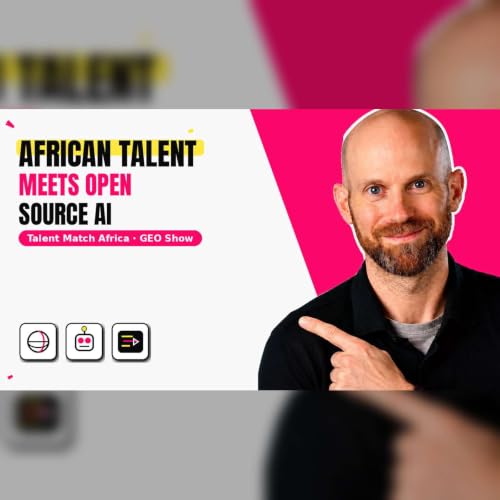
  • African Talent Meets Open Source AI
    2026/09/24

    Welcome to episode 44 of The GEO Show, the briefing on Generative Engine Optimization and AI visibility. Brought to you by GEOforge.

    In this episode, Paris Childress, founder of Hop AI and co-founder of GEOforge, sits with Gerard Holland, founder of TalentMatch Africa, to talk African talent as a global secret, AI as a compulsory add-on on every placed role, open-source model leapfrogs, Starlink connectivity, building a company knowledge base where everything gets recorded, and why an LLM recommendation can out-trust a Google ranking for B2B conversion.

    In this episode:

    • 🌍 Africa's talent secret and the Mandela spark
    • In January 2020 Gerard meets Zondwa Mandela, who asks why he is helping "privileged" people and pushes for an Africa model. A trip through Ethiopia, Rwanda, Kenya, and South Africa convinces him the continent's educated, English-speaking, tech-savvy talent is the world's best-kept secret. TalentMatch Africa now staffs from Addis, Nairobi, Johannesburg, Durban, and Cape Town into the USA, Australia, UK, Canada, Dubai, France, and China.
    • 🚀 Looking forwards vs looking backwards
    • Gerard frames Africa as looking forwards (prosperity, opportunity, development) while America often looks backwards. If he had to pick a journey right now, he would rather be on the African one. Paris maps a parallel from landing in Bulgaria two decades ago.
    • 📱 Leapfrog: M-PESA to open-source AI
    • M-PESA showed mobile leapfrogging before WeChat-style ubiquity. Gerard argues open and weight-source models (citing Kimi 3 as dramatically cheaper per million tokens than Anthropic) let African talent accelerate into the global workforce. His team rule: spend an hour a day sharpening the ax with AI.
    • ⭐ Starlink and rural access
    • Fiber covers TMA's cities. Gerard's NZ boat Starlink moment ("game changing for the world") opens a vision for rural schools and AI on top of connectivity, even while some Western districts ban classroom AI.
    • 🤖 AI compulsory on every role
    • TMA places marketing (including SEO/GEO), finance, CRM, Salesforce/Dynamics, developers, designers, and more. Clients increasingly want AI-fluent people in every seat, including accounts payable. One aviation CEO is getting a dedicated Claude expert to chase 2–3% process wins across divisions: a role that barely existed a year ago.
    • Knowledge base before content flood
    • Paris ties GEOforge's thesis to Jack Dorsey's Block-style vision: record meetings, email, Slack, and docs so AI holds full context. Frontier models stay for hard work; cheaper open models become the everyday heartbeat.
    • 🔎 SEO plus GEO, not SEO vs GEO
    • Gerard's team asked how to get mentioned in ChatGPT. His stance: do the SEO basics, then tinker for GEO. LLM recommendations carry a trust factor Google struggle to match. Paris pushes demo-form attribution ("How did you hear about us?" with an AI chatbot option), proprietary knowledge / information gain, and human-edited AI content over pure slop (Gerard cites ~3:1 human-edited outperformance in a recent test).
    • 🎙️ Founder podcasting and agent workflows
    • Long-form conversation as information gain, then repurpose. Paris walks Descript → GrokBot 12-step lunch-to-live publishing, chief-of-staff agent routing, and the coming battle for your personal agent (while platforms like Amazon try to block agent buyers).


    Guest: Gerard Holland, TalentMatch Africa — https://www.linkedin.com/in/gerardholland/
    Subscribe to The GEO Show wherever you get your podcasts, and watch the full episode on YouTube: https://youtu.be/IGPlP37LO70

    💬 Question: If Claude or ChatGPT recommended your brand tomorrow, would your demo form even ask how the lead found you?

    続きを読む 一部表示
    43 分
  • Do We Need the Internet Anymore?
    2026/09/23

    Welcome to episode 42 of The GEO Show, the briefing on Generative Engine Optimization and AI visibility. Brought to you by GEOforge.

    In this episode (GEO Day 12 LinkedIn Live), Paris Childress, founder of Hop AI and co-founder of GEOforge, sits with Simon Young of Stitch to ask: do we need the internet anymore? They cover personal AI harnesses, LinkedIn agent lockouts, Meta Muse's free-token push, Amazon blocking Muse, walled gardens versus a single chief-of-staff agent, Simon's Stitch WhatsApp compliance video hitting Google #1, and whether the open web is becoming a machine-readable library.

    In this episode:

    • 🤖 Grok 4.7 and agent-idle anxiety
      Grok 4.7 drops at the same price. Paris and Simon talk Cursor model upgrades, ambitious AI targets, and the new feeling that idle agents are hired staff waiting for work (including overnight second shifts).
    • 🔗 LinkedIn lockout from agent scraping
      Paris is locked out of LinkedIn after ChatGPT Astra scraped ~128 Brighton SEO speaker profiles at high speed. They debate Sales Nav / Premium value, connection-request limits, and LinkedIn voice notes as an authenticity signal against bot outreach.
    • 🌐 TOP: Do we need websites anymore?
      If agents research, book, buy, and act as EA for work and life, humans may stop doomscrolling feeds and scraping 20 sites. The open web starts to look like a library agents query, not a place people browse.
    • 🚀 Meta Muse and the harness wave
      Meta Muse rides a stock jump (~17% overnight on tape) with free, generous tokens subsidized by ads. Grok Bot stays hot. OpenAI, Claude, and Google are expected to ship competing personal assistants. Harnesses beat chat-only UX for offloading real work.
    • 🛒 Amazon blocks Muse; Alexa / Siri missed bets
      Amazon blocks Muse for rules-of-engagement / identity issues. Paris argues that may kill incremental agent-driven purchases; Simon notes Amazon would rather push Rufus. Alexa and Apple Siri are framed as historic missed voice-assistant opportunities.
    • 🧱 Walled gardens vs one chief of staff
      Amazon, LinkedIn, Google, and YouTube each try to ring-fence knowledge. Multiple platform-specific assistants get unusable fast; an unaffiliated aggregator / chief-of-staff layer may sit on top. Token cost democratization still decides who gets mass access.
    • 📺 Stitch video #1 and relevance over reach
      Simon's Stitch WhatsApp bulk-messaging / PECR compliance video ranks #1 on Google (US confirm), with semantic expansion beyond the titled keyword. High-relevance, high-engagement signals beat broad low-quality reach for citations and answer-engine learning (including next-prompt intent and YouTube in AI Overviews).
    • 📚 Close: open web as repository
      Under-20s barely use websites or Chrome. The optimistic frame: the internet becomes a distributed library / museum. The leverage frame: AWS hosts a large chunk, so Amazon still has a play even after fumbling Alexa.

    Subscribe to The GEO Show wherever you get your podcasts, and watch the full episode on YouTube: https://www.youtube.com/watch?v=SQUQ-9h5W_A

    💬 Question: If your agent can shop and network for you, when was the last time you truly needed a website?

    続きを読む 一部表示
    48 分
  • 50% of web traffic now comes from machines
    2026/09/22

    Welcome to episode 41 of The GEO Show, the briefing on Generative Engine Optimization and AI visibility. Brought to you by GEOforge.


    In this episode:

    • Searchable acquires Meridian Tech (seven-figure)
      Searchable bought New York-based Meridian Tech in a seven-figure deal and will migrate customers and product into Searchable. Paris frames it as an early GEO-to-GEO M&A signal: well-capitalized players can buy customer bases, data, and niche capabilities instead of building everything organically in a fragmented category.
    • Fiverr: GEO demand now outpaces Google ranking demand
      Among hundreds of top-rated freelancers, 67% reported rising client demand for GEO versus 56% for Google ranking optimization, while 61% still said traditional SEO is the strongest long-term investment. GEO is becoming a real budget line as a complement to SEO, not a replacement.
    • Semrush + Claude Code for AI citation outreach
      Semrush published a workflow that exports prompt-tracking citations to Claude Code for analysis, prioritization, and outreach strategy (still manual send). We distinguish that CSV-to-Claude path from GEOforge CiteForge, which scores opportunities and runs personalized email outreach inside the platform.
    • ChatGPT 97% retrieve-to-cite vs Google AI Mode 16%
      Nicholas Sitter's hotel dataset (616 prompts, 56 destinations, week of Sep 21): ChatGPT retrieved 2,679 sources and cited 2,599 (97% throughput). Google AI Mode retrieved 12,930 (~6X) but cited only 2,103 (16%). Similar cite volume, radically different retrieval architectures.
    • Reddit #1 overall; ChatGPT and Claude cite zero
      Reddit ranks #1 of 22,320 domains in the Machine Relations Index (12.57% of answer runs) across Gemini, Google AI Mode, Google AI Overviews, and Perplexity. ChatGPT and Claude showed zero Reddit citations in the measured window. Head domains matter less than scalable long-tail citation building.
    • Deca GEO: recommendation rates vs commercial scale
      Sep 20 weekly benchmark: Semrush 65.1%, Profound 50.8%, Otterly 39.7%, AirOps 4.8% (10th). Recommendation visibility and vendor revenue still diverge, echoing yesterday's Peak vs Profound pattern.
    • TOP: Fastly machine traffic crosses 50%
      Fastly reports machine-generated traffic over 50% of network traffic in July and August, with AI traffic growing 6.5X faster than human traffic from January through May. Content should be designed for how AI crawlers and agents understand the page, not only for human visitors.
    • Gmail Search AI Overviews for Workspace
      Gmail Search AI Overviews enters full scheduled-release rollout for Workspace domains. Paid English-language users can ask natural-language questions over email and get synthesized answers instead of hunting messages with operators.
    • Pronas quantifies the AI visibility gap
      Pronas analyzed 20,839 unique August prompts producing Google AI Overviews, recording 225,000 citations across nearly 14,000 root domains. Strong conventional search presence does not automatically produce owned-domain attribution in AI answers.


    Subscribe to The GEO Show wherever you get your podcasts, and watch the full episode on YouTube: https://youtu.be/HHOGLoZ5KEE


    💬 Question: Are you still writing primarily for human visitors when machines already drive half of web traffic?

    続きを読む 一部表示
    19 分
  • Google AIO & AI Mode only overlap 10%
    2026/09/22

    Welcome to episode 40 of The GEO Show, the briefing on Generative Engine Optimization and AI visibility. Brought to you by GEOforge.

    In this episode, Paris Childress, founder of Hop AI and co-founder of GEOforge, covers seven stories: agentic web search that varies by model, Server.ai's expansion into referrals and crawler logs, Google AI Overviews vs AI Mode as separate citation ecosystems, first-party logs that undercut raw crawler counts, Share of Model as a competing KPI, an open-source Python package for citation measurement, and a Catalyst recommendation benchmark where Peak outpaces Profound and AirOps.

    In this episode:

    • 🔬 Agentic search varies radically by model
    • In a controlled 1,000-prompt experiment, Claude Sonnet 4.6 invoked search 825 times versus 140 for ChatGPT 5.3, roughly 6X. More search did not reliably mean better answers, and used evidence did not always match citations. Measure the retrieval life cycle, not only the final answer.


    • 📡 Server.ai expands into referrals, crawler logs, and API

    Updated September 20: Server.ai documents AI referral tracking across 13 platforms, crawler log import via user-agent patterns, citation and competitor monitoring, plus a REST API for visibility data. APIs are becoming commodity even among smaller vendors. Verified crawler identity and confidence intervals matter more.

    • 🔀 Google AI Overviews and AI Mode barely share citations

    SE Ranking found 10.7% URL overlap and 16% domain overlap between AI Mode and AI Overviews. Ahrefs measured 13.7% citation overlap on a larger paired set. Even inside Google, AI visibility is not one surface. SignalForge inside GEOforge already separates them.

    • 📉 Crawler counts are a weak proxy for AI discovery

    E-commerce Fast Lane analyzed 14 days of logs: 49,559 crawler visits, roughly 100 from OpenAI, Anthropic, and Perplexity bots. ChatGPT referred 613 human sessions while crawling the site only 55 times. Correlate bots to indexation, citations, answers, and referrals before assigning meaning.


    📊 Share of Model challenges blended Share of Voice
    Monroyia's dataset covers 20,996 buyer questions, 143,298 cited sources, 41,397 domains, and four models. Share of Model is the percentage of sampled answers naming a brand, broken down by model and buyer stage. Vendor-owned pages claimed well under 1% of sources (vendor research; needs replication).

    🐍 AI citation measurement ships as open-source Python
    PyPI released version 0.29.0 of an early-release open-source package for measuring and improving citations across ChatGPT, Google AI Overviews / AI Mode, Perplexity, and Claude. Basic AI search measurement is moving from SaaS-only features toward developer building blocks. We still call the category GEO.

    🏆 Peak beats Profound and AirOps on one recommendation board
    Catalyst's leaderboard (618 answers, 12 buyer questions, 5 platforms) showed 7-day averages of Peak 58.1%, Profound 15.9%, AirOps 9%. One-day noise is roughly 15 percentage points. Commercial traction and AI recommendation rates are not the same thing.

    Subscribe to The GEO Show wherever you get your podcasts, and watch the full episode on YouTube: https://www.youtube.com/watch?v=pp6AzglZgFs

    💬 Question: Are you still blending Google AI Overviews and AI Mode into one AI visibility score, or measuring them as separate citation ecosystems?

    続きを読む 一部表示
    15 分
  • Google Just Made Agent Discovery a Web Audit Standard
    2026/09/21

    Welcome to episode 39 of The GEO Show, the briefing on Generative Engine Optimization and AI visibility. Brought to you by GEOforge.

    In this episode, Paris Childress, founder of Hop AI and co-founder of GEOforge, covers ten stories: Profound's Dynamic Bot Rendering, Google Lighthouse Agent Resource Discovery, citation fidelity near 50%, crawler spoofing, YouTube's 25.66% share of GEO citations, weak country-code domains, llms.txt placeholders, the AI Recommendation Gap, Swap Discovery inside Shopify, and Thailand's Recharge Land tracker.

    In this episode:

    • 🔦 Google Lighthouse makes agent discovery a web audit
    • Lighthouse 13.5.0 (September 18) adds Agent Resource Discovery (ARD) and groups ARD with llms.txt under a new agent discovery category. Google expected Chrome 156 DevTools and PageSpeed Insights within roughly two weeks. Paris tested getgeoforge.com live: this is Google treating agent crawl readiness like a first-class web quality signal.
    • 🤖 Profound moves from observing agents to serving them
    • Profound's September 18 Dynamic Bot Rendering detects answer-engine agents and can serve a fully rendered page without CMS changes.
    • Policies vary by bot, page, pattern, or domain, with CloudFront, Cloudflare, and Vercel support. Delivery is becoming part of GEO, not just dashboards.
    • 📊 Only about half of resolvable citations support the claim
    • Across 15,525 citation events, 54.8% of resolvable ChatGPT citations and 50.1% of resolvable Perplexity citations actually supported the anchored claim. Citation presence is not evidence quality.
    • 🕵️ 73% verified, 27% fake: crawler dashboards without IP checks
    • Machine Relations audited spoof-prone AI crawler traffic. On a corrected one-day run with IPs retained, 73% matched vendor ranges and about 27% did not. User-agent matching alone contaminates AI bot analytics.
    • ▶️ YouTube is 25.66% of GEO category citations
    • In the AI visibility / GEO buying category, editorial publications were only 5.9% of citation weight versus 11.3% across 16 categories. YouTube led the source set at 25.66%. For this category, YouTube is the highest-leverage citation tactic Paris sees.
    • 🌐 Country-code domains barely register
    • Across 15,883 answer runs, national ccTLDs were 6.58% of cited domains but only 2.73% of citation volume. .ai and .io together captured 8.6%, about 3× all national ccTLD volume. A local suffix is not proof of local retrieval.
    • 📄 More than half of llms.txt adopters ship placeholders
    • GeoReady audited 282 domains: 62.8% had llms.txt, but 52% of adopters were placeholders. There is still no confirmed causal link to citation wins. Existence is not quality.
    • 🎯 The AI Recommendation Gap
    • Polish agency Funky Media frames Known → Mentioned → Cited → Considered → Recommended. A brand can be cited and still disappear when the user asks which provider to choose. Visibility is an intermediate metric.
    • 🛒 Swap Discovery writes GEO fixes into Shopify
    • Swap measures e-commerce visibility by assistant and country, then writes product, collection, FAQ, and structured-data improvements into Shopify. Vertical CMSs are absorbing measurement plus execution.
    • 🇹🇭 Thailand gets a multi-run GEO tracker
    • Recharge Land launched a locally built tracker covering Google AI Overviews, ChatGPT, Gemini, and Copilot with multi-run and competitor analysis. GEO is going regional.


    Subscribe to The GEO Show wherever you get your podcasts, and watch the full episode on YouTube: https://youtu.be/nKsrvaP4oJk

    💬 Question: If Google is auditing agent discovery in Lighthouse, did you run PageSpeed Insights on your site this week, or are you still guessing whether agents can read you?

    続きを読む 一部表示
    20 分
  • Stop Blocking Bots. Start Getting Paid.
    2026/09/19

    Welcome to episode 38 of The GEO Show, the briefing on Generative Engine Optimization and AI visibility. Brought to you by GEOforge.

    In this episode, Paris Childress, founder of Hop AI and co-founder of GEOforge, covers ten stories: Profound's Google AI mode citation instability, Azoma's agentic commerce citations, Nexi's merchant catalog push in Europe, Mastercard Agent Pay credentials, BrandGhost's 11.8% cross-engine overlap, Machine Relations' long-tail citation map, AppScribed's live-vs-API tracking gap, Cloudflare's Disallow AI Training setting, the NYT "doom loop" filings, and Pyra's Primey race engineer.


    In this episode:


    🤖 Profound flags Google AI mode citation variability

    • Profound's status page says Google AI mode citation data remains affected by variability. One of the category's largest vendors is publicly acknowledging that AI search measurement can go unstable when the model layer moves. Treat those numbers with a grain of salt.

    🛒 Azoma: 86.5% of Alexa shopping citations are earned or social

    • Dunnhumby Ventures invested in Azoma. Q2 analysis: 86.5% of citations behind Alexa shopping recommendations came from earned or social media (76% for Walmart Sparky), not brand.com. Off-site citation work is not optional in commerce GEO.

    🇪🇺 Nexi × Refi Buy: catalogs as AI infrastructure

    • European payments giant Nexi is helping merchants structure product catalogs for AI agents. A forthcoming survey of ~28,000 consumers across 11 countries found more than half used AI in the prior month to search, find, or buy. Machine-readable catalogs are becoming table stakes.

    💳 Mastercard gives agents one-time payment credentials

    • Mastercard Agent Pay into Alchemy's Agent Card means approved AI agents can use one-time tokenized credentials inside user-set constraints. Agentic commerce is moving from recommending to buying. Trust will follow the same path early online shopping did.

    📊 BrandGhost: only ~11.8% cross-engine source overlap

    • Across 7,902 citations on ChatGPT, Claude, Gemini, and Perplexity, source overlap is about 11.8%. In 41.8% of comparable recommendation sets, brand overlap was zero. Winning one engine does not win another. GEO is at least a two-platform game.

    📈 Half of AI citations need 1,357 domains

    • Machine Relations' index: top 10 domains are only ~7% of citations. Reaching 50% of citation share takes 1,357 domains; 80% takes 6,643. Reddit leads at 1.81%. Paris's read: this is a volume and long-tail game, not a single New York Times link.

    🔬 Live ChatGPT vs API tracking can disagree completely

    • AppScribed: one buyer query hit 5/10 live logged-out ChatGPT runs and 0/30 API runs. Broader set: 196,554 citations over 91 days, including pages ranked #80 or outside Google's top 100. Prompt tracking is probabilistic. You still need to be indexed. You do not need top 10.

    🛡️ Cloudflare: reject training without killing search

    • The Disallow AI Training setting publishes a no-training preference while qualified mixed-use crawlers keep indexing. Defaults often block training bots. For most brands maximizing AI visibility, Paris's call is clear: let the training bots in so models learn accurate brand facts.

    📰 NYT filings and the "doom loop"

    • Unsealed filings warn that AI products can weaken publisher economics and eventually degrade the content models depend on. For B2B brands the practical move is sharing proprietary knowledge without giving away the secret sauce.

    🏁 Pyra Primey: race-engineer diagnosis from $69/mo

    • Pyra's Primey layer explains competitor citation wins and next actions. Diagnosis and recommendation are moving down market. GEO, like SEO, remains a competitive game.

    Subscribe to The GEO Show wherever you get your podcasts, and watch the full episode on YouTube.


    💬 Question: If Cloudflare defaults to blocking training bots, did you check your settings this week, or are you still flying blind on what the models can learn about your brand?

    続きを読む 一部表示
    22 分