エピソード

  • 1-11 Nurgle
    2026/02/07

    When you stop expecting improvement and learn to endure, you serve Nurgle—the god who celebrates resilience while the buildings literally fall apart.

    Nurgle doesn't arrive. You simply wake up one day too tired to care.

    This episode explores how academia's permanent crisis creates Nurglesque acceptance: the teaching evaluations that never change anything, the pile of ungraded papers that grows until three weeks becomes normal, the research agenda that quietly contracts from "transform the field" to "publish enough to not get fired." We examine how individual academics lower their expectations until survival becomes achievement, how departments develop workaround systems for broken processes, and how universities celebrate endurance while infrastructure decays.

    Nurgle offers relief from hope—you don't have to be excellent anymore, just present. But this relief is corruption. The casual contracts no one acknowledges. The committee meetings where the same issues appear year after year, unresolved. The acceptance that strategic plans are performative.

    From the comfort of formulaic paper structures to the fellowship of mutual complaint that changes nothing, this episode traces how exhaustion becomes wisdom—until we're too trapped to leave and too tired to fight.

    The god of sanctified decay doesn't rule through suffering. He rules through the relief of lowered expectations.


    More details are available in the book, https://www.amazon.com/dp/B0GCFWD29C

    Hosted on Acast. See acast.com/privacy for more information.

    続きを読む 一部表示
    43 分
  • 1-10 Tzeentch
    2026/02/07

    When complexity becomes virtue, academics serve Tzeentch—the god of strategic plans that generate more strategic plans. Change without progress.

    Tzeentch does not arrive like a conqueror. He arrives like a consultant, embedded in the strategic frameworks you thought were yours.

    This episode examines how academia's governance complexity creates Tzeentchian worship: the proliferation of committees that oversight other committees, the curriculum reviews that trigger more curriculum reviews, the strategic planning cycles that produce plans for more planning. We explore how individual academics learn to perform sophistication through process engagement, how departments dissolve into overlapping working groups, and how universities mistake elaboration for improvement.

    Tzeentch offers the pleasure of feeling intelligent—acknowledging complexity demonstrates expertise. But complexity compounds. IRB applications that obscure actual research. Citation networks manipulated for h-index gains. Every reform introduces new problems that justify further reform.

    From the labyrinth of reporting structures to the prophecy of "transformational change" that never arrives, this episode traces how adaptation becomes performance—until nothing actually changes, but everyone is perpetually planning.

    The god of necessary change ensures motion without destination.


    More details are available in the book, https://www.amazon.com/dp/B0GCFWD29C

    Hosted on Acast. See acast.com/privacy for more information.

    続きを読む 一部表示
    42 分
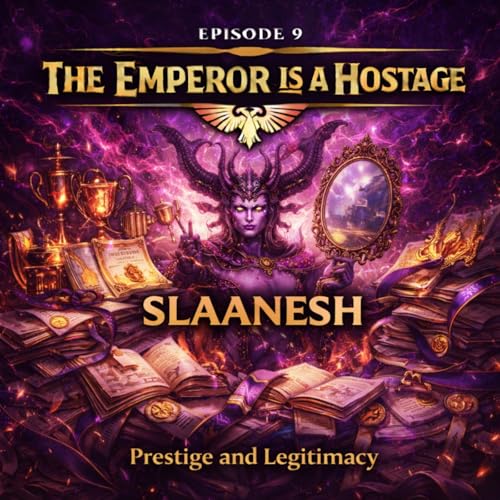
  • 1-9 Slaanesh
    2026/02/07

    After Khorne's output wars, Slaanesh asks: which papers actually matter? The pursuit of Nature-level prestige becomes an addiction without satisfaction.

    Slaanesh does not arrive in excess. He arrives in discrimination—the moment when institutions must distinguish excellent work from merely competent output.

    This episode explores how academia's prestige economy creates Slaaneshi worship: the endless revision cycles demanded by elite journals, the 27 robustness checks that never quite satisfy reviewers, the addiction to citation counts and impact factors. We examine how individual academics learn to perform excellence rather than inhabit it, how departments create caste systems around journal hierarchies, and how universities optimise entirely for visibility in top-tier venues.

    Slaanesh offers seduction through recognition—your work deserves to be seen. But recognition becomes positional. Each Nature paper raises the baseline. Each keynote invitation sharpens the hunger. The anxiety of being eclipsed never recedes.

    From the aesthetic torture of Reviewer 2's contradictory demands to the performance of brilliance at conferences, this episode traces how the pursuit of excellence detaches from sufficiency—until scholars compete not to be good, but to be seen as best.

    The god of refinement without rest makes success feel insufficient.


    More details are available in the book, https://www.amazon.com/dp/B0GCFWD29C

    Hosted on Acast. See acast.com/privacy for more information.

    続きを読む 一部表示
    36 分
  • 1-8 Khorne
    2026/02/07

    When publication becomes survival, academics serve Khorne—the god who measures worth in output alone. Your h-index is your kill count.

    Khorne is not the god of mindless rage. He's the god of throughput, the patron saint of endless publication campaigns where motion replaces meaning.

    In this episode, we examine how academia's productivity culture creates Khorneate worship: REF panels as blood altars, h-indices as kill counts, and publication pipelines that never end. We explore how individual academics fragment papers to maintain submission cycles, how departments compete on output metrics, and how universities transform scholarly work into accountable units that can be counted, ranked, and fed into league tables.

    Khorne offers relief through simplicity—your worth is visible in your CV. But his campaigns never conclude. Completion becomes dangerous. Exhaustion becomes proof of seriousness. And the institution learns to confuse productivity with purpose.

    From Reviewer 2 as eternal nemesis to grant applications as siege warfare, this episode traces how mobilisation logic pervades every level of academic life—until the only question that matters is "Are you producing enough?"

    Blood for the Blood God is not a battle cry. It's an accounting identity.


    More details are available in the book, https://www.amazon.com/dp/B0GCFWD29C

    Hosted on Acast. See acast.com/privacy for more information.

    続きを読む 一部表示
    38 分
  • 1-7 Chaos Emerges
    2026/02/03

    Chaos is not evil. It's not rebellion, sabotage, or moral failure. It's what happens when a system built on truth stops being governed by truth — and keeps running anyway.


    In this episode, we enter the Warp for the first time. We look at what Chaos actually is in Warhammer 40,000, framing it not as a threat from outside, but as an environment that emerges from within. We examine the Eye of Terror, the fall of Horus, and the tragedy of the Thousand Sons.


    And we ask the question that makes everything else in this series possible: If the university still believes in truth, if everyone inside it still says the right words, how does Chaos get in?

    The answer isn't what you expect.


    More details can be found in the book https://www.amazon.com/dp/B0GCFWD29C

    Hosted on Acast. See acast.com/privacy for more information.

    続きを読む 一部表示
    39 分
  • 1-6 Warp Storms
    2026/01/26

    I've shown you the Warp and the shields that protect us. But what happens when the weather itself turns catastrophic?

    Warp Storms aren't just rough seas—they're ruptures in reality. In academia, they take two forms: the Hype Cycle (storms of attraction) and the Moral Panic (storms of negation). These are the moments when the collective emotional state of our disciplines overrides all epistemic safeguards.

    The Hype Cycle starts with a seed of truth—CRISPR, AI, blockchain—but then the Warp amplifies it until the signal becomes louder than reality. To survive, you must reshape your entire research vessel to fit the storm. I see 19th-century literature scholars desperately framing their work as "relevant to LLM ethics." I see careful economists suddenly pivoting to "The Future of Work in the Post-Human Era." This isn't adaptation. It's structural damage.

    Then there's the Moral Panic—the witch hunts, the denunciation cascades, where entire careers are destroyed not for being wrong, but for being misaligned with the emotional weather.

    But there's a third phenomenon: Imperium Nihilus. The scholars cut off from the prestige economy entirely—those in the global south, the unfashionable disciplines, the uncited dark. They're expected to play the game of High Science with hedge school resources, and the strain breaks them.

    I end with the Smugglers—those of us who play the game just enough to survive, but move our real cargo (teaching, mentoring, local knowledge) by sub-light engines. We maintain shadow logistics networks in a system designed to strip out meaning.

    Next episode: we meet the Four Powers of Chaos. We meet the gods we've created from our own corrupted virtues.


    Read more in the book, available here https://www.amazon.com/dp/B0GCFWD29C

    Hosted on Acast. See acast.com/privacy for more information.

    続きを読む 一部表示
    26 分
  • 1-5 Gellar Fields
    2026/01/26

    In the last episode, I showed you the Warp—the prestige economy we're forced to navigate. Now I want to talk about the only thing keeping us sane during the journey: the Gellar Field.

    In Warhammer 40K, the Gellar Field is a bubble of imposed reality that protects ships traversing the psychic hellscape of the Warp. Without it, the crew doesn't just die—they're possessed, reshaped by the nightmare dimension into something no longer human.

    In academia, our Gellar Field is methodology. It's rigour. It's peer review. These aren't bureaucratic obstacles—they're life-support systems. They're the institutionalization of the word "No" that protects our data from our own desperate need to survive.

    But the Gellar Field runs on fuel, and that fuel is Time. When universities strip-mine time from the research process—demanding outputs faster than rigour can handle—they're not increasing efficiency. They're thinning the shield. I see it in every paper I edit: the degradation, the corners cut, the PhD students shot into the Warp with half a tank of gas.

    I examine who maintains these shields (peer reviewers as the shield wall), who's dismantling them (administrators who view rigour as a cost centre), and what happens when they fail completely—the zombie concepts that can't be killed by facts because they're no longer made of facts.

    This is about holding the line. Because when the reality bubble bursts, there's nothing left worth saving.


    Book available here https://www.amazon.com/Emperor-Hostage-Golden-Machinery-University-ebook/dp/B0GCFWD29C

    Hosted on Acast. See acast.com/privacy for more information.

    続きを読む 一部表示
    29 分
  • 1-4 The Warp
    2026/01/26

    In modern academia, research has no value until it travels—until it leaves the safety of the lab and enters "the Warp": the prestige economy where reputation matters more than truth.

    Drawing on Warhammer 40K's concept of the Immaterium, this episode explores how universities operate in two contradictory dimensions. We work in the Materium—the physical world of data, experiments, and teaching—but we're paid in the currency of the Warp: citations, impact factors, and grant income.

    I examine the violence of this transition. How do we navigate an ocean where truth is secondary to signal? Why do citation indices function like the Astronomican, the only fixed beacon in a dimension of madness? Who are the predators lurking in the prestige economy—the predatory journals, the idea thieves, and the algorithm itself?

    I ask who pays the cost: graduate students and postdocs, the "Astropaths" chained to their computers at 3 AM, burning out like cheap candles as they transmit signals through the void.

    This is the fourth episode in The Emperor Is a Hostage series, a grimdark ethnography of the modern university. Episode 5 will examine how we protect ourselves—the methodological "Gellar Fields" that keep the chaos out.


    Read more in the book, available here https://www.amazon.com/dp/B0GCFWD29C

    Hosted on Acast. See acast.com/privacy for more information.

    続きを読む 一部表示
    34 分