エピソード

  • #174 Aliko Dangote: How Africa’s Richest Man Built an Industrial Empire
    2026/09/22

    Aliko Dangote didn’t build his fortune by chasing the newest industry. He built it by controlling the basic materials economies run on.

    This episode traces Dangote’s rise from a Kano merchant family into one of Africa’s most powerful industrialists. We get into cement, sugar, salt, logistics, power generation, and the strategy of replacing imported goods with massive domestic manufacturing systems that could operate despite Nigeria’s infrastructure gaps.

    At the center is the Dangote Refinery, an enormous bet on turning Nigeria from a major oil producer that still imports fuel into a country capable of refining far more of its own energy. Dangote’s story becomes a bigger question about African development: can private industrial capital help move economies from exporting raw materials toward actually making more of what they consume?

    Follow along for the next deep dive.

    Stay curious.


    続きを読む 一部表示
    1 時間 7 分
  • #173 Apartheid: The System That Divided South Africa
    2026/09/22

    Apartheid wasn’t simply prejudice written into law. Beginning in 1948, South Africa’s National Party expanded earlier segregation into an elaborate system that classified people by race and controlled where they could live, work, study, travel, and participate politically.

    This episode explores how that system actually worked: land restrictions, pass laws, segregated education, labor controls, forced removals, and the creation of designated “homelands.” We also trace the resistance that grew against it, from the ANC and other liberation movements to Sharpeville, Soweto, labor organizing, armed struggle, international pressure, and the imprisonment of figures like Nelson Mandela.

    We follow apartheid through its growing economic and political crisis and the negotiations that finally produced multiracial elections in 1994. But ending the laws didn’t erase the landscape they created. This is a story about how inequality can be engineered into institutions—and why dismantling a legal system is much faster than undoing its consequences.

    Follow along for the next deep dive.

    Stay curious.

    続きを読む 一部表示
    1 時間
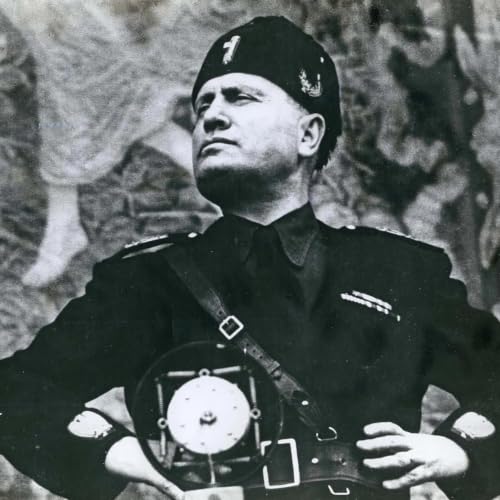
  • #172 Benito Mussolini: How Fascism Took Over Italy
    2026/09/22

    Before fascism became a global political force, Benito Mussolini was figuring out how to build it. Once a socialist, he broke with the movement during World War I, founded the Italian Fascist movement, and used the instability of postwar Italy to position himself for power after the March on Rome in 1922.

    This episode traces how Mussolini turned that opening into dictatorship: Blackshirt violence, propaganda, attacks on political opposition, and cooperation from institutions that believed they could contain or benefit from him. Rather than replacing democracy overnight, fascism tightened its grip piece by piece until meaningful opposition had largely disappeared.

    We follow Mussolini through imperial expansion, his alliance with Hitler, Italy’s disastrous war, and his eventual collapse and execution in 1945. His story is ultimately about more than one dictator—it’s about how fragile institutions, political violence, and elite accommodation can combine to dismantle a democracy from within.

    Follow along for the next deep dive.

    Stay curious.

    続きを読む 一部表示
    1 時間 20 分
  • #171 Asha Sharma: The Tech Outsider Reinventing Xbox
    2026/09/21

    Xbox has spent years acquiring studios, expanding Game Pass, and building one of the largest portfolios in gaming. But owning more doesn’t automatically mean running a better business.

    This episode looks at Asha Sharma’s approach to reshaping Xbox around a more disciplined operating model. We get into her background outside traditional gaming, the influence of companies like Meta and Instacart, and what happens when a leader trained around data, margins, and operational efficiency takes control of a creative industry built on expensive bets, long development cycles, and unpredictable hits.

    At the center is a tension bigger than Xbox itself: can you make creativity more efficient without squeezing out what makes it valuable? We explore studio closures and layoffs, franchise economics, Game Pass, Microsoft’s enormous gaming ecosystem, and the attempt to turn Xbox from a collection of ambitious assets into a more coherent and sustainable business.

    Follow along for the next deep dive.

    Stay curious.

    続きを読む 一部表示
    43 分
  • #170 Hong Kong Under Japan: The Three Years and Eight Months That Changed the City
    2026/09/21

    On Christmas Day 1941, Hong Kong surrendered to Japan after just 18 days of fighting. What followed became known locally simply as the “three years and eight months”—a period of military occupation that profoundly disrupted everyday life in the colony.

    This episode traces Hong Kong from the final years of British colonial rule before the invasion through Japanese occupation, food shortages, currency disruption, population displacement, and resistance. By 1945, Hong Kong’s population had fallen from more than 1.6 million before the occupation to roughly 600,000, while guerrilla groups including the Hong Kong Independent Battalion of the Dongjiang Column operated against Japanese forces.

    But the story is also about what occupation revealed. We explore the collapse of assumptions about British security, the competing resistance networks that formed under wartime rule, and how the experience became part of Hong Kong’s complicated historical memory between Britain, China, and Japan. This is a story about invasion, survival, imperial vulnerability, and what happens to a city when the political order it thought was permanent disappears almost overnight.

    Follow along for the next deep dive.

    Stay curious.

    続きを読む 一部表示
    59 分
  • #169 Twice in Flames: Why Los Angeles Erupted in 1965 and 1992
    2026/09/21

    Los Angeles erupted twice within a generation. The Watts Rebellion of 1965 and the 1992 Los Angeles uprising began with different immediate events, but both emerged from much deeper tensions around policing, economic exclusion, housing, and the geography of race in the city.

    This episode connects those moments to the Los Angeles that existed underneath them: racially restrictive housing, segregated neighborhoods, disappearing economic opportunity, and decades of conflict between law enforcement and Black communities. We move from Watts in 1965 to the killing of Latasha Harlins, the videotaped beating of Rodney King, the acquittal of four LAPD officers, and the unrest that spread across Los Angeles in 1992.

    But this isn’t only a story about what burned. It’s about how cities distribute opportunity, mobility, safety, investment, and power—and what happens when those systems leave the same communities carrying the consequences for decades. Looking at 1965 and 1992 together reveals how dramatically Los Angeles changed between the two uprisings, and how many of the underlying questions remained.

    Follow along for the next deep dive.

    Stay curious.


    続きを読む 一部表示
    1 時間 4 分
  • #168 Anime: How Japan Built a Global Storytelling Language
    2026/09/19

    Anime is everywhere now—but the style, industry, and storytelling language behind it were shaped by a very specific history.

    This episode traces anime from early Japanese animation and postwar production constraints through the influence of Osamu Tezuka, television, serialization, and the rise of studios like Studio Ghibli. We get into how limited budgets helped create a distinct visual grammar, why anime developed differently from Western animation, and how those choices opened the door to more mature themes, longer stories, and entire genres that could grow with their audiences.

    We also explore the global explosion of anime, the role of streaming and fandom, the “shōnen” machine, and the tension between record-breaking popularity and the difficult working conditions faced by many animators. This is a story about how scarcity became style, how style became industry, and how a distinctly Japanese form of animation became one of the world’s most influential storytelling languages.

    Follow along for the next deep dive.

    Stay curious.

    続きを読む 一部表示
    1 時間 6 分
  • #167 Julian Assange: WikiLeaks and the War Over Secrets
    2026/09/19

    WikiLeaks was built around a radical idea: what if governments and powerful institutions simply couldn’t keep their most important secrets?

    This episode traces Julian Assange from Australia’s early hacker culture to the creation of WikiLeaks and the disclosures that turned him into one of the most polarizing figures of the internet age. We get into cryptography, anonymous leaking, the Manning disclosures, Assange’s years inside the Ecuadorian Embassy, and the legal battles that followed as governments confronted a publishing model designed to make secrecy harder to maintain.

    But the bigger story is about the line between transparency and responsibility. When does exposing hidden information become journalism? When can disclosure itself create harm? And what happens when technology gives individuals the ability to challenge governments, intelligence agencies, and traditional media institutions at global scale? This is a story about secrecy, information warfare, press freedom, and the uncomfortable consequences of making powerful institutions radically more visible.

    Follow along for the next deep dive.

    Stay curious.

    続きを読む 一部表示
    1 時間 3 分