エピソード

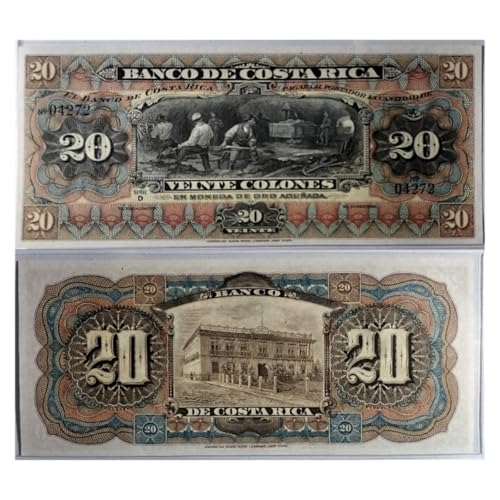
  • Costa Rica: Banco de Costa Rica 20 Colones Series D (1901)
    2026/02/17

    The turn of the 20th century marked a definitive inflection point for the Republic of Costa Rica, a period characterized by the ascendancy of the "Liberal State" and the aggressive modernization of its economic infrastructure. The banknote we are looking at—the Banco de Costa Rica 20 Colones, Series D, dated 1901 encapsulates the nation’s aspirations toward industrial progress, financial stability, and architectural grandeur.

    The specific specimen under analysis, identified by Serial Number 04272, belongs to a series of banknotes produced by the American Bank Note Company (ABNC) of New York. By deconstructing its physical composition, iconographic narratives, and institutional origins, we reveal the broader economic tapestry of the "Generation of Olympus" (Generación del Olimpo)—the liberal elite that governed Costa Rica and sought to integrate its coffee-based economy into the gold-standard global markets of Europe and North America.1

    This report asserts that the Series D 20 Colones note was designed to function as a "monument in paper." At a time when the Costa Rican Colón (introduced in 1896) was solidifying its value against gold, the Banco de Costa Rica—the nation's premier financial institution—commissioned a currency that visually equated the extraction of mineral wealth (the obverse mining scene) with the solidity of banking institutions (the reverse architectural portrait). The survival of Serial 04272 as a high-grade remainder allows for a pristine view into the engraving mastery of the late Victorian era, offering numismatists and historians alike a tangible link to the zenith of private bank issuance in Central America.

    続きを読む 一部表示
    25 分
  • Costa Rica: Banco de Costa Rica 20 Colones Series C (1906) Banknote
    2026/02/16

    A review of the history of the bank, the iconongraphy on the banknote, the Series C, and the market and technical specs. Did you know there was an American who wanted to establish English speaking colonies and slave states in Latin America and who was celebrated in the U.S>? Listen and find out where he fits in to the story.

    続きを読む 一部表示
    30 分
  • Costa Rica: PMG 65 EPQ Banco National De Costa Rica 5 Colones 1937-1938 (Pick 198a)
    2026/02/15

    The study of Latin American currency provides a unique lens through which to view the economic and political evolution of the region. We are looking at the Costa Rica 5 Colones note of 1937-1938, cataloged in the Standard Catalog of World Paper Money as Pick 198a. This banknote is not merely a medium of exchange; it is a transitional artifact that bridges two distinct eras of Costa Rican banking history: the period of the Banco Internacional de Costa Rica and the subsequent establishment of the Banco Nacional de Costa Rica.

    This report focuses on a specific, high-grade specimen of this issue: a 5 Colones note graded PMG 65 EPQ (Gem Uncirculated), identified as a "Top Pop" (Top Population) rarity. The existence of such a pristine example is a statistical anomaly given the tropical climate of Costa Rica and the heavy circulation these low-denomination notes typically endured. The note is characterized by its provisional nature—a revalidation of an earlier issue via a typographic overprint—and its striking obverse vignette, familiarly known to collectors as the "Banana Train."

    The visual narrative of the note, depicting the loading of bananas onto a railway car, encapsulates the "Green Gold" era of Costa Rica, dominated by the United Fruit Company and the Atlantic Railroad. This report will dissect the historical context, technical specifications, security features, and market dynamics surrounding this numismatic treasure, providing a definitive reference for the advanced collector.

    続きを読む 一部表示
    30 分
  • Mexico: Mexican Currency History from Cacao to Polymer
    2026/02/11

    Great overview to start with Mexican currency, from pre-Hispanic, to colonial to pre-revolution to revolution to independence to the latest issues, the Series G

    続きを読む 一部表示
    31 分
  • Mexico: Carranza and Pancho Villa, A Review of the Relationship
    2026/06/17

    Exploring the relationship and history of the two men during the Revolution including the numismatic impact

    続きを読む 一部表示
    1 時間 5 分
  • Mexico: Govierno Constitutionalista de Mexico Monclova 1 Peso Banknote (1913)
    2026/06/13

    The introduction of the 1913 Monclova 1 Peso banknote represents a pivotal inflection point in the monetary and political evolution of modern Mexico. The creation of this currency was not born from an orderly macroeconomic policy, but rather from the desperate financial requirements of a burgeoning revolution. In February 1913, a period known as the "Ten Tragic Days" (La Decena Trágica) culminated in the assassination of the democratically elected President Francisco I. Madero and Vice President José María Pino Suárez. Following this, General Victoriano Huerta seized control of the federal government in Mexico City, establishing a military dictatorship.

    Venustiano Carranza, who was serving as the Governor of the northern State of Coahuila at the time, steadfastly refused to recognize the legitimacy of the Huerta administration. On March 26, 1913, Carranza and a coalition of northern military leaders promulgated the Plan of Guadalupe. This political manifesto formally declared their rebellion against Huerta, established the Constitutionalist Army, and designated Carranza as the "First Chief" (Primer Jefe) of the movement.

    The primary obstacle immediately facing Carranza's Constitutionalist forces was the acquisition of capital. A military campaign spanning the vast geography of Mexico required immense funding for munitions, provisions, transportation, and troop salaries. The traditional financial infrastructure of the country, including the federal treasury and the established banking monopoly of the Banco Nacional de México, remained firmly under the control of the Huerta regime in the capital. Furthermore, as political instability swept the nation, hard currency—specifically gold coins and the standard silver pesos—rapidly vanished from circulation as citizens and foreign businesses hoarded precious metals to protect their wealth.

    Faced with a complete lack of specie and cut off from the capital markets of Mexico City, Carranza turned to the issuance of unbacked fiat paper currency. On April 26, 1913, operating out of his initial stronghold in Monclova, Coahuila, Carranza issued a decree authorizing the creation of the first official paper money of the Constitutionalist Government. This legal decree formed the foundation for the "Monclova Issue". The decree mandated that the new banknotes be recognized as legal tender within all territories subdued by the Constitutionalist Army. The initial authorization permitted the issuance of five million pesos, an amount that would be repeatedly expanded via subsequent decrees as the conflict escalated.

    続きを読む 一部表示
    47 分
  • Bulgaria: Bulgarian National Bank 200 Leva Banknote (1951)
    2026/06/13

    The subject of this podcast is the Bulgaria 200 Leva banknote, dated 1951 and issued by the Bulgarian National Bank (Българска Народна Банка). Bearing the Pick number P-87a, this banknote serves as a primary mechanism of economic control and state propaganda utilized during the early years of the People's Republic of Bulgaria.

    The early 1950s represented a period of radical transformation for the Bulgarian economy. The transition from a market-based system to a centralized command economy necessitated entirely new financial instruments, culminating in the drastic monetary reform of May 1952.2 This report analyzes the historical backdrop, the issuing authority, the visual and technical specifications, the market valuation, and a visual grading estimation of the specific 1951 200 Leva banknote provided in the image (Serial Number АВ 944040).

    続きを読む 一部表示
    30 分
  • Uganda: Bank of Uganda 20,000 Shillings Banknote (2010
    2026/06/11

    The subject of this podcast is the Uganda 20,000 Shillings banknote, specifically the iteration introduced in May 2010 as a core component of a nationwide currency redesign. This document provides a thorough examination of the banknote, encompassing the economic and institutional history of its issuance, a biographical review of its signatories, a breakdown of its thematic imagery, and an analysis of its anti-counterfeiting architecture.

    Furthermore, this report includes a visual assessment of the specific physical specimen provided in the attached image (Serial Number AN9801582), alongside an evaluation of its current numismatic market valuation based on third-party grading population reports and active market transaction data.

    続きを読む 一部表示
    30 分