エピソード

  • 3 Dangerous Bike Crashes & How to Avoid Them (Replay)
    2026/10/15

    Originally posted on The Bike Lawyer channel on YouTube on July 30. This is part of our Thursday replays, where we bring the back catalog to the podcast feed.

    Most bike-car crashes aren’t random. They follow a handful of patterns, and almost nobody teaches cyclists how to spot them before it’s too late.
    This is part one of a two-part series on the five most dangerous situations for cyclists sharing the road with cars. Using federal crash data from the past 30 years, this episode covers the three crash types caused by moving vehicles: the turning conflict, which causes more crashes than any other single cause; the intersection habit most cyclists overlook; and why overtaking crashes are rarer yet disproportionately deadly on faster roads. Plus a three-move fix you can use on your next ride, Florida’s cyclist fatality numbers, and the state laws that apply every time a car passes you.

    続きを読む 一部表示
    7 分
  • When Drivers See Bicyclists as Less Human (Replay)
    2026/10/08

    Originally posted on YouTube on August 14. This is part of our Thursday replays, in which we bring audio from previous YouTube videos to the podcast feed.

    Researchers showed 563 people pairs of photographs of cyclists and asked one question: which of the two looks less human?

    Same model. Same bike. The only thing that changed was what was on the rider's head or chest.


    Seven out of ten times, people picked the rider wearing the helmet. Nearly eight out of ten times, they picked the rider in the high-visibility vest. The safety gear performed worse than no safety gear at all.

    The researchers expected the helmet was simply hiding the rider's face. A baseball cap covers about as much and barely moved the needle. It was not the covered face. It was the safety equipment itself.


    And when people rate cyclists on a scale of zero to one hundred for how human they are, three percent rate them at zero. Not low. Zero. The people who rate cyclists that way report about twice as many deliberate acts of aggression toward them.

    That's a photographic study, and photographs don't drive. So here's what it looks like on pavement. In 2011, Florida's own Department of Transportation put cameras on nineteen roads in ten Florida cities and measured the passing distance of 2,185 drivers as they passed a bicyclist. Riders in ordinary street clothes got about four inches more room than those in a cycling kit. The state's own researchers couldn't explain it and settled on the idea that motorists "perceive less risk passing riders who are in bicycle outfits."

    In this episode: what that Florida study proves and what it doesn't, what one researcher found after riding the same road for six months in seven different outfits with a sensor on his bike, and the only two things anyone has ever tested that actually changed how drivers behave. Neither is bright clothing. One is a piece of plastic on a stick from 1979.

    I also explain what actually determines how much room you get, because it is not your jersey and it is not close. The original video is on YouTube at The Bike Lawyer.

    Studies referenced
    Limb & Collyer (2023), Transportation Research Part F
    Delbosc et al. (2019), Transportation Research Part F
    Haworth et al. (2018), Journal of Transport & Health
    Walker, Garrard & Jowitt (2014), Accident Analysis & Prevention
    Walker (2007) and Walker & Robinson (2019), Accident Analysis & Prevention
    Rubie et al. (2020), Transport Reviews
    Feizi et al. (2021), Transportation Research Part A
    Claros et al. (2024), Transportation Research Part F


    DISCLAIMER: This episode is for general educational purposes only and is not legal advice. Listening to it does not create an attorney-client relationship. Every case turns on its own facts. The hiring of a lawyer is an important decision that should not be based solely upon advertisements. Before you decide, ask me to send you free written information about my qualifications and experience. George Palaidis is licensed to practice law in Florida.

    続きを読む 一部表示
    12 分
  • Hit by a driver on your e-bike? Who covers you?
    2026/10/06

    A driver hits you on your e-bike. Four coverage layers may apply. Most e-bike riders don't know what they are, let alone the order to check them.

    This is the audio version of the YouTube video "Hit by a Car on Your E-Bike? (I'm a Lawyer)" from The Bike Lawyer channel. If you want the full visual experience — on-screen statute citations, case law references, state-by-state graphics, and the coverage layer checklist — head to youtube.com/@thebikelawyerfl and search for the title above.

    For listeners who prefer audio, this episode covers the correct order to check your coverage after an e-bike crash, why your state's e-bike classification doesn't automatically answer the insurance question, what to look for in your own policy, and what changes if the machine was modified beyond its legal class limits.

    This is Part 2 of a two-part series. Part 1 covers the same coverage layers for traditional cyclists and is available now in this feed.

    続きを読む 一部表示
    11 分
  • E-Bike Laws: 3 Restrictions Riders Get Wrong [Replay]
    2026/10/01

    🎧 Thursday Replay — this is the audio from a previously aired video on The Bike Lawyer YouTube channel. New episodes drop Tuesdays; archive episodes drop Thursdays.

    📅 Originally published July 24, 2026. E-bike law moves fast — the Hawaii and New Jersey rules discussed here were brand new at the time of recording. Verify anything time-sensitive against current law before relying on it.

    📺 Watch the full video version on YouTube @thebikelawyerfl

    This one has on-screen graphics, state-by-state comparisons, and the class breakdowns that are easier to follow visually — if any of it is hard to track by ear, the video is the better format.

    "You can't ride that on the road." "You need a license for that thing." "That's basically illegal unless you're 18."


    If you ride an e-bike, you've heard some version of all four. Almost none of it is true where you ride — and believing the wrong one means you either stay off roads you're legally allowed to use, or you buy the wrong bike based on rules that don't apply to you.


    In this episode, a Florida attorney breaks down:
    • Where you can actually ride a legal e-bike — and the restrictions that are real (interstates, controlled-access highways, some local trails)
    • The driver's license myth: only 2 states require a license or registration, and Florida isn't one of them
    • The three-class system, what Class 1 / 2 / 3 actually mean, and why Massachusetts, Pennsylvania and New Jersey don't follow it
    • The one restriction that can genuinely bite you — and it has nothing to do with your state
    • Helmet rules that change by state and by class

    👉 Subscribe to The Bike Lawyer on YouTube for the full video library.

    This episode is for general information only and is not legal advice. Laws change frequently — e-bike law in particular. Check the current statutes and local ordinances in your state and municipality, and consult an attorney licensed in your jurisdiction about your specific situation.

    続きを読む 一部表示
    8 分
  • The Driver's Insurance Won't Be Enough
    2026/09/29

    Most cyclists assume the driver's insurance covers everything after a crash. Roughly one in seven drivers is uninsured — and even when they carry coverage, minimum limits can be gone within hours of a serious injury.

    This is the audio version of the YouTube video "The Driver's Insurance Won't Be Enough (I'm a Lawyer)" from The Bike Lawyer channel. If you want the full visual experience — on-screen case citations, statute references, and a printable six-item declarations-page checklist — head to youtube.com/@thebikelawyerfl and search for the title above.

    For listeners who prefer audio, this episode covers everything in the video: where compensation actually comes from when the driver's policy isn't enough, how your own UM and UIM coverage may protect you on a bicycle, why Florida cyclists face a specific coverage gap most riders don't know about, and six things to check on your auto policy before your next ride.

    What this episode covers:

    • Why the driver's policy may not be enough, and in Florida, sometimes may not exist at all
    • How uninsured and underinsured motorist coverage can follow you onto a bicycle
    • Why who qualifies as an insured under the policy matters as much as whether UM exists
    • The Florida statute that directly addresses insureds injured while not in a vehicle
    • Court decisions where cyclists have pursued UM and UIM claims under their own auto policies
    • Six declarations-page checks, including limits, stacked vs. non-stacked, PIP, and the exact question to ask your agent
    • What happens if no one in your household has an auto policy at all

    This is Part 1 of a two-part series. Part 2 covers what changes when the bicycle is an e-bike.

    Subscribe / @thebikelawyerfl / Palaidis Law, PA / Fort Lauderdale, FL /
    DISCLAIMER: This is not legal advice. I am not your lawyer. All content provided is for informational purposes only and not for the purpose of providing legal advice. You should contact your attorney to obtain advice with respect to any particular issue or problem. Nothing here should be construed to form an attorney-client relationship. All non-licensed clips used for fair use commentary, criticism, and educational purposes. See Hosseinzadeh v. Klein, 276 F.Supp.3d 34 (S.D.N.Y. 2017); Equals Three, LLC v. Jukin Media, Inc., 139 F. Supp. 3d 1094 (C.D. Cal. 2015).

    続きを読む 一部表示
    10 分
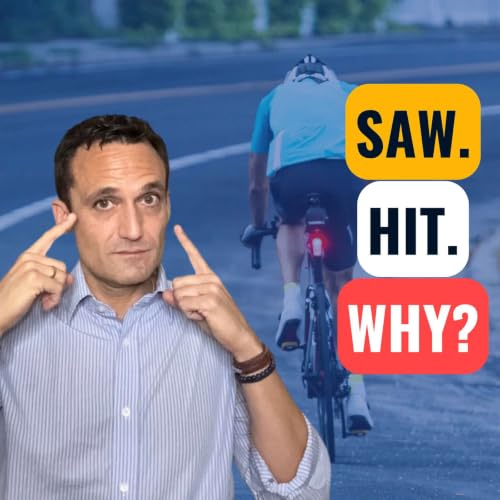
  • Why Drivers Hit Cyclists They Clearly See (I'm a Lawyer)
    2026/09/24

    A driver looks right at a cyclist on a clear, sunny day, and still drifts into them. How does that happen? Part of the answer is a human-factors problem most drivers have never been trained on: target fixation.

    In this episode, I break down how your hands tend to follow your eyes, why "I saw the cyclist" is not the same as safely avoiding one, and the one habit that helps prevent the crash, whether you are behind the wheel or on two wheels. I also explain why, in much of this country, cyclists are legally allowed to take the lane, and why that law makes more sense once you understand the problem.

    By the end, you will have a single shift in how you use your eyes, your steering, and your road position that can keep you out of a crash.

    Palaidis Law, PA

    Fort Lauderdale, FL

    call: 954-828-0848

    email: hello@palaidislaw.com


    DISCLAIMER

    This is not legal advice. I am not your lawyer. All content provided is for informational purposes only and not for the purpose of providing legal advice. You should contact your attorney to obtain advice with respect to any particular issue or problem. Nothing here should be construed to form an attorney-client relationship. All non-licensed clips used for fair use commentary, criticism, and educational purposes. See Hosseinzadeh v. Klein, 276 F.Supp.3d 34 (S.D.N.Y. 2017); Equals Three, LLC v. Jukin Media, Inc., 139 F. Supp. 3d 1094 (C.D. Cal. 2015).

    続きを読む 一部表示
    8 分