『TLDR: The B2B SaaS Growth Podcast Recording』のカバーアート

TLDR: The B2B SaaS Growth Podcast Recording

TLDR: The B2B SaaS Growth Podcast Recording

著者: Ishaan Shakunt (Founder @ Spear Growth)
無料で聴く

今ならプレミアムプランが3カ月 月額99円

2026年5月12日まで。4か月目以降は月額1,500円で自動更新します。

概要

The B2B SaaS growth podacast by Spear Growth (https://speargrowth.com/). This is not a marketing strategy, story, or inspirational podcast series. This is a to-the-point, grab-and-go podcast aimed at marketers with intermediate skills(not beginners) to find direct and actionable solutions to problems they are facing or experiments they are looking to do. Hosted on Ausha. See ausha.co/privacy-policy for more information.Marketing SG マーケティング マーケティング・セールス 経済学
エピソード
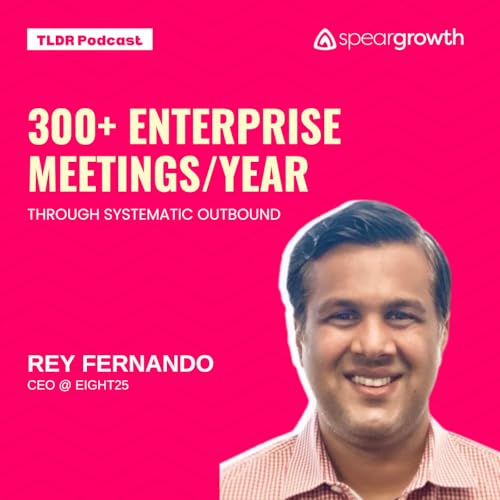
  • 300+ Enterprise Meetings/Year Through Systematic Outbound: Rey @ eight25 Media
    2026/03/26

    Everyone says cold email is "saturated."

    But what they really mean is: the usual way of doing cold email is dead.

    In this episode of TLDR, I spoke to Rey Fernando (CEO, eight25), who's generating 300+ enterprise meetings/year, ~$10-12M pipeline, and $3–7M closed revenue from outbound.

    But nothing about his system looks like what most teams do.

    Most outbound advice today centers on finding better signals, writing better templates, and scaling volume.

    Rey just flipped all of it. Here’s how,

    1. Signals don't tell you WHO to reach. They tell you HOW to reach.

    Most teams use signals to reduce their list. Rey doesn't. He reaches out to everyone in the ICP consistently. Signals simply help in shaping the angle of the message.

    2. The job of your email isn't what you think

    Not to explain your product. Not to build trust. Not even to drive conversion. Each part has one job: subject line gets the open, email gets the meeting, offer reduces friction. That's it. Don’t overthink this.

    3. Good outbound ≠ clever hacks

    I kept asking for systems, automations, shortcuts. But his answer was annoyingly simple: "You just have to write good emails."
    Before AI, his team wrote 2,000 custom emails per week manually. Timed. Trained. Iterated.

    4. The real constraint isn't volume. It's data quality.

    Most teams think they're emailing 3,000 people. They're not. Bad targeting leads to irrelevant emails, which leads to spam reports, which kills deliverability, which breaks the entire system.
    Rey's team verifies roles manually, checks relevance before sending, They don't just check 'do we have data?', they check 'is this data actually accurate?'"

    5. The most underrated insight

    Don't blast everyone in an account at once. Reach out to one person per company per week, rotating through your buying committee.
    Result: each person hears from you monthly, the company hears from you weekly. This way you stay present without creating fatigue, and you increase surface area over time.

    In short, outbound isn't broken. Lazy outbound is.

    The teams winning today aren't doing more. They're just doing the fundamentals way better than everyone else.


    Hosted on Ausha. See ausha.co/privacy-policy for more information.

    続きを読む 一部表示
    53 分
  • 30+ Events, 2.4M Revenue Through Relationship-Led Marketing: Taryn @ Fuel AI
    2026/03/19

    Most B2B marketers treat events like a channel.
    Book a venue. Get people in. Hope something comes out of it.

    And that's also why they fail.

    In this episode of TLDR, I spoke with Taryn Talley (30+ events, $2.4M in revenue over 4 years).

    Her approach is completely different.

    She doesn't start with pipeline targets or event logistics.

    She starts with: "Who do we actually want to build relationships with?"

    Then she builds a system around deepening those relationships.

    B2B deals need 7-12 touches to close. Events are just high-value touches in that sequence.

    Her biggest deals came from people who attended 3+ different events over time.

    Not one big event. A deliberate sequence of events.

    Here's how the system works:

    Build a network, not an invite list: Start with 100-1,000 core relationships. Track them in a spreadsheet. Document engagement history, pain points, last meaningful touch. Goal: grow this network 20% annually.

    Vary the format: Mix intimate dinners (20 people), networking events (150 people), multi-day experiences (30-40 people). Don't hit the same people with the same format twice.

    The real work happens after: Track every conversation. Document pain points shared. Schedule follow-ups: lunches, sports events, smaller dinners. Tag everyone in CRM. Track multi-touch progression.

    Her 2023 Growth Marketing Summit: 3 days in Park City, 30-40 executives, cost ~$80K.

    Result? The WhatsApp group stayed active for 12 months. Attendees invested in each other's companies. Multiple deals closed.

    Here’s the shift:

    Most marketers optimize event logistics (venues, catering, attendance, swag bags).

    Taryn optimizes relationship infrastructure (network growth, touch sequences, conversion tracking).

    That's the difference between treating events as a channel vs. treating them as systematic relationship building.

    This is operator-level thinking you can't learn from playbooks.

    If you're still running campaigns without direct customer context, you're just guessing.


    Hosted on Ausha. See ausha.co/privacy-policy for more information.

    続きを読む 一部表示
    57 分
  • 2.5x Higher LTV by Pricing Annual Plans on Retention: Dan @ Diligent
    2026/03/05

    Most SaaS companies guess their pricing.
    Because they're operating from a secondhand context.

    Competitor research. Pricing surveys. "Best practices."

    None of that tells you what'll work for YOUR product.

    And that's exactly how we had priced Chosenly.
    No framework. No model. Just gut feel on what would work.

    Turns out… that's not unusual.

    In this episode of TLDR, I spoke with Dan Layfield from Diligent about how real SaaS companies actually figure out pricing.

    Codecademy scaled from $10M → $50M ARR and eventually exited for $525M.

    And according to Dan, one of their biggest unlocks came from something most SaaS companies barely think about:

    How they price annual plans.

    Most companies do this: Monthly: $10 Annual: $96 or $120 (10–20% discount)

    Because… that's what everyone else does.

    But Dan shared a much smarter approach.

    Price your annual plan based on monthly retention.

    Example: If your product costs $10/month and users stay 4 months on average…

    Most companies make $40 LTV.

    Instead, price the annual plan around 6 months of value ($60).

    That pulls more users into annual.

    What happens next:

    • You collect more cash upfront

    • Payment churn drops

    • Users commit longer

    • Many renew annually

    Codecademy saw LTV jump from roughly $40 → $90 using this logic.

    Dan also breaks down:

    • Why pricing should be tested every ~6 months

    • Why willingness-to-pay surveys are only 60% accurate

    • How freemium models actually convert (and when they fail)

    • The simple A/B testing setup used to test pricing

    If you run a SaaS product, this episode will probably make you rethink your pricing page.

    It definitely made me rethink ours.


    Hosted on Ausha. See ausha.co/privacy-policy for more information.

    続きを読む 一部表示
    44 分
まだレビューはありません