『THRIVE: Turning Uncertainty into Competitive Advantage』のカバーアート

THRIVE: Turning Uncertainty into Competitive Advantage

THRIVE: Turning Uncertainty into Competitive Advantage

著者: Meridith Elliott Powell
無料で聴く

【Amazonプライム会員限定】今ならプレミアムプランが4か月 月額99円。

10月19日まで。※適用条件あり
THRIVE Turning Uncertainty into Competitive Advantage is where you hear the inspiring stories of how everyday business professionals forged unconventional paths to success. Learn new insights from business thought leaders and visionaries who made dramatic gains in self-awareness, discovered breakthrough new strategies, or blazed whole new trails that shifted and transformed the ways to succeed in today's economy. In the ever-changing, uncertain, crazy rollercoaster of the world of business, you can thrive in ways you may never have imagined before. Put this crisis behind you and emerge successful.All rights 2021 Motion First マネジメント・リーダーシップ リーダーシップ 経済学
エピソード
  • Transform Your Culture
    2026/07/14

    With Special Guest: Brian Biro, America's Breakthrough Coach and Bestselling Author of The ROI of Kindness

    Kindness has an image problem in business. Brian Biro has spent decades proving that image is wrong.

    In this episode, Meridith welcomes her longtime mentor Brian Biro, "America's Breakthrough Coach," to make the case that kindness is not a soft skill leaders can afford to skip. It is the foundation of trust, performance, and results. Brian traces his passion for kindness back to his own mentor, legendary UCLA basketball coach John Wooden, and shows why the companies that top every industry, from Southwest Airlines to Starbucks to Kaiser Permanente, all share kindness as a core value.

    Brian introduces his ESPN framework for building people: deliver thanks with real Effort and energy, use the power of Surprise, be fully Present, and choose Now over "as soon as." He and Meridith also tackle the question every leader eventually faces: how do you stay kind while still holding people accountable? Through stories, including Coach Wooden confronting a star player over a broken team rule, and Meridith's own story of delivering hard feedback to a talented young executive, they show that real kindness means telling someone the truth because you believe in what they can become, not withholding it to protect their feelings, or yours.

    What you will take away from this conversation:

    • Why the Pygmalion effect means what you focus on in your people is what you create in them
    • The ESPN framework for building trust: Effort and energy, Surprise, Presence, and Now
    • Why kindness and accountability are not opposites, and how to deliver a hard message with genuine care
    • The difference between being liked and being respected, and why leaders who chase the first lose both
    • Brian's closing truth: "The love we fail to share is the only pain we live with"

    If you lead people through uncertainty and want a culture that performs and holds together, this conversation gives you the blueprint.

    Connect with Brian Biro:
    brianbiro.com | Book: The ROI of Kindness

    https://www.linkedin.com/in/brianbiro/

    続きを読む 一部表示
    24 分
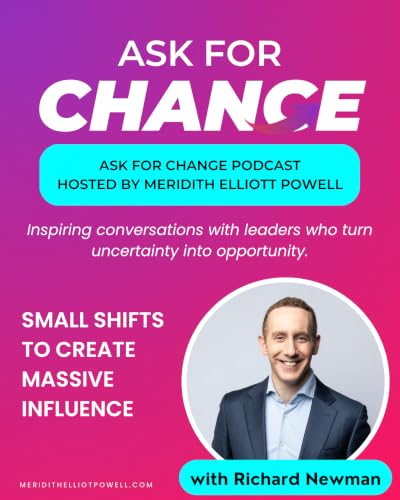
  • Small Shifts to Create Massive Influence
    2026/07/28

    With Special Guest: Richard Newman, Founder and CEO of Body Talk

    Most leaders think a failed change initiative comes down to a bad strategy. Usually, it comes down to bad delivery. In this episode of Ask for Change, I sit down with Richard Newman, founder and CEO of Body Talk and author of the bestseller Lift Your Impact. Richard has trained over 150,000 leaders at companies like Microsoft, Virgin, and 3M. His path started in an unlikely place. He was a painfully shy teenager who spent six months in a Himalayan monastery with monks who spoke no English. That forced silence became the foundation of his career.

    Richard's research with UCL psychology professor Adrian Furnham surveyed more than 2,000 people worldwide. The results are hard to argue with. A few specific shifts in posture and presence changed how people voted for a candidate by 59 percent. Nonverbal signals move an audience 42 to 44 percent more than words alone.

    We talk about why teams lose trust in a leader before that leader even speaks. We break down the three Cs every leader needs during change: clarity, care, and courage. And we unpack why the habits you call "just who I am" are actually the habits holding your influence back.

    If your organization is running into change fatigue, this episode gives you a different lever to pull. Not new words. A new presence.

    Connect with Richard:

    http://www.richardnewmanspeaks.com/

    https://www.linkedin.com/in/richardnewmanspeaks/

    https://www.instagram.com/richardnewmanspeaks/

    続きを読む 一部表示
    24 分
  • Navigating AI: The Shift from Doers to Deciders
    2026/08/18

    The Shift from Doers to Deciders: Neil Redding on Leading Through AI Disruption

    Neil Redding has spent more than three decades working at the intersection of technology and business, building future-innovation teams inside firms like MediaCom, Gensler, and ThoughtWorks, and helping organizations including Visa, Nike, Apple, and Verizon translate emerging technology into practical value. He calls himself the Near Futurist, and on this episode he explains exactly why: rather than forecasting a distant horizon, Neil focuses leaders on the 24-month window that actually determines whether a business stays relevant.

    Neil and Meridith unpack what he calls the shift from doers to deciders, the identity-level disruption happening as AI absorbs more of the tasks people have spent entire careers mastering. They talk through why old-style command-and-control planning cannot keep pace with how fast AI lets people execute, a mismatch Neil calls clock drift, and why the businesses actually benefiting from AI are the ones willing to redesign how work gets done rather than just accelerating their existing workflows. Neil offers a simple, repeatable starting point for leaders at any level: delegate first. This is a grounded, calm conversation about a genuinely disorienting shift, and it leaves listeners with a clear next step rather than more anxiety.

    Key takeaways:

    • The shift from doers to deciders: as AI takes on more execution, the higher-value (and more tiring) work becomes judgment and decision-making
    • Clock drift: the widening gap between how fast AI lets individuals build and how slowly organizations are structured to approve and adopt
    • Delegate first as a practical starting habit, treating AI like a capable intern you give context to, evaluate, and iterate with
    • Why command-and-control leadership, reinforced since 2008 and again through COVID, is now actively working against organizations
    • Speed as the real competitive advantage in an AI-enabled market, illustrated through how fast-moving companies out-decide their competitors
    • Adaptability is not a new skill humans lack, it is the same capability used in parenting and raising capable people, applied to how we build capable teams

    Connect with Neil Redding:

    • https://linkedin.com/in/reddingneil

    • https://www.instagram.com/neilredding/

    • https://youtube.com/neilredding

    続きを読む 一部表示
    35 分
adbl_web_anon_alc_button_suppression_t1
まだレビューはありません