『Surgical Ergonomics』のカバーアート

Surgical Ergonomics

Surgical Ergonomics

著者: Geeta Lal MD
無料で聴く

【Amazonプライム会員限定】今ならプレミアムプランが4か月 月額99円。

10月19日まで。※適用条件あり

This podcast will discuss everything relating to surgical and procedural ergonomics i.e. the people, ideas and technology that will help enhance your physical wellness and career longevity.

© 2026 Surgical Ergonomics
衛生・健康的な生活 身体的病い・疾患
エピソード
  • Beyond Wellness: Building Institutional Support for Surgical Ergonomics with Dr. Geeta Lal
    2026/10/05

    Episode Details

    In this episode of the Surgical Ergonomics Podcast, Dr. Geeta Lal discusses one of the questions she hears most often: How do I get my institution to take surgical ergonomics seriously?

    While individual strategies such as improving posture, stretching, exercising, and taking microbreaks are important, sustainable surgical careers require more than individual effort. The workplace environment, equipment, workflow, and institutional culture all play an important role in supporting the physical health and longevity of surgeons and proceduralists.

    Dr. Lal shares five practical strategies for building institutional support for surgical ergonomics and discusses why ergonomics should be viewed as an occupational and workforce sustainability issue—not simply an individual wellness responsibility.

    In This Episode, You'll Learn:

    • Change how you frame the problem — Move the conversation beyond wellness and toward occupational risk, career longevity, workforce sustainability, and retention.
    • Bring local data — Learn how collecting information about the ergonomic challenges experienced by your own surgeons, proceduralists, trainees, and OR teams can help demonstrate that ergonomics is a workplace issue.
    • Find partners — Identify people across your institution who can help address ergonomic challenges, including OR leadership, occupational health, physical and occupational therapy, nursing, workplace safety, and quality and safety teams.
    • Start with a specific problem — Rather than immediately proposing a comprehensive ergonomics program, begin with one concrete issue, assessment, pilot project, equipment evaluation, or educational intervention.
    • Don't stop at education — Understand why education is important but cannot compensate for poorly designed workspaces, equipment, instruments, or workflows, and why the goal should be to make the work environment function better for the people in it.

    Resource Mentioned

    Developing Specialty-Specific Workplace Standards for Sustainable Surgical Careers

    This episode references the work surrounding specialty-specific workplace standards and the importance of creating conditions that support sustainable surgical careers.

    Read the article in the Journal of the American College of Surgeons

    Follow Surgical Ergonomics on LinkedIn, X, Instagram, Facebook and YouTube please reach out to us if you have any suggestions regarding episode ideas and guests or if you'd like to be a guest on the podcast

    If you found this episode valuable, please share it with a colleague or your perioperative team to help bring greater awareness to the role of ergonomics in career longevity. If you're enjoying the podcast, I'd be grateful if you left a review on your favorite podcast platform. Your reviews help others discover the show and support our mission of improving the health and longevity of surgeons and proceduralists worldwide.

    続きを読む 一部表示
    18 分
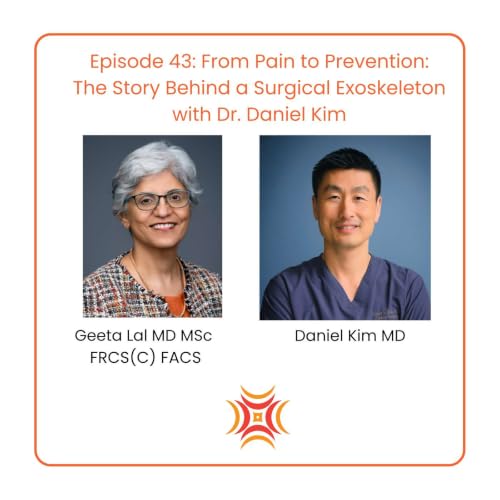
  • From Pain to Prevention: The Story Behind a Surgical Exoskeleton with Dr. Daniel Kim
    2026/09/21

    Episode Details:

    In this episode of the Surgical Ergonomics Podcast, Dr. Daniel Kim shares his personal journey with the physical demands of operating and how his own experience with neck and back strain ultimately led to the development of a surgical exoskeleton.

    He shares how early prototypes evolved, the challenges of designing a system that surgeons would actually want to wear, and why addressing issues such as headaches, comfort, mobility, and durability was essential.

    About Our Guest:

    Dr. Daniel Kim is a Clinical Professor in the Department of Plastic Surgery at the University of California, Irvine and has been practicing plastic surgery for more than 25 years. He maintains a private practice in California and specializes in secondary breast surgery, facial surgery, and total body rejuvenation procedures. He is also a co-inventor of NekSpine, a commercially available neck and back exoskeleton designed for surgeons. His interest in surgical ergonomics grew from his own experience with the physical demands of operating and his collaboration with biomedical engineer Mr. Roger Malcolm.

    In This Episode, You'll Learn:

    • How years of static, forward-leaning postures can affect surgeons over time.
    • Dr. Kim's personal experience with changing posture and operating-related pain.
    • How his conversations with biomedical engineer Roger Malcolm led to the idea for a surgical exoskeleton.
    • What an exoskeleton is and how it can support the body during less-than-ideal working positions.
    • The challenges involved in developing an exoskeleton specifically for surgeons.
    • Why headaches became an important problem to solve during the early development of the device.
    • How carbon fiber and other design changes contributed to the evolution of NekSpine.
    • How the device provides support for the neck and lumbar region.
    • The challenges of bringing an ergonomic innovation from an early prototype to a commercially available product.
    • What research has examined the effects of NekSpine, including studies involving posture and muscle activity.
    • Why exoskeletons should be viewed as one potential tool rather than a single solution to surgical ergonomics.
    • Why introducing ergonomics and career longevity concepts earlier in surgical training may be important.

    Resources mentioned: You can learn more about NekSpine and special pricing for podcast listeners here:https://nekspine.com/nekspine-special-offer-surgical-ergonomics-podcast/

    Articles evaluating NekSpine:

    https://pubmed.ncbi.nlm.nih.gov/40201977/

    https://pubmed.ncbi.nlm.nih.gov/41755295/

    Follow Surgical Ergonomics on LinkedIn, X, Instagram, Facebook and YouTube please reach out to us if you have any suggestions regarding episode ideas and guests or if you'd like to be a guest on the podcast

    If you found this episode valuable, please share it with a colleague or your perioperative team to help bring greater awareness to the role of ergonomics in career longevity. If you're enjoying the podcast, I'd be grateful if you left a review on your favorite podcast platform. Your reviews help others discover the show and support our mission of improving the health and longevity of surgeons and proceduralists worldwide.

    続きを読む 一部表示
    33 分
  • From RULA to AI: Measuring Ergonomic Risk in Surgery with Dr. Ali Golabchi
    2026/09/07

    Episode details:

    In this episode, we explore how ergonomic risk can be measured in surgical and procedural environments, and why simply asking surgeons whether they are experiencing pain or discomfort may not tell the whole story.

    About Our Guest:

    Dr. Ali Golabchi is the Chief Technology Officer and Director of Research at EWI Works International, Inc., Western Canada's leading ergonomics and wellness company. Ali joined EWI Works in 2016, where he oversees the development and adoption of technology-based, data-powered, science-driven solutions to improve health, safety, and productivity. His work focuses on bridging the gap between academic research and real-world application, using emerging technologies to address practical ergonomic challenges.

    In this episode, you'll learn:

    - Why measuring ergonomic risk is important instead of relying solely on surgeons' reports of pain or discomfort.

    - The difference between qualitative and quantitative approaches to measuring ergonomic risk.

    - What RULA and REBA are, how these observational tools work, and some of their limitations in surgical environments.

    - Why the operating room presents unique challenges for ergonomic measurement, including sterility, limited space, complex workflows, PPE, privacy, and multiple people in the surgical field.

    - The difference between marker-based, wearable sensor, and markerless motion capture systems.

    - How AI and computer vision can be used to analyze posture and movement from a standard video recording.

    - The story behind the development of PoseCheckerTM and how it evolved from research technology into a practical tool for ergonomic assessment.

    - How vision-based motion capture can potentially be used to evaluate ergonomic interventions by comparing risk before and after changes to equipment, workflow, or technique.

    - What Ali sees as the future of ergonomic risk assessment, including AI-powered tools, exoskeletons, wearable robots, and more proactive approaches to ergonomics.

    Resources Mentioned

    • RULA (Rapid Upper Limb Assessment)
    • REBA (Rapid Entire Body Assessment)
    • PoseChecker by EWI Works

    Follow Surgical Ergonomics on LinkedIn, X, Instagram, Facebook and YouTube please reach out to us if you have any suggestions regarding episode ideas and guests or if you'd like to be a guest on the podcast

    If you found this episode valuable, please share it with a colleague or your perioperative team to help bring greater awareness to the role of ergonomics in career longevity. If you're enjoying the podcast, I'd be grateful if you left a review on your favorite podcast platform. Your reviews help others discover the show and support our mission of improving the health and longevity of surgeons and proceduralists worldwide.

    続きを読む 一部表示
    32 分
adbl_web_anon_alc_button_suppression_t1
まだレビューはありません