エピソード

  • Weeping Things in Focus
    2026/10/15
    \“It’s very hard to describe what I’m looking for. Something that feels both familiar and strange at the same time.” — Gregory Crewdson “Change the way you look at things and the things you look at change.” — Wayne Dyer In this episode, Antonio and Ward talk about noticing what makes us stop and look—and being willing to follow it somewhere unexpected. Antonio shares discoveries from his Art of Noticing class, where students found photographs in everyday surroundings, and describes his experiments with nighttime photography inspired by Trent Parke. With his upcoming trip to Japan just weeks away, Ward shares his plans for photographing during a longer return visit and gathering material for future zines. A visit to Weeping Water, Nebraska, gives Antonio a lesson in reconsidering expectations when the black-and-white photographs he envisioned begin to come alive in color. He and Ward discuss processing as part of discovering what drew them to a subject, how viewers bring their own experiences to photographs, and the satisfaction of finding a way forward after an initially disappointing edit. Ward closes with a look at Dan Winters’ The Grey Ghost, whose black-and-white New York photographs prompt reflections on how knowing a place changes our experience of its images. Links & Resources Support the Show Support the podcast on Buy Me a Coffee Learning to Notice and Teaching Photography Southeast Community College — photography classes — Antonio discusses completing his Art of Noticing class and preparing a class on making photo zines. Southeast Community College — personal interest classes — Continuing education offerings in photography and other creative subjects. Ward’s Upcoming Japan Trip Gaijin: A Tourist’s Brief Urban Fever Dream of Japan — Ward’s first Japan zine, with further volumes planned as his familiarity with the country develops. “Point of Departure: Japan” — Ward’s reflections on photographing Japan as a visitor. “The 1.4% Solution: How I Found a Zine Inside 2,400 Images” — Ward’s account of identifying themes and selecting photographs for his Japan zine. Cameras, Lenses, and Creative Constraints Fujifilm X-S20 — One of the camera bodies Ward plans to take to Japan. Fujifilm X-E3 — Ward’s camera for his restricted black-and-white setup. Sigma 50–120mm F2.8 DC OS Contemporary — The compact telephoto zoom Ward is considering for Japan. Night Photography and Trent Parke Trent Parke — Magnum Photos — Inspiration for Antonio’s experiments with black-and-white photography at night. Weeping Water and Seeing Nebraska Travel with a Wiseguy — Weeping Water, Nebraska — The video that inspired Antonio’s visit to Weeping Water and the photographs discussed in this episode. Weeping Water — official city website — The town Antonio visits and photographs. Weeping Water — community website Andrew Wyeth — Brandywine Museum of Art — Antonio recognizes a connection to Wyeth’s paintings while working with his photographs. Andrew Wyeth — Christina’s World — The painting recalled during the discussion. Book Recommendation: Dan Winters The Grey Ghost: New York City Photographs — Ward’s featured book. The Grey Ghost — image gallery Dan Winters — official website — Portraiture, personal projects, and other photographic work. Antonio M. Rosario Website and portfolio Print store Photography lessons and workshops Instagram: @amrosariophoto Bluesky: @amrosario.bsky.social Facebook Ward Rosin Website and portfolio Books, zines, and prints Between Dust and Sky Gaijin Instagram: @wardrosinfineart Facebook X/Twitter: @wrosinphoto Follow the Show Street Shots Photography Podcast Listen on Apple Podcasts Listen through Podbean Subscribe to the Street Shots Substack Street Shots on Instagram Street Shots on Facebook
    続きを読む 一部表示
    1 時間 14 分
  • Tri-X. It's Easy!
    2026/09/30
    “A camera didn’t make a great picture any more than a typewriter wrote a great novel.” — Peter Adams “It’s not when you press the shutter, but why you press the shutter.” — Mary Ellen Mark In this episode, Antonio and Ward dig into what makes a photograph worth stopping for in the first place. Antonio shares how teaching a small photography class pushed him to focus less on perfect images and more on attention, curiosity, and the little details people notice once they slow down. Ward brings in recent film work, including medium-format rodeo photos, and the two talk through the special “airiness” and physical feel that film and older cameras can bring to an image. They carry that idea into large-format cameras, field cameras, phone photography, Fuji film simulations, and the creative blocks that can come from too many self-imposed limits. Ward wrestles with a Fuji X-E3 setup that has him feeling stuck, while Antonio considers how newer iPhone camera tools and film-grain textures change the look and feel of everyday shooting. The episode wraps with a recommendation for Mary Ellen Mark’s Encounters, a celebration of her social documentary work, and a reminder that gear matters most when it changes how photographers see. Links & Resources Learning to Notice The Art of Noticing: Better Photographs Close to Home — Antonio’s photography class through Southeast Community College in Lincoln. The class focuses on slowing down, noticing overlooked details, and finding worthwhile photographs close to home. Antonio’s private photography lessons and workshops Walker Evans — Discussed in connection with photographs of churches, vernacular architecture, and the visual influences photographers carry with them. Ward’s Film and Rodeo Work Hand Hills Lake Stampede — The Alberta rodeo where Ward made the medium-format photographs discussed in the episode. Flic Film — The Alberta-based film company and lab that developed and scanned Ward’s 120 film. Between Dust and Sky — Ward Rosin and Mark Reierson’s book documenting the 100th Hand Hills Lake Stampede. Medium-Format Cameras and Lenses Twin-lens reflex cameras — The waist-level medium-format camera design Ward used to photograph rodeo action. Rolleicord — Ward’s Rolleicord, the simpler sibling of the Rolleiflex, dates from around 1959 and uses a Schneider Xenar lens. Minolta Autocord — Another twin-lens reflex camera in Ward’s collection. Fujifilm GFX system — Fujifilm’s digital medium-format system, discussed in comparison with the look of 120 film. Porch Art Palooza and Large Format Porch Art Palooza — Lincoln’s free, self-guided neighborhood art tour, featuring local artists and pop-up galleries on residential porches. Intrepid Camera — The Brighton, UK, company making lightweight modern large-format cameras. Antonio handled one of its portable 4×5 field cameras at Porch Art Palooza. Intrepid 4×5 Kickstarter — The original crowdfunding campaign for the Intrepid field camera. Chamonix View Camera — Maker of handcrafted large-format field cameras. Despite the French-sounding name, Chamonix cameras are made in Zhejiang, China. Chamonix 4×5 cameras — An example of the company’s portable 4×5 field-camera designs. Graflex Crown Graphic — The classic press and field camera Antonio has in storage and hopes to put back into use. Alfie [BOXX] Camera — The British wooden camera Antonio backed. It exposes directly onto 6×9 cm photographic paper and uses a film holder that doubles as a portable developing tank. More about the Alfie [BOXX] — Sample images, development news, and details from Alfie Cameras. Scheimpflug principle — The focusing principle Antonio and Ward were trying to name. Tilting the standards changes the orientation of the plane of focus. Ansel Adams: The Camera — Adams’s technical guide to 35mm, medium-format, and large-format cameras, including camera movements and extended depth of field. Creative Constraints and Fujifilm Give Ward an assignment: Send him a tightly defined photography project through the Street Shots Substack or Instagram. He is looking for a prompt that will help him break through his creative block with the X-E3. iPhone Photography iPhone 18 Pro and iPhone 18 Pro Max — Antonio discusses the new variable-aperture main camera, manual shutter speed and white-balance controls, exposure histogram, and expanded Photographic Styles. iPhone 18 Pro camera specifications — Includes the four physical aperture settings, Pro controls, focal lengths, and camera formats. Using Photographic Styles — Apple’s guide to adjusting tone, color, texture, and simulated film grain. iPhone 18 Pro camera overview — Examples of variable aperture, motion blur, texture controls, and Photographic Styles 3. Book Recommendation: Mary Ellen Mark Explore Mary Ellen Mark’s work Mary Ellen Mark: Encounters — The episode’s featured book. ...
    続きを読む 一部表示
    1 時間 10 分
  • Art of Darkness
    2026/09/15

    "In order for the light to shine so brightly, the darkness must be present." - Francis Bacon

    "Character, like a photograph, develops in darkness." - Yousuf Karsh

    In this episode, Antonio and Ward welcome back Australian photographer Gavin Libotte for a wide-ranging conversation about street photography, travel, sequencing, and the pull of printed work.

    Gavin talks about photographing Japan with his family, moving between color and black-and-white approaches, and how Tokyo, Osaka, Kyoto, Mount Fuji, rainy streets, cherry blossoms, and strong light each shaped the work he brought home. He also shares plans for two Japan zines: one gritty, black-and-white, flash-driven project, and one color zine built around light, contrast, and the visual beauty of the trip.

    The conversation turns to Gavin’s zine Passenger, a dark, contemplative body of work made on Sydney’s ferry system. Antonio and Ward dig into the mood, sequencing, negative space, and emotional quiet of the images, while Gavin reflects on public transport as both a literal journey and a metaphor for the human condition.

    They also discuss influences including Ray K. Metzker, Trent Parke, Alex Webb, and the physical experience of photography in print: zines, books, gallery walls, paper, ink, pacing, and why printed work still matters in a social-media world.

    Links

    Gavin Libotte: Website | Instagram

    Gavin’s Passenger: Street Attitude feature | Paris International Street Photo Awards listing

    Gavin at Head On Photo Festival: Wanderland | 42 Days

    Mentioned: Trent Parke | Ray K. Metzker | Alex Webb

    Subscribe to our Substack Newsletter

    Help out the show by buying us a coffee!

    Support the show by purchasing Antonio’s Zines or buying a print.

    Support the show by purchasing Ward's Zine, Book and Prints

    Send us a voice message, comment or question.

    Antonio M. Rosario's Website, Vero, Instagram, Bluesky, and Facebook page

    Ward Rosin’s Website, Vero, Bluesky, Instagram and Facebook page.

    Subscribe to us on:

    Apple Podcasts

    Spotify

    Amazon Music

    iHeart Radio

    Deezer

    Podcast Addict

    続きを読む 一部表示
    1 時間 10 分
  • This Year's Model
    2026/08/31
    "You are responsible for every part of your image, even the parts you’re not interested in." "Take a look at what you’re looking at." -- Jay Maisel In this episode, Ward steps into unfamiliar territory at a fashion photography event sponsored by Sony and The Camera Store. Instead of simply making the same model pictures as everyone else, he falls back on what he knows: treating the whole thing like street photography. He moves between sets, waits for gestures and expressions, and eventually turns his camera toward the photographers crowding around the models. The experience gives him a taste of the collaboration that happens between a photographer and a willing subject—and makes the idea of organizing his own outdoor fashion shoot feel a lot less like a daydream. Antonio and Ward then remember legendary New York photographer Jay Maisel, who recently died at 95. Antonio shares his own encounters with Maisel, stories from the photographer’s famously blunt workshops, and the quiet influence Maisel’s work has had on the way he photographs color, light, and ordinary surroundings. Maisel claimed that when he went out with a camera, he looked for “absolutely nothing”—meaning he left his expectations behind and allowed the world to show him what was there. His photographs are a reminder that seeing is a skill, style can become a trap, and even the most everyday scene can become remarkable when someone is paying close enough attention. Mentioned in this episode That ’70s Shootout at Off Set Studios — The Camera Store’s recap of the event Ward attended The Camera Store — Calgary’s independent camera shop Peter Lindbergh — the fashion photographer Ward hopes to channel in his own way Jay Maisel — explore Maisel’s extensive photographic archive Jay Maisel’s favorites — photographs accompanied by Maisel’s own stories and observations About Jay Maisel — biography, interviews, books, and other resources Joe McNally — photographer and former Maisel student whose remembrance Antonio reads during the episode Light, Gesture, and Color — Maisel’s book about training the eye to recognize what makes a photograph work Jay Myself — a documentary about Maisel and his legendary home and studio at 190 Bowery Also mentioned Lauritzen Gardens — the Omaha botanical garden Antonio visits Adobe Project Indigo — the experimental iPhone camera app Antonio uses for extra reach and RAW capture Trent Parke’s Monument — the photobook Antonio shares with his class Subscribe to our Substack Newsletter Help out the show by buying us a coffee! Support the show by purchasing Antonio’s Zines or buying a print. Support the show by purchasing Ward's Zine, Book and Prints Send us a voice message, comment or question. Show Links: Antonio M. Rosario's Website, Vero, Instagram, Bluesky, and Facebook page Ward Rosin’s Website, Vero, Bluesky, Instagram and Facebook page. Subscribe to us on: Apple Podcasts Spotify Amazon Music iHeart Radio Deezer Podcast Addict
    続きを読む 一部表示
    1 時間 22 分
  • The Middle of Somewhere
    2026/08/14
    "I can’t seem to get enough of the ‘highway stuff,’ and the fascination of what may be around the next corner makes the whole trip worthwhile." -- Edgar Praus "Travel becomes a strategy for accumulating photographs." -- Susan Sontag In this episode, Antonio and Ward talk about how photographs begin to change when they’re placed next to one another. A quick exercise from Antonio’s class, using the still-unpublished zine they made together, leads into a conversation about sequencing, photo books, chapbooks, PDFs, and the simple pleasure of getting pictures off a screen. Not every image needs to be the big standalone “banger.” Sometimes a quieter photograph finds its purpose when it lands beside the right companion and becomes part of a larger story. From there, they head out of town. Ward takes a long, unhurried drive through small prairie communities, photographing weathered buildings and enjoying the rare freedom of not having to be anywhere at a particular time. Antonio returns to the Cass County Fair, where the smoke, noise, and motion of a tractor pull give him a chance to borrow a little inspiration from Ward’s rodeo and motorsport work. Going back for a second year lets him see what has stayed the same—and how much his own eye has changed. Together, they find that photography doesn’t require an exotic destination or a crowded city street. Sometimes the good stuff comes from revisiting familiar ground, wandering without too many expectations, and paying attention to what a place has been quietly trying to show you. Mentioned in this episode Miro — the collaborative board Antonio and Ward used to sequence their zine remotely Apple Freeform — an Apple-based alternative for arranging pictures and collaborating on visual boards Gavin Libotte Photography — Gavin’s photography and projects, including Wanderland Walker Evans at The Met — an influence on Ward’s direct photographs of prairie buildings Michael Kenna — the inspiration behind Antonio’s “diesel Michael Kenna” tractor-pull photographs Cass County Fair — home of the truck and tractor pull Antonio photographed Outlaw Truck and Tractor Pulling Association — more about the machines, events, and gloriously excessive noise Wilber Czech Festival — the festival and parade Antonio visited in Wilber, Nebraska Nebraska State Fair — Antonio’s next larger fairground photography opportunity Subscribe to our Substack Newsletter Help out the show by buying us a coffee! Support the show by purchasing Antonio’s Zines or buying a print. Support the show by purchasing Ward's Zine, Book and Prints Send us a voice message, comment or question. Show Links: Antonio M. Rosario's Website, Vero, Instagram, Bluesky, and Facebook page Ward Rosin’s Website, Vero, Bluesky, Instagram and Facebook page. Subscribe to us on: Apple Podcasts Spotify Amazon Music iHeart Radio Deezer Podcast Addict
    続きを読む 一部表示
    1 時間 17 分
  • Strangers on a Frame
    2026/07/31

    In this episode, Antonio introduces the work of Latvian photographer Inta Ruka, whose quiet, direct portraits have completely pulled him in. Her photographs may appear simple at first, but the longer Antonio and Ward sit with them, the more stories and visual relationships begin to emerge. What matters most is the connection behind the pictures: Ruka uses the camera as a passport into people’s lives, spending time with them and allowing each photograph to grow out of trust. Her Rolleiflex stays out of the way, leaving her free to maintain eye contact and treat the person as more important than the equipment.

    Ward then reviews The Art of Street Photography by Sean Tucker and Joshua K. Jackson, a book concerned less with camera settings than with learning how to think and see as a photographer. Tucker explores creative dry spells, fear, ethics, motivation, and the experience of being fully present with a camera, while Jackson’s rich, layered photographs demonstrate just how open street photography can be. Together, the words and pictures offer something Antonio and Ward keep returning to: permission. Permission to stop being rigid, photograph whatever genuinely catches the eye, and recognize that becoming tired of old habits may simply mean it is time to grow.

    The Art of Street Photography by Sean Tucker & Joshua K. Jackson

    Subscribe to our Substack Newsletter

    Help out the show by buying us a coffee!

    Support the show by purchasing Antonio’s Zines or buying a print.

    Support the show by purchasing Ward's Zine, Book and Prints

    Send us a voice message, comment or question.

    Show Links:

    Antonio M. Rosario's Website, Vero, Instagram, Bluesky, and Facebook page

    Ward Rosin’s Website, Vero, Bluesky, Instagram and Facebook page.

    Subscribe to us on:

    Apple Podcasts

    Spotify

    Amazon Music

    iHeart Radio

    Deezer

    Podcast Addict

    続きを読む 一部表示
    1 時間 15 分
  • Star Spangled Stampede
    2026/07/15

    "I take photographs in my neighborhood. I think that mysterious things happen in familiar places. We don’t always need to run to the other end of the world." -- Saul Leiter

    "There is one thing the photograph must contain, the humanity of the moment." -- Robert Frank

    In this midsummer episode, Antonio talks about returning to Seward, Nebraska, for the Fourth of July and giving himself one simple assignment: photograph people wearing the stars and stripes. By narrowing his attention, he actually becomes more present and comes home with a stronger, more connected group of pictures—a good reminder that creative limits can open things up instead of closing them down. As he prepares to teach his first six-week photography class, he also wrestles with how to give beginners enough technical knowledge without losing the bigger picture.

    Ward has just finished nine evenings at the Calgary Stampede, an event he has attended for more than forty years and photographed seriously for the last decade. This time, he finds himself looking beyond the strong, formal compositions he knows how to make and toward quieter pictures that say something about who people are. That shift brings more color, more interaction, and a little more humanity into the work. It also raises questions about responsibility: having the right to take and share a photograph does not always mean keeping it online is the most decent choice. Together, Ward and Antonio come around to the value of returning to the same places year after year. Familiar events can become long-term projects, giving photographers a chance to notice what interests them now, see how they are changing, and gradually find something deeper than the pictures they made the year before.

    Antonio's Seward July 4th Pix: https://adobe.ly/4hdxxVA

    Subscribe to our Substack Newsletter

    Help out the show by buying us a coffee!

    Support the show by purchasing Antonio’s Zines or buying a print.

    Support the show by purchasing Ward's Zine, Book and Prints

    Send us a voice message, comment or question.

    Show Links:

    Antonio M. Rosario's Website, Vero, Instagram, Bluesky, and Facebook page

    Ward Rosin’s Website, Vero, Bluesky, Instagram and Facebook page.

    Subscribe to us on:

    Apple Podcasts

    Spotify

    Amazon Music

    iHeart Radio

    Deezer

    Podcast Addict

    続きを読む 一部表示
    1 時間 25 分
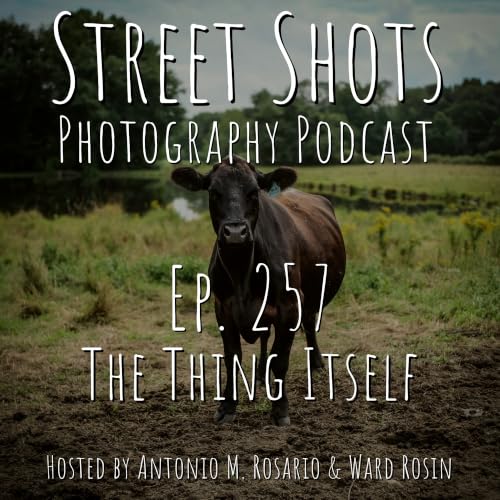
  • The Thing Itself
    2026/06/30

    "Anything that excites me for any reason, I will photograph; not searching for unusual subject matter, but making the commonplace unusual." -- Edward Weston

    "I see no reason for recording the obvious." -- Edward Weston

    In this episode, Antonio and Ward talk about Fujifilm cameras, autofocus, and film simulations. Antonio shares his frustration after missing bird photographs because the autofocus refused to lock onto obvious subjects, while Ward compares his own experiences photographing action with Fujifilm gear. They discuss firmware updates, the expectations photographers have for modern autofocus systems, and how working with film simulations can encourage a slower, more intentional approach to photography.

    Antonio and Ward spend the second half of the episode talking about Edward Weston’s Daybooks and the ideas that shaped his photography. They discuss Weston’s famous pepper photographs, his search for what he called “the thing itself,” and his belief that photography should reveal the true character of a subject rather than imitate painting. They talk about the relentless self-criticism found throughout his journals, the years he spent refining both his craft and his artistic philosophy, and the challenge photographers faced in convincing the art world that photography belonged alongside painting and sculpture. Along the way, they reflect on how Weston’s writing still offers practical lessons for photographers today and why his way of seeing continues to inspire nearly a century later.

    Links:

    • Edward Weston – The Flame of Recognition
    • Edward Weston’s Daybooks
    • Pepper No. 30
    • Fujifilm film recipe iPhone app
    • X Sim Lab - Fujifilm RAW processing iPad app

    Watch the YouTube video of this podcast here.

    Subscribe to our Substack Newsletter

    Help out the show by buying us a coffee!

    Support the show by purchasing Antonio’s Zines or buying a print.

    Support the show by purchasing Ward's Zine, Book and Prints

    Send us a voice message, comment or question.

    Show Links:

    Antonio M. Rosario's Website, Vero, Instagram, Bluesky, and Facebook page

    Ward Rosin’s Website, Vero, Bluesky, Instagram and Facebook page.

    Subscribe to us on:

    Apple Podcasts

    Spotify

    Amazon Music

    iHeart Radio

    Deezer

    Podcast Addict

    続きを読む 一部表示
    1 時間 18 分