エピソード

  • Still Unanswered- Bonny Lee Bakley: Murder on Woodbridge Street
    2026/11/05

    On May 4, 2001, Bonny Lee Bakley was shot to death while sitting in a parked car outside Vitello’s restaurant in Studio City, California. She was 44 years old, the mother of an 11-month-old daughter, and married to actor Robert Blake.

    Blake said he had left Bonny alone in the car while he returned to the restaurant to retrieve a handgun he had forgotten. When he came back, Bonny had been shot. The weapon he retrieved was tested and determined not to be the murder weapon, but the remarkably narrow window in which the shooting occurred immediately raised questions about whether the attack had been planned.

    Bonny’s life was complicated. She had a long history of pursuing relationships with wealthy or famous men, and her past became a major part of Blake’s defense after he was charged with her murder. Prosecutors, meanwhile, presented witnesses who said Blake had previously discussed having Bonny killed. He was ultimately acquitted in criminal court, while a civil jury later found him liable for her death under a lower burden of proof.

    Before Theresa reveals any of that, David knows only Bonny’s name, date of birth, and photograph.

    During his intuitive reading, David describes a woman he sees as deeply driven by the need to be loved, seen, and valued, but also someone whose own choices repeatedly complicated her life. He describes her sitting in the passenger seat of a sports car after dinner, recognizes that she knew the younger man he believes approached the vehicle, and interprets the shooting as planned rather than spontaneous.

    As Theresa begins revealing the documented case, several details begin to intersect—including the Studio City location, the sports car, Bonny’s infant daughter, and David’s unexpected connection to the name “Michael”, which turns out to have a direct relationship to Robert Blake’s birth name.

    But the central question remains unresolved.

    Robert Blake was acquitted of Bonny’s murder. A civil jury later reached a different conclusion. And more than two decades later, no one has conclusively established who actually pulled the trigger.

    Who killed Bonny Lee Bakley—and was the person responsible ever truly identified?

    Listen with an open mind. Consider the facts. Decide for yourself.

    David’s intuitive impressions are personal perceptions and are not presented as fact or evidence. Nothing discussed should be interpreted as an accusation or determination of guilt.

    Support the show

    Still Unanswered
    Evidence meets intuition.
    Hosted by David Zarza & Theresa Michaels.

    Explore cases, episodes & more at StillUnansweredPodcast.com
    Follow: @stillunansweredpodcast (Instagram & Facebook)

    Have a case you think we should investigate? Visit the website to get in touch or email directly contact@stillunansweredpodcast.com

    続きを読む 一部表示
    1 時間 14 分
  • Still Unanswered- Rebecca Zahau: The Death at Spreckels Mansion
    2026/10/22

    In July 2011, 32-year-old Rebecca Zahau was staying at the historic Spreckels Mansion in Coronado, California, with her boyfriend, pharmaceutical executive Jonah Shacknai.

    Two days before Rebecca’s death, Jonah’s six-year-old son, Max, suffered catastrophic injuries after falling inside the mansion while Rebecca and her teenage sister were present. Max remained hospitalized in critical condition as Rebecca returned to the mansion with Jonah’s brother, Adam Shacknai. The following morning, Rebecca was found hanging from a second-floor balcony. Her hands and feet were bound, a long-sleeved shirt was wrapped around her neck and partly in her mouth, and a cryptic message had been painted inside the bedroom:

    “She saved him. Can you save her?”

    The medical examiner ruled Rebecca’s death a suicide, and investigators said they found no evidence of a crime. Rebecca’s family fiercely disputed that conclusion. Years later, a civil jury found Adam Shacknai liable for her death, while a subsequent review by the Sheriff’s Department again concluded that the evidence remained consistent with the original suicide ruling.

    But before Theresa Michaels reveals any of that history, David Zarza knows only Rebecca’s name, date of birth, and photograph.

    During his independent intuitive reading, David describes a frightened woman, a wealthy and complicated relationship, a child’s accident inside a large home, a strained encounter with another man in the house, bindings, a balcony, and what he interprets not as an intentional suicide—but as a desperate act meant to be interrupted that went catastrophically wrong.

    Then Theresa begins revealing the documented case.

    Some details intersect in startling ways. Others raise entirely new questions.

    Was Rebecca Zahau’s death suicide, homicide— or could the truth be something neither side has fully considered?

    Listen with an open mind. Consider the facts. Decide for yourself.

    David’s intuitive impressions are personal perceptions and are not presented as fact or evidence. Nothing discussed should be interpreted as an accusation or determination of guilt.

    Support the show

    Still Unanswered
    Evidence meets intuition.
    Hosted by David Zarza & Theresa Michaels.

    Explore cases, episodes & more at StillUnansweredPodcast.com
    Follow: @stillunansweredpodcast (Instagram & Facebook)

    Have a case you think we should investigate? Visit the website to get in touch or email directly contact@stillunansweredpodcast.com

    続きを読む 一部表示
    55 分
  • Still Unanswered- Bob Crane: Murder in Scottsdale
    2026/10/29

    In June 1978, actor, radio personality, and drummer Bob Crane was in Scottsdale, Arizona, performing in Beginner’s Luck at the Windmill Dinner Theater. He was staying temporarily in apartment 132A at Winfield Place when he was found murdered inside the apartment on June 29. Crane had suffered severe blunt-force injuries to the head, and an electrical cord had been tied around his neck. There was no obvious forced entry, no clear robbery motive, and the murder weapon was never conclusively identified.

    Crane was best known to millions as Colonel Robert Hogan on Hogan’s Heroes, but the investigation into his death exposed a much more private side of his life. Police recovered videotapes from the apartment, and reports described hundreds of women appearing in Crane’s photographs and recordings over the years. Those discoveries dramatically expanded the number of people who might have had a reason to feel angry, humiliated, jealous, or threatened by him.

    Before Theresa reveals any of that, David knows only Robert Edward Crane’s name, date of birth, and photograph.

    During his intuitive reading, David describes a man with a strongly sexual private life, a temporary apartment that feels more like a bachelor pad than a permanent home, a female visitor behaving suspiciously near an exterior door, a close male friend stopping by later, and a killing that David believes happened after Crane fell asleep. He does not connect the close friend to the murder. Instead, David’s impressions lead him toward an unknown man he believes may have been connected to a woman in Crane’s orbit.

    Theresa then reveals that Crane really was staying in a temporary Scottsdale apartment, that longtime friend John Henry Carpenter was with him during part of his final night, and that the apartment door was later found unlocked. Carpenter ultimately became the central suspect, was charged, tried, and acquitted. He maintained his innocence until his death.

    Other theories have circulated for decades, but no one has ever been convicted.

    Who entered Bob Crane’s apartment that night? Was the answer hidden in his private life, in a relationship investigators never fully understood, or in evidence that can no longer speak for itself?

    Listen with an open mind. Consider the facts. Decide for yourself.

    David’s intuitive impressions are personal perceptions and are not presented as fact or evidence. Nothing discussed should be interpreted as an accusation or determination of guilt.

    Support the show

    Still Unanswered
    Evidence meets intuition.
    Hosted by David Zarza & Theresa Michaels.

    Explore cases, episodes & more at StillUnansweredPodcast.com
    Follow: @stillunansweredpodcast (Instagram & Facebook)

    Have a case you think we should investigate? Visit the website to get in touch or email directly contact@stillunansweredpodcast.com

    続きを読む 一部表示
    53 分
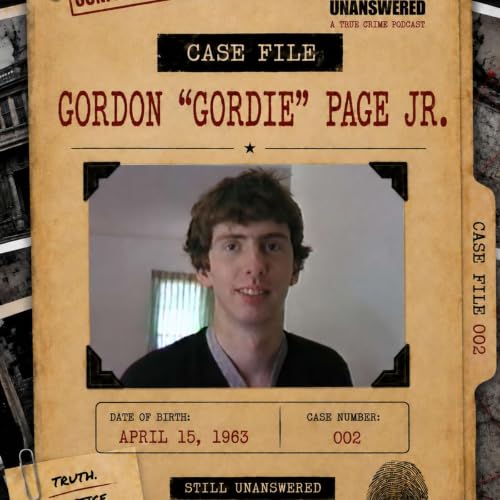
  • Still Unanswered- Gordon “Gordy” Page Jr.: Vanished from Grand Rapids
    2026/10/22

    In May 1991, 28-year-old Gordon “Gordy” Page Jr. disappeared from a residential home in Grand Rapids, Michigan.

    Gordy had been misdiagnosed with schizophrenia before later being recognized as autistic. He possessed an extraordinary memory—especially for baseball—and had amassed a collection of tens of thousands of baseball cards. Days before his disappearance, his father visited him at the home. When it was time for him to leave, Gordy desperately tried to follow. His father drove away with a decision he would regret for the rest of his life. Four days later, Gordy was gone.

    A possible sighting placed him hitchhiking toward Interstate 96. Weeks later, baseball cards believed to have belonged to Gordy were discovered beneath an I-96 overpass—including cards connected to some of his favorite players. But the trail ended there. More than three decades later, Gordy has never been found.

    Before hearing any of that history, David Zarza was given only Gordy’s name, birth date, and photograph. During his intuitive reading, David described a tall, lanky man with an intensely organized yet repetitive mind, a strong attachment to family, and images connected to sports cards. He also described someone leaving a residential setting, wandering for years, surviving largely on his own, and eventually traveling far from where his journey began.

    Then Theresa reveals the documented history—and the similarities begin to emerge.

    Where did Gordy go after leaving Grand Rapids? Who might have encountered him along the way? And could the clues left behind point toward a final destination no one has yet searched?

    Some stories end. Some questions don’t. This is Still Unanswered.

    David’s intuitive impressions are personal perceptions and are not presented as fact or evidence. Nothing discussed in this episode should be interpreted as an accusation or determination of guilt.

    Support the show

    Still Unanswered
    Evidence meets intuition.
    Hosted by David Zarza & Theresa Michaels.

    Explore cases, episodes & more at StillUnansweredPodcast.com
    Follow: @stillunansweredpodcast (Instagram & Facebook)

    Have a case you think we should investigate? Visit the website to get in touch or email directly contact@stillunansweredpodcast.com

    続きを読む 一部表示
    49 分