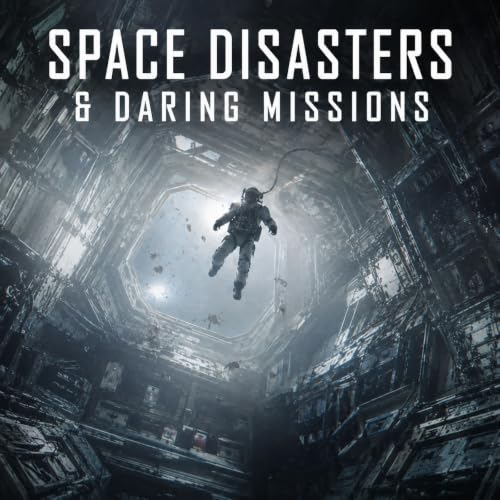
『Space Disasters & Daring Missions』のカバーアート

Space Disasters & Daring Missions

Space Disasters & Daring Missions

著者: OBOMEDIA ENTERTAINMENT
無料で聴く

Space has swallowed careers, missions, and men whole, leaving behind bolts, checklists, and a few surviving voices who know exactly how close the silence came. This show digs through NASA archives, mission transcripts, and the quiet testimony of astronauts to rebuild what actually happened when the plan fell apart forty miles above Earth or a quarter million miles toward the Moon.

Each episode is one complete, reconstructed story, told without a host standing between you and the record. A skull rides shotgun on Hubble's highest orbit. A 121-pound cap gets bolted onto a spacecraft that still won't reveal where it's leaking. A navigator with no instruments steers by starlight to bring Apollo 13 home. A surgeon performs emergency repairs on a live solar array with no operating room and no second attempt. These are not summaries — they are minute-by-minute accounts built from flight logs, radio chatter, and the private memories of the people who lived through space disasters that never made the headlines they deserved.

The show moves through the full arc of American spaceflight: the astronauts denied their missions for reasons buried in politics, the men who crossed space three times and still never got their wings, the geologists who proved the Moon itself had lied about a mountain's identity. It is NASA history told through the human cost of ambition — the near-misses, the improvised fixes, the decisions made in seconds that took decades to fully explain.

If you want space history that reads like a thriller because it actually was one, subscribe now. New episodes arrive weekly, each one a self-contained descent into a mission that almost didn't make it back.Copyright OBOMEDIA ENTERTAINMENT
天文学 天文学・宇宙科学 科学
エピソード
  • The tiny reserve of propellant that nursed the satellite back to orbit in time
    2026/10/30
    A $100M satellite tumbles into the wrong orbit after Challenger’s launch, and a tiny propellant reserve is the last hope - did they make it in time?

    The tiny reserve of propellant that nursed the satellite back to orbit in time

    In this episode, we follow the maiden flight of Space Shuttle Challenger and the crisis that unfolded when TDRS‑1 ended up in a wrong, low elliptical orbit. The story tracks the decisions, technical failures, and the burn-by-burn effort that relied on an unexpected propellant margin-could that small reserve save the mission?

    Date: April 4, 1983
    Vehicle: Space Shuttle Challenger
    Payload: TDRS‑1 (Tracking and Data Relay Satellite)
    Mass: 2300 kilograms
    Cost: $100 million

    - Challenger rolled out to Launch Complex 39A on December 8, 1982, as the second orbiter in the Shuttle fleet.
    - Pre-flight engine firings in December and January revealed hydrogen leaks and cracked low-pressure ducting, forcing multiple engine removals and replacements.
    - A February storm contaminated TDRS‑1 in the Payload Changeout Room, requiring the satellite to be returned for cleaning and delaying the schedule.
    - Challenger’s crew-Weitz, Bobko, Peterson, and Musgrave-were on their first shuttle flight, with Musgrave and Peterson slated for the first US spacewalk in nearly a decade.
    - After TDRS‑1 deployed and its Inertial Upper Stage ignited, the booster began tumbling and losing attitude, burning propellant off-target while teams on the ground weighed whether a small onboard reserve could salvage the satellite.

    To listen to this podcast ad-free and access premium episodes, try our subscription with a 14-day free trial at obomedia.com.

    © 2026 OBOMEDIA. All rights reserved.
    This episode and its content (audio, text, and related materials) are the exclusive property of OBOMEDIA and are protected by applicable copyright laws. Reproduction, distribution, editing, or commercial use, in whole or in part, without prior written permission from OBOMEDIA is prohibited. For permissions, licensing, and business inquiries: business@obomedia.com.
    続きを読む 一部表示
    19 分
  • The fifty‑foot robotic arm gripped Zarya - and the station's fate ticked down
    2026/10/29
    A fifty-foot robotic arm must catch Zarya as it drifts in orbit-one astronaut on the controls; did she make it in time?

    The fifty‑foot robotic arm gripped Zarya - and the station's fate ticked down

    In this episode, we follow the tense, technical moment when the shuttle Endeavour attempted the first on-orbit assembly of the International Space Station. It covers the lead-up to the capture of Zarya, the stakes of millimeter-level alignment, and the decisions that had to be flawless in orbit-could one operator bring it home?

    Person: Nancy Currie-Gregg
    Date: December 7, 1998
    Location: Low Earth orbit, ~220 miles above Earth
    Event: STS-88 capture and mating of Zarya and Unity
    Module: Zarya (first ISS module)

    - A fifty-foot Canadarm, operated by one astronaut, had to capture Zarya while both vehicles moved at 17,000 mph.
    - Zarya had launched 11 days earlier on a Russian Proton and floated ahead with its docking port aimed at the arm.
    - Endeavour closed 4.7 million miles of orbital path over two days to position for the delicate capture.
    - The docking required millimeter-level alignment; a single degree off could puncture pressure vessels and scatter debris.
    - Nancy Currie-Gregg brought Army helicopter experience, safety and industrial engineering training, and thousands of flight hours to the moment.

    To listen to this podcast ad-free and access premium episodes, try our subscription with a 14-day free trial at obomedia.com.

    © 2026 OBOMEDIA. All rights reserved.
    This episode and its content (audio, text, and related materials) are the exclusive property of OBOMEDIA and are protected by applicable copyright laws. Reproduction, distribution, editing, or commercial use, in whole or in part, without prior written permission from OBOMEDIA is prohibited. For permissions, licensing, and business inquiries: business@obomedia.com.
    続きを読む 一部表示
    22 分
  • The Valve That Lost Fuel and Cost Nozomi Its Mars Window
    2026/10/28
    A failed propulsion valve left Nozomi drifting after its missed 1999 Mars window - did controllers make Mars in time?

    The Valve That Lost Fuel and Cost Nozomi Its Mars Window

    In this episode, we follow the sequence that turned a precise Mars transfer into a multi‑year odyssey. The story covers the launch, the Earth flybys, the valve failure during the bipropellant burn, and the long rescue plan that hinged on gravity assists and surviving deep space - can calculated patience recover what one valve took?

    Person: Nozomi
    Date: Launch July 4, 1998; planned Mars arrival October 11, 1999
    Location: Earth flybys and heliocentric drift en route to Mars
    Event: Valve malfunction during Earth flyby bipropellant burn causing uncontrolled fuel loss
    Status: Mission trajectory revised to use additional Earth gravity assists and a multi‑year drift

    - Launched July 4, 1998, Nozomi carried 540 kg total mass including 282 kg of propellant dedicated to precise burns.
    - The mission used two lunar swingbys and an Earth atmosphere skim to build velocity with minimal fuel expenditure.
    - During the December 20, 1998 Earth flyby burn a valve in the bipropellant system failed, allowing uncontrolled fuel loss mid‑burn.
    - Controllers attempted correction burns on December 21 that consumed additional propellant and left the spacecraft underfueled for the original October 1999 arrival.
    - Engineers replanned a rescue using a four‑year heliocentric drift and two more Earth flybys in 2002 and 2003 to rebuild velocity by gravity assists.

    To listen to this podcast ad-free and access premium episodes, try our subscription with a 14-day free trial at obomedia.com.

    © 2026 OBOMEDIA. All rights reserved.
    This episode and its content (audio, text, and related materials) are the exclusive property of OBOMEDIA and are protected by applicable copyright laws. Reproduction, distribution, editing, or commercial use, in whole or in part, without prior written permission from OBOMEDIA is prohibited. For permissions, licensing, and business inquiries: business@obomedia.com.
    続きを読む 一部表示
    20 分
adbl_web_anon_alc_button_suppression_t1
まだレビューはありません