エピソード

  • Accreditation in a Time of Change
    2026/09/22

    Kent Barnds: “Welcome to Small College America, a podcast dedicated to exploring the role and value of small colleges in the higher education landscape. I'm Kent Barnds, Executive Vice President of Augustana College, and I’m joined by my co-host Dean Hoke, Co-Founder of Edu Alliance Group.”

    Dean: Today, we’re joined by Dr. Heather F. Perfetti, President of the Middle States Commission on Higher Education. Heather has served as a faculty member, chief academic officer, accreditation peer evaluator, and in several leadership roles at Middle States before becoming President in 2020. She has also been actively involved in national accreditation policy and federal rulemaking.

    Heather, welcome to Small College America. I understand that when you're not thinking about accreditation, the Delaware beaches—and two Chihuahuas—provide a pretty good change of pace.


    Kent: Question 1: Heather’s Journey — Seeing Accreditation From Both Sides

    Heather, before we get into some of the major changes taking place in accreditation, I’d like our audience to know a little more about you. You’ve been a faculty member, a chief academic officer, a peer evaluator, and now president of Middle States. How have those different experiences shaped the way you think about accreditation and what institutions need from an accreditor?


    Dean: Question 2: The Changing Accreditation Landscape — Why Middle States Left C-RAC

    Recently, Middle States announced it is leaving the Council of Recognized Accrediting Commissions, to to pursue broader partnerships. Can you tell our audience more about the Council of Recognized Accrediting Commissions and why you and Northwest decided to withdraw now?

    Kent: Question 3: Federal Rulemaking — How Significant Are These Changes?

    You participated in the federal negotiated rulemaking process, and we now have proposed regulations that could significantly change accreditation. When you look at the entire package — student outcomes, transfer credits, faculty oversight, institutional costs, and changes affecting accreditors themselves — which provisions concern you most, and which might actually improve the system?

    Dean: Question 4: Financial Stress — When Should the Accreditor Enter the Conversation?

    Small colleges are dealing with declining enrollment, tighter margins, and in some cases serious financial stress. From an accreditor’s perspective, what are the warning signs that an institution may be moving from financially challenged to genuinely at risk?

    Kent: Question 5: Mergers and Partnerships — The Part People Underestimate

    When we met, you made an interesting point: the legal transaction in a merger can actually be the relatively straightforward part. The more difficult work can be integrating services, curricula, and institutional cultures while honoring each institution’s legacy. What role does an accreditor play in helping institutions navigate that process?

    Dean: Question 6: Five Years From Now — What Does Accreditation Become?

    Let’s close by looking ahead. Five years from now, with more competition among accreditors, new federal requirements, AI, changing demographics, new credentials, and continuing financial pressure on institutions, how different do you think accreditation will look from what we know today?

    Closing

    Kent: Heather, thank you for joining us and for helping us better understand both the changing role of accreditation and what those changes mean for small colleges. We appreciate your perspective and your time.

    For those listening or viewing, visit www.smallcollegeamerica.net to learn more about Small College America, find past and upcoming episodes, leave comments, and to subscribe.

    Dean: On behalf of our guest, Heather Perfetti, my co-host, Kent Barnds, and me, thank you for joining us.


    続きを読む 一部表示
    34 分
  • Mergers, Acquisitions and Reinvention: What Small Colleges Need to Know
    2026/09/15

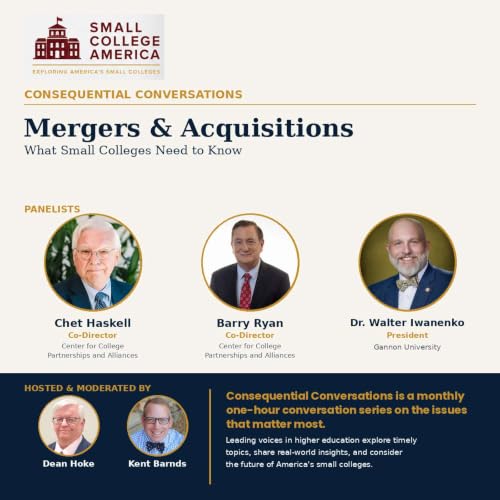
    Welcome everyone to this special edition of Small College America and the first of our Consequential Conversations series. I’m Dean Hoke, and I’m joined by my co-host Kent Barnds. Today’s conversation is “Mergers, Acquisitions and Reinvention: What Small Colleges Need to Know.”Mergers and partnerships are no longer subjects that small colleges can afford to discuss only when they are in trouble. Today we want to look at when institutions should begin considering their options, what makes these efforts work, what can cause them to fail, and what presidents and boards need to know before circumstances narrow their choices.

    We have three panelists who bring both direct institutional experience and extensive work with colleges considering partnerships, mergers, acquisitions, and other forms of reinvention. Let me briefly introduce them:

    • Chet Haskell, Co-Director of the Center for College Partnerships and Alliances, brings extensive higher education leadership and experience with institutional partnerships, mergers, and acquisitions.

    • Barry Ryan, Co-Director of the Center for College Partnerships and Alliances, has worked with institutions on partnerships, mergers, acquisitions, and other strategic options for colleges facing change.

    • Dr. Walter Iwanenko, President of Gannon University, has spent more than two years leading the Gannon-Ursuline College merger and brings the perspective of a sitting president navigating the process in real time.

    Question 1 - When Should the Conversation Begin? One of the themes we want to explore today is timing. If an institution waits until it needs a merger or partnership to survive, has it already waited too long? What signs should tell a president and board that it is time to begin seriously exploring strategic partnerships, mergers, or other alternatives?


    Question 2 - The Gannon-Ursuline Experience. Walter, you have been living this process for more than two years. Take us inside the Gannon-Ursuline merger. What brought the two institutions to the table, what made you believe the combination could work, and what have been the most important lessons so far? Barry, from your experience, what stands out to you about the conditions that make a merger like this possible?


    Question 3 - A Merger Is Not the Only Option. When people hear that a small college is considering collaboration, they often jump immediately to merger or closure. But there is a much broader range of possibilities. What options should institutions be considering before a full merger, and how does a college determine which level of partnership or integration best fits its circumstances?


    Question 4 - Boards, Presidents, Mission and Culture. These decisions are about more than finances. They involve governance, institutional identity, mission, alumni, faculty, staff, and community. What roles should the president and board play in beginning and managing these conversations, and how do you protect mission and culture while still being willing to make significant change?


    Question 5 - Why Promising Partnerships Fail. Not every promising partnership or merger succeeds. From what you have seen, what are the most common reasons these efforts break down? Are the biggest obstacles financial, cultural, governance-related, personality-driven, timing—related, or something else?


    Question 6 - What Should Leaders Do Now? Let’s close the main discussion by looking forward. If you were speaking privately with a president or board chair of a small college that is stable today but concerned about the next five to ten years, what would you tell them to be doing now to preserve the greatest number of options for the institution’s future?

    Question 7 - Quick Insights. I’d like each of you to give us one brief answer. What is one thing you wish more presidents and trustees understood about mergers, partnerships, or institutional reinvention? Please keep it to about 60 seconds each.

    Additional Questions from Audience

    Close

    続きを読む 一部表示
    49 分
  • HigherEd PodCon Announces Finalists for Inaugural Higher Education Podcasting Awards
    2026/05/18

    HigherEd PodCon today announced the finalists for its inaugural HigherEd PodCon Awards, recognizing outstanding achievement across five categories in higher education podcasting. The announcement marks a significant milestone for the growing community of educators, administrators, students, and independent creators who are using audio storytelling to advance the mission of higher education.

    Organized by the co-founders of HigherEd PodCon, of which Dean Hoke of Small College America is a co-founder, created the awards program to formally recognize the innovation and impact of higher education podcasting. The response from the community was exceptional: 155 nominations were received, representing the higher education podcast community.


    Outstanding Podcast Series

    “Where What If Becomes What’s Next” (Carnegie Mellon University) - ​R​andy Scott

    “Lab Coat Optional” (Arizona State University Knowledge Enterprise) - Pete Zrioka

    “Policy and Governance Perspectives” (George Mason University) - ​ ​D​avid Ramadan

    Episode of the Year

    “Individual Choices, Challenges, and Social Changes” Series: Good Is In The Details - Gwendolyn Dolske (Cal Poly Pomona) and Rudy Salo (Chapman University)

    “Sounds of College Life with Stage Left” Series: Sounds of College Life Podcast, (Miami University) - Maggie Snee

    “Rest Matters” (Worcester Polytechnic Institute) - Colleen Wamback featuring Stacy Shaw.

    Outstanding Student-Led Podcast

    “Major Insight” (Miami University) - Submitted by James Loy

    “The Bridge” (University College London) - Submitted by Indianna Dimmer

    “Madison Science Mystery Tour” (WSUM, University of Wisconsin–Madison) Submitted by Nalina Cherr

    “Curing the Curriculum: Students’ Take on Medical Education” (University of Groningen, Netherlands) - Submitted by Ulf Ebeling

    Podcaster of the Year

    Garret Castleberry, (Mid-America Christian University) - Host of “Special Topics in Media”

    Kimberlé Crenshaw, (Columbia Law School and UCLA School of Law) - Host of “Intersectionality Matters!”

    Lolita Cummings, (Eastern Michigan University) - Host of “Enlighten U”

    ​Kate Young, (Purdue University) - Host of “This Is Purdue”

    Outstanding Institutional Podcast Network

    Dragon Podcasts (Howard Community College)

    This Is UIC Podcast Network (University of Illinois Chicago)

    Wharton Podcast Network (Wharton School, University of​ Pennsylvania)

    LCC Connect — (Lansing Community College)

    About HigherEd PodCon

    HigherEd PodCon is the premier conference dedicated to podcasting in higher education. The event brings together creators, educators, communications professionals, and institutional leaders to share best practices, explore innovation, and celebrate the power of audio storytelling in advancing higher education’s mission.

    Award winners will be announced at HigherEd PodCon 2026, taking place July 16–17 in Cleveland, Ohio at Cuyahoga Community College. For more information and to register, visit www.higheredpodcon.com.

    続きを読む 一部表示
    13 分
  • Inside the Crisis Facing Small Colleges with Jon Marcus
    2026/05/05

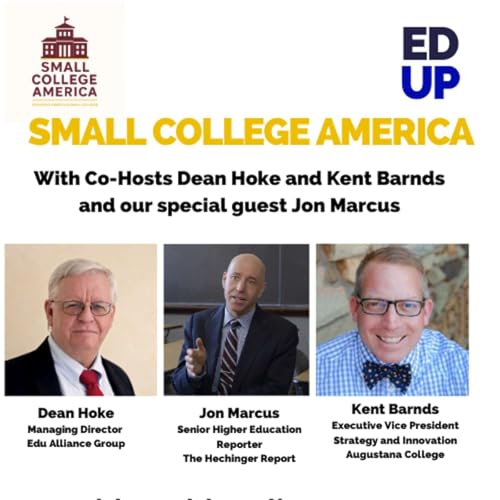
    Welcome to Small College America, a podcast dedicated to exploring the role and value of small colleges in the higher education landscape. I'm Kent Barnds, Executive Vice President of Augustana College, and I’m joined by my co-host Dean Hoke, Co-Founder of Edu Alliance Group.


    Today, we’re joined by Jon Marcus, a senior higher education reporter at The Hechinger Report, whose recent reporting has helped bring national attention to a sobering reality: hundreds of small private colleges may be at risk of closure or merger in the years ahead.

    His reporting has appeared widely, including on NPR, The Washington Post, and The New York Times, and he co-hosts the higher education podcast College Uncovered.

    In addition to his reporting, Jon teaches journalism at Boston College and holds a master’s degree in journalism from Columbia University.

    Jon, welcome to Small College America, and by the way, if you are not aware, The Report is an outstanding independent nonprofit news organization based at Columbia University.

    Question 1:

    Kent: Jon, let’s start with your April 13 reporting on the projection that 442 private colleges are at risk of closing or merging over the next decade. That’s a striking number. When you reported that, did it surprise you, and what does it really tell us about where higher education is right now?


    Question 2:

    Dean: Jon you started that article with Sterling College, which is closing this year. Taken on its own, Sterling—with enrollment falling from about 150 students to around 40 may not be entirely surprising. But it’s now the seventh private college in Vermont to close since 2016.

    When you zoom out and looking at the bigger picture, how should we be thinking about the broader impact of these closures, not just on students, but on the communities that rely on these institutions?


    Question 3:

    Kent: You’ve noted that about 20% of college leaders have had serious merger discussions. From what you’ve seen, are institutions still too hesitant to pursue partnerships or mergers early enough, and what gets in the way of acting sooner?


    Question 4:

    Dean: Jon, let me put you in a different seat. Suppose you’re invited to speak at a board retreat for a small private college. Based on everything you’ve reported, what would you want those trustees and that president to understand, and what would you urge them to do?


    Question 5:

    Kent: At some point, this becomes a consumer decision. From your reporting, are parents still convinced small colleges are worth it, or is the conversation now primarily about price?


    Question 6:

    Dean: Looking out five to ten years, with the demographic cliff, declining college-going rates, and growing skepticism about value, how do you see the landscape for small private colleges evolving? Are we headed toward continued contraction—or something more transformative?


    Closing Kent: Jon, this conversation is a reminder that beyond the data and projections are real people navigating uncertainty and difficult choices. Your reporting helps us better understand those realities. Thank you for your perspective, your clarity, and for the important work you do.

    For those listening or viewing, if you'd like to learn more about Small College America, go to our web page at www.smallcollegeamerica.net, where you can find details on upcoming episodes, contact us, and suggest topics you’d like us to cover. Also, I encourage you to subscribe to our series on your favorite podcast network,

    This episode of Small College America is made possible with underwriting support from Edu Alliance Group — a higher education consulting firm that champions small colleges and the communities they serve.And if your college or university is involved in podcasting, be sure to check out HigherEd PodCon, coming to Cleveland, Ohio, on July 16th and 17th. It's a wonderful opportunity for professional development and networking with others doing this work in higher education. Visit www.higheredpodcon.com for details.

    On behalf of our guest, Jon Marcus, my co-host Dean Hoke, and I, thank you for joining us.

    続きを読む 一部表示
    30 分
  • Inside the Provost’s Office: Leading Small Colleges Through Change
    2026/04/28

    Welcome to Small College America, a podcast dedicated to exploring the role and value of small colleges in the higher education landscape. I’m Dean Hoke, Co-Founder of Edu Alliance Group, and I’m joined by my co-host, Kent Barnds.

    Joining us today is Leamor Kahanov, who serves as Provost and Senior Vice President at Alvernia University, a private Franciscan institution in Reading, Pennsylvania. A scholar, administrator, and academic strategist with more than 25 years of experience as a provost, dean, and professor, Dr. Kahanov has also served as Provost at Stockton University and SUNY Oneonta, before joining Alvernia in August 2023.

    Her scholarly credentials are remarkable, with more than 90 peer-reviewed publications, 120 peer-reviewed presentations, a textbook on athletic training and therapy, and she is co-host of EdUp Accreditation Insights, a nationally recognized podcast that has won EdTech Chronicle’s Best in Education award two years running, where she brings a working provost’s lens to the complex world of accreditation.

    Before her career in academic administration, she served as a certified athletic trainer, including at the Olympic Games. She earned her doctorate from the University of San Francisco and completed the Institute for Management and Leadership in Education at Harvard University. Welcome to the show, Leamor.

    Reminder: For those listening or viewing, if you’d like to learn more about Small College America, go to our web page at www.smallcollegeamerica.net, where you can find details on upcoming episodes, contact us, and suggest topics you’d like us to cover. Also, I encourage you to subscribe to our series on your favorite podcast network. This episode of Small College America is made possible with underwriting support from Edu Alliance Group — a higher education consulting firm that champions small colleges and the communities they serve. And if your college or university is involved in podcasting, be sure to check out HigherEd PodCon, coming to Cleveland, Ohio, on July 16th and 17th. It’s a wonderful opportunity for professional development and networking with others doing this work in higher education. Visit www.higheredpodcon.com for details.

    続きを読む 一部表示
    31 分
  • Inside Financial Aid: Strategy, Access, and the Future for Small Colleges
    2026/04/21
    Welcome to Small College America, a podcast dedicated to exploring the role and value of small colleges in the higher education landscape. I'm Dean Hoke, Co-Founder of Edu Alliance Group, and I’m joined by my co-host, Kent Barnds, Executive Vice President of Augustana College. Kent: Joining us today is Maximo Flint-Morgan, MBA, who serves as Director of Financial Aid at Le Moyne College, a private Jesuit institution in Syracuse, New York, where he has led the financial aid office within the Division of Enrollment Management since February 2021. A Syracuse-area professional with a broad background spanning higher education, nonprofit work, and business, Maximo previously served as Associate Director of Financial Aid at Syracuse University, where he developed and managed comprehensive communications strategies for financial aid services.Deeply committed to the profession, he is an active contributor to the New York State Financial Aid Administrators Association, supporting training and professional development for aid officers across the state. He is also a frequent speaker to students and families, offering practical guidance on FAFSA completion, scholarships, and financial planning. Outside the office, Maximo is a devoted dad with a passion for soccer and world music. Welcome to the show, Maximo.Question 1: Finding the Path — Career Journey & Role TodayDean: Maximo, your path to financial aid wasn't exactly a straight line — how did you first find your way into this work? And give us a sense of what your role looks like today at Le Moyne. Question 2: Beyond the Paperwork — What Financial Aid Really IsKent: When families think of 'financial aid,' they often think of paperwork. What are they missing about the actual work your office does? Question 3: Mission vs. Market — Aid Strategy at a Jesuit CollegeDean: Le Moyne is a private Jesuit institution with a commitment to access, but financial aid today is also deeply strategic. How much of what your office does is formula versus strategy?Question 4: FAFSA, Federal Policy & the Turbulence of ChangeKent: FAFSA has been through significant turbulence in recent years. From your seat at a small private college, what's working, and what's not?Question 5: Student Mindset & Practical Advice for FamiliesDean: Are today's students and families approaching college financing differently than even five years ago, and if you were sitting across from a family with a high school junior right now, what are the two or three things you'd tell them to do today?Possible Follow-up: How should families think about borrowing responsibly? Is there a way to reframe student loans that you find resonates with families?Question 6: Closing — The Future QuestionKent: Looking out five to ten years, with demographic shifts, the FAFSA's evolution, growing skepticism about the value of a college degree, and the financial pressures facing private institutions, how do you see the future of financial aid unfolding? And what role do small private colleges like Le Moyne play in that future?ClosingDean: Maximo, this conversation is a reminder that behind every financial aid office is someone who genuinely cares whether students get to the starting line. Thank you for your candor, your expertise, and for the work you do at Le Moyne every day."For those listening or viewing, if you'd like to learn more about Small College America, go to our web page at www.smallcollegeamerica.net, where you can find details on upcoming episodes, contact us, and suggest topics you’d like us to cover. Also, I encourage you to subscribe to our series on your favorite podcast network,This episode of Small College America is made possible with underwriting support from Edu Alliance Group — a higher education consulting firm that champions small colleges and the communities they serve.And if your college or university is involved in podcasting, be sure to check out HigherEd PodCon, coming to Cleveland, Ohio, on July 16th and 17th. It's a wonderful opportunity for professional development and networking with others doing this work in higher education. Visit www.higheredpodcon.com for details.On behalf of our guest, Maximo Flint-Morgan, my co-host Kent Barnds, and I, thank you for joining us.
    続きを読む 一部表示
    33 分
  • Cybersecurity, AI, and the Future of Small Colleges with Irv Bruckstein
    2026/04/14
    Kent Barnds: “Welcome to Small College America, a podcast dedicated to exploring the role and value of small colleges in the higher education landscape. I’m Kent Barnds, and I’m joined by my co-host, Dean Hoke.”Dean: Joining us today is Irving “Irv” Bruckstein, a transformational technology executive with more than three decades of experience across higher education, enterprise IT, and cybersecurity. He most recently served as Chief Information Officer at Washington College, where he rebuilt IT operations following a ransomware incident, modernized infrastructure, and led major initiatives in cybersecurity, digital transformation, and online learning.Irv is now the incoming CEO of CyberAI Group, where he is focused on advancing AI-driven cybersecurity solutions and helping organizations strengthen resilience in an evolving threat landscape. Known for building high-performing teams and aligning technology with strategic outcomes, he brings a pragmatic, results-oriented approach to leadership. He holds a B.S. in Computer Science and Mathematics and an M.S. in Cybersecurity from Hofstra University’s DeMatteis School of Engineering. Irv, welcome to Small College America. Question 1: From Big Campuses to Small CollegesKent: Irv, your career includes some of the largest institutions in the country — Columbia University, NYU, where you helped build an entire campus from the ground up in Abu Dhabi. At some point you made a deliberate move toward smaller colleges. What drew you in that direction, and what surprised you most when you got there?Follow-ups:• What can a small college CIO do that a large university CIO simply can’t?Question 2: Walking Into the AftermathDean: Irv, when you arrived at Washington College in January 2024, the institution was still dealing with the fallout of a serious ransomware attack that had occurred about a year earlier. You were essentially brought in to rebuild. Walk us through what you found when you got there, and how you approached turning things around.Follow-ups:• What was the hardest conversation you had with college leadership in those early weeks?Question 3: The Small College Cybersecurity GapKent: Small colleges are often described as "target-rich, resource-poor" when it comes to cybersecurity; they hold enormous amounts of sensitive student data but rarely have the staffing or budget of a large research university. In your experience, do most small college presidents truly understand the cyber risk their institution faces, and should the CIO have a genuine seat at the leadership table?Question 4: AI on Campus — Promise and PerilDean: You’ve been thinking about AI in higher education since at least 2019, when you co-hosted a symposium at Salve Regina about adaptive learning and AI-driven student outcomes. Now AI is everywhere. What should a small college realistically be doing with AI today — and where do you see institutions getting into trouble?Question 5: Crossing to the Other Side of the TableKent: You’ve recently made a significant shift, from being a buyer and implementer of technology inside higher education to now building cybersecurity products at CyberAI Group. What does the view look like from that side? And what do you wish technology vendors understood better about what small colleges actually need?Question 6: Closing — The Road AheadDean: Last question, Irv — and we ask this of everyone on the program. Looking five to ten years out, what does the small college that’s getting technology right actually look like? And what’s at stake for the institutions that don’t get there?Closing Kent: Irv, thank you for a conversation that I think will stay with our listeners. The work of protecting a campus — its people, its data, its future, often happens invisibly, and you’ve helped make it visible today. We’re grateful for your time and your candor.For those listening or viewing, if you’d like to learn more about Small College America, go to our web page at www.smallcollegeamerica.net, where you can find details on upcoming episodes, contact us, and suggest topics you’d like us to cover. Also, I encourage you to subscribe to our series on your favorite podcast network.This episode of Small College America is made possible with underwriting support from Edu Alliance Group, a higher education consulting firm that champions small colleges and the communities they serve.On behalf of our guest, Irving Bruckstein, my co-host Dean Hoke, and I, thank you for joining us.
    続きを読む 一部表示
    30 分
  • Rooted in Mission, Reaching the World: Rebecca Stoltzfus at Goshen College
    2026/04/07

    Welcome to Small College America, a podcast dedicated to exploring the role and value of small colleges in higher education. I’m Kent Barnds, at Augustana College, and I’m joined by my co-host, Dean Hoke.


    Our guest today is Dr. Rebecca J, Stoltzfus, the 13th president of Goshen College in Goshen, Indiana. Rebecca became president in 2017 after serving as Vice Provost for Undergraduate Education and Professor of Human Nutrition at Cornell University. Earlier in her career, she taught at the Johns Hopkins Bloomberg School of Public Health, and her research has focused on the causes and consequences of malnutrition among women and children in low-income countries.

    Rebecca’s connection to Goshen runs especially deep. She is a 1983 graduate of the college, as is her husband Kevin, and her father, Victor, also served as president of Goshen College from 1984 to 1996.

    After a career that included global research and leadership at major research universities, she returned to lead her alma mater, bringing both an international perspective and a personal commitment to the college’s mission.

    Rebecca, welcome to Small College America. We’re delighted to have you with us today.

    Q1: Goshen College Today - Rebecca, tell us about Goshen College. How would you describe the student body and mission of Goshen College today, and how have the changing demographics of the region influenced the college’s identity and recruitment strategy?


    Q2: Liberal Arts in a Manufacturing Economy - Northern Indiana is one of the country’s most dynamic manufacturing regions, particularly around the RV industry in Elkhart County.

    Q3: Faith, Mission, and Inclusion - Goshen College is rooted in the Mennonite tradition, which emphasizes peacebuilding, service, and community. At the same time, the student body today is quite diverse and includes many students who are not Mennonite. How does the college maintain that faith-based mission while welcoming students from many backgrounds, and how does that identity show up in the student experience?


    Q4: Global Learning and Experiential Education - One of Goshen’s most distinctive programs is the Study-Service Term, which I believe has existed since the mid to late 1960”. Goshen sends students around the world for immersive cross-cultural experiences. In a time when many colleges are emphasizing internships and workforce readiness, why has Goshen remained committed to global service learning, and what impact do you see it having on students?


    Q5: Town and Gown - Goshen is both a manufacturing center in northern Indiana and a vibrant small city with strong civic engagement and a growing multicultural population. How would you describe the relationship between Goshen College and the city, and how does the college contribute to the community and regional economy?


    Q6: Looking Ahead - Rebecca, looking into the future, what capabilities do you believe small colleges like Goshen must strengthen now to remain resilient and relevant? - and as you think about Goshen specifically, what gives you the greatest confidence about the college’s future?


    Closing - Rebecca, thank you for joining us today and for sharing your insights about leading Goshen College — a place with deep roots, a distinctive mission, and a meaningful role in its community.

    For those listening or viewing, if you'd like to learn more about Small College America, visit our website at www.smallcollegeamerica.net, where you can find details on upcoming episodes, contact us, and suggest topics you’d like us to cover.

    This episode of Small College America is made possible with underwriting support from Edu Alliance Group — a higher education consulting firm that champions small colleges and the communities they serve.

    On behalf of our guest, President Rebecca Stoltzfus, my co-host Dean Hoke, and I, thank you for joining us.

    続きを読む 一部表示
    26 分