• AWS Retires DevOps Guru: What the End of Support Means, Kubernetes Cross-Namespace CVE-2026-2270, Node.js Undici WebSocket DoS & Cloudflare’s New CLI for AI Agents
    2026/10/01

    This week on Ship It Weekly: AWS is retiring Amazon DevOps Guru and pointing customers toward CloudWatch and the newer Amazon DevOps Agent. Kubernetes disclosed a vulnerability where StatefulSet and ControllerRevision permissions can allow cross-namespace pod creation under specific conditions. A vulnerability in Undici can let a malicious WebSocket server crash a Node.js process through compressed data. And Cloudflare launched a new CLI as AI agents grow from 25 percent to 48 percent of Wrangler usage.

    The bigger theme this week is how the systems around our infrastructure are changing. Managed cloud services still have lifecycles that eventually become migration work. Kubernetes authorization can depend on what controllers do with the resources users are allowed to manipulate. Applications acting as clients still process untrusted data. And infrastructure tooling is starting to treat AI agents as first-class users rather than humans who happen to automate commands.

    In the lightning round: another Kubernetes vulnerability affecting Windows nodes can expose NetNTLMv2 credentials through NTLM coercion. GitHub now supports custom runners for Dependabot version and security updates. And external systems like a CMDB or internal developer portal can push repository properties into GitHub while remaining the source of truth.

    And the human closer comes from Lorin Hochstein and SRE Weekly. Some availability risks are probably never going away. Resources are finite, networks fail, security controls can affect availability, and production systems have to change. Preventing individual failures still matters, but incident response is part of reliability engineering too. Sometimes improving reliability means getting better at handling the failures you cannot eliminate.

    Links

    Amazon DevOps Guru End of Support - https://tsn.io/GQHN8

    Kubernetes CVE-2026-2270: Cross-Namespace Pod Creation - https://tsn.io/BsNs8

    Undici CVE-2026-85024: WebSocket Denial of Service - https://tsn.io/LncLd

    Cloudflare: Introducing the cf CLI - https://tsn.io/Wk3ma

    Cloudflare Forge - https://tsn.io/bAPJu

    Lightning Round

    Kubernetes CVE-2026-76654: Windows NTLM Coercion - https://tsn.io/36Kc3

    GitHub: Custom Runners for Dependabot - https://tsn.io/tYl9K

    GitHub: External Custom Properties - https://www.tellerstech.com/go/s-1fd1396d/

    Human Closer

    Omnipresent Availability Risks in Cloud Software - https://www.tellerstech.com/go/s-076db9dd/

    Our Links

    This Week’s On Call Brief - https://tsn.io/fKB9V

    Ship It Weekly - https://tsn.io/NqkdP

    On Call Brief - https://tsn.io/Gpz2d

    続きを読む 一部表示
    17 分
  • AWS Puts Elastic Beanstalk on EKS, CrowdSec Supply-Chain Breach, Critical Next.js RCE, Microsoft Disrupts EvilTokens & Why Fixing the Initial Compromise Isn’t Enough
    2026/09/25

    This week on Ship It Weekly: AWS introduced Elastic Beanstalk Cluster Mode, allowing multiple applications to run on shared EKS infrastructure while AWS handles much of the Kubernetes complexity. CrowdSec published how a software supply-chain compromise led to attackers copying roughly 170 private repositories using a stolen OAuth token. A critical Next.js vulnerability in ImageResponse can lead to remote code execution through attacker-controlled SVG data. And Microsoft disrupted EvilTokens, a cybercrime platform linked to more than 12,000 compromised inboxes across 10,000 organizations.

    The bigger theme this week is what happens after trust has been established. Elastic Beanstalk Cluster Mode puts more infrastructure behind a managed abstraction, but shared infrastructure still means understanding isolation and blast radius. CrowdSec shows how an initial compromise can become a credential problem long after the malicious code is gone. Next.js shows how something as ordinary as generating a social preview image can expose a server-side execution path. And EvilTokens shows how attackers can use valid access to move faster once inside an account.

    In the lightning round: F5 has a critical BIG-IP APM vulnerability under active exploitation. GitHub Enterprise Cloud can now export an inventory of credentials with enterprise access, including PATs, SSH keys, OAuth tokens, and GitHub App credentials. Zyxel patched a vulnerability affecting GS1900 switches. And Veeam Agent for Microsoft Windows has a privilege-escalation vulnerability that can lead to SYSTEM access.

    And the human closer comes back to CrowdSec. Removing the malicious package, patching the server, or reimaging the workstation does not necessarily end the incident. If an attacker already stole an OAuth token, cloud credential, SSH key, session, or registry credential, that access can survive long after the original compromise is gone. Containment means understanding not only how the attacker got in, but what they took with them

    Links

    AWS Elastic Beanstalk Cluster Mode

    https://tsn.io/1xaV7

    CrowdSec Supply-Chain Attack Analysis

    https://tsn.io/7yq2f

    Next.js ImageResponse Security Advisory

    https://tsn.io/8JvHp

    Microsoft: Disrupting EvilTokens

    https://tsn.io/DtbC9

    Microsoft: EvilTokens and Device-Code Phishing

    https://tsn.io/ZzwtD

    F5 BIG-IP APM CVE-2026-94127

    https://tsn.io/sFuKW

    GitHub Enterprise Credential Inventory

    https://tsn.io/7bpMn

    Zyxel GS1900 Security Advisory

    https://www.tellerstech.com/go/s-b2595852/

    Veeam Agent for Microsoft Windows Vulnerability

    https://www.tellerstech.com/go/s-166d3119/

    This Week’s On Call Brief

    https://tsn.io/Nnd8g

    Ship It Weekly

    https://tsn.io/NqkdP

    On Call Brief

    https://tsn.io/Gpz2d

    続きを読む 一部表示
    17 分
  • GitHub Actions Security, Cisco Email Gateway RCE, Helm 3 End-of-Life, Ubuntu 26.04 Runners & Why “Nothing Changed” Is Never the Whole Story
    2026/09/19

    This week on Ship It Weekly: GitHub Actions workflow execution protections are now generally available, giving organizations more control over who and what can trigger individual workflows. Cisco is patching critical vulnerabilities in Secure Email Gateway, including an actively exploited issue that can lead to remote command execution as root. Helm 3 has reached its final minor release and is heading toward end-of-life in February 2027. And GitHub’s ubuntu-latest Actions runner is preparing to move from Ubuntu 24.04 to 26.04.

    The bigger theme this week is infrastructure that changes even when your code does not. GitHub is making CI execution permissions more explicit, Helm teams now have a defined migration deadline, and the ubuntu-latest transition is a good example of how a completely unchanged workflow can suddenly be running in a different environment. Pinning everything forever is not necessarily the answer. The important part is knowing which dependencies are allowed to move and testing those changes deliberately.

    In the lightning round: GitHub Actions checks, workflow runs, and statuses will begin following your configured retention period on October 1. GitHub Advanced Security can now enforce configurations from the enterprise level. GitHub added API support for tracking when self-hosted Actions runner versions lose support. And AI Scan for pull requests can now be used without requiring CodeQL default setup.

    And the human closer starts with a sentence almost every infrastructure engineer has heard during an incident: “But nothing changed.” Maybe nothing changed in the application, but the runner image changed, a dependency moved, a certificate expired, DNS changed, or an external service behaved differently. Latest tags, loose version constraints, external APIs, and even support windows are dependencies. The goal is not to freeze everything forever. It is to avoid accidental mutability, where something can change without the team realizing it was ever allowed to change.

    Links

    GitHub Actions Workflow Execution Protections

    https://tsn.io/fbqif

    Cisco Secure Email Gateway Security Advisory

    https://tsn.io/jX2wk

    Helm 3 End of Life

    https://tsn.io/Ii7jb

    Ubuntu 26.04 GitHub Actions Runners and ubuntu-latest Migration

    https://tsn.io/7IJ9k

    GitHub Actions Retention Changes

    https://tsn.io/idFxy

    GitHub Advanced Security Configuration Enforcement

    https://tsn.io/8vRMx

    GitHub Actions Self-Hosted Runner Lifecycle API

    https://tsn.io/9UhY1

    GitHub Code Scanning AI Scan

    https://tsn.io/ULAVW

    This Week’s On Call Brief

    https://www.tellerstech.com/go/26w38/

    Ship It Weekly

    https://tsn.io/NqkdP

    On Call Brief

    https://tsn.io/Gpz2d

    続きを読む 一部表示
    16 分
  • Amazon Linux 2027, GitHub Actions Cache Security, Secret-Scanning Merge Blocks, N-central CVSS 10 RCE, Karmada Graduation, ShieldCrash, CodeQL ARM64 & When Observability Fails Too
    2026/09/12

    This week on Ship It Weekly: Amazon Linux 2027 enters public preview with kernel 7.1+, SELinux enforcing by default, DNF5, newer language runtimes, AWS-LC, and an x86-64-v3 baseline. GitHub Actions adds explicit cache permissions to reduce cache-poisoning risk. GitHub can now block pull requests from merging when they introduce exposed secrets. And N-able N-central has a critical pre-auth RCE that Huntress says is being actively exploited in the wild.

    The bigger theme this week is catching problems before they turn into incidents. Amazon Linux 2027 gives teams time to test AMIs, bootstrap scripts, agents, Terraform, CloudFormation, and CI/CD before the next platform generation becomes production reality. GitHub’s new cache controls make workflow trust boundaries explicit instead of leaving them implied. And secret-scanning rulesets move credential detection directly into the merge path, where developers can actually act on it.

    In the lightning round: Karmada graduates from the CNCF as multi-cluster and distributed AI scheduling grow, ShieldCrash research claims another Microsoft Defender patch bypass with SYSTEM-level access, CodeQL 2.27 adds native Linux ARM64 support, and Dependabot can now read private GitHub Packages without another personal access token.

    And the human closer is about what happens when observability shares the same failure domain as the thing it is watching. A full disk is bad enough. It gets worse when logs stop writing, monitoring data disappears, and the tools used to diagnose the outage start failing too. The takeaway is not that every monitoring component needs total isolation. It is that you should know what can blind you, and make sure at least one useful signal survives the failures you care about most.

    Links

    Amazon Linux 2027 Public Preview

    https://tsn.io/NHlEa

    Amazon Linux 2027 Overview and Preview Details

    https://tsn.io/izDYx

    Amazon Linux 2027 Known Issues and Preview Limitations

    https://tsn.io/tdugd

    GitHub Actions Cache Permissions with cache-mode

    https://tsn.io/8p94n

    Block Pull Requests with Exposed Secrets from Merging

    https://tsn.io/BspA2

    N-able N-central 2026.3 Hotfix 4

    https://tsn.io/xredG

    Huntress: N-able N-central Vulnerability and Active Exploitation

    https://tsn.io/QjNd5

    Karmada Graduates from the CNCF

    https://tsn.io/lcJGh

    Microsoft Defender ShieldCrash Zero-Day Research

    https://tsn.io/YfsJ6

    CodeQL 2.27 Adds Linux ARM64 Support

    https://tsn.io/lxfnF

    Automatic Dependabot Access to GitHub-Hosted Registries

    https://tsn.io/pSilA

    Ship It Weekly

    https://www.tellerstech.com/go/siw/

    On Call Brief

    https://www.tellerstech.com/go/ocb/

    続きを読む 一部表示
    15 分
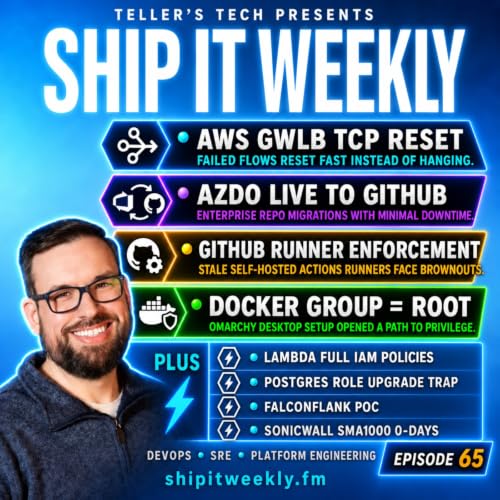
  • AWS GWLB TCP Reset, Azure DevOps Live Migrations to GitHub, GitHub Runner Enforcement, Docker Root Risk, Lambda IAM Updates, PostgreSQL Upgrade Traps, SonicWall Zero-Days & Better Incident Reviews
    2026/09/04

    This week on Ship It Weekly: AWS Gateway Load Balancer gets TCP Reset, giving applications a faster way to recover when firewalls or other inline appliances fail instead of waiting minutes for TCP retries to time out. Microsoft puts Enterprise Live Migrations into public preview for moving Azure DevOps repositories to GitHub Enterprise Cloud with data residency while developers keep working. GitHub is beginning enforcement against outdated self-hosted Actions runners. And Omarchy fixes a Docker configuration that effectively gave normal desktop processes a path to root.

    The bigger theme this week is failure modes hiding inside infrastructure we already trust. A dead network path can look like a slow application. A repository migration involves far more than copying Git history. A self-hosted runner can quietly become unsupported while it continues looking healthy. And giving a developer access to the Docker socket may sound like convenience until you remember that the Docker group is effectively a root-level privilege.

    In the lightning round: Lambda gets full IAM resource-based policies, AWS warns that circular PostgreSQL role memberships can stall major RDS and Aurora upgrades, a researcher releases the FalconFlank CrowdStrike privilege-escalation PoC while CrowdStrike investigates, and SonicWall patches two SMA1000 zero-days after confirming active exploitation.

    Links

    AWS Gateway Load Balancer TCP Reset

    https://www.tellerstech.com/go/s-d7e609ab/

    Azure DevOps Enterprise Live Migrations Public Preview

    https://www.tellerstech.com/go/s-ea05aff9/

    GitHub Actions Self-Hosted Runner Minimum Version Enforcement

    https://www.tellerstech.com/go/s-6e8540c4/

    Omarchy: Any User Process Can Escalate to Root

    https://www.tellerstech.com/go/s-d22971c3/

    AWS Lambda Full IAM Resource-Based Policies

    https://www.tellerstech.com/go/s-ff2a04b5/

    Fix Circular Role Dependencies Before Upgrading RDS and Aurora PostgreSQL

    https://www.tellerstech.com/go/s-e4578f52/

    FalconFlank CrowdStrike Privilege Escalation PoC

    https://www.tellerstech.com/go/s-8c21b00b/

    SonicWall SMA1000 Zero-Day Advisory

    https://www.tellerstech.com/go/s-559ffc8b/

    Remote Incident Reviews: Async First, Live Later?

    https://www.tellerstech.com/go/s-68ca9f5e/

    This Week’s On Call Brief

    https://tsn.io/L95NS

    Ship It Weekly

    https://www.tellerstech.com/go/siw/

    On Call Brief

    https://www.tellerstech.com/go/ocb/

    続きを読む 一部表示
    17 分
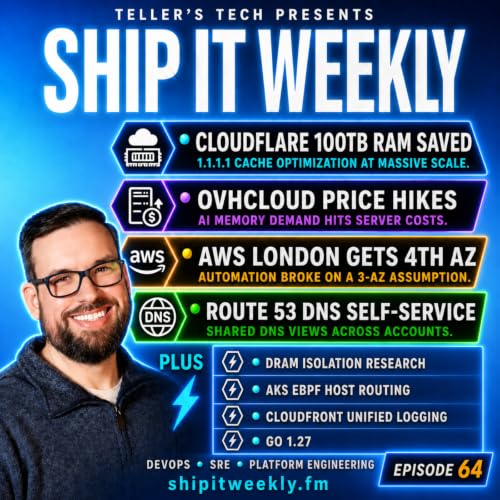
  • Cloudflare Saves 100TB of RAM, AI Drives Server Prices Up, AWS Adds a Fourth London AZ, Route 53 DNS Self-Service, AKS eBPF Routing, Go 1.27, and the Danger of Hidden Infrastructure Assumptions
    2026/08/29

    This week on Ship It Weekly: Cloudflare explains how five low-level optimizations to the cache behind 1.1.1.1 freed roughly 100 terabytes of RAM while also improving performance. OVHcloud is raising infrastructure prices as AI demand reshapes the memory supply chain. AWS adds a fourth Availability Zone to London, exposing automation that quietly assumed there would always be three. And Route 53 Global Resolver gets a cleaner cross-account model for DNS self-service.

    The bigger theme this week is assumptions. A few wasted bytes do not matter until you have 250 billion cache entries. A Region having three Availability Zones feels permanent until AWS adds a fourth. And centralized DNS governance works fine until every application team needs a networking ticket just to make a private zone resolvable.

    In the lightning round: new research looks at manipulating DRAM controller translation registers and the assumptions that creates for memory isolation, AKS eBPF Host Routing reaches general availability, CloudFront Functions can now put custom context directly into access logs, and Go 1.27 lands generic methods along with runtime, tooling, and standard-library improvements.

    And the human closer looks at an easy Kubernetes mistake: running kubectl against the wrong cluster. Because the active context belongs to the kubeconfig rather than a terminal tab, changing it in one shell can silently affect another. It is a good reminder that some friction is worth keeping around production, and that the safest guardrails live somewhere stronger than operator memory.

    Links

    Cloudflare: How We Saved 100 Terabytes of Memory by Optimizing 1.1.1.1’s DNS Cache https://www.tellerstech.com/go/s-9d6c2943/

    OVHcloud Raises Prices as AI Memory Demand Reprices Non-AI Infrastructure https://tsn.io/tnaYj

    AWS Adds a Fourth Availability Zone to Europe (London) https://tsn.io/YfGxa

    Shared DNS Views with Amazon Route 53 Global Resolver https://tsn.io/WEyig

    DRAM Controller Register Manipulation Breaks CPU Memory Isolation https://tsn.io/QKr1x

    AKS eBPF Host Routing https://tsn.io/T3PMh

    CloudFront Functions Unified Logging https://tsn.io/nTXLn

    Go 1.27 https://tsn.io/vfXIT

    kubectl Ran on the Wrong Cluster? Fix Your Context Switching https://tsn.io/6LxfG

    This Week’s On Call Brief https://tsn.io/064QE

    Ship It Weekly https://www.tellerstech.com/go/siw/

    On Call Brief https://www.tellerstech.com/go/ocb/

    続きを読む 一部表示
    17 分
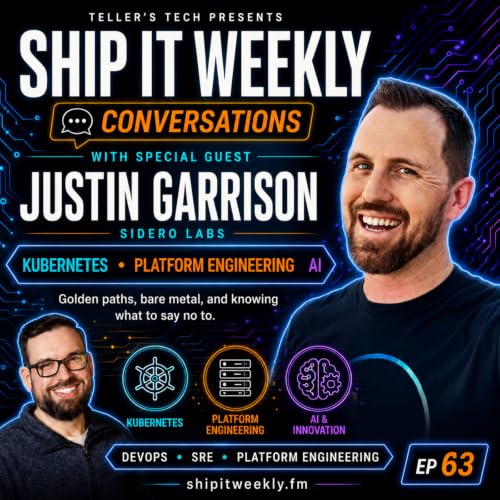
  • Ship It Conversations: Justin Garrison of Sidero Labs on Kubernetes, Platform Engineering, AI, Golden Paths, and Knowing What to Say No To
    2026/08/24

    This is a guest conversation episode of Ship It Weekly, separate from the weekly news recaps.

    In this Ship It Conversations episode, I talk with Justin Garrison of Sidero Labs about Kubernetes, platform engineering, bare metal, AI, golden paths, and why knowing what to say no to may be one of the most important skills a platform team can develop.

    Justin is Field CTO at Sidero Labs, the company behind Talos Linux, and co-host of Fork Around and Find Out.

    We start with the evolution of Kubernetes and how managed services like EKS and GKE made Kubernetes easier to consume while also pulling teams deeper into proprietary cloud ecosystems. Justin explains why on-prem and bare metal are getting renewed attention, especially as teams look at cloud costs, data sovereignty, and the operational overhead that comes with constantly optimizing cloud environments.

    We also get into where Kubernetes helps and where it becomes self-inflicted pain. Justin talks about abstraction, cognitive load, and why teams tend to use familiar tools for problems they were never really designed to solve.

    A big part of the conversation is platform engineering and golden paths. Justin argues that every organization needs its own path, but platforms become dangerous when they try to centralize everything. He shares why one of the best decisions his team made at Disney Plus was simply saying no to stateful workloads.

    We also talk about what really belongs in a platform: security controls, logging, monitoring, software supply chain visibility, and cost management. Justin explains why centralization can help in those areas, but can become a bottleneck when applied too broadly.

    Near the end, we get into AI, security, tooling dependency, and engineering culture. Justin makes the point that people have always formed strong attachments to tools, and AI is another version of that. The challenge is knowing where AI actually helps versus where it becomes another dependency teams stop questioning.

    The big takeaway: good platform engineering is not about supporting everything. It is about understanding what should be standardized, what should stay flexible, and what your team should explicitly refuse to own.

    Highlights

    • Why Kubernetes has become increasingly productized

    • Why some teams are moving back toward on-prem and bare metal

    • Where cloud cost optimization starts to become its own operational burden

    • Why Kubernetes helps with abstraction and cognitive load

    • Why familiar tools often get used for the wrong workloads

    • What golden paths actually represent inside an organization

    • Why platform teams need to know what to say no to

    • What should and should not be centralized

    • How AI changes engineering workflows without changing the need for judgment

    • Why finding work you actually enjoy matters for avoiding burnout

    Links

    Sidero Labs: https://www.siderolabs.com

    Talos Linux: https://www.talos.dev

    Justin Garrison: https://justingarrison.com

    Fork Around and Find Out: https://www.forkaroundandfindout.com

    More episodes and show notes: https://shipitweekly.fm

    On Call Brief: https://oncallbrief.com

    LMGT Awards: https://lmgt.org

    続きを読む 一部表示
    41 分
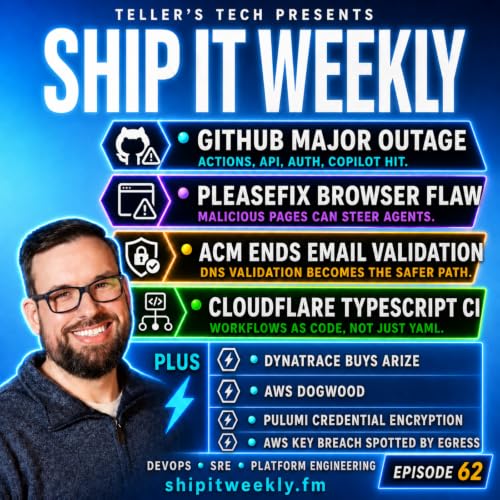
  • GitHub Outage, PleaseFix Agentic Browser Vulnerability, AWS Certificate Manager Drops Email Validation, Cloudflare TypeScript CI Workflows, AI Observability Consolidation, and the Hidden Cost of “Simple” Platform Changes
    2026/08/21

    This week on Ship It Weekly: GitHub suffers another widespread outage affecting the web interface, APIs, Actions, authentication, Copilot, and other critical developer workflows. Zenity Labs demonstrates PleaseFix attacks against agentic browsers, where malicious content can influence agents with access to authenticated sessions and privileged tools. AWS Certificate Manager is moving away from email validation, and Cloudflare is experimenting with CI pipelines defined as TypeScript instead of YAML.

    The bigger theme this week is dependencies and boundaries we tend to ignore until something breaks. GitHub is no longer just where the code lives. Agentic browsers are no longer just displaying webpages. Certificate renewal is not something you want depending on someone checking an inbox. And CI pipelines have become software systems of their own.

    Links

    GitHub Hit by Widespread Outage https://devops.com/github-hit-by-widespread-outage-halting-work-for-global-developers/

    Zenity Labs: PleaseFix in Agentic Browsers https://zenity.io/company-overview/newsroom/company-news/zenity-labs-exposes-the-full-scope-of-pleasefix

    AWS Certificate Manager Ending Email Validation https://aws.amazon.com/blogs/security/aws-certificate-manager-will-discontinue-email-validation-to-prove-domain-validation-for-certificates/

    Certificate Expiry Is Still Taking Down Major Platforms https://tokentimer.ch/blog/tls-certificate-expiry-outages

    Cloudflare Turns CI Pipelines into TypeScript Workflows https://www.infoq.com/news/2026/08/cloudflare-ci-code-workflows/

    Dynatrace Acquires Arize https://devops.com/dynatrace-acquires-arize-as-ai-agents-deepen-the-observability-challenge/

    AWS Open-Sources Dogwood https://www.infoq.com/news/2026/08/aws-dogwood-agent-policy/

    Pulumi v3.258.0 https://github.com/pulumi/pulumi/releases/tag/v3.258.0

    AWS Key Breach and Data-Transfer Signal https://assets.theregister.com/2026/08/13/20267/

    Mario Saved the EU but Broke My System https://www.uptimelabs.io/articles/hamed-2012-outage-reflections

    This week’s On Call Brief https://www.tellerstech.com/on-call-brief-news/2026-W34/

    Ship It Weekly https://shipitweekly.fm/

    続きを読む 一部表示
    18 分