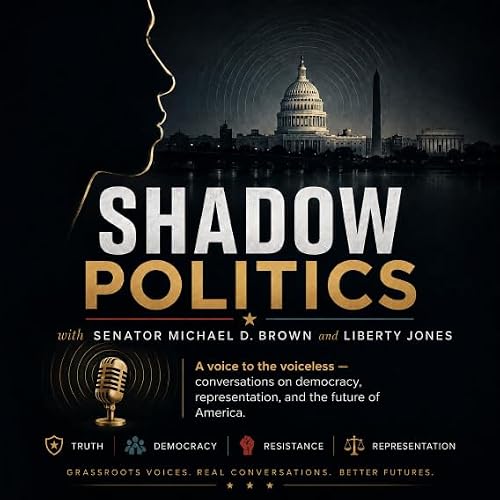
エピソード

  • Shadow Politics, April 26, 2026
    2026/04/27
    Shadow Politics with Senator Michael D. Brown and Co-host Liberty Jones Reclaiming Truth, Guest, Josh Levs on dismantling victim narratives and the formula for media literacy In this episode of Shadow Politics, former CNN lead fact-checker Josh Levs joins hosts to dissect the systemic collapse of media integrity. He explores how "clickbait politics" and memetic warfare have replaced objective journalism, offering a framework for citizens to reclaim the truth through curiosity and context. The Crisis of Mainstream Media and the Rise of Clickbait The American media landscape has shifted from being a "standard bearer" of truth to a fractured environment driven by engagement metrics. Josh Levs notes that mainstream outlets, including the New York Times, CNN, and the BBC, have frequently failed to correct factual errors or provide necessary context, leading to an all-time low in public trust. This decline is fueled by a corporate focus on short-term stock returns and "rage-bait" headlines designed to trigger emotional responses rather than inform the public. As trust erodes, audiences are increasingly turning to social media, which often acts as a breeding ground for unverified conspiracy theories and partisan echo chambers. Mechanics of Manipulation: Memetic Warfare and Victim Narratives Political extremists on both the far right and far left utilize sophisticated "memetic warfare"—the use of images and brief, emotionally charged messages—to bypass the conscious mind and influence the subconscious. This is often coupled with "victim narratives" based on the "Drama Triangle" (Victim, Villain, Hero). By casting their audience as victims and themselves as heroes, political figures and media outlets manipulate public sentiment to fuel hatred and radicalization. Levs points out that surveys show a growing acceptance of political violence across the spectrum, a reality often ignored by mainstream media because it does not fit their established partisan narratives. Building a Truth Counter-Movement The long-term solution to media manipulation lies in a "truth counter-movement" rooted in curiosity rather than opinion. Levs advocates for a shift in education—moving away from teaching children how to "debate" a side and toward teaching them how to investigate facts. By prioritizing instinctive curiosity and demanding "facts plus context," citizens can pressure the media to return to its essential societal role. Furthermore, the rise of independent voters suggests a potential for a centrist political coalition that could move beyond the hatred-driven duopoly of the current two-party system. The current crisis of truth is a result of both human nature and systemic media failures. However, by recognizing manipulation tactics like the "Drama Triangle" and insisting on a standard of "Facts + Context," individuals can navigate the noise. The path forward requires a collective commitment to curiosity and the courage to hold both media institutions and political leaders accountable to the reality of the facts.
    続きを読む 一部表示
    57 分
  • Shadow Politics, April 19, 2026
    2026/04/20
    Shadow Politics with Senator Michael D. Brown and Co-host Liberty Jones Navigating War, Narrative, and the Digital Divide This episode of Shadow Politics explores the escalating conflict in Iran, the systemic erasure of Indigenous history in American museums, and the widening socioeconomic gap exacerbated by Artificial Intelligence. Hosts Michael D. Brown and Liberty Jones challenge mainstream narratives, urging listeners to seek truth beneath political rhetoric and foster genuine human connection in a divided nation. The Iran Conflict and Diplomatic Isolation The discussion opens with a critical assessment of the ongoing war in Iran and the strategic instability surrounding the Straits of Hormuz. Senator Brown highlights a significant disconnect between administration claims of victory and the reality of continued naval attacks, suggesting that the U.S. is faltering on the diplomatic front. A primary critique is the lack of international consultation; by acting as a "singular actor" without the overwhelming post-WWII economic dominance it once held, the U.S. has left itself without allies in a "forever war" that suffers from a total lack of an exit strategy. Historical Revisionism and Indigenous Rights Liberty Jones shares her disillusionment with the Smithsonian National Museum of the American Indian, noting that the exhibits often present a sanitized narrative of "compromise" rather than the brutal reality of colonization. The hosts contrast these "passive" stories with the historical record of figures like General Howard and the ongoing disrespect signaled by the Washington Commanders' use of Indigenous imagery on helmets. They argue that America’s inability to be culturally sensitive stems from a mainstream narrative that avoids uncomfortable truths about the past. The AI Frontier: Progress vs. Deterioration The conversation shifts to the dual nature of technology, specifically Artificial Intelligence. While acknowledging AI's potential to cure diseases, the hosts express deep concern over "brain deterioration"—the loss of basic skills like mental math or addressing envelopes due to automation. More critically, they discuss how AI can be weaponized to exploit public ignorance through "alternative facts" and deepfakes, potentially reinforcing existing prejudices rather than expanding human knowledge. Social Fabric and the "Woke" Narrative The hosts analyze the weaponization of the term "woke," lamenting that a word meaning "to be aware" has been reframed as a pejorative. They argue that the current political climate thrives on "us vs. them" ideologies because they provide a false sense of belonging in an increasingly lonely, digital world. The segment concludes with a call for the Democratic party to stop "talking down" to voters and instead focus on genuine listening and empathy to bridge the divide. The episode serves as a sobering reminder that while technology and warfare evolve, the fundamental human need for truth and connection remains unchanged. By dismantling false narratives—whether they concern historical atrocities or modern military engagements—society can begin to move toward a more "sane" and inclusive future.
    続きを読む 一部表示
    55 分
  • Shadow Politics, April 12, 2026
    2026/04/13
    Shadow Politics with Senator Michael D. Brown and Co-host Liberty Jones Political Debate Against the Other Side of the Isle and Ideological Crossroads Guest, Noah Witherspoon - Floridian political activist of Turning Point USA On Shadow Politics, an intense and polarizing discussion featuring host Senator Michael D. Brown, co-host Liberty Jones, debating conservative organizer Noah Witherspoon. The dialogue serves as a microcosm of the current American political divide, touching on fiscal policy, constitutional interpretation, and the moral foundations of leadership. The conversation begins on a "homework assignment" given to Noah Witherspoon to justify conservative appeal to senior citizens. This quickly evolves into a heated debate over Donald Trump’s legacy, the validity of Critical Race Theory, and the legal nuances of birthright citizenship, highlighting a sharp contrast between institutional experience and emerging grassroots conservatism. The Conservative Case for Seniors and Fiscal Rebuttals Noah Witherspoon presented several arguments for why seniors should align with conservatism, focusing on economic security through the Tax Cuts and Jobs Act (TCJA) and the protection of Social Security. He highlighted the record-high VA budget of $488 billion projected for 2027 and the construction of over 450 miles of border wall as key successes. Senator Brown countered these points by arguing that the Republican party has historically sought to cut Social Security and that the current administration's focus on defense spending comes at the expense of essential social services like childcare. Urban Governance and the "Beautification" of D.C. A significant portion of the debate focused on the "Beautification Movement" in Washington, D.C. Liberty Jones questioned the ethics of spending 400 million on ball room renovations and 10 billion on D.C. aesthetics while cutting 120,000 households for elderly housing and 33,000 for people with disabilities. Noah defended these expenditures as necessary for the dignity of the nation's capital, while the Senator characterized private donations for these projects as "bribes" and criticized the incompetence of newly appointed judicial figures like Jeanine Pirro. Social Theory and Academic Influence The participants clashed over the role of Critical Race Theory (CRT) in academia. Noah characterized CRT as a "dangerous concept" that suggests racism is permanent within white society. In response, Liberty Jones, a sociology minor, argued that CRT is a structural analysis of systemic disparities, such as housing, rather than an attack on individuals. The Senator added that understanding the "prologue" of American history—including its darker chapters—is essential for future progress. Faith, Values, and the MAGA Slogan The dialogue concluded with a philosophical exploration of "Make America Great Again" and Christian values. The hosts argued that the MAGA slogan ignores historical periods of racial and gender-based oppression. Senator Brown challenged Noah to find "Christianity" in policies of retribution and military aggression, citing biblical passages on love and neighborliness. Noah maintained that Trump is a "builder" who is valiantly defending the country's foundations. The interview underscores a profound disconnect between the "facts" as perceived by different political factions. While Noah Witherspoon represents a highly articulate and researched new generation of conservatives, Senator Brown and Liberty Jones emphasize historical context and institutional integrity. The debate remains unresolved, reflecting the broader national struggle to define the "true" American identity and the proper interpretation of its founding documents..
    続きを読む 一部表示
    59 分
  • Shadow Politics, March 30, 2026
    2026/03/31
    Shadow Politics with Senator Michael D. Brown and Co-host Liberty Jones Guest, Jonetta Rose Barras, The DC Sovereignty Crisis, Power, Organizing, and the Future of D.C. In this episode of Shadow Politics, host Michael D. Brown and guest Jonetta Rose Barras discuss the critical need for strategic mobilization in the District of Columbia. They explore the limitations of current D.C. leadership, the tactical errors in seeking statehood, and the necessity of building a "citizen army" to demand political autonomy. The Illusion of Generational Change While the upcoming June primary is often framed as a generational shift due to the retirement of long-standing figures like Eleanor Holmes Norton and Anita Bonds, Barras remains skeptical of radical transformation. She argues that current candidates often cling to decade-old policy visions, suggesting that any upcoming changes may be merely stylistic or incremental rather than substantive. The conversation highlights a lack of strategic sophistication within the Wilson Building, where leaders often fail to connect local policy to broader political organizing. Mobilizing the "Citizen Army" A recurring theme is the failure of the D.C. government to effectively organize its 700,000 residents. Barras notes that while historical movements like the Southern Christian Leadership Conference (SCLC) maintained constant organization, D.C. lacks a consistent "army" to stand up to congressional interference. Brown expresses frustration that small protests of 300 people are often mislabeled as "movements," arguing that true power requires a significant percentage of the population to consistently engage and demand their rights. Incrementalism and Home Rule Barras suggests that the path to statehood may require a more incremental approach, focusing first on strengthening the Home Rule Charter. By enlarging the legislature and adopting state-like terminology—such as referring to the Mayor as a "Governor"—the District could begin to behave like the state it aspires to be. This strategy aims to shift the focus from a purely symbolic fight for statehood to a practical expansion of local destiny and control. National Threats and Bipartisan Realities The discussion turns to the "insanity" of D.C.'s current political strategy, which often involves "preaching to the choir" of Democrats while ignoring Republicans who hold the key to legislative change. With 13 bills currently in the House threatening D.C. sovereignty—including proposals for the President to appoint the local Attorney General—the need for proactive, bipartisan lobbying is urgent. Barras critiques the reliance on government funding for advocacy, pointing to the Civil Rights movement and modern crowdfunding as better models for sustainable political change. The dialogue concludes with a sobering reminder from Frederick Douglass: "Power concedes nothing without a demand." For D.C. to achieve its goals of statehood or expanded autonomy, it must move beyond symbolic gestures and develop a sophisticated, privately-funded, and highly mobilized grassroots strategy that engages both sides of the political aisle.
    続きを読む 一部表示
    58 分
  • Shadow Politics, March 22, 2026
    2026/03/23
    Shadow Politics with Senator Michael D. Brown and Co-host Liberty Jones Brooke Pinto, DC’s Congressional Future and the defense of local autonomy In this episode of Shadow Politics, Senator Brown and Liberty Jones host DC Councilwoman Brooke Pinto to discuss her campaign for DC’s Congressional Delegate. The conversation explores the urgent need for local autonomy, Pinto’s legislative successes in public safety, and the strategic "quarterback" role required to protect District residents from federal overreach. The Struggle for Home Rule and Local Autonomy The dialogue centers on the unique challenges facing Washington, D.C., particularly the frequent interference from Congress in local governance. Councilwoman Pinto highlights recent "attacks" on home rule, such as Congress disallowing the District from spending $1 billion of its own local funds and attempting to override local tax laws. A significant point of contention involved DC's "decoupling" of local taxes from the federal system to provide relief for working families—a move Congress later disapproved, creating confusion for 75,000 residents who had already filed. Pinto emphasizes that while the city will "recouple" next year to satisfy federal demands, her priority remains protecting the consistency and dignity of DC’s self-governance. Legislative Track Record: Public Safety and Education Pinto details her six-year tenure on the Ward 2 Council, specifically her leadership on the "Secure DC" legislation. This comprehensive bill included over 100 interventions and has been credited with a nearly 60% reduction in violent crime since its passage. Beyond safety, she highlights her work in education, noting that DC is currently the fastest-improving jurisdiction for literacy in the country due to targeted teacher training. She also discusses economic recovery efforts, such as incentivizing the conversion of vacant office spaces into affordable housing and retail units to revitalize the downtown core. Strategic Advocacy on Capitol Hill As a candidate for the Congressional Delegate seat, Pinto argues that effectively representing DC requires a deep understanding of political psychology. She describes a "mapping" strategy used to protect Medicaid funding, where her team identified which stakeholders—from hospital CEOs to individual beneficiaries—would be most persuasive to specific members of Congress. This nuanced approach is presented as essential for building "pro-DC" coalitions to counter the "anti-DC" sentiments held by a small but vocal group of Republican lawmakers. Civil Liberties and National Concerns The latter half of the discussion shifts to broader concerns regarding civil liberties and the current administration’s impact on human rights. Pinto shares her efforts to pass emergency legislation requiring federal agents (such as ICE) to release body-worn camera footage if they use force within DC limits, emphasizing transparency as a prerequisite for justice. Liberty Jones and Senator Brown further discuss the "power games" played at the federal level, expressing concerns over potential voter intimidation and the importance of electing women to leadership positions during International Women’s Month. Brooke Pinto presents herself as a seasoned legislator ready to transition from the City Council to Capitol Hill. By focusing on public safety, education, and a sophisticated strategy for federal advocacy, she aims to serve as a "new quarterback" for DC residents, ensuring that the District’s values and autonomy are protected in an increasingly volatile political environment.
    続きを読む 一部表示
    53 分
  • Shadow Politics, March 15, 2026
    2026/03/16
    Shadow Politics with Senator Michael D. Brown and Co-host Liberty Jones Admiral Joe Sestak, the erosion of US military dominance and the rise of cyber-kinetic warfare In this episode of Shadow Politics, host Michael D. Brown interviews Admiral Joe Sestak, a former presidential candidate and high-ranking military official. The discussion provides a sobering assessment of the United States' current military standing, highlighting critical vulnerabilities in cyber warfare, supply chain dependencies on China, and the shifting nature of global conflict. The Shift to a "Second-Tier" Military Power Admiral Sestak argues that the U.S. has effectively become a "second-tier" military power in specific strategic domains, particularly concerning China. Recent war games indicate that U.S. networks are prone to immediate failure because the national security infrastructure has been outsourced. Currently, approximately 45,000 Chinese companies provide parts for the U.S. Department of Defense, creating a "cyber incarceration" where hardware—from Aegis Cruisers to F-35 fighter jets—contains components that could be remotely compromised or programmed to fail. The "Iron Triangle" and Institutional Stagnation The lack of innovation is attributed to the "Iron Triangle"—the intersection of Congress, the military, and a consolidated industrial complex. Following the Cold War, the number of major defense firms plummeted from 92 to just five, creating an oligopoly that prioritizes "cost-plus" contracts over efficiency. This has led to massive budget overruns, such as the F-35 program doubling in cost to $2 trillion. Sestak notes that military advancement is often stifled because personnel achieve success by "climbing existing trees rather than planting new ones," leading to a "BlackBerry moment" for the U.S. Navy where it fails to adapt to the "iPhone" era of cyber-centric warfare. Tactical Dilemmas in the Middle East The conversation critiques the current administration's handling of Iran and Israel. Sestak emphasizes that the withdrawal from the Iran Nuclear Deal (JCPOA) was a strategic error, as it removed the "24/7 eyes and ears" that prevented cheating. Regarding current tensions, he warns that the U.S. cannot easily operate within the Persian Gulf during a conflict due to Iran's ability to deploy mines via fishing boats and utilize midget submarines that evade sonar in shallow waters. He argues that the U.S. has allowed itself to be "tied down" like Gulliver, losing its moral authority by failing to prevent indiscriminate killings in Gaza while attempting to maintain a world order based on universal values. Education as Homeland Defense A central theme of Sestak’s philosophy is that "every issue is a national security issue." He posits that education is the ultimate form of homeland defense. While China has surpassed the U.S. in government research spending and leadership in critical fields like chemistry and engineering, the U.S. ranks last among the 38 OECD countries in training and retraining its workforce. He calls for a shift in focus toward the "enlisted" and blue-collar workers, advocating for apprenticeship programs similar to Germany’s to ensure the nation remains competitive and secure. The discussion concludes that America is at a crossroads, currently "sleeping" through a revolution in warfare. True national security no longer rests solely on the number of soldiers or traditional weapons, but on data, algorithms, and the educational foundation of the citizenry. To remain a global leader, the U.S. must break the "Iron Triangle" and embrace a strategy where "all others must bring data".
    続きを読む 一部表示
    55 分
  • Shadow Politics, March 1, 2026
    2026/03/02
    Shadow Politics with Senator Michael D. Brown and Co-host Liberty Jones Petula Dvorak, Ex Reporter for the Washinton Post - Struggle for DC Identity and the Decline of Local Truth This episode of Shadow Politics, dives into a deep-dive conversation between Michael D. Brown, Liberty Jones, and veteran columnist Petula Dvorak regarding the precarious state of Washington D.C. It explores the intersection of "taxation without representation," the systemic dismantling of local journalism at The Washington Post, and the alarming militarization of the nation's capital. The discussion serves as both a critique of current political narcissism and a plea for renewed civic engagement through historical and cultural understanding. The Cultural Erasure and Political Limbo of District Residents The District of Columbia remains in a state of "taxation without representation," a situation exacerbated by the impending retirement of long-time advocate Eleanor Holmes Norton and a Senate filibuster that blocks the path to statehood. Beyond the legal hurdles, there is a profound cultural disconnect; much of the nation views DC either as a "bureaucratic laboratory" or a "criminal hellscape" rather than a vibrant city where 700,000 people live, work, and raise families. This disrespect is felt practically, from DC licenses being rejected as "fake" in other states to the city being omitted from address menus on national websites. Dvorak suggests that a mandatory civic visit to DC should be part of the national core curriculum to bridge this "civics gap" and humanize the city beyond its political caricatures. The Erosion of Local Journalism at The Washington Post Dvorak details a "chilling" shift in the mission of The Washington Post, noting that the local reporting staff has been systematically whittled away. Despite a legacy of Pulitzer-winning local journalism—from Watergate to investigations into police force—the local desk has shrunk from a peak of 200 reporters across various bureaus to a mere 10 people today. The termination of local columnists in 2023, under the claim that they were "unsustainable," has severed the intimate, "front porch" relationship the paper once held with its readers. This decline in local oversight allows for the quiet dismantling of checks and balances within federal commissions and local governance, as there are fewer "reporters on the ground" to witness small but significant administrative shifts. Militarization and the Immigrant Perspective The conversation highlights a disturbing trend of militarization in DC, with the presence of National Guard and ICE agents evoking traumatic memories for immigrant communities. For those who fled dictatorships in countries like Brazil or the former Czechoslovakia, the sight of troops on the streets and "forced patriotism" feels like a "dimming of the American promise." This atmosphere is compounded by "clickbait politics," where extremist rhetoric and celebrity-style spectacle often overshadow substantive issues like humanitarian crises or local economic struggles. Gen Z, represented by Liberty Jones, views this landscape as an "adversarial" environment where attention is the only currency, making it increasingly difficult for young people to find stable career paths in a "consolidated" media and political world. The District of Columbia stands at a crossroads where its legal rights are stalled and its local narrative is being erased by a shrinking press. As national politics shifts toward "theatrics and stagecraft," the speakers emphasize that the only antidote to this erosion of truth and community is a combination of rigorous independent journalism, historical perspective, and a commitment to "leading with love" to keep hope alive for the next generation.
    続きを読む 一部表示
    56 分
  • Shadow Politics, February 22, 2026
    2026/02/23
    Shadow Politics with Senator Michael D. Brown and Co-host Liberty Jones Guest, Charles Moreland 1st US Representative for DC - The Legacy of Activism In this episode of Shadow Politics, a profound dialogue between Senator Emeritus Michael D. Brown and Representative Charles Moreland, the first elected U.S. Representative for the District of Columbia. They reflect on the mentorship of Jesse Jackson, the historical parallels between DC’s struggle and global civil rights movements, and the urgent need for a grassroots mobilization to achieve full statehood. The Catalyst of the 1990s: Jesse Jackson’s Influence The election of Charles Moreland and Jesse Jackson in 1990 marked a turning point for the District of Columbia. Jackson, a veteran of the Civil Rights Movement, brought national gravitas to the "Shadow" delegation, teaching local leaders the importance of visibility and national lobbying. Despite initial local skepticism regarding his arrival, Jackson acted as a master mentor, emphasizing that the fight for DC was a logical extension of the march from Selma to Montgomery. Symbolic Protests and Civil Disobedience The movement for statehood was characterized by direct action, including blocking Pennsylvania Avenue and dumping tea on the steps of the IRS to protest "taxation without representation". These acts were intended to mirror the founding principles of the United States, highlighting the irony that the "cradle of democracy" denies basic voting rights to its own residents. The "Home Rule" Trap vs. True Statehood A significant portion of the discussion focuses on the inadequacy of "Home Rule," which Moreland describes as a "dictatorship of the powerful over the powerless". Unlike a state, DC's local laws and budget are subject to Congressional veto, and its residents lack voting members in the Senate and House. The speakers argue that many residents have developed a "slave mentality," accepting the illusion of democracy provided by a local mayor while the federal government retains ultimate control over their finances and judicial appointments. Political Analysis and the Path Forward The dialogue touches on the 2024 election, with Moreland critiquing the Democratic Party for failing to prioritize statehood when they held the majority. He attributes political shifts to deep-seated racism and gender bias, noting that voter suppression is often ignored in mainstream post-election analysis. Ultimately, the speakers conclude that statehood will not be granted through polite lobbying alone; it requires a mass movement where citizens demand their rights, echoing Frederick Douglass’s maxim that "power concedes nothing without a demand". The conversation serves as both a historical record and a call to action. While the legacy of leaders like Jesse Jackson and Florence Pendleton provided a foundation of hope, Moreland and Brown emphasize that the "lightning bug" of Home Rule is no substitute for the "lightning bolt" of statehood. The path to freedom requires DC residents to shed the "slave mentality" and demand the same rights enjoyed by every other citizen in a modern democracy.
    続きを読む 一部表示
    54 分