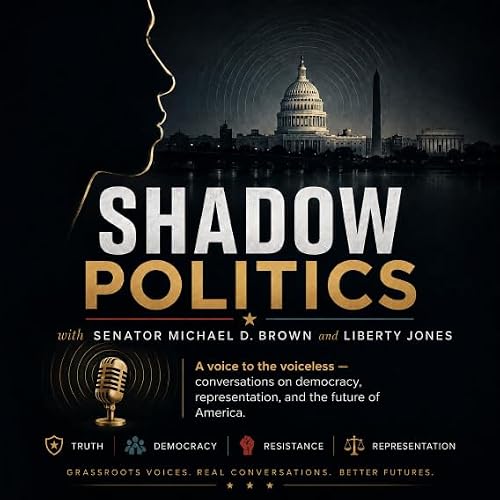
『Shadow Politics with US Senator Michael D Brown』のカバーアート

Shadow Politics with US Senator Michael D Brown

Shadow Politics with US Senator Michael D Brown

著者: BBS Radio BBS Network Inc.
無料で聴く

今ならプレミアムプランが3カ月 月額99円

2026年5月12日まで。4か月目以降は月額1,500円で自動更新します。

概要

Shadow Politics is a grass roots talk show giving a voice to the voiceless. For more than 200 years the people of the Nation's Capital have ironically been excluded from the national political conversation. With no voting member of either house of Congress, Washingtonians have lacked the representation they need to be equal and to have their voices heard. Shadow Politics will provide a platform for them, as well as the millions of others nationwide who feel politically disenfranchised and disconnected, to be included in a national dialog. We need to start a new conversation in America, one that is more inclusive and diverse and one that will lead our great nation forward to meet the challenges of the 21st century. At Shadow Politics, we hope to get this conversation started by bringing Americans together to talk about issues important to them. We look forward to having you be part of the discussion so call in and join the conversation. America is calling and we're listening… Shadow Politics is about America hearing what you have to say. It's your chance to talk to an elected official who has spent more than 30 years in Washington politics. We believe that if we start a dialog and others add their voices we will create a chorus. Even if those other politicians in Washington don't hear you — Senator Brown will. He's on a mission to listen to what America has to say and use it to start a productive dialog to make our democracy stronger and more inclusive. If we are all part of the solution we can solve any problem.Copyright 2026 Senator Michael Brown 政治・政府
エピソード
  • Shadow Politics, April 19, 2026
    2026/04/20
    Shadow Politics with Senator Michael D. Brown and Co-host Liberty Jones Navigating War, Narrative, and the Digital Divide This episode of Shadow Politics explores the escalating conflict in Iran, the systemic erasure of Indigenous history in American museums, and the widening socioeconomic gap exacerbated by Artificial Intelligence. Hosts Michael D. Brown and Liberty Jones challenge mainstream narratives, urging listeners to seek truth beneath political rhetoric and foster genuine human connection in a divided nation. The Iran Conflict and Diplomatic Isolation The discussion opens with a critical assessment of the ongoing war in Iran and the strategic instability surrounding the Straits of Hormuz. Senator Brown highlights a significant disconnect between administration claims of victory and the reality of continued naval attacks, suggesting that the U.S. is faltering on the diplomatic front. A primary critique is the lack of international consultation; by acting as a "singular actor" without the overwhelming post-WWII economic dominance it once held, the U.S. has left itself without allies in a "forever war" that suffers from a total lack of an exit strategy. Historical Revisionism and Indigenous Rights Liberty Jones shares her disillusionment with the Smithsonian National Museum of the American Indian, noting that the exhibits often present a sanitized narrative of "compromise" rather than the brutal reality of colonization. The hosts contrast these "passive" stories with the historical record of figures like General Howard and the ongoing disrespect signaled by the Washington Commanders' use of Indigenous imagery on helmets. They argue that America’s inability to be culturally sensitive stems from a mainstream narrative that avoids uncomfortable truths about the past. The AI Frontier: Progress vs. Deterioration The conversation shifts to the dual nature of technology, specifically Artificial Intelligence. While acknowledging AI's potential to cure diseases, the hosts express deep concern over "brain deterioration"—the loss of basic skills like mental math or addressing envelopes due to automation. More critically, they discuss how AI can be weaponized to exploit public ignorance through "alternative facts" and deepfakes, potentially reinforcing existing prejudices rather than expanding human knowledge. Social Fabric and the "Woke" Narrative The hosts analyze the weaponization of the term "woke," lamenting that a word meaning "to be aware" has been reframed as a pejorative. They argue that the current political climate thrives on "us vs. them" ideologies because they provide a false sense of belonging in an increasingly lonely, digital world. The segment concludes with a call for the Democratic party to stop "talking down" to voters and instead focus on genuine listening and empathy to bridge the divide. The episode serves as a sobering reminder that while technology and warfare evolve, the fundamental human need for truth and connection remains unchanged. By dismantling false narratives—whether they concern historical atrocities or modern military engagements—society can begin to move toward a more "sane" and inclusive future.
    続きを読む 一部表示
    55 分
  • Shadow Politics, April 12, 2026
    2026/04/13
    Shadow Politics with Senator Michael D. Brown and Co-host Liberty Jones Political Debate Against the Other Side of the Isle and Ideological Crossroads Guest, Noah Witherspoon - Floridian political activist of Turning Point USA On Shadow Politics, an intense and polarizing discussion featuring host Senator Michael D. Brown, co-host Liberty Jones, debating conservative organizer Noah Witherspoon. The dialogue serves as a microcosm of the current American political divide, touching on fiscal policy, constitutional interpretation, and the moral foundations of leadership. The conversation begins on a "homework assignment" given to Noah Witherspoon to justify conservative appeal to senior citizens. This quickly evolves into a heated debate over Donald Trump’s legacy, the validity of Critical Race Theory, and the legal nuances of birthright citizenship, highlighting a sharp contrast between institutional experience and emerging grassroots conservatism. The Conservative Case for Seniors and Fiscal Rebuttals Noah Witherspoon presented several arguments for why seniors should align with conservatism, focusing on economic security through the Tax Cuts and Jobs Act (TCJA) and the protection of Social Security. He highlighted the record-high VA budget of $488 billion projected for 2027 and the construction of over 450 miles of border wall as key successes. Senator Brown countered these points by arguing that the Republican party has historically sought to cut Social Security and that the current administration's focus on defense spending comes at the expense of essential social services like childcare. Urban Governance and the "Beautification" of D.C. A significant portion of the debate focused on the "Beautification Movement" in Washington, D.C. Liberty Jones questioned the ethics of spending 400 million on ball room renovations and 10 billion on D.C. aesthetics while cutting 120,000 households for elderly housing and 33,000 for people with disabilities. Noah defended these expenditures as necessary for the dignity of the nation's capital, while the Senator characterized private donations for these projects as "bribes" and criticized the incompetence of newly appointed judicial figures like Jeanine Pirro. Social Theory and Academic Influence The participants clashed over the role of Critical Race Theory (CRT) in academia. Noah characterized CRT as a "dangerous concept" that suggests racism is permanent within white society. In response, Liberty Jones, a sociology minor, argued that CRT is a structural analysis of systemic disparities, such as housing, rather than an attack on individuals. The Senator added that understanding the "prologue" of American history—including its darker chapters—is essential for future progress. Faith, Values, and the MAGA Slogan The dialogue concluded with a philosophical exploration of "Make America Great Again" and Christian values. The hosts argued that the MAGA slogan ignores historical periods of racial and gender-based oppression. Senator Brown challenged Noah to find "Christianity" in policies of retribution and military aggression, citing biblical passages on love and neighborliness. Noah maintained that Trump is a "builder" who is valiantly defending the country's foundations. The interview underscores a profound disconnect between the "facts" as perceived by different political factions. While Noah Witherspoon represents a highly articulate and researched new generation of conservatives, Senator Brown and Liberty Jones emphasize historical context and institutional integrity. The debate remains unresolved, reflecting the broader national struggle to define the "true" American identity and the proper interpretation of its founding documents..
    続きを読む 一部表示
    59 分
  • Shadow Politics, March 30, 2026
    2026/03/31
    Shadow Politics with Senator Michael D. Brown and Co-host Liberty Jones Guest, Jonetta Rose Barras, The DC Sovereignty Crisis, Power, Organizing, and the Future of D.C. In this episode of Shadow Politics, host Michael D. Brown and guest Jonetta Rose Barras discuss the critical need for strategic mobilization in the District of Columbia. They explore the limitations of current D.C. leadership, the tactical errors in seeking statehood, and the necessity of building a "citizen army" to demand political autonomy. The Illusion of Generational Change While the upcoming June primary is often framed as a generational shift due to the retirement of long-standing figures like Eleanor Holmes Norton and Anita Bonds, Barras remains skeptical of radical transformation. She argues that current candidates often cling to decade-old policy visions, suggesting that any upcoming changes may be merely stylistic or incremental rather than substantive. The conversation highlights a lack of strategic sophistication within the Wilson Building, where leaders often fail to connect local policy to broader political organizing. Mobilizing the "Citizen Army" A recurring theme is the failure of the D.C. government to effectively organize its 700,000 residents. Barras notes that while historical movements like the Southern Christian Leadership Conference (SCLC) maintained constant organization, D.C. lacks a consistent "army" to stand up to congressional interference. Brown expresses frustration that small protests of 300 people are often mislabeled as "movements," arguing that true power requires a significant percentage of the population to consistently engage and demand their rights. Incrementalism and Home Rule Barras suggests that the path to statehood may require a more incremental approach, focusing first on strengthening the Home Rule Charter. By enlarging the legislature and adopting state-like terminology—such as referring to the Mayor as a "Governor"—the District could begin to behave like the state it aspires to be. This strategy aims to shift the focus from a purely symbolic fight for statehood to a practical expansion of local destiny and control. National Threats and Bipartisan Realities The discussion turns to the "insanity" of D.C.'s current political strategy, which often involves "preaching to the choir" of Democrats while ignoring Republicans who hold the key to legislative change. With 13 bills currently in the House threatening D.C. sovereignty—including proposals for the President to appoint the local Attorney General—the need for proactive, bipartisan lobbying is urgent. Barras critiques the reliance on government funding for advocacy, pointing to the Civil Rights movement and modern crowdfunding as better models for sustainable political change. The dialogue concludes with a sobering reminder from Frederick Douglass: "Power concedes nothing without a demand." For D.C. to achieve its goals of statehood or expanded autonomy, it must move beyond symbolic gestures and develop a sophisticated, privately-funded, and highly mobilized grassroots strategy that engages both sides of the political aisle.
    続きを読む 一部表示
    58 分
まだレビューはありません