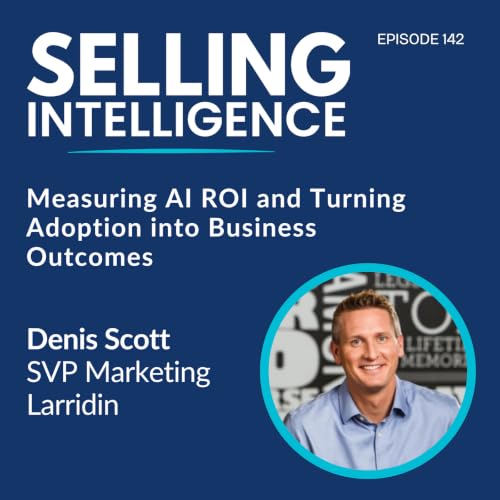
『Selling Intelligence (formerly Selling the Cloud)』のカバーアート

Selling Intelligence (formerly Selling the Cloud)

Selling Intelligence (formerly Selling the Cloud)

著者: Mark Petruzzi KK Anderson
無料で聴く

Selling Intelligence is the evolution of Selling the Cloud and designed for revenue leaders who are navigating the AI era.

Hosted by Mark Petruzzi and Kristin "KK" Anderson, the show brings candid conversations with C-suite leaders across sales, marketing, and customer success on how AI is reshaping the way companies grow, sell, and compete.

From agentic GTM strategies to AI-powered pipeline and revenue execution, each episode focuses on what’s actually working and how leaders are turning intelligence into performance.

If you’re responsible for growth and trying to lead through the fastest shift in go-to-market we’ve ever seen, this podcast is for you.


© © 2026 Selling the Cloud
マネジメント マネジメント・リーダーシップ リーダーシップ 経済学
エピソード
  • Ep. 142 – Measuring AI ROI and Turning Adoption into Business Outcomes with Denis Scott - Part 2
    2026/09/02
    General Episode Description:In Part 2 of this conversation, Denis Scott continues the discussion by exploring what AI accountability looks like inside boardrooms, executive teams, and private equity backed organizations. He explains why leaders must move beyond tracking AI adoption and begin measuring how AI investments contribute to business performance, operational efficiency, and long term enterprise value.The conversation also examines what separates AI mature organizations from those still experimenting with adoption. Denis shares why AI fluency is becoming a competitive advantage, how organizations can build stronger measurement frameworks, and why the future belongs to companies that combine human judgment with AI driven execution.What You’ll Learn:What boards expect to see when evaluating AI investmentWhy AI measurement is becoming essential during due diligence and company exitsHow AI maturity differs from simple AI adoptionWhy AI fluency creates stronger business outcomesHow marketing leaders can measure AI performance inside their teamsPractical ways organizations can improve AI adoption across departmentsWhy adaptability is becoming one of the most valuable leadership skillsHow to balance AI efficiency with human creativity and decision makingKey Topics:AI governanceAI measurementPrivate equity and AIBoard reportingAI fluencyEnterprise AI strategyMarketing leadershipBusiness outcomesAI adoptionOrganizational changeAI ROIExecutive leadershipGuest Spotlight: Denis ScottDenis Scott is the Chief Marketing Officer at Laradin, an AI execution intelligence company focused on helping organizations measure AI adoption, productivity, and business impact. Prior to Laradin, Denis held senior marketing leadership roles at OpenTable, Lyft, SurveyMonkey, Fanatics Betting and Gaming, CharterUp, and other leading technology companies, where he built data driven marketing organizations and enterprise growth strategies.Resources & Mentions:LaradinAI execution intelligenceAI fluencyAI ROIEnterprise AI measurementPrivate equity advisory🎧 Listen now and follow Selling Intelligence for more conversations with today’s leading revenue executives, AI innovators, and GTM leaders. Subscribe wherever you get your podcasts.Mark Petruzzi (00:00)Welcome back to Selling Intelligence. I'm Mark Petruzzi.Alan Rudolph (00:03)And I'm Alan Rudolph. This is part two with Dennis Scott, CMO of Laradin. Be sure to go back and listen to part one fascinating discussion. this broad, you know, where are we today in this in this AI world? But if you want to start here, let's bring you up to speed. Dennis Scott spent over 20 years in marketing at firms like Open Table and Lyft, SurveyMonkey, Fanatics, Betting, and Gaming before becoming CMO of Charter Up. In partOne, he told us what brought him into Laradin, an AI execution intelligence company built to answer the question most enterprises cannot answer today. Is the AI spend actually working? He walked us through why 72% of enterprises call AI adoption their biggest challenge. I mean, just fascinating data. And how does Laradin Scott platform reveal when companies finally see their ownAI usage data.Mark Petruzzi (00:59)So in part two, we get into the boardroom where we love to be. What this means for private equity bac pr private equity backed companies staring down an exit, and what it actually looks like on the other side once an organization gets measurement done right, whether they are a private equity portfolio company, other s medium sized organizations, or even the enterprise ones. We're all stressing andbeing challenged by the same things. Dennis, welcome back.Denis Scott (01:28)Thankyou for having me back. This is great. Yeah, I really enjoyed the conversation in the first one.Alan Rudolph (01:32)You know, Dennis, as I sit in board meetings where AI spend is being, addressed at a line item level, and sponsors are asking about measurement, about business value, and management teams are trying to defend what they did, why they did it, where where is my expense? Where's my capital allocation, etc.? What should a portfolio company CEO be able to show a board today that most simply cannot?Denis Scott (01:58)Yeah, this is exactly where our product lands often is in board conversations, right? And so we are finding that teams are leveraging our Larid and data to have those conversations. And so what they're really trying to show the board is is really the two thing, well, three things I should say. One, how has our organization adopted AI, So is it is it only engineering? Is it across functions? What what does it look like AI within within the the company?The second thing is, what does our spend look like on AI? AndAlan Rudolph (02:30)Mm.Denis Scott (02:31)that number, whatever that number may be, naturally that leads to, well, I don't know, is that good or bad? Are we spending enough or are we doing too little? so then that naturally leads to, well, what are the business ...
    続きを読む 一部表示
    22 分
  • Ep. 141 – Measuring AI ROI and Turning Adoption into Business Outcomes with Denis Scott - Part 1
    2026/08/26
    General Episode Description:In this episode of Selling Intelligence, Denis Scott, Chief Marketing Officer at Laradin, joins Mark Petruzzi and Alan Rudolph to explore one of the biggest questions facing business leaders today: how do you measure whether AI is actually delivering business value?Drawing from his experience leading marketing at companies like OpenTable, Lyft, SurveyMonkey, and Fanatics, Denis explains why AI adoption is no longer enough. Organizations now need visibility into how AI is being used, where it creates measurable outcomes, and where it introduces unnecessary complexity. The conversation explores the challenges of measuring AI investments, hidden AI costs across organizations, and how executives can connect AI usage directly to business performance.What You’ll Learn:Why AI adoption alone is no longer a meaningful success metricHow organizations can connect AI usage to measurable business outcomesThe hidden AI costs most companies fail to trackWhy measuring AI proficiency matters more than measuring adoptionHow AI improves workflows when applied to the right business processesCommon mistakes organizations make when introducing AI into daily workWhy executive teams need visibility into enterprise wide AI usageHow AI measurement helps boards, CFOs, and executives make better investment decisionsKey Topics:AI measurement and ROIEnterprise AI adoptionAI proficiency versus adoptionHidden AI costsAI workflow optimizationMarketing leadershipExecutive decision makingAI governanceBusiness outcomesAI productivity measurementBoard reportingEnterprise technology strategyGuest Spotlight: Denis ScottDenis Scott is the Chief Marketing Officer at Laradin, an AI execution intelligence company focused on helping organizations measure AI adoption, productivity, and business impact. Prior to Laradin, Denis held senior marketing leadership roles at OpenTable, Lyft, SurveyMonkey, Fanatics Betting and Gaming, CharterUp, and other leading technology companies, where he built data driven marketing organizations and enterprise growth strategies.Resources & Mentions:LaradinComscoreOpenTableLyftSurveyMonkeyFanatics Betting and GamingCharterUpAI execution intelligenceAI ROI🎧 Listen now and follow Selling Intelligence for more conversations with today’s leading revenue executives, AI innovators, and GTM leaders. Subscribe wherever you get your podcasts.Mark Petruzzi (00:00)Welcome to Selling Intelligence. I'm Mark Petruzzi.Alan Rudolph (00:03)And I'm Alan Rudolph.Mark Petruzzi (00:04)Every company we work with has the same exact story right now. Budget is improved, tools rolled out, adoptions declared a win in some sort of a board deck, and almost nobody can tell you with real data whether any of it has moved the business at all.Alan Rudolph (00:22)Our guest built his career on the marketing side of some of the biggest consumer brands in tech, and now he's on the other side of that exact problem. Dennis Scott spent over 20 years leading marketing at Open Table, Lyft, SurveyMonkey, and Fanatics Betting and Gaming, and most recently served as CMO of Charter Up. He's now CMO of Laradin, an AI execution intelligence company built by the team that created the original.Digital Measurement Infrastructure at ComScore. Dennis, welcome to Selling Intelligence.Denis Scott (00:56)Hi everybody and Alan and Mark, thank you so much for having me. Excited to be here.Mark Petruzzi (01:00)Excellent. So we'll jump right into topic one. it and it's entitled From Consumer Marketplaces to AI Measurement, Dennis's Plant Path to Laradin. So, Dennis, you spent your career building brands people trust. they trust the the those companies with their money and their time. Companies like Open Table, Lyft, SurveyMonkey.What did you see that pulled you towards an enterprise AI measurement company at this point in your career?Denis Scott (01:27)Yeah, I think I've had the fortune of working for some great brands throughout my career, which has been an incredible experience. But one of the things that, as a marketing leader, you're always accountable for is really the the measurement, given that you're you're usually one of the largest line items on a PL. And as we all know, this AI explosion three years ago, none of us were really living in this world. And nowIt's sort of the topic of the day every day, every and so as a marketing leader, one of the problems I saw was this is really hard to quantify and understand. And how do we how do we figure this out? And so when I learned and heard about Laridan and the team that was running it, I almost ran to it living here in the Bay Area, being surrounded by this AI challenge and opportunity.To know that somebody is actually solving how do I think about this? How do I understand this? And how do I communicate this to leadership, to boards, to investors?Alan Rudolph (02:26)Awesome. great intro, Dennis. So Laridan's entire pitch is built on radical honesty. Love that comment about what'sDenis ...
    続きを読む 一部表示
    27 分
  • Ep. 140 - How Great CROs Build Revenue Engines That Actually Scale with Lance Haffner - Part 2
    2026/08/19
    General Episode Description:In this episode of Selling Intelligence, Lance Haffner, Chief Revenue Officer at Papaya Global, returns to discuss one of the biggest challenges facing modern revenue leaders: creating demand for problems buyers do not yet recognize. He shares practical strategies for validating market fit, identifying the right buyer personas, building effective sales processes, and knowing when it’s time to pivot.The conversation also explores the growing trust deficit created by AI in sales. Lance explains why AI should enhance, not replace, human interactions, how revenue teams can use AI to improve forecasting and sales execution, and why speed, simplicity, and transparency are becoming essential competitive advantages. Finally, he shares leadership lessons from building a CRO organization from the ground up and the timeless sales disciplines every revenue leader should never overlook.What You’ll Learn:How to create demand when buyers don’t yet recognize the problem they haveWhy validating market fit should come before scaling go to market effortsThe importance of identifying the right buyer persona before refining messagingHow continuous feedback loops help improve sales messaging and executionWhy AI should remove friction instead of replacing human relationshipsPractical ways AI improves forecasting, pipeline management, and coachingHow to recognize when a go to market strategy needs to changeLeadership principles for building high performing revenue organizations from scratchKey Topics:Creating new market demandMarket fit validationBuyer persona strategySales methodology and discoveryRevenue operations feedback loopsAI enabled sales executionBuilding trust in an AI driven buying environmentPipeline management and forecastingRevenue leadershipCRO best practicesCustomer experienceSales process optimizationGuest Spotlight: Lance HaffnerLance Haffner is the Chief Revenue Officer at Papaya Global, where he leads the company’s global revenue organization through its next phase of growth. With leadership experience spanning staffing, HR technology, and enterprise SaaS, Lance is known for building scalable revenue functions, applying data driven decision making, and combining AI with disciplined sales execution to accelerate growth.Resources & Mentions:Papaya GlobalScott Kirby, CEO of United AirlinesAI enabled sales organizationsRevenue OperationsSales methodologies including SPICED and Challenger🎧 Listen now and follow Selling Intelligence for more conversations with today’s leading revenue executives, sales innovators, and GTM operators. Subscribe wherever you get your podcasts.Mark Petruzzi (00:36)Welcome back to Selling Intelligence. I'm Mark Petruzzi.KK Anderson (00:40)And I'm KK Anderson. This is part two with Lance Hafner, Chief Revenue Officer at Papaya Global. Be sure to go back and listen to part But if you want to start here, let us bring you quickly up to speed. Lance told us how he has moved from staffing sales into HR and then into revenue leadership by applying a business enablement mindset where he wherever he sat and what it's taken to build papaya's first ever CRO function.While the company shifts from years of product investment into a scale up phase.Mark Petruzzi (01:12)In part two, we get into how Lance is building demand for a problem most buyers don't know they have yet, the trust deficit. Lance is watching this show up directly into his AI enabled sales motion. And we'll go into and we'll analyze how he uses AI day in and day out to diagnose what's actually happening inside his sales team. Lance, welcome back.Lance Haffner (01:36)Thanks, Laura. Thanks, KK. Happy to be here again.Mark Petruzzi (01:39)Great. So yeah, let's jump into creating demand for a problem buyers do not know they have. you've compared the awareness problem you're facing to introducing a genuinely new category. How do you build go-to-market motion around the pain point most buyers don't even know they have yet?Lance Haffner (01:56)This is such a great question. And and it's it's it's been salient a few times in my my career. if you look back over the years and you look back at the new we as consumers, things that have been launched in the consumer market. I remember this this thing in in two thousand and six, seven, Apple releases the iPhone and we didn't even know we needed a handheld computer device that didn't have keys. In fact, it was absurd to think about it.I was a Blackberry fan to be honest, and I wanted my keys and I resisted for two years.Mark Petruzzi (02:26)Ha haKK Anderson (02:28)Was it clipped on your belt, Lance? Did you have it clipped on your belt?Lance Haffner (02:32)I look, I may have had a clip. Yes, I may have had a clip. yeah. I mean look, we can goMark Petruzzi (02:36)I'm not gonna admit to that, Lance.KK Anderson (02:38)yes you are.Lance Haffner (02:39)back to you, we can go back to the days you had the pager clipped, right? Not less, yeah, orMark Petruzzi (02:...
    続きを読む 一部表示
    24 分
adbl_web_anon_alc_button_suppression_t1
まだレビューはありません