エピソード

  • Ep. 5 - Leading Sales Teams Through Change and Profitable Growth with Bill Muldoon - Part 1
    2026/11/11

    Revenue growth looks great on paper, but what happens when higher sales come at the expense of profitability? In this episode of Sales, Actually, host KK Anderson sits down with Bill Muldoon, former Vice President of Global Sales at Chemelex and current consultant to go-to-market organizations in the manufacturing industry, to explore what it takes to build a sales organization that delivers profitable growth. Drawing on his experience leading global sales teams, Bill explains how pricing decisions, compensation structures, and leadership behaviors can either strengthen a business or quietly undermine its financial performance.

    Bill shares how his organization navigated a major transformation, shifting approximately 335 sales professionals from revenue-focused incentives toward margin-based compensation. He discusses the challenges of implementing pricing changes during a period of shifting tariffs, overcoming resistance from sellers, and helping teams understand the difference between selling products and delivering measurable customer value. The conversation also explores how transparency, financial visibility, and thoughtful compensation planning helped reduce uncertainty while encouraging salespeople to adopt new behaviors. Bill shares how these efforts contributed to a reported $19 million increase in EBITDA.

    What You’ll Learn

    • Aligning Sales Incentives With Profitability: Understand why rewarding salespeople solely for revenue can encourage behaviors that weaken margins and how compensation structures can better support business objectives.
    • Leading Teams Through Compensation Changes: Learn how transparency, scenario planning, and temporary compensation protections can reduce uncertainty when introducing new performance expectations.
    • Selling Value Instead of Competing on Price: Discover how understanding customers’ business challenges, operational requirements, and desired outcomes helps sellers justify pricing and differentiate their solutions.
    • Building Trust During Organizational Change: Explore how empathy, direct communication, and leadership involvement help employees and customers navigate difficult transitions.
    • Preparing Sales Managers to Execute Change: Learn why early manager involvement, continuous feedback, localized training, and flexible implementation plans are essential when rolling out major organizational initiatives.

    Guest Spotlight: Bill Muldoon

    Bill Muldoon is a sales executive and business leader with decades of experience across industrial, technology, and global sales organizations. Most recently, he served as Vice President of Global Sales at Chemelex, where he helped lead initiatives focused on pricing strategy, sales compensation, margin improvement, and organizational transformation.

    Bill is currently consulting with go-to-market organizations in the manufacturing industry, drawing on his experience managing global sales operations and navigating complex business challenges.

    His leadership experience includes guiding large, geographically diverse sales teams through significant changes in business strategy, incentive structures, and customer engagement practices. His approach emphasizes aligning sales performance with profitability while maintaining the trust, communication, and leadership support necessary for successful execution.

    In this episode, Bill shares firsthand lessons on balancing financial performance with the human side of organizational change.

    Resources & Mentions

    • Chemelex: Bill’s former organization, where he served as Vice President of Global Sales and helped implement pricing and compensation changes.
    • nVent: The company from which Chemelex was separated, as discussed during the conversation.
    • SAP: Referenced in the discussion about sales systems and providing sellers with visibility into product margins.
    • CRM Systems: Discussed as tools for tracking sales information and supporting greater transparency around pricing and profitability.
    • EBITDA: A financial performance measure referenced when discussing the impact of pricing and compensation changes.
    • Value-Based Selling: A sales approach centered on understanding customer challenges and connecting solutions to measurable business value.
    • Sales Operations and Revenue Operations: Organizational functions involved in compensation modeling, training, implementation, and ongoing support.

    🎧 Listen now and follow Sales, Actually for more conversations with experienced sales leaders about building stronger teams, navigating change, and making the practical shifts that move the needle.

    Subscribe wherever you get your podcasts, and stay tuned for Part 2 with Bill Muldoon, where the conversation continues with lessons from his career journey, sales management experience, and approach to developing successful sales teams.

    続きを読む 一部表示
    24 分
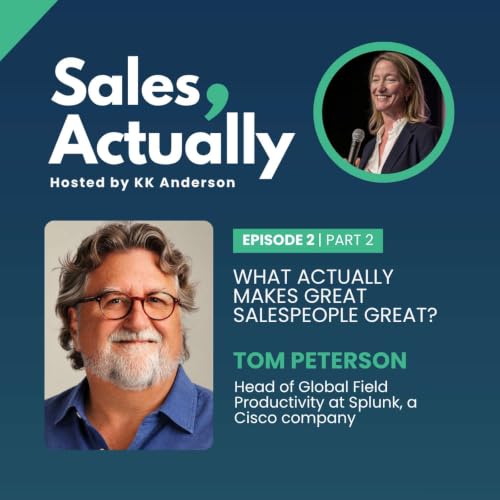
  • What Actually Makes Great Salespeople Great with Tom Peterson - Part 2
    2026/10/29
    In Part 2 of this conversation on Sales, Actually, host KK Anderson continues her discussion with Tom Peterson, Head of Global Field Productivity at Splunk, a Cisco business unit. Together, they explore why frontline sales managers have such a powerful influence on team performance, how consistent practice builds confident sellers, and why technology should enhance rather than replace the human side of selling.Tom shares how investing in frontline managers creates a multiplier effect across sales teams and why practical coaching, role-playing, and continuous skill development deliver more value than traditional product-focused training. The conversation also explores how AI is transforming sales productivity, from simplifying administrative work and forecast preparation to identifying individual skill gaps and improving sales conversations. But while these technologies offer significant opportunities, Tom and KK discuss the risks of relying too heavily on automation, particularly when prospecting and building meaningful customer relationships.As AI-generated outreach becomes increasingly common, the ability to establish trust, ask thoughtful questions, and connect with buyers on a personal level may become an even greater competitive advantage. Tom challenges conventional prospecting strategies, emphasizing the importance of timing, relevance, and genuine relationships over automated outreach volume. The episode closes with a reflection on career success, personal fulfillment, and the importance of finding balance beyond titles, quotas, and professional achievements.What You’ll LearnWhy Frontline Managers Create a Multiplier Effect: Discover how developing the coaching capabilities of first-line sales leaders can improve the performance of entire teams and why investing in managers can deliver greater organizational impact than focusing exclusively on individual sellers.How Practice Builds Sales Confidence: Learn why role-playing, repetition, and realistic sales scenarios help sellers develop the confidence to navigate unexpected objections, adapt conversations, and identify new opportunities during customer meetings.Where AI Adds Value to Sales Productivity: Explore how AI agents and conversational intelligence can streamline administrative responsibilities, support forecast preparation, identify coaching opportunities, and help sales leaders focus on higher-value activities.Why Human Connection Still Matters in an Automated World: Understand how excessive reliance on AI-generated outreach can weaken personalization and trust, and why curiosity, thoughtful questioning, and authentic relationships remain essential to effective selling.How to Rethink Prospecting and Long-Term Success: Examine why relevant timing and customer relationships may be more valuable than high-volume outreach, along with Tom’s perspective on balancing professional ambition with personal fulfillment.Key TopicsThe multiplier effect of investing in frontline sales managersMeasuring sales enablement success through leadership feedbackRole-playing, repetition, and practical sales skill developmentAI agents, sales productivity, and automated forecast preparationConversational intelligence and identifying individual coaching opportunitiesBuilding buyer trust through curiosity and meaningful conversationsThe limitations of AI-generated prospecting and sales automationRethinking career success, professional ambition, and work-life balanceGuest Spotlight: Tom PetersonTom Peterson is the Head of Global Field Productivity at Splunk, a Cisco business unit, where he focuses on improving sales effectiveness through leadership development, coaching, and practical skill-building.With extensive experience in sales leadership and field productivity, Tom brings a perspective on what drives sustainable sales performance. His approach emphasizes developing frontline managers, creating opportunities for consistent practice, and equipping sellers with the skills needed to navigate complex customer conversations.In this episode, Tom shares his experience building productivity initiatives at Splunk, explores the opportunities and limitations of AI in sales, and explains why human judgment, authentic relationships, and continuous development remain essential to creating high-performing sales organizations.Resources & MentionsSplunk: The Cisco business unit where Tom Peterson leads global field productivity initiatives.Cisco: Referenced in discussions about internally developed AI tools, employee AI agents, and sales productivity.AI Agents: Discussed as tools for automating administrative responsibilities, gathering sales updates, and supporting forecast preparation.Conversational Intelligence: Explored as a way to analyze sales conversations, identify missed opportunities, and improve individual coaching.AI-Powered Role-Playing: Discussed as a training approach that allows sellers to practice conversations with virtual executives, including CIOs, ...
    続きを読む 一部表示
    18 分
  • What Actually Makes Great Salespeople Great with Tom Peterson - Part 1
    2026/10/29
    In the inaugural episode of Sales, Actually, host KK Anderson sits down with Tom Peterson, Head of Global Field Productivity at Splunk, a business unit of Cisco, to explore what truly drives sales effectiveness. Drawing on decades of experience as an individual contributor, sales leader, and productivity executive, Tom shares the lessons that shaped his approach to selling, leadership, and developing high-performing sales teams.From his first sales job selling candy in office buildings to closing multimillion-dollar enterprise deals, Tom explains why understanding the buyer’s priorities matters more than perfecting a product pitch. He and KK discuss the importance of developing internal champions, identifying genuine compelling events, and recognizing the difference between sales activity and meaningful progress. They also examine why organizations continue promoting their best salespeople into management roles without adequately preparing them for the responsibilities of leadership.The conversation challenges traditional approaches to sales enablement and professional development. Tom shares how his early struggles as a sales manager influenced his leadership philosophy and why effective coaching, mentorship, and practical selling skills deserve greater attention. For CROs, sales managers, enablement leaders, and individual contributors, this episode offers a fresh perspective on building successful sales careers, developing stronger leaders, and creating sales conversations that lead to real business outcomes.What You’ll LearnWhat Makes a Great Salesperson: Why intellectual curiosity, persistence, patience, and the willingness to handle rejection are essential qualities for long-term success in sales.The Power of Champions and Compelling Events: How identifying influential internal advocates and understanding a buyer’s genuine reasons for change can create stronger opportunities and more predictable sales outcomes.Why Great Sellers Don’t Always Become Great Managers: The risks of promoting top-performing individual contributors into leadership positions without evaluating their readiness or providing proper training and mentorship.How to Prepare Future Sales Leaders: Why succession planning, hands-on leadership experience, coaching, and thoughtful career decisions are critical to developing effective sales managers.Why Sales Enablement Must Go Beyond Product Training: How developing discovery, qualification, storytelling, and consultative selling skills helps salespeople create meaningful business conversations instead of relying on product features.Key TopicsThe qualities and behaviors that distinguish high-performing sales professionalsEarly career lessons and the importance of understanding buyer motivationsBuilding internal champions in enterprise salesIdentifying genuine compelling events and creating urgencyThe challenges of transitioning from individual contributor to sales managerLeadership readiness, succession planning, and mentorshipThe evolution of sales enablement and field productivityConsultative selling, customer trust, and business-focused conversationsGuest Spotlight: Tom PetersonTom Peterson is the Head of Global Field Productivity at Splunk, a business unit of Cisco. With extensive experience spanning enterprise sales, sales management, and sales enablement, Tom has built his career around understanding what makes salespeople successful and how organizations can help them perform at their best.Throughout his career, Tom has served as an individual contributor, frontline sales manager, and Vice President of Sales before transitioning into sales enablement and field productivity. His firsthand experience navigating the challenges of selling and leading teams has shaped his approach to developing sales talent and improving organizational effectiveness.At Splunk, Tom focuses on helping sales professionals strengthen the practical skills required to succeed in complex selling environments. His work emphasizes developing internal champions, improving discovery and qualification, building stronger customer relationships, and equipping sales leaders to coach their teams more effectively.Resources & MentionsSplunk: Tom Peterson’s organization, where he leads global field productivity.Cisco: Parent company of Splunk.Clarify: Enterprise CRM company where Tom achieved significant sales success and received an early promotion into sales management.Siebel and PeopleSoft: Enterprise software companies mentioned in the discussion of Tom’s earlier sales career.Internal Champions: The importance of identifying and developing advocates within customer organizations who can influence purchasing decisions.Compelling Events: Understanding the business circumstances, deadlines, and consequences that create genuine urgency for buyers.Sales Enablement: The role of coaching, practical skill development, and field support in improving sales effectiveness.Consultative Selling: An approach ...
    続きを読む 一部表示
    22 分
  • Build Trust, Lead Better, and Sell Smarter with Joe Fontana - Part 2
    2026/10/29
    What happens when a successful salesperson becomes a leader but discovers that the same approach that drove individual success can push an entire team away? In this episode, Sales, Actually, host KK Anderson continues her conversation with Joe Fontana, Chief Marketing Officer at Amzai, to explore the leadership lessons, accountability practices, and personal growth required to build high-performing sales teams. Drawing on decades of experience in sales management and coaching, Joe shares how early leadership mistakes transformed his understanding of what it truly means to lead people.Joe recounts becoming a sales manager on Wall Street at just 19 years old, overseeing professionals with significantly more experience than he had. His early success created confidence, but it also led to an inflexible leadership style that eventually caused eight of his top producers to walk out. That experience forced him to reconsider how he approached coaching, communication, and individual development. Rather than treating every salesperson the same, Joe learned to recognize different personalities, learning styles, and motivations while building stronger relationships based on respect, trust, and mutual accountability.The conversation also explores why motivation alone cannot sustain sales performance and how genuine accountability requires sellers to take ownership of their decisions, preparation, and results. Joe challenges the growing dependence on AI-powered sales tools, explaining why technology should support sound judgment rather than replace personal responsibility. Through practical examples of rebuilding struggling sales teams, he demonstrates how developing fundamental selling skills, reviewing automated outreach, and understanding customer needs can create more effective sales professionals.For sales managers, revenue leaders, and professionals looking to improve their performance, this episode offers a perspective on balancing individual coaching with measurable business outcomes. KK and Joe discuss the importance of leading through personal investment, creating a culture of ownership, and understanding the difference between encouraging employees and genuinely coaching them to improve. Part 2 reinforces a central lesson: effective sales leadership is not simply about managing numbers, but about developing people who take responsibility for their own success.What You’ll LearnWhy Great Salespeople Don’t Automatically Become Great Leaders: Discover how Joe’s early experiences managing seasoned Wall Street professionals revealed the importance of earning respect, developing leadership skills, and recognizing that individual sales success does not guarantee effective management.How Leadership Mistakes Can Transform Your Management Approach: Learn what happened when eight top-performing sellers walked out on Joe and how that experience taught him to lead with greater empathy, respect, and attention to individual needs.Why Accountability Matters More Than Motivation: Understand why short-term encouragement cannot replace consistent preparation, personal responsibility, and the discipline required to achieve sustainable sales results.How to Build Ownership Without Creating Dependence on Technology: Explore how sales leaders can help their teams use AI and automation responsibly while maintaining accountability for prospect research, messaging quality, and customer engagement.How Individualized Coaching Improves Sales Performance: Learn how reverse engineering performance goals, identifying individual development needs, and investing time in coaching can help leaders create predictable results without treating every salesperson the same.The Difference Between Coaching and Cheerleading: Discover why effective coaches do more than offer encouragement. They establish expectations, challenge individuals to improve, and provide the guidance necessary for meaningful professional growth.Key TopicsJoe Fontana’s early leadership experiences on Wall Street.Earning the right to lead experienced sales professionals.The leadership mistakes that caused eight top performers to leave.Treating salespeople as individuals rather than performance metrics.Balancing personalized coaching with pipeline and revenue goals.Why motivation is temporary and accountability requires ownership.Developing responsible AI usage and reducing dependence on automation.Strengthening prospect research, personalized outreach, and sales fundamentals.Encouraging sales professionals to become the CEO of their own roles.Understanding the difference between effective coaching and simple encouragement.Building trust, credibility, and stronger customer relationships through active listening.Guest Spotlight: Joe FontanaJoe Fontana is the Chief Marketing Officer at Amzai, with more than 35 years of experience in sales and a career that includes coaching and training over 5,000 sales professionals.Joe began his leadership journey at just 19 years old on ...
    続きを読む 一部表示
    27 分
  • Build Trust, Lead Better, and Sell Smarter with Joe Fontana - Part 1
    2026/10/29
    In this episode of Sales, Actually, host KK Anderson sits down with Joe Fontana, Chief Marketing Officer at Amzai, to explore why technology alone cannot replace sound judgment, authentic relationships, and effective sales leadership. Drawing on decades of experience building sales organizations and coaching sales professionals, Joe challenges the assumption that more automation automatically produces better results.The conversation examines the risks of relying too heavily on AI-powered sales tools without proper oversight, including Joe’s firsthand experience with an automated outreach campaign that sent 750 misguided messages in approximately 90 minutes. KK and Joe discuss why successful selling requires more than generating activity, booking meetings, or delivering polished product presentations. As buyers become increasingly informed, sellers must demonstrate credibility, ask meaningful questions, understand underlying business challenges, and know when to involve technical experts. Rather than competing with buyers on product knowledge, effective sales professionals create value by helping customers make confident, informed decisions.Beyond technology and buyer relationships, Joe shares his perspective on what separates a sales manager from a true sales leader. He explains why developing confidence, understanding individual motivations, and investing in people can create stronger teams than relying solely on performance metrics and activity tracking. For sales leaders navigating AI adoption, changing buyer expectations, and increasing pressure to deliver results, this conversation offers practical insights into building trust, improving sales effectiveness, and creating a culture of accountability. Part 1 sets the foundation for a deeper exploration of leadership lessons and personal accountability in Part 2.What You’ll LearnWhy AI Amplifies Sales Behavior Rather Than Fixing It: Understand why introducing advanced sales technology without addressing poor selling habits can increase mistakes, damage credibility, and create more problems than it solves.How to Build Trust With Today’s Informed Buyers: Discover why credibility, transparency, and a genuine understanding of business challenges matter more than product knowledge alone when engaging buyers who have already completed extensive research.Why Sales Conversations Should Start With Business Problems: Learn how to move discussions beyond technical specifications and product features by uncovering the challenges driving a buyer’s decision and connecting them with the right expertise.What Separates Sales Managers From Effective Sales Leaders: Explore why strong individual sales performance does not automatically translate into leadership ability and how understanding different personalities, motivations, and development needs can improve team performance.How to Create Accountability Through Belief and Personal Investment: Learn why treating salespeople as individuals, building their confidence, and supporting their professional growth can encourage greater ownership, stronger commitment, and more consistent execution.Key TopicsThe risks of AI-driven sales automation without proper oversight and quality control.How excessive prospecting activity can damage relationships and brand reputation.The growing knowledge gap between informed buyers and traditional sales approaches.Building credibility through transparency, active listening, and buyer-focused conversations.The importance of diagnosing business challenges before presenting solutions.Rethinking traditional sales methodologies in an increasingly buyer-driven environment.The transition from individual sales contributor to people-focused leader.Developing team confidence, personal accountability, and a culture of trust.Guest Spotlight: Joe FontanaJoe Fontana is the Chief Marketing Officer at Amzai, bringing decades of experience in sales leadership, team development, and coaching sales professionals and managers.Throughout his career, Joe has focused on understanding the behaviors, mindsets, and leadership practices that influence sales performance. His approach emphasizes the importance of building confidence, developing individual strengths, and creating environments where salespeople feel empowered to take ownership of their success.Joe brings a practical perspective to the evolving relationship between artificial intelligence and human judgment in sales. He advocates for responsible technology adoption, stronger buyer relationships, and leadership practices that prioritize personal development alongside business results.In this episode, Joe shares lessons from his experiences managing sales organizations, navigating the challenges of AI-powered prospecting, and helping sales teams develop the trust, credibility, and accountability necessary for long-term success.Resources & MentionsAmzai: The company where Joe Fontana serves as Chief Marketing Officer.AI-Powered Sales Development ...
    続きを読む 一部表示
    23 分