エピソード

  • Episode 19 The Ripple Effect: Future Leaders — Cognitive Mirroring
    2026/09/01
    In this solo episode of The Ripple Effect, Lynne Brodie continues the Future Leaders Series by examining cognitive mirroring—the ability to reflect another person's thinking back to them with enough accuracy and clarity that they can recognize the structure of their own thought process. Lynne explains that highly capable leaders often know more than they can immediately articulate. They may be processing multiple priorities, risks, possibilities, relationships, and consequences simultaneously. Under pressure, those thoughts can become compressed, fragmented, or difficult to communicate. The leader may sense that something is wrong without yet having language for it. They may be moving toward a decision while still holding contradictory assumptions. They may repeatedly discuss the same issue without identifying the unresolved question underneath it. Cognitive mirroring helps make that thinking visible. Lynne distinguishes cognitive mirroring from imitation, agreement, advice, or simply repeating someone's words. It is not about copying another person's language or confirming everything they say. It is also not about imposing an external interpretation on their thinking. Accurate cognitive mirroring reflects the deeper architecture of what the person is communicating, including: The central issue beneath the details Assumptions influencing the conclusion Priorities competing for attention Contradictions between stated intentions and actual concerns Questions that remain unresolved Patterns appearing across several situations Ideas that are beginning to form but have not yet been fully expressed Emotional pressure affecting the person's interpretation The decision the person may already be approaching The purpose is to help leaders hear what they are actually thinking. Lynne explains that leaders frequently receive advice before they have fully clarified the problem. Advisors, colleagues, and team members may quickly offer solutions based on their own experiences, preferences, or assumptions. This can add more information to an already overloaded cognitive environment without improving understanding. Cognitive mirroring creates a different kind of interaction. Instead of immediately supplying an answer, the listener reflects what appears to be present in the leader's thinking and allows the leader to confirm, correct, expand, or reject that reflection. This process may sound like: "You appear to be evaluating two different risks." "The stated concern is timing, but the recurring issue seems to be trust." "You are describing this as a resource problem, although the examples point toward decision authority." "Part of you appears ready to move, while another part is still waiting for information." "These options seem different, but they are all attempting to solve the same underlying problem." "You have returned to this issue several times without naming the decision that must be made." The mirror does not determine the answer. It helps the leader see the thinking that is producing the answer. Lynne also explains why cognitive mirroring is valuable during periods of complexity and pressure. When leaders are carrying too much information, their thinking can become circular. They may repeat the same concerns, add more analysis, revisit settled questions, or confuse the volume of information with the quality of understanding. An accurate reflection interrupts that cycle by organizing what is already present. It helps distinguish: Facts from interpretations Evidence from assumptions Present conditions from anticipated outcomes Strategic concerns from emotional reactions Genuine uncertainty from delayed commitment Several visible problems from one underlying issue What is known from what still needs to be investigated This separation improves decision quality because it reduces cognitive noise without oversimplifying the situation. Cognitive mirroring also has an important organizational application. Teams often appear to disagree when the deeper problem is that people are operating from different mental models. Two executives may use the same word—such as growth, innovation, urgency, accountability, or risk—while assigning different meanings to it. Meetings continue, but the apparent agreement never produces coordinated action because the participants are not actually working from the same understanding. A leader using cognitive mirroring can reflect the differences clearly: One person may define growth as revenue expansion while another defines it as market influence. One department may interpret urgency as immediate action while another interprets it as rapid but controlled evaluation. One executive may view accountability as individual ownership while another sees it as shared system responsibility. One team may believe innovation requires experimentation while another believes it requires predictability and control. Making these mental models visible allows the group to address ...
    続きを読む 一部表示
    9 分
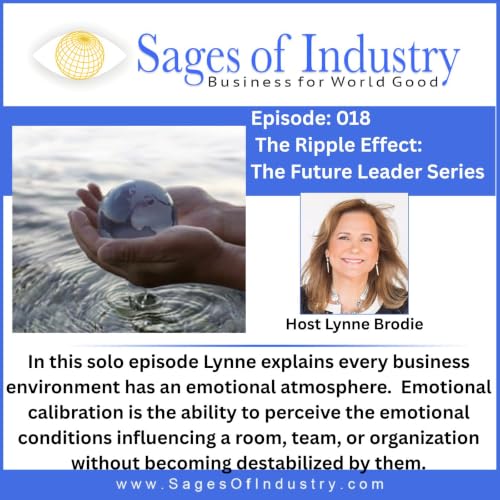
  • 018 The Ripple Effect Future Leaders Series- Emotional Calibration
    2026/08/25
    In this solo episode of The Ripple Effect, Lynne Brodie continues the Future Leaders Series by examining emotional calibration—the ability to perceive the emotional conditions influencing a room, team, or organization without becoming destabilized by them. Lynne explains that every business environment has an emotional atmosphere. Leaders may enter a meeting and immediately sense confidence, uncertainty, tension, fatigue, urgency, resistance, or guardedness before anyone states those feelings directly. These emotional conditions are not separate from business performance. They influence: The quality of decisions The willingness to raise concerns The speed of execution How people respond to change Whether disagreement becomes productive or defensive Whether teams move with confidence or hesitation Whether important information is openly communicated Many leaders are trained to pay attention to words, metrics, presentations, and formal behavior while overlooking the emotional conditions beneath them. Yet what remains unspoken can shape an outcome as strongly as what appears in the agenda. Emotional calibration is more than simply "reading the room." Lynne distinguishes it from emotional absorption, suppression, or reaction. A leader who absorbs the room may take on the anxiety, frustration, or urgency of others and begin responding from that emotional state. A leader who suppresses emotion may ignore meaningful signals and continue pushing forward without understanding why participation, trust, or execution is declining. A calibrated leader can sense what is present while maintaining enough internal stability to interpret it accurately. This requires leaders to distinguish between: What they are personally feeling What another individual may be feeling What is being generated by the group What pressure is coming from the larger organization What emotions are temporary reactions What emotions indicate a deeper structural issue Lynne explains that emotion should be treated as information, but not automatically as instruction. Anxiety may reveal uncertainty, but it does not necessarily mean a decision is wrong. Resistance may indicate fear, unresolved risk, lack of trust, or incomplete understanding. Enthusiasm may represent genuine commitment, but it can also reflect compliance, group pressure, or a desire to please authority. The leader's responsibility is not to react immediately to the emotional signal. It is to understand what the signal is communicating. Lynne provides practical examples of how emotional conditions appear beneath visible behavior. A team may verbally agree with a strategy while the atmosphere shifts when implementation is discussed. A meeting may appear energetic while urgency is concealing confusion. Silence may indicate thoughtful consideration, disengagement, fear, or an unwillingness to challenge the leader. The same visible behavior can have different meanings depending on the emotional and organizational context surrounding it. Future-ready leaders therefore pay attention to shifts such as: Where the energy in a conversation increases or decreases Which topics create hesitation When people become more guarded Where enthusiasm feels natural or forced Which questions remain unanswered When the room becomes unusually quiet Who begins overexplaining Who withdraws from participation What changes when a particular person speaks Which concerns are repeatedly approached but never directly named These changes provide information about the conditions influencing the team. The episode also examines emotional calibration in high-pressure environments. Under pressure, a leader's emotional state becomes highly influential. Teams look to the leader for signals about the seriousness of a situation, the level of risk, and whether the organization remains capable of responding effectively. If the leader becomes visibly reactive, defensive, or overwhelmed, that emotional instability can spread through the team. If the leader denies the seriousness of the situation, employees may lose trust in the leader's judgment. Calibration does not require pretending that everything is fine. It requires acknowledging reality while remaining sufficiently centered to think, communicate, and act deliberately. Lynne explains that a regulated leader can help a group regain clarity without controlling or dismissing its emotions. The leader becomes a stabilizing presence—not by forcing calm, but by creating enough coherence for people to examine the situation accurately. Self-awareness is essential to this capability. Leaders must understand their own emotional baseline, sensitivities, assumptions, and triggers. Without that awareness, they may confuse their personal anxiety with organizational risk or interpret another person's hesitation through the lens of their own experience. Emotional calibration asks leaders to pause and consider: Is this emotion mine? Is it coming from another ...
    続きを読む 一部表示
    10 分
  • 0017 The Ripple Effect: Future Leaders — Reading Systems Within Systems & Organizational Architecture
    2026/08/20
    In this solo episode of The Ripple Effect, Lynne Brodie continues the Future Leaders Series by examining a capability that becomes increasingly important as organizations grow more complex: the ability to read systems within systems. Lynne explains that organizations cannot be understood only through what is formally visible. Organizational charts, reporting relationships, documented processes, policies, strategies, and performance metrics reveal only part of how a business actually operates. Beneath those formal structures are additional systems that influence behavior and results: Incentives Informal influence networks Historical relationships Unspoken assumptions Competing priorities Perceived risks Resource flows Decision authority Emotional pressures Patterns of trust and resistance These systems continuously interact. The outcomes an organization produces are often determined less by its stated intentions than by the alignment—or conflict—between these underlying forces. Lynne explains that many leadership problems are therefore misdiagnosed. Leaders may assume that an initiative stalled because a person failed, a team resisted, or a process was incomplete. However, the deeper problem may be a conflict between the systems surrounding the work. An organization may publicly encourage innovation while operationally rewarding risk avoidance. It may ask departments to collaborate while compensation structures reward individual competition. It may demand speed while keeping decision authority concentrated at the top. In each case, the visible expectation and the underlying system are working against each other. The episode then moves from systems thinking into organizational architecture. Lynne describes organizations as living systems shaped by relationships between incentives, pressure, beliefs, timing, authority, information, and resources. This architecture determines: How information moves Where decisions slow Which behaviors become normal How innovation spreads Where resistance develops Which issues repeatedly escalate Whether responsibility is supported by sufficient authority Whether strategy becomes coordinated action Surface-level analysis often misses these dynamics because they do not appear clearly on an organizational chart. Future-ready leaders learn to observe the deeper arrangement of relationships, pressure points, decision pathways, and momentum influencing performance. Lynne also explains that an organization's architecture can become outdated even when the formal structure remains unchanged. As companies grow, responsibilities expand, decisions become more interconnected, competing priorities intensify, and old operating models may no longer support the organization's current level of complexity. The symptoms can include: More meetings Slower decisions Inconsistent execution Repeated escalation Leadership overload Fragmented information Responsibility without authority Initiatives that repeatedly stall at the same points No single problem may explain the slowdown. The difficulty comes from the way multiple systems are interacting. Lynne encourages leaders to look beyond what people say the organization values and examine what the system consistently produces. Repeated outcomes reveal the real architecture. If collaboration is repeatedly discussed but competition continues, the system may reward competition. If leaders promote empowerment but every important decision is escalated, the system may reward dependency. If speed is a strategic priority but approvals remain centralized, the system is designed for control rather than velocity. Advanced leadership therefore requires the ability to distinguish isolated events from system-generated outcomes. Lynne offers a series of practical questions leaders can use to begin reading the organization more accurately: What incentives are shaping behavior? Which informal networks influence decisions? Where do stated priorities conflict with rewarded outcomes? What assumptions are operating without examination? Where does information consistently slow? Which decisions require excessive effort? Where does responsibility exceed authority? Which tensions repeatedly remain unresolved? What does the organization consistently produce, regardless of what leaders say they want? Recurring friction points reveal the underlying architecture. The episode closes by connecting systems perception to Strategic Flow Activation. Lynne explains that sustainable change occurs when leaders address the architecture producing an outcome rather than repeatedly trying to correct the outcome itself. Organizations do not move according to their intentions alone. They move according to their underlying design. Once leaders can perceive that design, they can begin changing it with far greater precision. Key Takeaways Organizations operate through multiple formal and informal systems at the same time. Organizational charts, processes, policies, ...
    続きを読む 一部表示
    10 分
  • Episode 16 with Nicole Jansen: Future Leaders Purpose-Driven Leadership, Human-Centered Business, and Developing People
    2026/08/11
    In this episode of Sages of Industry, Lynne Brodie speaks with Nicole Jansen about the changing expectations facing business leaders and why traditional, profit-centered, top-down leadership models are becoming less effective. Nicole explains that employees, customers, and emerging leaders are increasingly frustrated with corruption, disconnected leadership, and business practices that prioritize financial results without considering people or purpose. Individuals want to work for and purchase from organizations whose values are visible in the way they operate—not only in their marketing. The conversation examines the growing importance of integrity and values alignment. Nicole notes that many experienced leaders continue using approaches that worked in the past but no longer produce the same results. Leaders may have achieved considerable success through established methods, yet find that those methods are not engaging today's employees, attracting the right talent, or responding effectively to a changing business environment. Nicole and Lynne also discuss the expanding role of artificial intelligence. Nicole sees AI as a useful business tool, but cautions against treating it as a substitute for judgment, independent thinking, or human connection. She observes that people are already experiencing technology and video-conference fatigue. As companies adopt more automation, leaders will need to become more intentional about creating genuine interaction with employees and customers. A significant part of the episode focuses on Nicole's experience growing up in an entrepreneurial family. Her parents built businesses around a mission and involved Nicole and her brother in understanding what the business was intended to accomplish. That experience shaped her belief that an organization's mission should guide its decisions and that team interests must take precedence over individual agendas. The discussion then turns to personal and organizational transformation. Nicole distinguishes genuine transformation from superficial behavior modification. Asking people to display approved behaviors without addressing the beliefs beneath those behaviors can produce interactions that feel forced or disingenuous. According to Nicole, behavior is influenced by what people believe to be true about themselves, other people, and the world around them. Sustainable transformation begins when a person becomes aware of those beliefs, makes a different choice, and takes action based on that choice. Awareness without action does not produce meaningful change. Nicole and Lynne examine how this applies inside organizations. Employees may be placed in the wrong roles, prevented from using their full capabilities, or expected to conform rather than contribute their individual strengths. When people feel unseen, underused, or disconnected from meaningful work, they often disengage. Rather than immediately judging an employee who appears to have checked out, Nicole encourages leaders to ask what may be happening beneath the behavior. The employee may be dealing with difficulties outside work, may lack the support required to succeed, or may be working in a role that does not use their abilities effectively. This approach requires leaders to support the whole person while maintaining clear expectations. Nicole explains that employees who feel respected and supported are more likely to communicate openly—even when they are preparing to leave the organization. Leaders should not measure success only by how long someone remains employed. They should also consider whether the person became more capable, confident, and prepared for their next opportunity. Nicole closes by reflecting on the leadership legacy of her parents and the lessons she learned from both effective and ineffective leaders. Financial achievement matters, but the more enduring measure of leadership is the number of people strengthened, encouraged, and equipped to make a difference because of their experience with you. Key Takeaways Employees and customers increasingly expect organizations to demonstrate integrity, values, and a meaningful purpose. Profit-centered, top-down leadership models are becoming less effective in a more transparent and human-centered business environment. Leadership practices that produced results in the past may not engage today's employees or respond effectively to current conditions. Purpose-driven companies can attract people who want their work and purchasing decisions to align with their values. AI is a valuable tool, but it should not replace critical thinking, independent judgment, creativity, or genuine human interaction. As technology becomes more prominent, human connection becomes a more important competitive and leadership capability. Business partnerships require alignment around mission, values, commitment, and direction—not simply opportunity or personal loyalty. Sustainable transformation is deeper than behavior ...
    続きを読む 一部表示
    42 分
  • 015 The Ripple Effect: Future Leaders Series- Strategic Foresight as an Early Advantage
    2026/07/28
    In this solo episode of The Ripple Effect, Lynne Brodie continues the Future Leaders Series by examining strategic foresight—the ability to recognize where conditions are moving before the resulting change becomes obvious. Lynne begins by connecting strategic foresight to the previous episode on pattern recognition. Pattern recognition helps leaders identify what is repeating beneath visible events. Strategic foresight takes that perception further by asking what those patterns, pressures, and emerging signals are likely to become. A central point in the episode is that most organizations respond to change only after its effects are already visible. By that point, competitors may already be adapting, customer expectations may have shifted, internal resistance may have increased, or an innovation opportunity may have narrowed. Future-ready leaders learn to identify these developments earlier. Lynne explains that strategic foresight is not fortune-telling and is not dependent on predicting one exact outcome. It is a disciplined form of perception that involves observing multiple signals, understanding their significance, and preparing for several credible possibilities. She encourages leaders to ask more precise questions: What trends are beginning to appear? Which long-standing assumptions are becoming less reliable? What early signals are being dismissed because they are not yet measurable? What changes are underway before they become widely recognized? What options can be created now rather than after circumstances force a response? Where is the organization operating according to someone else's timing? The episode also focuses on inflection points—moments when existing conditions begin shifting toward a different reality. These moments rarely announce themselves clearly. They first appear through subtle changes in customer expectations, team dynamics, decision-making, technology, market behavior, organizational pressure, and the usefulness of existing solutions. Lynne explains that leaders can detect these shifts by paying attention to momentum. They should examine where momentum is increasing, where it is decreasing, where resistance is building, where decisions are repeatedly delayed, and where conversations are being revisited without resolution. Strategic foresight therefore requires more than collecting information. It requires interpreting pressure, movement, coherence, resistance, and timing across a larger system. The episode closes by showing how the Future Leaders capabilities work together. Pattern recognition identifies the structures and behaviors that are repeating. Strategic foresight interprets where those patterns may lead. Emotional calibration—the next capability in the series—helps leaders understand the human and emotional forces influencing whether change will accelerate, stall, or be resisted. Together, these capabilities allow leaders to sense meaningful shifts before others can fully articulate what is changing. Key Takeaways Strategic foresight is the ability to recognize where conditions are moving before the resulting change becomes obvious. Most organizations react after change is measurable. Future-ready leaders identify emerging signals while there is still time to create options. Pattern recognition and strategic foresight are closely aligned. Pattern recognition identifies what is repeating; strategic foresight evaluates what those patterns are becoming. Strategic foresight is not about predicting one exact future. It is about preparing for several credible possibilities. Leaders should examine trends, weakening assumptions, overlooked signals, changing customer expectations, team dynamics, technology, and market behavior. Inflection points rarely announce themselves directly. They reveal themselves through changes in pressure, momentum, resistance, coherence, and decision patterns. Repeated delays, unresolved conversations, declining usefulness of existing solutions, and increasing resistance can all be early indicators of a larger shift. Better foresight does not necessarily require more information. It requires more accurate interpretation of the information and conditions already present. Strategic foresight gives leaders time to create options before circumstances reduce their choices. Pattern recognition, strategic foresight, and emotional calibration operate as an integrated leadership-perception system. Discussed Topics Introduction to strategic foresight Recap of pattern recognition How pattern recognition and foresight work together Why organizations respond after change becomes obvious Recognizing emerging market shifts Cultural changes and organizational friction Innovation opportunities and early signals Strategic foresight versus prediction Working with multiple signals simultaneously Questioning assumptions that are becoming unreliable Preparing for possibilities rather than forecasting one outcome Creating strategic options ...
    続きを読む 一部表示
    10 分
  • 014 The Ripple Effect Future Leaders Series- Leadership Precision Using Pattern Recognition as a Strategic Asset
    2026/07/14
    In this solo Ripple Effect episode, Lynne Brodie narrows the Future Leaders Series to one specific executive capability: pattern recognition. The episode's core argument is that many leadership failures do not come from a lack of intelligence, effort, or even strategy. They come from misreading what is actually repeating inside the system. Lynne frames pattern recognition as the ability to detect the recurring structures, behaviors, pressures, and incentives that sit beneath visible events. That fits her public Future Leader framing, which argues that advanced leadership now depends on reading complexity beyond surface form. A major theme in the episode is that most leaders are trained to respond to symptoms, while future-ready leaders learn to read the recurrence underneath the symptoms. Instead of reacting to isolated incidents, Lynne focuses on identifying what keeps happening across meetings, teams, decisions, market behavior, and organizational dynamics. In that sense, pattern recognition is not intuition as guesswork. It is disciplined perception: seeing the same structure reappear through different forms. That aligns with her public description of pattern recognition as part of a broader perceptive system that also includes strategic foresight, rapid synthesis, and timing. The episode also connects pattern recognition directly to leadership precision. Once a leader sees what is repeating, they can intervene earlier, interpret situations more accurately, and avoid wasting energy on surface-level fixes. Lynne's public Future Leaders Series framing makes the same point in broader terms: leaders now need to recognize emerging patterns, read organizational dynamics, understand hidden incentives, and sense momentum shifts before they become obvious to everyone else. Another strong thread is that pattern recognition changes the quality of decision-making. Rather than collecting more and more information, the future leader learns to see which signals matter, what they connect to, and what they are likely to become. The series moves beyond conventional analysis into better interpretation under complexity. Overall, this episode presents Lynne's ability to provide pattern recognition as a foundational future-leader skill. It is not just a cognitive gift. It is a strategic advantage: the ability to see what is actually shaping the system before the rest of the room has language for it. Key Takeaways This is a short, snackable solo Ripple Effect episode focused specifically on pattern recognition within the broader Future Leaders Series. Lynne frames leadership breakdowns as problems of misperception, not only problems of talent, planning, or effort. Pattern recognition is presented as the capacity to detect recurring structures beneath surface events. Future-ready leaders do not just notice isolated events. They identify repeated behaviors, recurring friction, hidden incentives, and momentum shifts. The episode links pattern recognition to earlier intervention, better decisions, and more accurate interpretation under complexity. This capability fits Lynne's larger public model of multidimensional leadership, which includes structural, emotional, cognitive, energetic, and temporal perception. Discussed Topics Introduction to the Future Leaders Series Why pattern recognition matters now Symptoms versus recurring structures Why conventional leadership often misreads complexity Repetition across teams, meetings, and decisions Pattern recognition in complex systems Reading organizational dynamics beneath the surface Hidden incentives and repeating friction Seeing what is emerging before it becomes obvious Better interpretation rather than more information Decision quality under uncertainty Pattern recognition as a strategic leadership advantage Timeline 00:00 Welcome to The Ripple Effect 00:18 Introduction to this Future Leaders episode 00:42 The focus of this episode: pattern recognition 01:10 Why leaders often misread what is happening 01:42 Symptoms versus the deeper recurring structure 02:15 What pattern recognition actually means in leadership 02:52 Seeing repetition across people, teams, and decisions 03:30 Why reacting to isolated events leads to poor intervention 04:05 Reading what keeps repeating beneath visible problems 04:42 Pattern recognition in complex systems and organizations 05:18 Hidden incentives, recurring friction, and structural signals 05:55 How pattern recognition improves decision-making 06:32 Why better interpretation matters more than more data 07:08 Detecting shifts earlier than the rest of the room 07:42 Pattern recognition as a future-leader advantage 08:18 Closing reflections on leadership and perception 08:46 Episode wrap-up Get more detail my Blog at https://lynnebrodie.com/blog/ Or listen in on: Hosted: https://sites.libsyn.com/615595 Apple: https://podcasts.apple.com/us/podcast/sages-of-industry/id1894954630 iHeart: https://iheart.com/podcast/331031474 Spotify: https://...
    続きを読む 一部表示
    9 分
  • 013 The Ripple Effect Future Leaders Series Detail
    2026/07/07
    In this solo Ripple Effect episode, Lynne Brodie lays out the core premise behind her Future Leaders Series: traditional leadership models are no longer enough for the level of complexity leaders now face. She argues that many organizations still rely too heavily on analysis, planning, process, and conventional management tools, even though the real breakdown often happens at the level of perception. The issue is not always capability or strategy. It is that complexity has outpaced the leader's ability to read what is actually happening beneath the surface. A major theme in the episode is that the future leader must become multidimensional. Lynne describes leadership as no longer purely analytical, but structural, emotional, cognitive, energetic, and temporal all at once. She explains that the leaders creating disproportionate impact are learning to interpret patterns, recognize momentum shifts, understand emotional dynamics, read hidden incentives, and act with precision under pressure. Those same ideas appear in Lynne's recent public framing of "The Future Leader," where she argues that advanced leadership now requires leaders to perceive what others cannot yet articulate. She also uses the episode to define the specific perceptual and strategic demands of next-generation leadership. The future leader is presented not simply as a better planner, but as someone who can detect emerging patterns early, anticipate future scenarios, sense invisible friction, interpret system behavior, and make decisions under uncertainty. This episode positions those capacities as practical business competencies rather than abstract personal-development ideas. Another strong thread is that leadership development itself must change. Lynne contrasts older leadership models built around strategic planning, financial analysis, operational management, and process optimization with the newer requirements of a more interconnected environment. In her framing, these older skills still matter, but they are no longer sufficient by themselves. What matters now is how information is interpreted, not just how much information is collected. That emphasis closely matches the public "Future Leader" piece tied to the same concepts. The episode closes by moving from diagnosis to invitation. Lynne frames the Future Leaders Series as a way of developing the deeper perceptual capacities that let leaders see beyond visible events, improve decision quality, and accelerate execution. The overarching message is clear: the future belongs to leaders who can see beyond the obvious and respond to complexity with greater depth, accuracy, and timing. Key Takeaways This is a short solo Ripple Effect episode focused on the Future Leaders Series and what future-ready leadership actually requires. Lynne argues that the real leadership bottleneck is often perception, not a lack of talent, funding, or formal strategy. She describes advanced leadership as multidimensional: structural, emotional, cognitive, energetic, and temporal. The future leader must be able to recognize emerging patterns, anticipate future scenarios, read organizational dynamics, understand hidden incentives, sense momentum shifts, and make decisions under uncertainty. These exact themes align with Lynne's public "Future Leader" framing and her rare gifts and abilities which activates Strategic flow to open your Genius Zone. Traditional leadership capabilities such as planning, operations, finance, and process remain important, but they are no longer enough on their own. The competitive advantage belongs to leaders who can interpret what others cannot yet articulate. The Future Leaders Series is presented as a pathway to expanding perception so decision-making and execution improve. Discussed Topics Introduction to the Future Leaders Series Why traditional leadership models are no longer sufficient Complexity outpacing conventional leadership perception The difference between capability problems and perception problems Advanced leadership as multidimensional Structural, emotional, cognitive, energetic, and temporal leadership Pattern recognition in complex systems Anticipating future scenarios Reading organizational dynamics Understanding hidden incentives Sensing momentum shifts Decision-making under uncertainty Invisible friction inside organizations Why interpretation matters more than more information Strategic Flow Activation and becoming the leader of the future Timeline 00:00 Welcome to The Ripple Effect 00:18 Introduction to the Future Leaders Series 00:45 Why this conversation matters now 01:10 A leadership scenario: clear strategy, clear opportunity, but execution still slipping 01:45 The real issue is not always capability — it is perception under complexity 02:20 Why traditional leadership models rely too heavily on analysis 02:55 Advanced leadership now requires more than planning, finance, operations, and process 03:30 The future leader as multidimensional 04:...
    続きを読む 一部表示
    10 分
  • 012 Human Centered Innovation, Strategy Execution, and The Conditions for Real Change with Pate Moore, CEO of Humangood
    2026/06/30
    In this episode, Lynne Brodie speaks with Pate Moore about why so many organizations struggle to turn strategy into real execution, even when the plan itself looks sound. The conversation centers on the idea that the real bottleneck is often not the strategy, but the human system carrying it. From there, the discussion expands into employee experience, leadership behavior, internal culture, ownership, and what it actually takes to create an environment where people can do meaningful, innovative work. A major theme in the episode is that innovation is not just a toolkit or workshop exercise. Pate frames it as an ecosystem. He talks about the need to design conditions where people can contribute fully, where trust and ownership rise, and where execution does not depend on constant top-down pressure. The conversation treats innovation as something that must be embedded into the daily work environment rather than isolated in a separate initiative. Another strong thread is the distinction between surface solutions and deeper structural realities. Lynne and Pate keep returning to the invisible conditions underneath performance: how people experience work, how they relate to one another, how safe or constrained they feel, and whether the system is actually built for contribution. The episode positions these factors not as soft side topics, but as central drivers of execution, transformation, and growth. The discussion also moves into a more human view of leadership and design. Rather than focusing only on process, tools, or accountability, Pate emphasizes internal conditions, emotional truth, and the importance of connecting head and heart. The result is a conversation about building organizations that are not only more innovative, but more alive, more coherent, and more capable of sustaining change over time. Key Takeaways Strategy often fails at the point of human execution, not at the point of planning. The episode frames culture, employee experience, and internal conditions as performance variables, not secondary concerns. Innovation is treated as an ecosystem that must be built into everyday work, not a one-off exercise. Ownership rises when systems are designed for contribution rather than protection or compliance. Leadership pressure is not the same as scale; when everything still depends on the leader, the system is not yet truly working. The conversation points toward a more integrated model of innovation that includes mindset, emotional capacity, trust, and structural design. A recurring idea is that meaningful transformation requires both capability and capacity, not just skill or process. Discussed Topics Pate Moore's background and Humangood Human-centered innovation ecosystems The gap between strategy and execution Why execution problems are often human-system problems Employee experience as a business-performance issue Culture, trust, and ownership Designing conditions for contribution Innovation beyond workshops and tools Leadership dependence versus true scale Internal constraints that limit change Heart-centered innovation and deeper human connection The relationship between design, emotion, and execution Sustainable transformation inside organizations Building organizations where human potential can emerge Timeline 00:00 Welcome and introduction to Pate Moore 00:42 Pate's background and the work behind Humangood 01:45 What human-centered innovation ecosystems actually mean 03:00 Why strategy often fails in execution 04:20 The human system beneath organizational performance 05:35 Employee experience, culture, and service delivery 06:50 Why innovation cannot live only in workshops or special programs 08:05 Building conditions where ownership and contribution emerge 09:25 Trust, pressure, and the limits of compliance-based leadership 10:45 When growth still depends on the leader 12:00 The deeper architecture of transformation 13:15 Capability, capacity, and human readiness for change 14:40 Why internal conditions matter as much as strategy 16:00 Heart-centered innovation and connecting head and heart 17:30 Emotional truth, leadership, and meaningful design 18:45 What sustainable change looks like in practice 20:00 Implications for leaders, teams, and scaling organizations 21:20 Final reflections and where this work leads 22:15 Closing Top of Form Contact Pate More at: www.linkedin.com/in/iampate-humangood Bottom of Form
    続きを読む 一部表示
    23 分