エピソード

  • Letting the Sunshine In: Rose and Tiny Tim’s Story
    2026/11/09

    After 20 years in the U.S. Army and two deployments to Iraq, Rose found the transition home harder than anything she’d faced in uniform. Without the camaraderie and purpose of service, she struggled with anxiety, depression, sleeplessness and nightmares, and she withdrew from the world around her.

    Then her fellow wounded warriors pointed her to American Humane Society’s Pups4Patriots program, where she was paired with Tiny Tim, a Labrador Retriever. The two graduated together in December 2024. Today Tiny Tim’s steady routine of meals, walks and playtime gives Rose’s days structure, and she opens the blinds, enjoys the beach and the carnival, and can walk into a busy store and feel safe.

    Join Dr. Robin Ganzert for a moving conversation about service, healing and the human-animal bond. In Rose’s words, she never could have known that a hug of paws would save her life.

    続きを読む 一部表示
    22 分
  • A Blind Dolphin, a Fragmented River, and a Rare Conservation Win
    2026/11/02

    Most people have never heard of the Indus River dolphin, and it exists nowhere else on Earth. Known locally as the bhulan, it is functionally blind and navigates one of the world’s great rivers entirely by echolocation. Dams and irrigation barrages have shrunk its range by roughly 80 percent, yet it is one of the few river dolphins whose numbers are climbing instead of falling.

    On this episode of Robin’s Nest, Dr. Robin Ganzert talks with Dr. Abdul Kabir, a veterinarian and One Health researcher from Sindh, Pakistan, about how dolphins get stranded in irrigation canals, what a rescue looks like, and how fishing communities along the river have become the species’ strongest protectors. They also discuss why zoos and aquariums should be part of the fight, and what this rare comeback can teach the rest of the world.

    In this episode:

    • What makes the Indus River dolphin so unusual
    • How a rescue works when dolphins are trapped in canals
    • Why community partnership is the key to recovery
    • The case for connecting field conservation to zoos and aquariums
    続きを読む 一部表示
    12 分
  • Beyond the Big Cats: Saving the Species No One Talks About
    2026/10/26

    Dr. Yadvendradev Jhala, one of India’s foremost wildlife scientists and a returning Kiessling Prize finalist, rejoins Dr. Robin Ganzert to talk about the species that rarely make headlines. He explains why fewer than 120 Great Indian Bustards remain and how his breeding program became their insurance policy. He also covers his 25 years with Asiatic lions, which descend from fewer than 50 animals and are severely inbred, and his research on the world’s most ancient wolf lineages and on the vulture deaths that led India to ban diclofenac. He says his greatest contribution is the roughly 1,600 conservation practitioners he has trained, and he describes the international field course he would build with the Kiessling Prize.

    続きを読む 一部表示
    22 分
  • Nature’s Unsung Heroes: Inside the Fight to Save Africa’s Vultures
    2026/10/19

    Vultures are Africa’s cleanup crew, and they are vanishing. In this episode of Robin’s Nest, Dr. Robin Ganzert talks with Kerri Wolter, founder and CEO of VulPro, South Africa’s leading vulture conservation organization. Kerri left a career in banking to spend two decades pulling poisoned vultures back from the edge.

    Kerri explains why vultures matter to human health as much as wildlife, since they stop the spread of anthrax, botulism and rabies. She shares how VulPro breeds permanently injured birds that can never fly free, then releases their offspring into historical ranges. She also describes the upstream work: modifying deadly powerlines, investigating poisonings, tracking birds and helping drive restrictions on the toxic drug diclofenac.

    Kerri was also a finalist for Global Humane Society’s Kiessling Prize. She shares what the recognition means to her and how she would use it to protect the Great Karoo’s “silent sky,” from a new satellite rescue facility to safe feeding sites for vultures.

    続きを読む 一部表示
    27 分
  • The Race to Save Madagascar’s Lemurs with Dr. Jonah Ratsimbazafy
    2026/10/12

    Madagascar is home to more than 100 lemur species found nowhere else on Earth, and more than 90% of them face extinction. This week on Robin’s Nest, Dr. Robin Ganzert welcomes back Dr. Jonah Ratsimbazafy, Madagascar’s foremost primatologist, President of the Groupe d’Étude et de Recherche sur les Primates de Madagascar (GERP) and a Kiessling Prize finalist for the second time. A year after his first visit, the threats have escalated. Lemurs are being trafficked by the thousand, hunted for bushmeat and exposed to diseases that cross from forests into people. Dr. Ratsimbazafy shares what wildlife crime looks like on the ground, why enforcement alone is not the answer, and how AI-enabled camera traps, genomic research and zoo-based education could change the odds for the species that depend on Madagascar’s forests.

    続きを読む 一部表示
    21 分
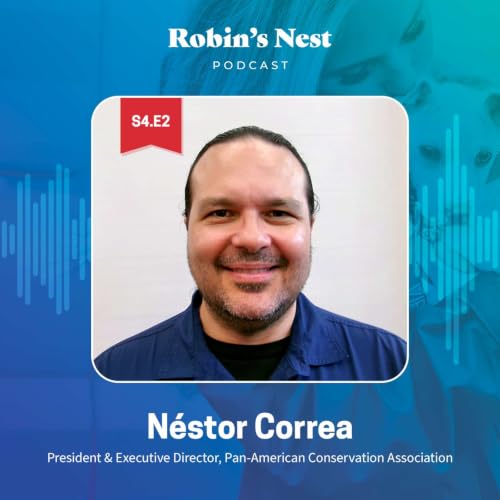
  • Slow Down, Sloths Are Being Tracked: Néstor Correa on Life After Rescue
    2026/10/05

    What happens to a rescued animal after you let it go? Néstor Correa wasn't satisfied with not knowing. On this episode of Robin's Nest, Dr. Robin Ganzert sits down with the environmental lawyer turned conservation scientist who founded Panama's first wildlife rescue organization. During the Panama Canal Expansion, he led one of the largest wildlife relocations ever attempted in a tropical forest, moving nearly 2,500 animals across more than 100 species. Then he asked the question the field had been avoiding: not how many animals were released, but how many survived.

    To find out, his team put radio trackers on rehabilitated sloths and followed them into the rainforest. The results are some of the first hard evidence of what happens to them after release. Néstor and Robin talk about the rescue, what sloths have taught him, and the Panama Nature Center, a new home for rescue, neonatal care, research and education. He's also a finalist for the Kiessling Prize, which could help him expand that work and build a conservation education center for Panamanian children.

    Listen now on Robin's Nest, the podcast where the science of animal welfare meets the heart of humane advocacy.

    続きを読む 一部表示
    2 時間 6 分
  • The Only Comeback of Its Kind: Dr. Ding Wang, 2026 Kiessling Prize Recipient
    2026/09/28

    In 2007, the baiji was declared functionally extinct. Dr. Ding Wang had spent his career trying to save it, and he watched it disappear from the Yangtze River forever. Then he made a decision: it would not happen twice.

    Nearly twenty years later, the Yangtze finless porpoise, known in China as the smiling angel of the Yangtze, is the only critically endangered small cetacean on Earth that is recovering. The wild population stopped declining in 2022 and has climbed to 1,426, a 40 percent increase since 2017.

    This week on Robin’s Nest, Dr. Robin Ganzert sits down with Dr. Wang, newly named recipient of the Wolfgang Kiessling International Prize for Species Conservation, to talk about four decades on one river, the loss that changed everything, and why he believes the porpoise’s survival depends on whether people are willing to change.

    続きを読む 一部表示
    28 分
  • Paws, Purpose & Heroism
    2026/05/18

    This week on Robin’s Nest, we celebrate courage, loyalty, and the incredible bond between humans and dogs with four remarkable past winners of the American Humane Hero Dog Awards. From lifesaving rescues to inspiring acts of service and companionship, these extraordinary canine heroes and their devoted handlers share unforgettable stories that prove why dogs truly are man’s best friend. Join Robin as she welcomes these inspiring guests for a heartwarming episode filled with hope, heroism and wagging tails.

    続きを読む 一部表示
    29 分