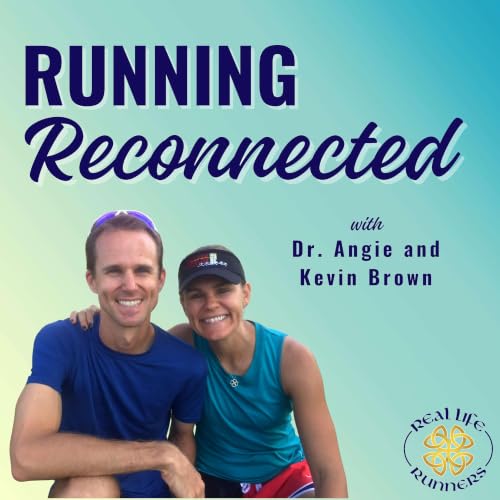
『Running Reconnected with Dr. Angie and Kevin Brown』のカバーアート

Running Reconnected with Dr. Angie and Kevin Brown

Running Reconnected with Dr. Angie and Kevin Brown

著者: Dr. Angie Brown
無料で聴く

Dr. Angie and Kevin Brown are here to help runners reconnect to themselves to become physically and mentally stronger runners through conversations about training, mindset, nutrition, health and wellness, family, and all the crazy things that life throws at us. The lessons that we learn from running can carry over into all aspects of our life (and vice versa), and we are here to explore those connections through current research, our experiences, and stories from real people out on the roads and trails, so that you can become a physically and mentally stronger runner and achieve the goals that matter to you.

© 2026 AKB Health, Inc.
ランニング・ジョギング 個人的成功 自己啓発 衛生・健康的な生活
エピソード
  • 483: The Law of Diminishing Returns: Are you doing too much or not enough?
    2026/10/15

    When it comes to running, more isn't always better. At some point, adding more miles, intensity, or strength training can stop helping and start working against you.

    In this episode, Kevin and I discuss the law of diminishing returns and how it affects running performance, recovery, and race preparation. We share lessons from our daughter's intensive PSAT prep and explain why, just like studying for a big test, there comes a point when you need to trust the work you've already done instead of trying to squeeze in more.

    We also discuss professional marathoner Vinny Nauti's high-volume training, why copying another runner's approach doesn't always work, and how to recognize when you're accumulating fatigue instead of making progress. I share why building an easy running base, balancing training intensity, prioritizing recovery, and adjusting your plan to fit your life are essential for long-term improvement.

    We also break down race tapering, including how to adjust your running and strength training so you can arrive at race day ready to perform.

    00:00 – When More Stops Helping: The Law of Diminishing Returns
    01:07 – PSAT Prep and Knowing When to Stop
    02:16 – Trusting Your Training During a Race Taper
    02:59 – Mileage, Training Stress, and Recovery
    04:50 – Breaking Through Plateaus: Push, Pull Back, or Wait?
    06:06 – The Salt Analogy: Finding the Right Amount
    08:05 – Vinny Natti and the Outlier in Marathon Training
    11:17 – High Mileage and Fast Treadmill Running
    15:40 – Is It Overtraining, or Just Part of Racing?
    19:59 – Finding Your Individual Training Limit
    21:37 – The Gray Zone: When Every Run Feels Moderately Hard
    23:19 – Balancing Running Volume and Intensity
    24:26 – Build Your Easy Running Base First
    26:20 – Making Training Enjoyable and Sustainable
    28:13 – Age, Running History, and Recovery Needs
    30:46 – Lifestyle, Sleep, Nutrition, and Performance
    35:01 – Creative Training Cycles and Adjusting Your Schedule
    36:18 – Race Tapering: Trust the Work You've Done
    38:03 – How to Adjust Strength Training During a Taper
    40:02 – Running Taper Variations and Individual Needs
    42:15 – Balancing Training Stress and Life Stress

    Gain access to my new secret podcast, Unbreakable: The Runner's Guide To Injury-Proofing Your Body After 40. Click here: https://www.realliferunners.com/secret

    Join the Team! --> https://www.realliferunners.com/team

    Thanks for Listening!!

    Be sure to hit FOLLOW on Apple Podcasts, Spotify, or your favorite podcast player

    Leave a review on Apple Podcasts. Your ratings and reviews really help and we read each one!


    Come find us on Instagram and say hi!


    Don't forget: The information on this website is not intended to treat or diagnose any medical condition or to provide medical advice. It is intended for general education in the areas of health and wellness. All information contained in this site is intended to be educational in nature. Nothing should be considered medical advice for your specific situation.

    続きを読む 一部表示
    47 分
  • 482: My 3 Part Framework To Treat Any Running Injury
    2026/10/08

    Pain and injury can be incredibly frustrating as a runner, especially when it feels like the pain came out of nowhere. In this episode, I’m sharing the three-part framework I’ve used throughout my 20 years as a physical therapist to understand pain and determine what to do next: Evaluate, Assess, and Treat.

    We’ll look beyond the painful body part and consider the bigger picture, including training load, mobility, strength, sleep, stress, fueling, hormones, and previous injuries. I’ll also walk you through how I decide when to modify running, how much pain may be okay during recovery, and why complete rest usually isn’t the answer. The goal is not just to get you out of pain, but to help your body become stronger and better able to handle the demands of running long term.


    00:00 Understanding Running Pain and Injury

    03:00 The EAT Framework: Evaluate, Assess, and Treat

    06:00 Understanding Your Pain Story

    08:00 Running Injuries and Your Training Load11:00 Sleep, Stress, Fueling, and Recovery

    00:16:00 Pain and Injury Red Flags

    18:00 Screening for Bone Stress Injuries

    22:00 Testing Mobility, Stability, and Strength

    26:00 Assessing What Needs to Be Addressed First

    29:00 Making Your Nervous System Feel Safe

    32:00 How Much Pain Is Okay?

    33:00 The 24-Hour Rule

    35:00 Mobility, Stability, and Strength

    40:00 Modifying Your Running During Recovery

    43:00 When to Return to Running

    45:00 Fixing the Root Cause

    47:00 Building Your Body’s Capacity to Handle More Load

    49:00 What’s Next in the Injury Series

    Gain access to my new secret podcast, Unbreakable: The Runner's Guide To Injury-Proofing Your Body After 40. Click here: https://www.realliferunners.com/secret

    Join the Team! --> https://www.realliferunners.com/team

    Thanks for Listening!!

    Be sure to hit FOLLOW on Apple Podcasts, Spotify, or your favorite podcast player

    Leave a review on Apple Podcasts. Your ratings and reviews really help and we read each one!


    Come find us on Instagram and say hi!


    Don't forget: The information on this website is not intended to treat or diagnose any medical condition or to provide medical advice. It is intended for general education in the areas of health and wellness. All information contained in this site is intended to be educational in nature. Nothing should be considered medical advice for your specific situation.

    続きを読む 一部表示
    50 分
  • 481: Pain Is Not a Fixed Trait: What the Berlin Marathon Teaches Us About Pain and the Brain
    2026/10/01

    What do you think would happen if you completely ruptured your Achilles tendon with two kilometers left in a marathon? Most of us would probably assume the race was over. But Tigst Assefa’s 2026 Berlin Marathon story forces us to ask a much more interesting question: how could someone experience a significant injury and still keep running at an incredibly fast pace? Assefa developed pain around 31K, eventually completely ruptured her Achilles around 40K, and still finished the race, won, and set a course record. That doesn’t mean she somehow didn’t have an injury or that pain is “all in her head.” It gives us a fascinating look at how the brain processes pain and how much context can influence what we actually feel.

    In this episode, Angie and Kevin break down the idea that pain is an output created by the brain based on much more than tissue damage alone. Your brain is constantly taking in information about what is happening in your body, along with your stress level, sleep, emotions, attention, past experiences, expectations, social environment, and how important the current situation is to you. They talk through examples ranging from phantom limb pain and the famous construction-worker nail story to elite athletes, childbirth, war injuries, and their own experiences with running and pain. The bigger takeaway is that pain isn't simply an on/off switch. It's more like a volume dial that can move up or down depending on the context.

    And this is where the conversation gets really practical for everyday runners. You can learn to change some of the inputs that influence your pain experience. Better sleep, reducing chronic stress, having a meaningful goal, shifting your attention outward, social connection, gentle movement, and slow breathing can all help turn the volume down. But Angie and Kevin also emphasize an important warning: becoming really good at ignoring pain isn't the goal. Pain is still a protective signal, and turning that signal down too far can allow you to continue running through an injury that needs attention. The goal isn't to become someone who never feels pain. It's to develop more nuance around what you're feeling, understand the context, and learn when to listen, when to adjust, and when you can safely keep going.

    00:00 – Berlin Marathon Shock

    01:44 – Achilles Rupture Details

    03:34 – Pain Comes From Brain

    04:34 – Phantom Pain Stories

    05:54 – Pain Inputs Explained

    08:48 – Turning Pain Down

    09:43 – Achilles Anatomy Q&A

    12:29 – Descending Modulation

    16:23 – Stress and Pain Effects

    20:40 – Elite Athletes and Pain

    23:51 – Research on Pain Tolerance

    27:01 – Training Builds Nuance

    29:42 – Trauma And Ultra Running

    31:54 – Stress Kills Pain Edge

    33:43 – War And Survival Analgesia

    39:03 – Childbirth Expectations Shift

    41:28 – Everyday Pain Amplifiers

    47:59 – How Pain Spirals In Races

    48:49 – Tools To Turn Pain Down

    54:30 – When Tuning Out Backfires

    Gain access to my new secret podcast, Unbreakable: The Runner's Guide To Injury-Proofing Your Body After 40. Click here: https://www.realliferunners.com/secret

    Join the Team! --> https://www.realliferunners.com/team

    Thanks for Listening!!

    Be sure to hit FOLLOW on Apple Podcasts, Spotify, or your favorite podcast player

    Leave a review on Apple Podcasts. Your ratings and reviews really help and we read each one!


    Come find us on Instagram and say hi!


    Don't forget: The information on this website is not intended to treat or diagnose any medical condition or to provide medical advice. It is intended for general education in the areas of health and wellness. All information contained in this site is intended to be educational in nature. Nothing should be considered medical advice for your specific situation.

    続きを読む 一部表示
    53 分
adbl_web_anon_alc_button_suppression_t1
まだレビューはありません