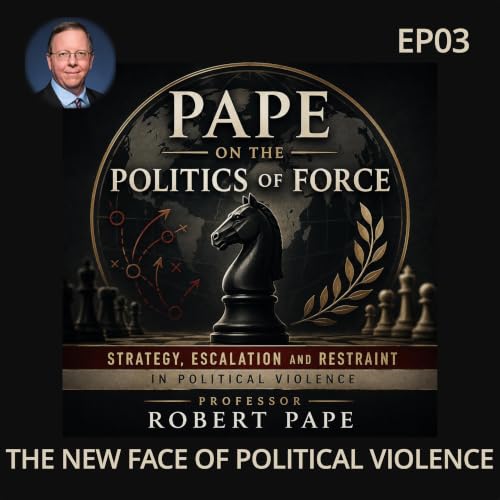
エピソード

  • Who Strikes First - Trump or Iran
    2026/11/18

    Got something to say to this podcast? Send a voicemail, and you might hear yourself on the next episode!

    For eight months, the Escalation Trap has turned on one question: how high will Washington climb? Since the midterms, that question is flipping.

    The US position in the Gulf has become fragile, and the midterms just exposed it. Tehran saw a weakened president and moved within days. On Nov. 8, President Pezeshkian said the Supreme Leader had ordered an end to “neither war nor peace.” Within a week, Iran claimed five or more tankers hit its mines in Hormuz, and said it struck the US radar in Bahrain, twice.

    When one side’s position cracks, first strikes follow. So why does a weaker Trump make round two more likely? Which side moves first? It turns on one signal, and on what happens to your gas prices when it fires.

    続きを読む 一部表示
    4 分
  • THE NIXON SPIRAl
    2026/11/08

    Got something to say to this podcast? Send a voicemail, and you might hear yourself on the next episode!

    Trump’s power only wanes from here. Tuesday’s defeat leaves an administration in terminal decline.

    The closest example in American history is Richard Nixon. In January 1973, fresh from a 49-state landslide, Nixon stood at 67 percent approval. Nineteen months later he left the White House at 24 percent.

    Trump’s approval among Tuesday’s voters was 38 percent. On Nixon’s curve, that is the summer of 1973. The tapes had just been revealed, and Nixon’s worst months were still ahead.

    What came next for Nixon was a war in the Middle East, an oil shock, a Congress taking back its war powers, and a world on nuclear alert. In his final days, his own Pentagon reportedly took a step no Defense Department had taken before.

    Which of these is next for Trump?

    続きを読む 一部表示
    5 分
  • No Redlines: Iran Threatens The US Homeland
    2026/11/04

    Got something to say to this podcast? Send a voicemail, and you might hear yourself on the next episode!

    Iran’s leader just ordered war without borders, as U.S. strikes loom

    In written orders to his commanders Saturday, Iran’s unseen Supreme Leader, Mojtaba Khamenei, demanded that any new American attack be met with a response that is “immediate, impactful and geographically unrestricted.” He ordered the military to update its target bank with “all kinds of physical and non-physical assets” of the United States and Israel. His foreign minister added: “Red lines are a thing of the past.”

    He never names the American homeland. He doesn’t need to. There is only one way to read “no geographic limits.”

    続きを読む 一部表示
    6 分
  • Saudi Arabia's Worst Week Ever
    2026/10/26

    Got something to say to this podcast? Send a voicemail, and you might hear yourself on the next episode!

    -Originally published on October 14th to paid Substack members-

    In six days, attacks hit Riyadh’s international airport, a Riyadh refinery and Saudi Aramco’s headquarters. Nothing like it has happened in the Kingdom’s modern history. The pattern of targets tells us what comes next, and that next target would move every oil price on earth.

    続きを読む 一部表示
    6 分
  • The New Face Of Political Violence
    2026/10/21

    Got something to say to this podcast? Send a voicemail, and you might hear yourself on the next episode!

    Previously recorded from a Substack Live Briefing

    America is experiencing a surge of political violence—and it is no longer confined to the fringes. From mass protests that turn destructive to attacks on political leaders and assassination attempts, the past five years have seen a breadth of political violence not witnessed since the 1960s.

    But the deeper danger is not simply the violence itself. It is the slippery slope by which violence becomes normalized: first condemned, then excused, then accepted as a legitimate weapon against political enemies.

    Why does this keep happening? What transforms isolated incidents into broader waves of confrontation? And how close are we to a point where political violence becomes a regular feature of American political life?

    I’ll begin with a 20-minute presentation explaining the mechanisms driving this transformation and what they mean for America’s future.

    Then, for 20–25 minutes, I’ll answer your questions live. Bring your questions about political violence, the forces driving it, and what comes next for American democracy.

    My new book, Our Own Worst Enemies: America in the Age of Violent Populism, explores the deeper forces behind this dangerous shift.

    続きを読む 一部表示
    44 分
  • EP02 : The Pickaxe Mountain Trap
    2026/10/18

    Got something to say to this podcast? Send a voicemail, and you might hear yourself on the next episode!

    The Pickaxe Mountain Trap: Why a Tactical Nuke Won’t Stop Iran—And Could Wreck the American Economy

    SHOULD TRUMP USE A NUCLEAR WEAPON?

    With domestic gas prices skyrocketing and construction rapidly accelerating at Pickaxe Mountain—Iran’s most fortified facility for weaponizing enriched uranium—the geopolitical clock is running out. Pressure is mounting on President Trump to deliver a decisive blow against Tehran before the pivotal midterm elections on November 3.

    続きを読む 一部表示
    21 分
  • The War Is Coming Home
    2026/10/18

    Got something to say to this podcast? Send a voicemail, and you might hear yourself on the next episode!

    The War Is Coming Home: Support for Political Violence Has Doubled

    In the year America went to war with Iran, support for political violence at home doubled.

    That’s the finding of our new CPOST national survey, taken Aug 29-31 2026:

    • 16% of American adults, over 40 million people, support President Trump using the U.S. military to suppress protests against his agenda.
    • 25%, over 60 million, support using force to prevent Trump from being president.

    Both have doubled since September 2025.

    Read those together. Using troops against protesters is becoming more popular. So is resisting the president by force. That is a pernicious cocktail, and it’s being mixed in the middle of an election.

    I’ve studied political violence for 30 years. Here’s what most coverage misses: wars don’t stay abroad. They change politics at home.

    続きを読む 一部表示
    5 分