エピソード

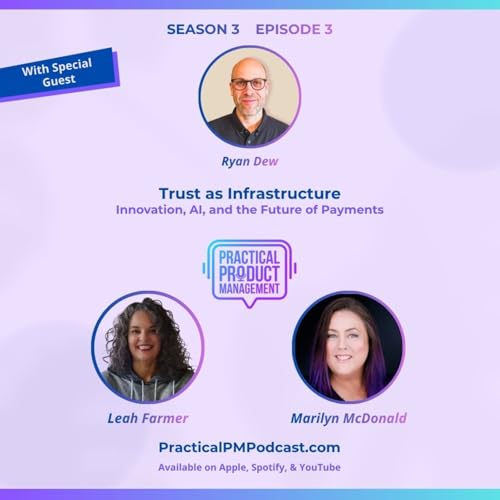
  • Trust as Infrastructure: Innovation, AI, and the Future of Payments
    2026/03/25

    In this episode of Practical Product Management, hosts Leah Farmer and Marilyn McDonald sit down with Ryan Dew, CPO at Thredd, a global issuing processor based in London, to explore what innovation really means when you're operating at the foundation of the payments ecosystem.

    Ryan explains how Thredd approaches innovation as a "slow burn" in a heavily regulated industry — building guardrails first, earning trust before shipping features, and letting their fintech and program manager customers build the flashy user experiences on top. The conversation covers the emergence of trust-as-a-service as a critical pillar for AI and agentic commerce, how the role of the product manager is evolving into a full-stack builder, and why stablecoin may be the most significant disruptor the payments industry has seen in years.

    KEY TAKEAWAYS

    1. In regulated industries, trust is the product. Innovation in payments isn't about moving fast — it's about building the guardrails first. Trust-as-a-service has moved from a nice-to-have to a foundational requirement, especially as AI and agentic commerce introduce new layers of complexity and risk.

    2. The plumbing has to be right before the experience can be delightful. Platform product management gets underestimated, but no consumer experience works if the underlying infrastructure fails. The most innovative fintech UX in the world is worthless if the payment doesn't go through.

    3. AI in payments isn't new — but where it's going is. Machine learning has been powering fraud detection in payments for over a decade. The next wave is agentic commerce, intelligent payment routing, and stronger authentication — and stablecoin rails may change cross-border money movement more fundamentally than anything we've seen.

    4. Consumer behavior changes faster than we think — when it has to. The pandemic forced entire markets to shift from cash to digital payments almost overnight. The lesson for product managers: when the benefit is clear and the reason is compelling, people adapt. The job is to make that transition feel safe and obvious.

    続きを読む 一部表示
    51 分
  • Innovation at the Edge: AI, ERP, and the Art of the Calculated Bet
    2026/03/11

    In this episode of Practical Product Management, hosts Leah Farmer and Marilyn McDonald sit down with Evan J. Schwartz, Chief Innovation Officer at AMCS Group, to explore what innovation really looks like inside a large, mature SaaS organization.

    Evan explains how his role works as a separate innovation track — taking high-risk bets on AI and emerging technology, running lean matrixed teams, and handing proven concepts back to the product organization once they've reached critical mass. The conversation covers how to structure innovation without creating resentment among product and engineering teams, the difference between technical innovation and product innovation, and why the most important question is simply: is there a there there?

    The second half digs into ERP transformations — one of the most reliably painful experiences in enterprise technology. Evan draws on his book and years of implementation experience to explain why transformations fail, why weak upfront requirements are the root cause of most project death marches, and why "do nothing" should always be a viable outcome of a systems review. Marilyn and Leah push back, debate, and ultimately arrive at the same place: map your as-is, define your to-be, and know your why before you touch anything.

    Key Takeaways

    1. Innovation needs a separate track — and a clear handoff. At a certain company size, core product teams can't run high-risk bets alongside mature product delivery. A dedicated innovation function proves ideas out fast and hands them back once the questions are answered — with tight oversight and shared standards throughout.

    2. Fail fast, fail cheap, and know when to stop. The job of an innovation team is to answer questions, not build finished products. "Not a good bet" is a valuable outcome. The goal is to find that out as quickly and cheaply as possible and redirect the budget.

    3. ERP transformations fail because companies skip the foundations. The technology is rarely the problem. Weak goals, no baseline metrics, and undocumented processes are where implementations go sideways. Map your current state and define three ROI-backed reasons for the change before you sign anything.

    4. "We have to upgrade" is not a vision. A compelling, shared picture of the future state is what carries teams through the friction of a rollout. Without it, every paper cut becomes a project-stopper.

    続きを読む 一部表示
    39 分
  • The Books That Made Us Better Product Managers (And Better Humans)
    2026/02/25

    In the Season 3 premiere of Practical Product Management, hosts Leah Farmer and Marilyn McDonald ditch the traditional PM reading list and get personal — sharing the books outside of product management that have most shaped their careers, their leadership, and how they show up as humans at work.

    From Brené Brown's case for vulnerability and clear communication, to Marshall Rosenberg's Nonviolent Communication and the surprisingly violent language baked into everyday tech culture, to Susan Cain's exploration of introversion and what it means to make space for quieter voices — the conversation covers a remarkable amount of ground. They also dig into perfectionism as a superpower, the concept of who deserves a seat at your personal board table, what it means to truly reject feedback you don't believe is true, and why the four short agreements in Don Miguel Ruiz's classic might be the most practical PM framework nobody talks about.

    Season 3 promises more of the same: honest, human, practical conversations about the craft — with some interesting guests already on the way.

    KEY TAKEAWAYS

    1. The best PM reading list isn't a PM reading list. Books about communication, vulnerability, introversion, and human behaviour do more to shape great product leaders than most frameworks ever will. The craft is fundamentally human work — and the reading should reflect that.

    2. Clarity is kindness — and sloppy language is a leadership risk. Whether it's Brené Brown's argument against the feedback "shit sandwich," Marshall Rosenberg's Nonviolent Communication, or Jefferson Fisher's practical conversational strategies — the throughline is the same: words matter enormously, especially under pressure. Intentional language builds trust; careless language erodes it.

    3. Your perfectionism might be a superpower in disguise. Katherine Morgan Schafler's The Perfectionist's Guide to Losing Control reframes perfectionism not as something to fix, but something to direct. For PMs who spend more time being wrong than right — and doing the job well means you do — learning to aim toward the North Star without freezing is a genuinely useful skill.

    4. Not everyone earns a seat at your table — and your company definitely doesn't. You are the CEO of your own life, and that means being intentional about who gets to influence your identity and decisions. Managers, companies, and randos don't automatically get a seat. The people at your table should know you, have your long-term wellbeing at heart, and carry no agenda.

    続きを読む 一部表示
    39 分
  • Season Wrap Up - The CEO of Your Life
    2025/12/02

    In the Season 2 finale of Practical Product Management, Leah and Marilyn close the year with an honest and deeply human conversation. They revisit the idea of being the CEO of your own life, choosing who gets a seat at your personal board table, and why your job doesn’t deserve a vote in your identity. They explore the hard parts of product leadership and reflect on the importance of having a strong spine as a team. They also share the joyful, real-life practices that keep them grounded, from baking to moon rituals to community building, ending the season with a hopeful reminder: if your life doesn’t feel the way you want it to, you get to choose again.

    Key Takeaways

    1. You Are the CEO of Your Life - You choose who gets a seat on your personal board of directors...and your job, your boss, and your company don’t get a vote. The people who guide you should care about your joy, humanity, and long-term well-being, not your output. 

    2. Courage + Clarity Are Non-Negotiable - Whether it’s prioritization, layoffs, financial decisions, or leadership accountability, most organizational pain stems from avoiding the hard conversations. Teams need spine, honesty, and transparency to make real progress. 

    3. Humanity vs Frameworks - No org chart, process, or framework can fix a team that’s running on fear. Creativity and problem-solving only happen when people feel safe, trusted, and able to tell the truth. Product is fundamentally human work and leaders must “human” before anything else.

    続きを読む 一部表示
    58 分
  • Best of Season 2, Part 2 - Conversations that reminded us why Product is a "people-first" craft.
    2025/11/19

    In this second Best Of episode, Leah and Marilyn revisit Episodes 11–20 — a set of conversations that explored burnout as data, the importance of communication, and the courage it takes to build meaningful products. Featuring guests like Charity, Sunny, Greg, Ryan, Steve, and Ali, this collection highlights the deeply human side of product work. It’s a reminder that great product leadership comes from curiosity, clarity, and the willingness to challenge old patterns.

    Key Takeaways

    1. Burnout Is Data, Not Drama

    When energy fades or creativity dips, it’s not failure — it’s a signal worth paying attention to.

    2. People Build Software — Communication Is the Real Glue

    Most product challenges stem from communication breakdowns, not technical ones. Trust and clarity are foundational.

    3. Curiosity + Courage > Predictability + Roadmaps

    Experimentation, iteration, and informed risk-taking are essential — not chaotic — parts of modern product craft.

    続きを読む 一部表示
    56 分
  • Best of Season 2, Part 1 - Highlights, lessons and laughs from our most curious season yet.
    2025/11/05

    In this special Best Of episode, Leah and Marilyn look back at the first ten episodes of Season 2 — a lively mix of conversations that capture the depth, humor, and humanity of product work. From fractional leadership and accessibility to GovTech, AI, and personal growth, these highlights reveal just how dynamic the product world has become.

    Featuring guests like Peter Collingridge, Mike Paciello, Rob Monroe, Sam Zebarjadi, Jen Bloom, and more, this compilation explores the edges of product practice — where leadership meets curiosity, where bureaucracy becomes a design challenge, and where learning never stops.

    As they wrap up this half of the season, Leah and Marilyn reflect on the themes that have stayed with them: focus over frenzy, context over theory, and the courage to do less but do it better.

    Key Takeaways

    1. Context is EverythingProduct theory only matters when it meets reality. Success comes from understanding your environment — and adapting accordingly.
    2. Focus Over FrenzyIn an AI-driven world, clarity beats speed. Being essential in the moments that matter is more powerful than doing more, faster.
    3. Practice Like You PlayLeadership is a daily practice. Show up, even when it’s messy. Repetition builds confidence and muscle memory for when it counts.
    4. Do Less, BetterImpact matters more than activity. Prioritize the work that truly moves your product — and your people — forward.

    続きを読む 一部表示
    55 分
  • Designing for Play: Building Games That Bring People Together
    2025/10/22

    In this episode of Practical Product Management, hosts Leah Farmer and Marilyn McDonald sit down with Sunny Lee, Experience Design Director at EA’s Full Circle Studio, to explore the intersection of design, empathy, and play.

    Sunny’s career spans from building AAA games at EA Sports to shaping purpose-driven experiences in health tech — and back again to lead design for Skate, EA’s newly relaunched open-world game. She shares how thoughtful design can empower players, foster inclusion, and build real human connection in digital spaces.

    The conversation moves from the craft of experience design to the ethics of monetization, from diversity in game culture to the importance of making failure fun. Whether you’re building software or skate parks, this episode is a reminder that great design — like great leadership — is about creating spaces where people feel seen, confident, and free to explore.

    Key Takeaways

    1. Design Is More Than Pixels — It’s About Human Connection. Great design balances usability, emotion, and purpose. Sunny emphasizes that creating for humans means understanding both what they say and how they actually behave.

    2. Make Failure Fun - From learning new tricks in Skate to building new products, progress comes through iteration. Embrace experimentation and treat failure as part of play, not proof of defeat.

    3. Diversity Makes Better Products — and Communities. “Games look like the people who make them.” Diverse creators lead to richer, more inclusive experiences. Representation isn’t just ethical — it’s essential for designing products that truly connect.

    続きを読む 一部表示
    51 分
  • Fearless Fundamentals: How Language, Bravery, and Trust Shape Great Product Teams
    2025/10/08

    In this episode of Practical Product Management, hosts Leah Farmer and Marilyn McDonald are joined by Steve Brieloff, a seasoned product leader from Expedia Group, for a conversation about what truly defines great product management.

    Steve shares insights from his years leading teams across Expedia’s product suite, highlighting how getting the fundamentals right—from crafting precise problem statements to choosing meaningful success metrics—sets the foundation for success. The trio dives deep into the importance of language, the evolution of confidence and conviction in product decisions, and how bravery shows up at every level of a PM’s career.

    From building trust through vulnerability to balancing open debate with decisive action, this episode explores how mastering the basics and leading with courage can transform teams, culture, and products alike.

    Key Takeaways

    1. Master the Fundamentals — and the Words You Choose Matter. Great product work starts with writing a precise problem statement and choosing the right success metrics. One misplaced word can send a team in the wrong direction.

    2. Bravery is a Core Product Skill. Whether it’s voicing dissent, standing behind a decision, or leading culture change, bravery shows up at every level of product work — from junior PMs to execs.

    3. Build Trust Through Vulnerability and Debate. Encourage disagreement, listen deeply, and be transparent — but also know when the debate is over. Leadership is about hearing others, making the call, and moving forward together.

    続きを読む 一部表示
    53 分