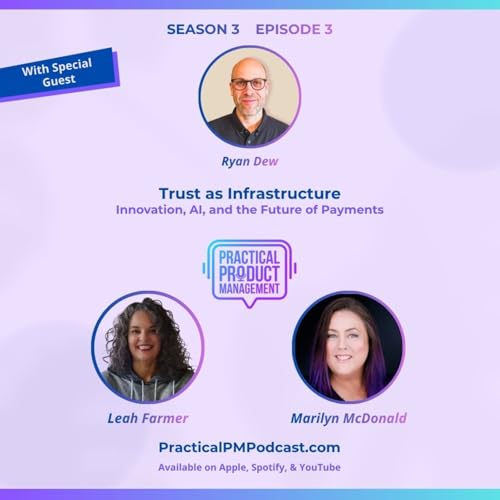
『Practical Product Management』のカバーアート

Practical Product Management

Practical Product Management

著者: Leah Farmer & Marilyn McDonald
無料で聴く

今ならプレミアムプランが3カ月 月額99円

2026年5月12日まで。4か月目以降は月額1,500円で自動更新します。

概要

Each week we peel back the layers of product management theory and dive into the nuts and bolts of making real decisions in high-stakes tech environments. Join us, Marilyn McDonald and Leah Farmer, as we share insights from our 20+ years at the forefront of Big Tech, Payments, Scaleups, and Startups.

Practical Product Management 2024
経済学
エピソード
  • Trust as Infrastructure: Innovation, AI, and the Future of Payments
    2026/03/25

    In this episode of Practical Product Management, hosts Leah Farmer and Marilyn McDonald sit down with Ryan Dew, CPO at Thredd, a global issuing processor based in London, to explore what innovation really means when you're operating at the foundation of the payments ecosystem.

    Ryan explains how Thredd approaches innovation as a "slow burn" in a heavily regulated industry — building guardrails first, earning trust before shipping features, and letting their fintech and program manager customers build the flashy user experiences on top. The conversation covers the emergence of trust-as-a-service as a critical pillar for AI and agentic commerce, how the role of the product manager is evolving into a full-stack builder, and why stablecoin may be the most significant disruptor the payments industry has seen in years.

    KEY TAKEAWAYS

    1. In regulated industries, trust is the product. Innovation in payments isn't about moving fast — it's about building the guardrails first. Trust-as-a-service has moved from a nice-to-have to a foundational requirement, especially as AI and agentic commerce introduce new layers of complexity and risk.

    2. The plumbing has to be right before the experience can be delightful. Platform product management gets underestimated, but no consumer experience works if the underlying infrastructure fails. The most innovative fintech UX in the world is worthless if the payment doesn't go through.

    3. AI in payments isn't new — but where it's going is. Machine learning has been powering fraud detection in payments for over a decade. The next wave is agentic commerce, intelligent payment routing, and stronger authentication — and stablecoin rails may change cross-border money movement more fundamentally than anything we've seen.

    4. Consumer behavior changes faster than we think — when it has to. The pandemic forced entire markets to shift from cash to digital payments almost overnight. The lesson for product managers: when the benefit is clear and the reason is compelling, people adapt. The job is to make that transition feel safe and obvious.

    続きを読む 一部表示
    51 分
  • Innovation at the Edge: AI, ERP, and the Art of the Calculated Bet
    2026/03/11

    In this episode of Practical Product Management, hosts Leah Farmer and Marilyn McDonald sit down with Evan J. Schwartz, Chief Innovation Officer at AMCS Group, to explore what innovation really looks like inside a large, mature SaaS organization.

    Evan explains how his role works as a separate innovation track — taking high-risk bets on AI and emerging technology, running lean matrixed teams, and handing proven concepts back to the product organization once they've reached critical mass. The conversation covers how to structure innovation without creating resentment among product and engineering teams, the difference between technical innovation and product innovation, and why the most important question is simply: is there a there there?

    The second half digs into ERP transformations — one of the most reliably painful experiences in enterprise technology. Evan draws on his book and years of implementation experience to explain why transformations fail, why weak upfront requirements are the root cause of most project death marches, and why "do nothing" should always be a viable outcome of a systems review. Marilyn and Leah push back, debate, and ultimately arrive at the same place: map your as-is, define your to-be, and know your why before you touch anything.

    Key Takeaways

    1. Innovation needs a separate track — and a clear handoff. At a certain company size, core product teams can't run high-risk bets alongside mature product delivery. A dedicated innovation function proves ideas out fast and hands them back once the questions are answered — with tight oversight and shared standards throughout.

    2. Fail fast, fail cheap, and know when to stop. The job of an innovation team is to answer questions, not build finished products. "Not a good bet" is a valuable outcome. The goal is to find that out as quickly and cheaply as possible and redirect the budget.

    3. ERP transformations fail because companies skip the foundations. The technology is rarely the problem. Weak goals, no baseline metrics, and undocumented processes are where implementations go sideways. Map your current state and define three ROI-backed reasons for the change before you sign anything.

    4. "We have to upgrade" is not a vision. A compelling, shared picture of the future state is what carries teams through the friction of a rollout. Without it, every paper cut becomes a project-stopper.

    続きを読む 一部表示
    39 分
  • The Books That Made Us Better Product Managers (And Better Humans)
    2026/02/25

    In the Season 3 premiere of Practical Product Management, hosts Leah Farmer and Marilyn McDonald ditch the traditional PM reading list and get personal — sharing the books outside of product management that have most shaped their careers, their leadership, and how they show up as humans at work.

    From Brené Brown's case for vulnerability and clear communication, to Marshall Rosenberg's Nonviolent Communication and the surprisingly violent language baked into everyday tech culture, to Susan Cain's exploration of introversion and what it means to make space for quieter voices — the conversation covers a remarkable amount of ground. They also dig into perfectionism as a superpower, the concept of who deserves a seat at your personal board table, what it means to truly reject feedback you don't believe is true, and why the four short agreements in Don Miguel Ruiz's classic might be the most practical PM framework nobody talks about.

    Season 3 promises more of the same: honest, human, practical conversations about the craft — with some interesting guests already on the way.

    KEY TAKEAWAYS

    1. The best PM reading list isn't a PM reading list. Books about communication, vulnerability, introversion, and human behaviour do more to shape great product leaders than most frameworks ever will. The craft is fundamentally human work — and the reading should reflect that.

    2. Clarity is kindness — and sloppy language is a leadership risk. Whether it's Brené Brown's argument against the feedback "shit sandwich," Marshall Rosenberg's Nonviolent Communication, or Jefferson Fisher's practical conversational strategies — the throughline is the same: words matter enormously, especially under pressure. Intentional language builds trust; careless language erodes it.

    3. Your perfectionism might be a superpower in disguise. Katherine Morgan Schafler's The Perfectionist's Guide to Losing Control reframes perfectionism not as something to fix, but something to direct. For PMs who spend more time being wrong than right — and doing the job well means you do — learning to aim toward the North Star without freezing is a genuinely useful skill.

    4. Not everyone earns a seat at your table — and your company definitely doesn't. You are the CEO of your own life, and that means being intentional about who gets to influence your identity and decisions. Managers, companies, and randos don't automatically get a seat. The people at your table should know you, have your long-term wellbeing at heart, and carry no agenda.

    続きを読む 一部表示
    39 分
まだレビューはありません