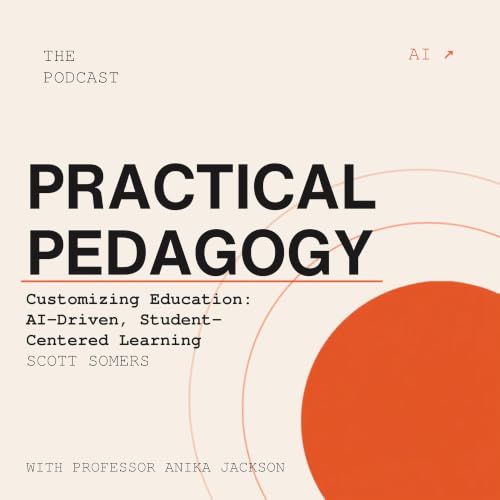
『Practical Pedagogy: The Art of Teaching for the Future of Work』のカバーアート

Practical Pedagogy: The Art of Teaching for the Future of Work

Practical Pedagogy: The Art of Teaching for the Future of Work

著者: Anika Jackson
無料で聴く

概要
Preparing students and working professionals for the future of work means teaching with AI, not just about it. Practical Pedagogy brings together educators, researchers, and industry leaders reimagining what it means to teach and learn in an AI-integrated world. Each week, we explore real conversations happening in classrooms, boardrooms, graduate seminars, and workplaces: How do we guide learners toward thoughtful, strategic AI collaboration? What does pedagogy look like when AI tools evolve faster than curriculum? And what skills actually matter when generative AI can handle the rest? You'll hear from professors redesigning courses around AI literacy, students learning responsible AI use, working professionals navigating upskilling and career transitions, researchers uncovering what works, and industry leaders hiring for skills that don't exist in textbooks yet. Whether you're in K-12 education, higher education, corporate learning and development, or figuring out your next chapter, this show is about preparing for—and thriving in—work being redefined in real time. Our approach is practical and relaxed. We're as interested in failures and lessons learned as we are in wins. Because the question isn't whether to embrace AI or resist it. It's how we prepare learners of all kinds to evolve alongside it. For educators, students, working professionals, researchers, and anyone curious about the future of learning and work.2026 Anika Jackson 経済学
エピソード
  • Jerry Kolber on the Secret to Engaging Young Minds
    2026/11/12
    Anika sat down with Jerry Kolber—the Emmy-nominated creator behind Brain Games (National Geographic), Brainchild (Netflix), and the top 0.5% kids podcast Who Smarted?—to explore what it actually takes to capture attention and make learning stick. Jerry shared insights from his work with children aged 8 to 10, revealing a surprising countertrend: kids actively recoil from AI in their creative and educational lives, preferring human connection, emotion, and storytelling over algorithmic shortcuts.In This EpisodeThe origin story of Brain Games and creating National Geographic’s hit seriesWhy attention isn't the ultimate goal—and why engagement and making kids care come firstThe Children's Television Workshop (CTW) secret sauce: making information relevant before teachingWhat Jerry discovered when kids in his podcast camp accidentally pressed the "magic AI fix button"The hidden impact of COVID-19 and remote isolation on this generation's desire for human connectionWhere AI actually helps inside a lean team (spreadsheets and analytics) versus where the hard line is drawn (creative output, voice, and scripts)Why adults and buyers get optimized for in ed tech, while kids get left out of the design processThe neuroscience of attention decay: why stimuli must change every 2 to 3 minutesThe power of audio: why kids comprehend 2 to 3 grade levels higher through sound than text Timestamps00:00 Introduction: Welcome to Practical Pedagogy with Professor Annika Jackson and guest Jerry Kolber01:19 The secret sauce of educational entertainment: making neuroscience accessible through story03:08 When kids recoil from AI: discovering what 8-to-10-year-olds really think about automated tools06:57 The Gen X perspective on technology: viewing computers as tools rather than social hubs09:22 The hard line on AI: why creative work, scripts, and voice narration must remain human14:49 From scripted TV and Sex and the City to reality television (Queer Eye) and National Geographic17:40 Driving critical thinking in a world of bubbles and echo chambers18:36 Optimizing for the adult buyer versus the child end-user in ed tech21:04 The early days of AI text and image generation as the "lowest hanging fruit"24:04 Earning attention in 90 seconds and the art of "pulling the rug out from under the viewer"27:10 Active participation: quizzes, relatable authority figures, and playful neuroscience29:12 Asking the kids: what education looks like when you design for the end-user31:59 Rewarding attention immediately and managing the 2-to-3-minute attention decay cycle33:50 The audio advantage: why children comprehend 3 to 4 grade levels higher through listening35:30 Finding a North Star: making good shows that make the world a better place Key Insights & Takeaways Insight 1: Make People Care Before You Make Them Want to Understand Information without a story is forgettable. Whether teaching history, science, or math, the foundational rule of engagement is to anchor facts inside a narrative arc that makes the learner care immediately. If you walk into a room and demand attention without context, you've lost them before you start. Insight 2: The Next Generation Cravings Human ConnectionKids coming of age in the wake of remote learning and screen-heavy isolation during COVID-19 show a distinct resistance to AI in creative spaces. They want human emotion, humor, nuance, and social-emotional bonds. Automated content production feels sterile and uninspired to a generation seeking genuine interaction. Insight 3: Ed Tech Often Optimizes for the Buyer, Not the UserMost educational technology and AI tools in schools are designed to make life easier for parents and teachers—automating grading, scheduling, or curriculum generation. While valuable for adults, these systems frequently overlook what actually engages the child sitting through the lesson. True engagement requires human-to-human connection. Insight 4: Attention Decays Every Two to Three Minutes Research and extensive testing across thousands of episodes reveal that a human's ability to maintain focus on a complex topic decays rapidly. To sustain engagement, the stimulus, cadence, or tone must shift every couple of minutes—refreshing the attention pool in the brain without losing the core narrative. Insight 5: Audio Unlocks Higher-Level Comprehension Children can comprehend complex ideas and vocabulary two to three (and sometimes four) grade levels higher through audio than through written text alone. Writing slightly older while keeping core topics safe allows programs to engage younger listeners while naturally inviting shared listening experiences with parents and educators. Insight 6: AI Belongs in the Back Office, Not the Creative Front AI excels at complex data processing, spreadsheet analysis, and financial modeling where human bandwidth is limited. However, it lacks emotion, nuance, and humor. When applied to creative output, voice narration, or storytelling, its ...
    続きを読む 一部表示
    39 分
  • Customizing Education: Scott Somers on AI-Driven, Student-Centered Learning
    2026/11/05
    Anika sat down with Scott Somers to explore how educators and parents can use artificial intelligence to move away from rigid, standardized textbooks and design deeply personalized learning projects. The conversation revealed a counterintuitive truth: the reading and engagement crisis in modern education isn't caused by a lack of student capability, but by forcing kids to memorize irrelevant facts instead of connecting material to their genuine interests. Scott’s journey from a Title I middle school classroom in rural Alaska to founding Next Chapter Homeschool Outpost offered practical insights into building student-centered curriculums, alongside a sharp look at how technology can act as an educational assistant rather than a replacement for human reasoning.In This EpisodeThe frustration of standardized school districts and the moment Scott realized traditional textbooks fail to engage studentsSolving the low-engagement puzzle: helping a struggling student connect 1920s history through fashion designLiving and teaching in rural Alaska: navigating extreme isolation, high-speed fiber optics, and limited local learning optionsShifting from traditional teaching to founding Next Chapter Homeschool Outpost to support individualized learning mapsUsing AI as an educational intern to research sources, create project rubrics, and draft tailored lessonsEstablishing ethical AI boundaries: teaching students how to spot synthetic writing, verify sources, and avoid hallucinationsBuilding a customized tech stack with Claude and GPT to scale personalized homeschooling supportThe guiding North Star: recognizing that every child is unique, and their education should reflect that individuality Timestamps00:03 Introduction: Meet Scott Somers, former Alaska teacher and homeschool curriculum builder01:30 The classroom realization: Why traditional standardized pacing and geography textbooks fail students06:04 The turning point: Transforming student engagement through 1920s fashion and World War II tanks11:50 Life in rural Alaska: Balancing extreme wilderness, 12-hour grocery trips, and high-speed fiber internet17:15 Solving education for his own son: Designing a deep-dive food history and geography project21:27 Individualized project-based learning: Managing unique student projects using an AI educational intern27:12 The AI literacy challenge: Teaching students source verification, ethical use, and how to spot synthetic writing37:32 Next Chapter Homeschool Outpost: Creating personalized learning maps instead of mimicking traditional classrooms45:57 The personal tech stack: Using Claude, GPT, and structured daily codex backups to build customized curriculums50:02 Closing philosophy: Embracing the unique nature of every child to drive a specialized education Key Insights & TakeawaysInsight 1: Give Students a Reason to CareStandardized curricula often force students to memorize abstract data—like the gross domestic product of a random country—that they will never retain. True learning begins when education is built around students' real passions, whether that is fashion, tanks, culinary arts, or mythology. Insight 2: AI Acts as an Educational Intern, Not a ReplacementUsing artificial intelligence does not mean letting a machine do the work for students. Instead, educators and parents can leverage AI to handle massive research passes, structure rubrics, and brainstorm tailored lesson plans, while keeping human oversight and academic rigor front and center. Insight 3: Move from Standardized Testing to Project-Based FluencyStandardized tests offer a fleeting snapshot of short-term memorization. Immersive, project-based learning allows students to investigate complex historical and scientific concepts through sustained creation, ensuring the knowledge actually sticks decades later. Insight 4: Technology Must Be Critically VerifiedAs artificial intelligence becomes ubiquitous, students and teachers must maintain a healthy skepticism. Guarding against hallucinations and synthetic writing requires rigorous source checking, teaching learners how to cross-reference data with reliable real-world information. Insight 5: Education Should Be as Unique as the ChildWith millions of students in the country, forcing everyone into the same rigid classroom mold stifles potential. Personalizing educational paths allows children to lean into their specialized strengths, fears, and hopes early on, paving a much clearer road toward their future careers. Resources & Links MentionedNext Chapter Homeschool OutpostTools & Software: Claude, OpenAI GPT, VS Code, Perplexity, GrokLiterature referenced: Two Old Women, Lord of the Flies, Treasure Island About Scott SomersScott Somers is a former middle school teacher in rural Alaska and a homeschool curriculum builder. He uses AI to help design learning projects around students' interests while keeping their choices and reasoning at the center of the work. His classroom examples include history ...
    続きを読む 一部表示
    52 分
  • Protecting Young Minds in the Digital Age: NaLonni N Madden on AI Safety and Cognitive Retention
    2026/10/29
    Anika sat down with NaLonni N Madden to explore why the rapid rollout of artificial intelligence in education has created a massive translation and onboarding problem. The conversation revealed a counterintuitive truth: the tech industry keeps shipping advanced tools and confusing acronyms without building a bridge for everyday consumers. NaLonni’s perspective as a systems thinker, educational consultant, and homeschooling parent offered practical pushback against unguided AI adoption, alongside a sharp look at why tech companies must design for the end-consumer rather than just developers. In This EpisodeTransitioning from USC student to guest: navigating life on the other side of the micDefining an "ordinary systems thinker" and applying holistic solutions to educationThe AI translation gap: why tech companies ship complex jargon without onboardingInstitutional failures in ed-tech: thrusting tools onto educators with zero trainingBuilding bespoke learning tools to shorten the distance between curriculum and retentionChoosing an LLM: navigating OpenAI, Claude, and Meta's Muse for specific needsAI training bias: encountering eurocentric data and adding cultural contextGuardrails for minors: why children under 16 need strict parameters and supervisionThe cognitive disconnect: separating human critical thinking from AI task outsourcingA concluding North Star: remembering that you know more than you think you know Timestamps01:17 From student to guest: NaLonni's background and systems mindset02:15 Defining systems thinking and homeschooling problem-solving05:39 The AI translation and onboarding gap for consumers11:54 Institutional failures and ed-tech integration hurdles13:41 Building custom learning devices to bridge curriculum gaps18:34 Navigating LLM options: OpenAI, Claude, and Meta's Muse28:32 Overcoming eurocentric AI training data and adding cultural context35:05 Guardrails and safety considerations for minors using AI39:15 Setting graduate-level boundaries on critical thinking versus AI outsourcing43:42 Closing thoughts: trusting your own expertise and inner knowledge Key Insights & TakeawaysInsight 1: AI Has a Severe Translation and Onboarding ProblemTech companies design and market LLMs from the perspective of developers and computer scientists, flooding the space with confusing acronyms like MCP and CLI. There is an urgent need for translation layers so everyday users—such as parents, grandmothers, and students—can actually understand the instructions they receive. Insight 2: Systems Thinking Focuses on the Path Between Pain and SolutionRather than fixing isolated pain points, holistic systems thinking examines the entire pathway. When navigating educational requirements or homeschooling without clear instructions, the goal is to construct a bridge that makes the learning process seamless for both parent and child. Insight 3: AI Is a Prediction Model, Not an Answer KeyAI should never be treated as an unquestionable source of truth. Because underlying models are heavily trained on Western-facing data, users must actively inject diverse historical and cultural context to prevent narrowed outputs and biased accounts. Insight 4: Children Under 16 Need Strict AI GuardrailsLarge language models were built for monetization, not with children's psychological safety in mind. Without proper parental supervision, clear guardrails, and age-appropriate platforms, unguided AI use can pose significant risks to young, developing minds. Insight 5: Cognitive Friction Is Essential for LearningUsing AI to instantly write papers or solve assignments bypasses the brain's ability to build new neural connections. Students must do the critical thinking work first, using AI sparingly as an assistant or editor rather than a total replacement for human intellect. Resources & Links MentionedMeta’s MuseAnthropic Claude & OpenAI ChatGPTHistory Odyssey CurriculumLovable (app building platform) About NaLonni N MaddenNaLonni N Madden is an education consultant, systems thinker, and former student at USC Annenberg. Specializing in educational frameworks and curriculum design, she leverages her background to help students and parents navigate structural hurdles, demystify emerging technologies, and build practical tools that bridge learning gaps. Connect with NaLonniThreads: https://www.threads.com/@naylahknee
    続きを読む 一部表示
    45 分
adbl_web_anon_alc_button_suppression_t1
まだレビューはありません