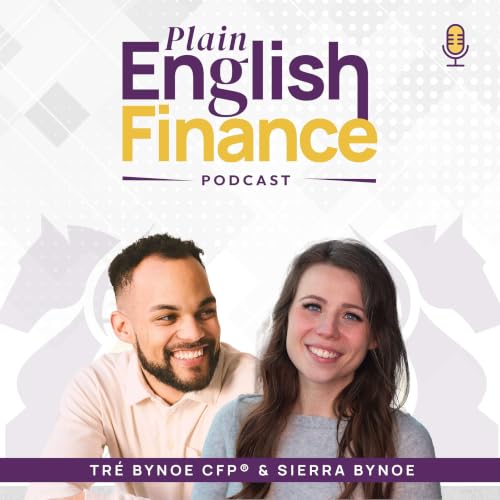
『Plain English Finance』のカバーアート

Plain English Finance

Plain English Finance

著者: Tré Bynoe CFP® CIM®
無料で聴く

The Plain English Finance podcast is hosted by Tré Bynoe CFP® CIM®, a financial planner with TCU Wealth Management and Aviso Wealth.


While Tré specializes in working with families with more complicated finances, typically involving corporations and trusts, this podcast is for anyone wanting to learn how to make high-quality decisions based on evidence, to give themselves the highest likelihood of financial success.


You should always consult with your financial, legal, and tax advisors before making changes.

This podcast is provided as a general source of information and should not be considered personal investment advice or solicitation to buy or sell any securities.

The views expressed are those of the individual and are not necessarily those of Aviso Financial Inc.

Mutual funds and other securities are offered through Aviso Wealth, a division of Aviso Financial Inc.


© 2026 Plain English Finance
個人ファイナンス 経済学
エピソード
  • 3 Warning Signs Your Corporate Wealth Plan Isn’t Working | Ep. 59
    2026/07/10

    Send us Fan Mail

    How do you know if the way you are managing wealth inside your corporation is actually working?

    In this episode of the Plain English Finance Podcast, Tré and Sierra discuss three warning signs that a corporation owner may not have a real financial plan: too much idle corporate cash, an advisor who is not discussing taxes, and no clear exit strategy for the business. The episode also includes a bonus red flag: using the exact same investments across your TFSA, RRSP, and corporate account without considering tax efficiency or asset location.

    For Canadian corporation owners, incorporated professionals and business owners, these issues can become expensive because mistakes compound quietly. A strategy that feels “fine” today can create tax, investment and planning problems years later when the money matters most.

    In this episode, we discuss:

    • Why corporate cash sitting in a chequing account may be a red flag
    • How much operating cash a business may actually need
    • Why excess corporate cash should have a defined purpose
    • Why setting up the right accounts early can prevent years of delay
    • Why not every advisor is a financial planner
    • Why not every financial planner specializes in corporations
    • Why tax planning matters when investing outside RRSPs and TFSAs
    • Why business owners should understand their eventual exit strategy
    • How selling shares, winding down a business, or retiring can create different tax issues
    • Why the Lifetime Capital Gains Exemption and corporate structure can matter
    • Why identical portfolios across TFSA, RRSP and corporate accounts may signal weak asset-location planning
    • Why good intentions from an advisor do not guarantee good advice

    The main idea is simple: if your corporation is accumulating wealth, you need more than an investment account. You need a structure for deciding how much cash to keep in the business, what to invest, where to locate assets, and how today’s decisions affect your future exit, retirement, and taxes.

    A corporation can be a powerful financial planning tool, but only if the plan is deliberate.

    Website | Youtube | Linkedin

    続きを読む 一部表示
    21 分
  • Should You Use Your TFSA to Buy a House? | Ep. 58
    2026/07/02

    Send us Fan Mail

    Should you use your TFSA to buy a home, or leave it invested and use a different strategy?

    In this episode of the Plain English Finance Podcast, Tré and Sierra work through a real planning puzzle: someone wants to buy a home, has money in both a non-registered investment account and a TFSA, and needs to decide whether using the TFSA creates a better long-term outcome. The answer depends on tax deductibility, investment returns, taxable income, how quickly the TFSA can be replenished, and whether the borrowed money is actually used to invest.

    The key issue is that mortgage interest on a personal home is normally paid with after-tax dollars, whereas interest on money borrowed for investment may be deductible if certain conditions are met. In this case, using the TFSA helped pay off the home purchase fully, then allowed a larger investment loan to be created in a non-registered account. That created a larger potential interest deduction, but it also meant temporarily giving up tax-free TFSA growth.

    In this episode, we discuss:

    • Whether it makes sense to use a TFSA for a home purchase
    • Why mortgage interest for a personal home is different from investment-loan interest
    • Why the paper trail matters when borrowing to invest
    • Why borrowed money cannot be used inside a TFSA or RRSP for this strategy
    • The trade-off between tax-free TFSA growth and deductible investment-loan interest
    • Why taxable income and tax bracket matter
    • Why investment allocation and risk tolerance matter
    • Why tax drag matters in non-registered accounts
    • Why active management can change the tax result
    • How quickly replenishing the TFSA can change the answer
    • Why the result may flip depending on market returns
    • Why this kind of decision needs actual planning, not rules of thumb

    Website | Youtube | Linkedin

    続きを読む 一部表示
    17 分
  • Why Investing Gets Complicated for Corporation Owners | Ep.57
    2026/06/26

    Send us Fan Mail

    Investing gets more complicated once you move beyond RRSPs, TFSAs and simple registered accounts. For Canadian corporation owners, incorporated professionals, and investors with taxable accounts, the type of income your investments generate can matter almost as much as the return itself.

    In this episode of the Plain English Finance Podcast, Tré and Sierra discuss three core investment concepts that help explain how financial planning, tax planning and portfolio construction fit together for corporation owners. The episode focuses on investment income types, how to think about risk, and why a consistent investment philosophy matters when taxes and corporate accounts are involved.

    In this episode, we discuss:

    • Why investing becomes more complicated in non-registered and corporate accounts
    • The three main types of investment income: interest, capital gains and dividends
    • Why GICs, bonds and fixed income create interest income
    • Why capital gains are treated differently from interest income
    • Why Canadian dividends can have a different tax profile
    • Why RRSPs change the tax treatment of investment income
    • Why asset location matters across RRSPs, personal taxable accounts and corporations
    • Why “risk” should not only mean volatility
    • Why fixed income may become riskier over long timeframes
    • Why market ups and downs are a feature, not a flaw
    • Why low-cost, globally diversified investments can simplify planning
    • Why turnover matters in taxable accounts
    • How active management can create unexpected taxable capital gains
    • Why corporate investment decisions should be made with tax drag in mind

    Learn more about working with Tré Bynoe, CFP®, CIM®:
    https://trebynoe.ca

    This podcast is provided as a general source of information and should not be considered personal investment, tax or legal advice. Consult your financial, legal and tax professionals before making changes to your financial plan.

    Website | Youtube | Linkedin

    続きを読む 一部表示
    24 分
adbl_web_anon_alc_button_suppression_t1
まだレビューはありません