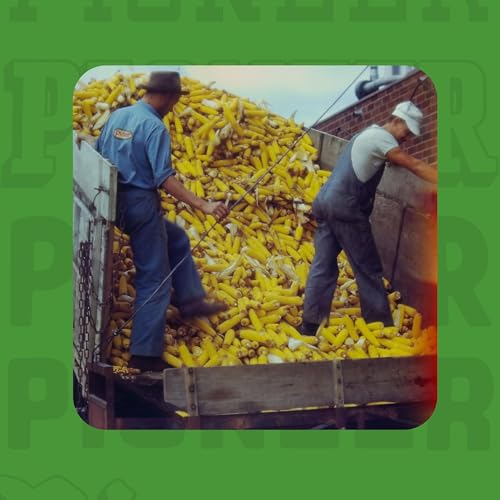
『Pioneer 100』のカバーアート

Pioneer 100

Pioneer 100

著者: Pioneer Seeds
無料で聴く

今ならプレミアムプランが3カ月 月額99円

2026年5月12日まで。4か月目以降は月額1,500円で自動更新します。

概要

The Pioneer 100 podcast celebrates and honors a century of agricultural innovation. Host Max Armstrong takes a look back to where it all began and looks forward to where the industry is going — with guests who have witnessed history and folks who are creating it. It’s an interesting and thought-provoking way to join the excitement of the 100th anniversary of Pioneer.™ ® Trademarks of Corteva Agriscience and its affiliated companies. © 2026 Corteva. 世界 科学
エピソード
  • The Pioneer Sales Representative Model and Other Firsts To Better Serve Farmers
    2026/04/23
    Episode 06: The Pioneer Sales Representative Model and Other Firsts to better Serve Farmers

    In this final installment of the Pioneer 100 Podcast, host Max Armstrong wraps up the century-long journey of Pioneer by focusing on its most enduring innovation: not a seed or a piece of software, but a way of doing business.

    Max is joined by Lance Gibson (Agronomy Training Manager) and Scott Walker (Pioneer Customer Experience Leader) to discuss the farmer-salesman model. Born out of necessity during the Great Depression, this model revolutionized how hybrid corn technology was adopted by placing expertise in the hands of respected local growers. The duo explores how this 1930s blueprint has evolved into today’s high-tech era of AI and data analytics while remaining firmly rooted in the "Long Look" philosophy of putting the farmer first.

    What You’ll Learn in This Episode
    • The Origin Story: How Henry A. Wallace, Nelson Urban, and Roswell Garst disrupted the crowded 1930s seed market.
    • Neighbors Over Catalogs: How studies from the 1940s proved that farmers trusted their neighbors more than any marketing material.
    • The Modern Sales Rep: How 1,700+ current representatives balance boots-on-the-ground agronomy with cutting-edge drone imagery and data management.
    • Data vs. Insights: How Pioneer distills data overload into actionable plans for growers.
    • The Next 100 Years: A look at the future of AI in agriculture and why the human element remains irreplaceable.
    Episode Timestamps
    • [00:00] – Introduction by Max Armstrong: Wrapping up 10 decades of history.
    • [01:15] – The 1930s Seed Landscape: Lance explains the crowded market of open-pollinated varieties.
    • [02:45] – The Birth of the Model: How Roswell Garst and Nelson Urban pioneered the farmer-salesman concept.
    • [04:20] – Why It Worked: The psychological shift from buying out of a catalog to buying from a neighbor who uses the product.
    • [06:10] – Maintaining the Blueprint: Scott discusses the current 2026 sales rep model and the 70% of reps who are active farmers.
    • [08:30] – Exclusivity and Genetics: The value of the Pioneer brand and localized testing.
    • [10:15] – Sorting the Chaff: Using technology to turn data overload into profitable decisions.
    • [12:45] – Looking Forward: Reflections on the Pioneer “Long Look" and the legacy of Henry A. Wallace.
    • [15:00] – Final Sign-off: Celebrating 100 years of agricultural innovation.

    Hosted by Simplecast, an AdsWizz company. See pcm.adswizz.com for information about our collection and use of personal data for advertising.

    続きを読む 一部表示
    19 分
  • Rise of Information and Data in Agriculture
    2026/04/16
    Episode 5: The Digital Field – 100 Years of Data and Agriculture

    In this episode of the Pioneer 100 Podcast, host Max Armstrong dives into the silent engine behind a century of agricultural success: data. While many view "Big Data" as a modern tech buzzword, the Pioneer history reveals a 100-year-old commitment to tracking, analyzing, and predicting plant performance.

    Max is joined by David Bowen (Corteva Data Strategy and Governance Analyst) and Matt Smalley (Data Science Leader at Pioneer) to discuss how the company’s data collection evolved from handwritten field notebooks to autonomous robots and AI-driven gene editing.

    The conversation journeys through the 1950s — highlighting a landmark $20,000 contract with IBM — to the present day, where Pioneer processes petabytes of genomic and geospatial data. You’ll learn how the record-breaking yields of today (including David Hula’s world records) can be traced back to the genetic founder inbreds of the 1920s through meticulously preserved data pedigree.

    Key Moments & Timestamps
    • [00:00] – Introduction: Celebrating a century of Pioneer and the rise of data in agriculture.
    • [01:15] – From Notebooks to Robots: David explains the evolution of data collection from pencils to autonomous streaming cloud data.
    • [02:40] – The 1950s IBM Partnership: A look back at the $20,000 investment in 1959 that saw Pioneer transition to punch cards and early mainframe computing.
    • [04:45] – Understanding a Petabyte: Matt puts the Pioneer data scale into perspective — one petabyte equals 100 Libraries of Congress.
    • [05:30] – Speed of Science: How computers reduced protein structure analysis from months to just six seconds.
    • [07:10] – 10 Billion Miles of Data: The staggering scale of the Pioneer genomic sequence data and how it grows at 300,000 miles per hour.
    • [08:00] – NVIDIA and Tech Giants: How Pioneer collaborates with AI leaders to adapt Big Tech tools for biological use cases.
    • [10:15] – The Gene Editing Revolution: Matt discusses using AI to navigate the 2 billion DNA base pairs in the corn genome.
    • [11:50] – The 100-Year Connection: Tracing modern world-record yields back to Raymond Baker’s 1920s founder inbreds.

    Hosted by Simplecast, an AdsWizz company. See pcm.adswizz.com for information about our collection and use of personal data for advertising.

    続きを読む 一部表示
    15 分
  • Farming Technologies Beyond Genetics
    2026/04/09
    Pioneer 100 Podcast: Episode 4 – Beyond the Genetics

    In this episode of the Pioneer 100 Podcast, host Max Armstrong explores the century-long history of innovation at Pioneer, focusing specifically on mechanization and farming technologies that exist outside the realm of seed genetics. Joined by Jordan Spear (Productivity Global Lead) and Josh Mongan (Automation and Field Technology Leader), the discussion highlights how the company transitioned from hand-harvesting and visual inspections to high-tech solutions like AI-driven sorting and custom-engineered research machinery.

    Episode Description

    While Pioneer is widely recognized for seed breeding, this episode dives into the "engineering engine" that helps those genetics actually reach the farmer with maximum quality. The guests trace the evolution of seed processing from the industry’s first dedicated seed house in the late 1920s to modern-day automated labs.

    Key topics include the development of portable dryer systems to stabilize grain moisture, the mechanization of the detasseling process, and the transition from cloth mail-order bags to the industry-standard PROBOX. The episode also showcases "bleeding edge" R&D tools, such as the Boreas wind machine, which mimics up to F2 tornadoes to test crop resilience, and the use of molecular marker technologies to ensure seed purity without waiting for a full growing season.

    Highlights & Timestamps
    • [00:00] Introduction: Max Armstrong introduces the theme of 100 years of Pioneer innovation beyond genetics.
    • [01:12] The First Seed House: How Pioneer revolutionized seed processing in the late 1920s to ensure quality and purity.
    • [02:27] Production Milestones: The introduction of portable dryers and the shift from hand-harvesting to mechanization in the 1930s and ’40s.
    • [03:33] Evolution of Detasseling: Moving from manual labor to mechanical pullers and, eventually, genetic male sterility.
    • [04:42] Custom Engineering and Boreas: Why Pioneer builds its own equipment, including a machine that generates sustained high winds and tornado-level bursts to test plant architecture.
    • [08:10] R&D Innovation: The story of building a research combine from scratch in 2010 and the use of drones and sensors for phenotyping.
    • [09:00] Seed Delivery Systems: The journey from cloth bags to the PROBOX and modern bulk delivery systems.
    • [09:57] Molecular Markers and AI: How DNA analysis and vision technology are used for quality sorting and accelerating the R&D pipeline.
    • [11:15] Closing Thoughts: Why technical innovation matters for the farmer's bottom line.

    Key Takeaways:

    • Pioneer builds its own leading-edge technology: Because the market often lacks the specific tools needed for advanced seed research, the Pioneer engineering department frequently designs equipment from scratch, including a custom research combine built in 2010 and the Boreas wind machine that can mimic up to F2 tornado-strength winds to test crop resilience.
    • Innovation spans the entire seed lifecycle: The company has focused on "beyond the genetics" innovations for a century, ranging from creating the industry's first dedicated seed house in the late 1920s to developing portable grain dryers and the industry-standard PROBOX delivery system.
    • Modern technology accelerates quality and scale: The integration of molecular markers, robotics, and AI-driven vision technology has allowed Pioneer to move from manual processes (like hand-sorting seeds or physical detasseling) to automated systems that ensure higher purity and faster "shots on goal" in the R&D pipeline.

    Hosted by Simplecast, an AdsWizz company. See pcm.adswizz.com for information about our collection and use of personal data for advertising.

    続きを読む 一部表示
    23 分
まだレビューはありません