• Keeping Pace with a Changing Reimbursement Landscape
    2026/08/13
    In this episode, host Debbie Stadtler welcomes John Kane, senior vice president of reimbursement policy at AHCA/NCAL, to discuss how reimbursement policy directly impacts the resources providers have to deliver quality care and the challenge of keeping pace with an ever-changing policy landscape. Kane explores the development of the Patient-Driven Payment Model (PDPM), its shift from volume-based reimbursement to a model centered on patient characteristics, and the challenges states face when adapting PDPM for Medicaid populations. He also examines major Medicaid changes under H.R. 1, ongoing Medicare Advantage challenges related to access and payment, and the growing regulatory demands facing facilities. The conversation highlights why staying informed and engaged is increasingly important as reimbursement continues to evolve toward value-based care. Perspectives in Long Term Care is produced by Association Briefings. Transcript Debbie Stadtler: Hi, I'm Debbie Stadtler, editor-in-chief of Provider Magazine, the flagship publication of the American Health Care Association and the National Center for Assisted Living. I'd like to welcome you to this episode of Perspectives in Long term Care, a monthly podcast produced by AHCA and NCAL. Each month, we'll talk with long term care and assisted living professionals about the opportunities and challenges impacting the long term and post-acute care profession. My guest today is John Kane. John is the senior vice president of reimbursement policy at AHCA and NCAL. Prior to this, he spent almost 15 years at the Centers for Medicare and Medicaid Services. Welcome, John. Thanks for being with us. John Kane: Thank you very much, Debbie. It's a pleasure to be here. Debbie Stadtler: We like to start at the beginning. So tell us how you got involved in long term care. How did your career lead you to where you are today? John Kane: A combination of things probably. I think one part of the journey started back years ago when I was studying philosophy of all things... and had every intention of becoming a college professor: teaching, publishing, sipping wine. And but I found that as I was talking with my colleagues, and I would be asking questions that they didn't seem to really care much about. We would be talking about health policy, and I would ask questions like, "Well, how are we gonna pay for that?" Or "How are providers going to implement this?" And they didn't really seem to care, and I realized at that point I wanted to do something that was more applied and less theoretical. And at the same time, as a matter of coincidence, I was actually working at a facility in Blacksburg, Virginia, Five Stars Warm Hearth, shout out. Nothing glamorous but very important role. I worked in the kitchen. And I'll tell you that trying to make a soft liquid diet palatable takes a lot of skill. But my experience there also helped me to see the daily struggle of the people that were working in that industry and the amount of passion that they brought to it and really just dedicating their lives to valuing the lives of seniors. And I loved being a part of it, even a small part. And as I was there, I felt like there was more that I could do, and I wanted to get deeper into it. And so that eventually led me into the deeper areas of health policy and eventually led me to CMS. Debbie Stadtler: I love that story. A little hands-on kitchen experience really leads you to your greater purpose in health policy and helping those in long term care. I love that story. John Kane: I like to think that I've done more not burning people's food than- Debbie Stadtler: Always important. Your background includes years spent working at the Centers for Medicare and Medicaid Services, what we know as CMS. What's that like working on the government side of reimbursement, and how did that time kind of influence your views? John Kane: My time at CMS was some of the most formative and memorable time of my life, especially my career. I can't speak highly enough about the people that I worked with at CMS and that continue to work within CMS. They are dedicated public servants, all of them, and it was also just an incredible feeling to be at the genesis of policy development. It was hard to not feel as though you were doing something that was impactful and you were making a difference every day. At the same time, I also felt a certain disconnection from the industry that I had grown to love. I would go to visit facilities, whether it was because my dad was in a facility or just to get back out in the field and go and visit with residents or visit into the various homes, and it felt different. I was no longer just a person walking through the halls. I was CMS now. And so conversations became more focused on policy than on people, and I missed it. And moreover, I think being at CMS, you develop a level of specialization that is nurtured by the, the siloed nature of the agency. While I was there, ...
    続きを読む 一部表示
    23 分
  • Reflecting on the Past, Preparing for the Future
    2026/07/14
    In this episode, host Debbie Stadtler welcomes James Carlson, senior reimbursement advisor at AHCA/NCAL, and Nicolette Reilly, senior vice president of quality at the Oregon Health Care Association, for a conversation about the evolution of assisted living over the past four decades. They reflect on the origins of the assisted living model, how the definition of quality has expanded to focus on resident experience and continuous improvement, and the balance between regulation and innovation. The discussion also explores the role of NCAL in advancing the profession and looks ahead to the future of assisted living, including emerging technologies, workforce development, personalized care, and changing consumer expectations. Perspectives in Long Term Care is produced by Association Briefings. Transcript Debbie Stadtler: Since its inception in the 1980s, assisted living has used innovation to redesign aging. Hear more about the evolution of assisted living, how quality has matured, and why the next 25 years may be the best yet. Hi, I'm Debbie Stadtler, editor-in-chief of Provider Magazine, the flagship publication of the American Health Care Association and the National Center for Assisted Living. I'd like to welcome you to this episode of Perspectives in Long Term Care, a monthly podcast produced by AHCA and NCAL. Each month, we'll talk with long term care and assisted living professionals about the opportunities and challenges impacting the long term and post-acute care profession. My guests today are Jim Carlson and Nicolette Reilly. Jim is a senior reimbursement advisor at AHCA/NCAL, and he spent 30 years with the Oregon Health care Association, including 23 years as the CEO. Nicolette is the senior vice president of quality at the Oregon Health care Association. Welcome, Jim and Nicolette. Thanks for being with us. Jim Carlson: Good afternoon. Debbie Stadtler: Well, let's start at the beginning. Tell us about your career journey. What led you to get started in assisted living and long term care? Jim, do you want to kick us off there? Jim Carlson: Sure. I'd say probably my first interest really in health policy and all the issues related to Medicaid and Medicare and the economics and aging demographics was, I worked for an economics professor of mine in college when he ran for Congress. And we spent hours upon hours driving around the Fourth Congressional District in Oregon, and he had a particular interest in health care and health care economics. And since he was running for Congress, he had a particular interest in federal level issues, dealing with Medicaid and Medicare and health care economics. And so it piqued my interest. He ended up losing that race, but I ended up, after graduation, going to work for another member of Congress, and being low man on the totem pole on the staff, Medicaid and Medicare came into my portfolio. And so I really, from just a very young age, got very interested in federal health care finance and reimbursement programs and the economics, and I always had a real keen interest about demographics and the impact that had on the economy and society. Debbie Stadtler: Nicolette, how did you get started? Nicolette Reilly: My path was very different from Jim's. When I graduated with my undergraduate degree, I had a business minor, and right out of college, I started working as a finance and business office manager for a new assisted living in Fort Collins, Colorado. And as a very young, new into the profession, I never envisioned that my career would be in long term care. It just happened to be this door that opened up to me from a business perspective. So in 1995, I started out as a business office manager in an assisted living, and just over the years went from a business office manager to an assistant administrator to an administrator, and then to a regional ops person, and then a vice president of operations. Even did a stint as an owner/operator of an assisted living company a while back. And then about four or five years ago, really wanted to find a way to take my passion of working with seniors and take my passion around driving quality in long term care, and try and find different ways that I could engage and influence the quality that was happening in long term care and how to drive that. And so I had a great opportunity to come over to the Oregon Health Care Association, where now I've been able to see long term care from a completely different perspective, more from the legislative perspective and the regulatory perspective and what goes into that, and the wonderful opportunity to advocate on behalf of providers in both of those areas. Debbie Stadtler: That's interesting. So both of you come at assisted living from a different perspective than normal. Usually I hear about people have a family member that inspired them, or they start as a caregiver, a CNA, and things like that. But you guys really come from, like, the business economics perspectives, ...
    続きを読む 一部表示
    33 分
  • The Power of Showing Up: Advocating for the Long Term Care Profession
    2026/06/15
    In this episode, host Debbie Stadtler sits down with Barry Carr, chairman and co-founder of Ignite Medical Resorts, and Randi Carr, Ignite’s chief of staff, to discuss the importance of advocacy and relationship-building in the long-term care profession. As they celebrate 40 years of marriage and prepare to receive the Joe Warner Patient Advocacy Award, Barry and Randi reflect on how their involvement with AHCA/NCAL inspired them to become more engaged with policymakers at the local, state, and federal levels. They share practical insights on building lasting relationships with elected officials, emphasizing the value of consistency, education, and offering solutions rather than simply highlighting challenges. The conversation explores how facility tours can help policymakers better understand the realities of long-term care and why providers must stay engaged on issues ranging from Medicaid reimbursement and staffing mandates to federal regulations. Barry and Randi also discuss current advocacy priorities, including Medicare Advantage obstacles and the ongoing challenges surrounding the three-midnight rule and observation stays. Throughout the episode, they highlight how proactive advocacy helps strengthen the profession, improve patient care, and ensure policymakers have a clearer understanding of the vital role long-term care providers play in their communities. Perspectives in Long Term Care is produced by Association Briefings. Transcript Debbie Stadtler: Politicians are people too. Learn more about building relationships with policymakers and advocating for our profession from Barry and Randi Carr in this episode of Perspectives in Long term Care. Hi, I'm Debbie Stadtler, editor-in-chief of Provider Magazine, the flagship publication of the American Health Care Association and the National Center for Assisted Living. I'd like to welcome you to this episode of Perspectives in Long Term Care, a monthly podcast produced by AHCA and NCAL. Each month, we'll talk with long term care and assisted living professionals about the opportunities and challenges impacting the long term and post-acute care profession. My guests today are Barry and Randi Carr. Barry is chairman and co-founder of Ignite Medical Resorts. Before founding Ignite, he spent years growing new care services from roughly 1,000 to nearly 5,000 beds. Randi serves as Ignite's chief of staff and engages regularly with state and federal policymakers. Barry and Randi met at the University of Michigan and are celebrating their 40th wedding anniversary this year, which deserves a hearty congratulations. Welcome to the podcast, Barry and Randi. Barry Carr: Thank you. Randi Carr: Thank you. Glad to be here. Debbie Stadtler: Well, tell us about your career journey. What led you to get started in long term care? How did you get to where you are today? Barry Carr: I started about 41 years ago. My father-in-law was an investor in a group of facilities, and they needed an assistant administrator, so I came on board, said I would do that for a year or two, and they ended up selling the company a few years later. And then I got back together with his old partner, and we grew that company together. His family was getting involved. There was a nice growth. I left after 27 years and then broke off and started Ignite with my partner, Tim Fields, about eight years ago now. Randi Carr: When Barry and Tim, in 2018, when they were starting up the company, Barry had one facility on his own. They were trying to acquire more properties, and Barry said to Tim, "The company doesn't really have any money yet, but we do need someone to help us out, and Randi's really organized, and we don't have to pay her." So that's how I got my job. In the beginning, he always had such a really busy work life, I was in charge of the kids and the house, and I was a stay-at-home mom, but I also was a substitute teacher for 20 years. So that overlapped a little bit with when I started with Ignite. But then when COVID shut the schools down, it just kind of got busier at that time, and it just evolved. Barry Carr: Yeah. Timing was right. Randi Carr: Yeah. Debbie Stadtler: You're both receiving the Joe Warner Award. Again, congratulations. For those who don't know, the Joe Warner Patient Advocacy Award honors members who embody compassion, service, leadership, and an unwavering dedication to the elderly and people with disabilities. What does this award mean to you? Barry Carr: It's a great honor. It surprised us both. Randi Carr: It really surprised us. We weren't vying for it. Yeah. We didn't even really know much about it. Barry Carr: But we don't do things for the award. Our focus is really on people and making sure that the patients are taken well care of, the families are happy, the staff is happy. So really for us, it was, it's just a Randi Carr: Bonus ... Barry Carr: it's a bonus, yeah, on top. Randi Carr: I mean, it's really, we're very ...
    続きを読む 一部表示
    23 分
  • Finding Solutions to Long Term Care Workforce Shortages
    2026/05/13
    In this episode, host Debbie Stadtler is joined by Rachel Bunch, executive director of the Arkansas Healthcare Association, for a conversation about innovative approaches to addressing workforce shortages in long term care. Bunch shares her professional journey and discusses how the association responded to member needs by launching the Arkansas Healthcare Association School of Nursing. What began as a medication assistant program designed to help CNAs expand their responsibilities and allow nurses to practice at the top of their license evolved into a tuition-free, employer-focused CNA-to-LPN pathway. The discussion explores how the program incorporates accelerated coursework, coordinated work schedules, and wraparound student support to improve retention and completion rates. Bunch also highlights the school’s strong outcomes, including a nearly 92% graduation rate, ongoing expansion efforts across the state, a focus on geriatric care training and faculty development, and future plans to explore an LPN-to-RN pathway. She also reflects on the importance of listening to members and being willing to pursue nontraditional solutions to workforce challenges. Perspectives in Long Term Care is produced by Association Briefings. Transcript Debbie Stadtler: We know that finding workers in long term care is a challenge. Learn more from the Arkansas Health care Association, who have seen great success in starting a nursing school to address that need. Hi, I'm Debbie Stadtler, editor-in-chief of Provider Magazine, the flagship publication of the American Health care Association (AHCA) and the National Center for Assisted Living (NCAL). I'd like to welcome you to this episode of Perspectives in Long Term Care, a monthly podcast produced by AHCA and NCAL. Each month, we'll talk with long term care and assisted living professionals about the opportunities and challenges impacting the long-term and post-acute care profession. Today, my guest is Rachel Bunch, executive director of the Arkansas Health Care Association. Rachel also serves on the Governor's Council on Aging and the Alzheimer's Disease and Dementia Council. She is the president of the Arkansas Health Care Association’s School of Nursing, which we are going to talk more about shortly. Welcome, Rachel. Rachel Bunch: Thank you very much. Debbie Stadtler: Let's start at the beginning. Tell us about your career journey. What led you to get started in long term care? Rachel Bunch: I guess you could say it's one of those... What's the quote about the best laid plans are not plans? So I actually started working at the Arkansas Health Care Association when I was in college back in 2008. Started working there and really enjoyed it. I, at the time, didn't know really what an association was or the role that they played, and really enjoyed my work there so much with them, and then did a lot of different duties with them. Started in my position at the end of 2013, and so I'm going on my 18th year now with the Health Care Association in Arkansas, which is really wild and hard to believe that it's been that long. Time flies when you're having fun, right? Definitely. A little bit of a non-traditional route. Debbie Stadtler: We know that workforce challenges are top of mind for long term care providers, and the Arkansas Health Care Association decided to help address this challenge with a nursing school. Tell us more about it. Rachel Bunch: Sure. Thank you. So it's been a really exciting journey and something that has really, we've laid the groundwork over the last several years. We didn't necessarily seek out to do this. We've done education at the association for many years, just like a lot of the other state affiliates offer, and this really started with our medication assistant program in 2023. That was a, a level in our workforce, a licensure level that a lot of other states had, and we didn't, and worked to add that through legislation and with various state boards in Arkansas. And once we started offering that program, it really took off, I think because we were a little bit behind the curve on having those professionals in the state, but also the workforce shortage was so great. And the key difference that it made for us, it allowed us... The structure of our program, it allowed us to take existing CNAs and put them through this medication assistant program for higher wages, more responsibility, and they went through the program, and they were so motivated to go to school. The facilities really embraced it, and it went well because it gave our nurses on the floor got time back in their day to do other nursing tasks other than pass meds, and it really allowed those nurses to work at the height of their license, which made such a difference. And so that was the beginning, and we had a lot of motivated students, a lot of motivated providers that really had done some tuition reimbursement before but hadn't had a real structured process to be able...
    続きを読む 一部表示
    21 分
  • What It Takes to Achieve Quality Excellence
    2026/04/13
    In this episode, host Debbie Stadtler sits down with with Renee Ridling, Executive Director of the Gingerbread House, to explore quality improvement and the AHCA/NCAL Quality Award program. Ridling shares her journey into long-term care—from marketing to licensure—and her experience helping organizations earn Bronze, Silver, and Missouri’s first Gold award. They break down the progression of the program, from defining an organization’s identity (Bronze), to documenting processes and data (Silver), to achieving results through a rigorous Baldrige-based framework (Gold). Along the way, Ridling highlights common pitfalls—especially focusing too much on “what” instead of “how”—and underscores the importance of repeatable processes, team engagement, and using feedback reports as a tool for sustained improvement. Perspectives in Long Term Care is produced by Association Briefings. Transcript Debbie Stadtler: Improving quality is always a goal in long-term care. Hear more about the ins and outs of the continuous quality improvement journey in this episode of Perspectives in Long-Term Care. Hi, I'm Debbie Stadtler, editor-in-chief of Provider Magazine, the flagship publication of the American Healthcare Association and the National Center for Assisted Living. I'd like to welcome you to this episode of Perspectives in Long-Term Care, a monthly podcast produced by AHCA and NCAL. Each month we'll talk with long-term care and assisted living professionals about the opportunities and challenges impacting the long-term and post-acute care profession. My guest today is Renee Ridling, executive director of Gingerbread House, a nonprofit provider for high acuity, medically fragile, developmentally disabled individuals in Rolla, Missouri. Renee has served as a silver and gold level examiner for the AHCA and NCAL Quality Award program for eight years. She joined the quality award panel of judges in 2018 and continues to serve as a judge for the program. She has also successfully led two skilled nursing facilities to two bronze and two silver quality awards, and in 2014, her facility became the first facility in Missouri to achieve the gold quality award. Welcome, Renee. Thanks for being with us. Renee Ridling: Thank you for having me. Debbie Stadtler: Those are some awesome accomplishments, and I want to talk much more about the Quality Award program. But first, tell us about your career journey. How did you get into the field? What led you to choose this career? Renee Ridling: I actually got into long-term care by accident. I'd always wanted to work in healthcare, and I had a background in marketing. I interviewed for a position in marketing with a long-term care facility and I fell in love with it. And I worked at that time for Beverly Enterprises, a company that had over 200 facilities nationwide at that time. And I was asked if I would be interested in the AIT program and. It was intriguing, so I said yes, and the rest, as they say, is history. I obtained my license in late 1992, early 93, and I've been working in long-term care consistently since then. I just fell in love with everything about the people that we care for and the challenges that we face as an industry every day. Debbie Stadtler: It's amazing, and as I talk to folks about their career and how they get started, it's so evident that there is a love and a passion for the industry and for the people that are in it. So I can see that is reflected in your career as well. But let's talk about the quality improvement journey. You have a unique perspective because you've seen it from both sides, both as an applicant and recipient, but also as an examiner and a judge. So give us a quick overview of the program and your experience with it. Renee Ridling: Well, I actually became an examiner after we received our bronze quality award in 2008 for my facility here in Missouri. And I wanted to learn more about the criteria, wanted to be able to help my organization to understand the process better and just to do a better job of learning and finding out what the quality improvement journey was all about. So that's when I became an examiner. I've stayed an examiner because I found it to be helpful in learning about my organization, how continuous improvement can benefit all aspects of the organization, not just the leadership part of it, not my job, but quality improvement continuously. Looking at opportunities to get better can help everybody, my residents, my staff, and really just became a student of that criteria. I really enjoyed the silver. And then I became a gold examiner. I've been a team lead at both levels. And then I was approached to be a judge, and that was a really interesting term. So it's been a really great opportunity for me not only to learn about myself, but to also learn about the organizations that I've had the opportunity to work with. Debbie Stadtler: I love how you mentioned that becoming an examiner was a ...
    続きを読む 一部表示
    23 分
  • New CMS Models and What They Mean to Long Term Care Providers
    2026/03/16
    In this episode, host Debbie Stadtler speaks with Nisha Hammel, Vice President of Reimbursement Policy and Population Health for AHCA/NCAL, about the rapid shift from fee-for-service to value-based care and what it means for long-term care and assisted living providers. Nisha reflects on her journey from geriatric social work to national policy leadership and explains how CMS has introduced roughly 11 new payment models in the past year. These models place increasing emphasis on prevention, provider accountability, technology-enabled care, and patient engagement, with more than 70 percent of payments now tied to quality and patient experience. The conversation explores several models that could affect providers, including the mandatory TEAM model, the state-based AHEAD and GEO AHEAD initiatives, and the forthcoming 10-year LEAD ACO model. Nisha encourages providers to stay informed, talk with clinical partners about ACO participation, understand their baseline utilization data, strengthen on-site clinical workflows to reduce avoidable transfers, and take advantage of AHCA/NCAL resources such as toolkits and the Population Health Management Summit. Perspectives in Long Term Care is produced by Association Briefings. Transcript Debbie Stadtler: [00:00:00] The transition from fee-for-service to value-based care is here. Learn the latest on new CMS payment models in this episode of Perspectives in Long Term Care. Hi, I'm Debbie Stadtler, editor-in-chief of Provider Magazine, the flagship publication of the American Healthcare Association and the National Center for Assisted Living. I'd like to welcome you to this episode of Perspectives in Long Term Care, a monthly podcast produced by AHCA and NCAL. Each month we'll talk with long term care and assisted living professionals about the opportunities and challenges impacting the long term and post-acute care profession. My guest today is Nisha Hammel, vice president of reimbursement policy and population health for AHCA and NCAL. She leads the association's policy and strategic initiatives on value-based care and innovative payment models. She brings 20 years of experience in post-acute care and senior living. Welcome, Nisha. Thanks for being with [00:01:00] us. Nisha Hammel: Thanks, Debbie. Thank you for having me. Debbie Stadtler: We'd like to start at the beginning, so tell us a little bit about you and your career journey. What led you to get started in long term care? Nisha Hammel: My career journey really began next door with my maternal grandparents who were like second parents to me. I grew up in a home and culture that really revered old adults, so my passion for aging was shaped early. You could say, I honestly never stood a chance of choosing anything else. Even when my peers would ask like, what are you majoring in? I stuck with geriatric social work as my master's program back when only a couple of schools in the entire country offered it as even as an optional major. From there, I started out as a social worker in a skilled nursing facility and moved [00:02:00] through a variety of operational and leadership roles in assisted living, home health, hospice, affordable housing. Really, I think each step taught me something new about caring for older adults with dignity. I really feel very blessed for that incredible journey. Eventually, I joined a state association where I helped lead providers in exploring new ways to work together that included some of our earliest conversations around value-based care and population health, and even how long term care could participate in Medicare Advantage in a meaningful way. It was an experience I still consider a privilege, and it has carried me into essentially the next chapter of my journey, which led me to AHCA, where I now have the opportunity to help advance models and policies that [00:03:00] transform care for older adults and support the truly exceptional providers who care for them every single day. Also, having the opportunity to advocate for some common sense policies to Medicare Advantage. I'd say each position has really felt like something I was called to do, and I am deeply humbled by this path and incredibly grateful that it all started with two grandparents right next door. Debbie Stadtler: I'm always amazed at how many people have that personal connection, whether it's a grandparent or a family friend or a mother/father that really started them out in this profession. And I think, like you said, so many people feel it's a calling. It's really such a personal connection to this work, and I think that makes it really special. I want us to talk about value-based payments. Set the stage for us. [00:04:00] Where are we now? What has happened recently? What's going on in this area? Nisha Hammel: Sure. I'd say value-based care has consistently received support from both Democratic and Republican administrations. While each may emphasize different elements, I think the overall ...
    続きを読む 一部表示
    27 分
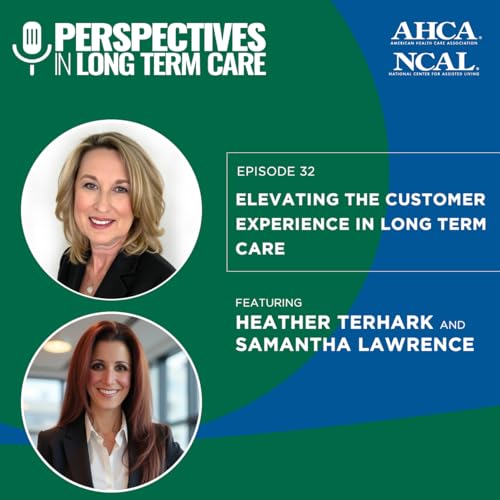
  • Elevating the Customer Experience in Long Term Care
    2026/02/13
    In this episode, host Debbie Stadtler welcomes Heather TerHark, Chief Strategy Officer at Viva Senior Living, and Samantha Lawrence, Regional Vice President of Operations at Brightview Senior Living, for a conversation on redefining customer experience in long-term care. Together, they explore how organizations can move beyond traditional customer service to deliver more personalized, relationship-driven care. The discussion highlights the growing expectations of today’s residents, the impact of technology and AI on safety and engagement, and the critical role of staff training, empathy and culture in shaping meaningful experiences. The episode also invites listeners to get involved by joining the Customer Experience Committee to help advance resources and innovation across the industry. Perspectives in Long Term Care is produced by Association Briefings. Transcript Debbie Stadtler: [00:00:00] Is your facility making the best impression possible on everyone who walks through the front door? Learn easy ways to boost your customer experience in this episode of Perspectives in Long Term Care. Hi, I'm Debbie Stadtler, editor-in-chief of Provider Magazine, the flagship publication of the American Health care Association and the National Center for Assisted Living. I'd like to welcome you to this episode of Perspectives in Long Term Care, a monthly podcast produced by AHCA and NCAL. Each month we'll talk with long-term care and assisted living professionals about the opportunities and challenges impacting the long-term and post-acute care profession. My guests today are Heather TerHark and Samantha Lawrence. Heather is the chief strategy officer at Viva Senior Living and brings more than 27 years of experience to the table. Samantha is regional vice president of operations at Brightview Senior Living in New Jersey and has served seniors in various capacities for 26 [00:01:00] years. Heather and Samantha are the co-chairs of AHCA's Customer Experience Committee. Welcome, Heather. Samantha. Thanks for being with us. Heather TerHark: Thank you for having us, Debbie. We're so excited to be here. Debbie Stadtler: We like to start at the beginning. So tell us a little bit about your personal journey, your career journey. How did you end up where you are now? What led you to get started in long-term care? Samantha, start with your journey. Tell us a little bit about it. Samantha Lawrence: So I was fortunate to know three great-grandparents and all of my grandparents and wow, when I was about 10 years old, my one great-grandfather had developed Alzheimer's. And at that time, communities like Heather and I had the opportunity to be engaged with didn't quite exist, so it was in a rural nursing home. I went to visit my great-grandfather and a woman that was a patient/resident there grabbed my arm and said, honey, will you get me a laxative? I did not know what that was at the ripe old age of 10. But I knew she [00:02:00] needed something. So I went to the desk and I said, excuse me, this woman over there in blue, she needs a laxative and that nurse turned my career path. Because she said, “Honey, she says that all the time. Just ignore her.” I didn't know what the right answer was, but I knew that didn't sound like the right answer. So I just went back and started talking to her and then you could not peel me out of there. I'm like, “Mom, this woman can't reach her cup. This woman is shaking and her food's falling off of her fork and we have to go.” Like I said, these people need help. So volunteering closer to my home, playing the violin at dinner for a local nursing home, and they needed a part-time receptionist when I turned 16. I did a paper application. I called my mom on a payphone. I said I was really nervous about my big interview, and she said, “You are the only 16-year-old that is stoked about working in a nursing home. I think you'll get the job.” And so then I never looked back. I grew my career in different frontline roles in reception activities, moved into management roles, got my administrator's license [00:03:00] in assisted living. Went into a subject matter expert role in dementia programming, but realized my heart was in operations, and been with Brightview now for the past 11 years, about six of those in a regional capacity, and was an executive director in Paramus, New Jersey, for them. Opening that community actually prior to this role. Debbie Stadtler: It's amazing how many people that I speak with that the beginning of their journey has some sort of family connection to how they start in this industry. So it's really interesting. Heather, tell us a little bit about your journey. Heather TerHark: Sure I wasn't quite as soon as Sam at the age of 10, but a woman in college. We all think we're going into college and we have this career path all mapped at, and I was working at a hospital as just more of that part-time job that you do in college and I got the ...
    続きを読む 一部表示
    30 分
  • Building Trust Where It Matters Most
    2026/01/12

    In this episode, host Debbie Stadtler sits down with David Gifford, MD, MPH, chief medical officer of the American Health Care Association, for a thoughtful conversation on building trust in long-term care. Dr. Gifford shares his career journey and explores why trust is foundational to effective healthcare systems. Together, they discuss the role of empathy, authenticity, and clear communication in strengthening relationships among care teams, residents, and families. Dr. Gifford also addresses the challenges technology can introduce and offers practical strategies for cultivating trusted colleagues and leading with intention. The episode includes actionable guidance for fostering stronger trust and communication in long-term care settings.

    Perspectives in Long Term Care is produced by Association Briefings.

    続きを読む 一部表示
    30 分