エピソード

  • What Is Pinealon? Brain Aging, Neuroprotection, and the Evidence
    2026/08/31

    Check out The Peptide App here: thepeptide.app/explained

    What is Pinealon, and does this three-amino-acid peptide really protect the aging brain?

    Pinealon—also called EDR or Glu-Asp-Arg—is a synthetic tripeptide associated with the Khavinson bioregulator research program. It is discussed for memory, neuroprotection, oxidative stress, brain aging, and even Alzheimer's disease, but the evidence is much more complicated than the marketing language suggests.

    John Garrett, examines Pinealon's proposed mechanism, cell and animal research, a newer induced-neuron study, and the PubMed-indexed human reports that are often overlooked. The episode also explains why Pinealon is different from Epitalon, where the human evidence is weak, what remains unknown about brain exposure and long-term safety, and why a plausible mechanism is not the same thing as an established cognitive therapy.

    Educational content only. Not medical advice.

    続きを読む 一部表示
    22 分
  • Khavinson Peptide Bioregulators: What Do They Actually Do?
    2026/08/30

    What are Khavinson peptide bioregulators, and what do they actually do?

    John Garrett examines the Russian research tradition behind organ-derived peptide complexes and synthetic ultrashort peptides. This episode explains the proposed gene-expression mechanism, the claim of tissue specificity, common examples such as Thymalin and Epitalon, the limitations of the human evidence, oral absorption questions, product-quality concerns, safety, and U.S. regulatory status.

    The science is more interesting than a simple dismissal—but less proven than organ-rejuvenation marketing suggests.

    This episode is educational and is not medical advice.

    続きを読む 一部表示
    19 分
  • Did Your GLP-1 Stop Working? Appetite, Receptors and Weight-Loss Plateaus
    2026/08/30

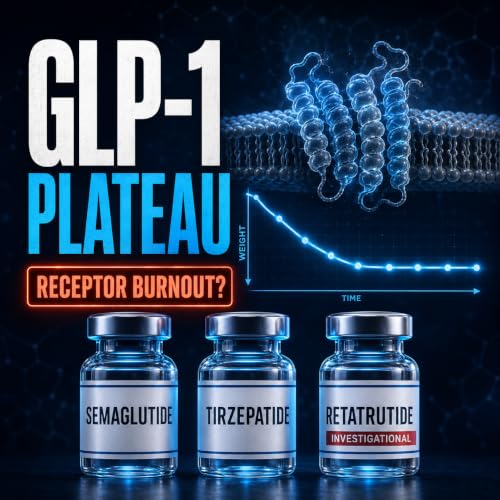
    Does a weight-loss plateau mean your GLP-1 receptors have become desensitized? John separates cellular receptor biology from whole-body weight regulation and compares semaglutide, tirzepatide, and investigational retatrutide. We examine appetite suppression, food noise, gastric-emptying tachyphylaxis, metabolic adaptation, switching therapies, and what the clinical evidence can—and cannot—tell us.

    A plateau is real. "Receptor burnout" is a much bigger claim.

    Educational only; not medical advice.

    続きを読む 一部表示
    22 分
  • Should You Be Using Peptides? The Honest Answer
    2026/08/20

    Visit Peptide-Solutions.info for more info

    Check out App.PeptidesExplained.info

    Should you be using peptides?

    The honest answer is that not everyone should. Peptides are not a nutritional requirement, a shortcut to better health, or something you need simply because they are trending.

    But some people do have a defined problem—such as obesity, metabolic disease, an injury, loss of function, a diagnosed hormone-related condition, or another health issue—for which a peptide-based medication or investigational compound may be relevant.

    In this episode, John Garrett, explains how to decide whether a peptide belongs in the conversation. You will learn how to start with the problem rather than the product, compare FDA-approved, off-label, compounded, experimental, and research-use categories, evaluate human versus animal versus anecdotal evidence, identify better-established alternatives, and build a plan for monitoring and stopping.

    This episode also points viewers to "The 11 Peptides I Find Most Compelling" and the individual Peptides Explained deep dives for compound-specific education.

    This content is educational only and is not medical advice. Speak with a qualified healthcare professional before starting, stopping, or changing any therapy.

    続きを読む 一部表示
    19 分
  • ARA-290: Can It Repair Small Nerve Fibers?
    2026/08/18

    ARA-290, also called cibinetide, is an investigational 11-amino-acid peptide designed from erythropoietin biology to activate tissue-protective signaling without stimulating red-blood-cell production.

    In this episode, John Garrett, RN, breaks down the innate repair receptor, why ARA-290 has been studied in small-fiber neuropathy, what randomized human trials in sarcoidosis and type 2 diabetes actually found, and why objective nerve-fiber signals are interesting—but not the same thing as an approved therapy.

    You'll learn:

    • What ARA-290/cibinetide is

    • How it differs from full-length erythropoietin

    • What the innate repair receptor is

    • Why researchers studied corneal nerve fibers

    • What the 22-patient pilot trial showed

    • What the 64-patient phase 2b trial showed

    • Why pain and nerve-fiber endpoints did not tell exactly the same story

    • What is known—and not known—about safety

    • Why online ARA-290 products should not be assumed equivalent to trial material

    Explore the Peptides Explained app: app.peptidesexplained.info

    Learn more through Peptide Solutions: peptide-solutions.info

    Educational content only. ARA-290 is investigational and is not an FDA-approved treatment for neuropathy or any other clinical indication.

    続きを読む 一部表示
    17 分
  • Lipo-C Injections: What Do They Actually Do?
    2026/08/12

    Check out Peptide.Solutions.info/Pathways and submit a request to see what companies I have partnered with to get products.

    Lipo-C injections are often marketed for fat burning, energy, liver support, or breaking a weight-loss plateau. But "Lipo-C" is not one standardized formula—and real metabolic biology is not the same thing as proven fat loss.

    In this episode, John Garrett, RN, breaks down the ingredients commonly found in Lipo-C blends, including L-carnitine, choline, methionine, inositol, and B vitamins. We examine what each ingredient actually does, what human studies of L-carnitine suggest, why that evidence cannot automatically be applied to a compounded injection, and the questions to ask before paying for one.

    You'll learn:

    • Why two products called Lipo-C may be completely different

    • How carnitine participates in mitochondrial fatty-acid oxidation

    • What "lipotropic" does—and does not—mean

    • Whether Lipo-C is FDA approved

    • What people report versus what trials establish

    • Risks, limitations, and when provider involvement matters

    Explore the Peptides Explained app: app.peptidesexplained.info

    Learn more through Peptide Solutions: peptide-solutions.info

    Educational content only. This is not medical advice or a recommendation to use an injectable product.

    続きを読む 一部表示
    15 分
  • FOXO4-DRI: Can It Really Remove Senescent Cells and Reverse Aging?
    2026/08/10

    FOXO4-DRI has been called a "zombie-cell killer," a senolytic peptide, and even a possible anti-aging breakthrough. The mechanism is fascinating—but the claims have moved much faster than the human evidence.

    In this episode, John explains what senescent cells are, why they are not automatically harmful, and how FOXO4 and p53 help regulate cell survival and cell death. He then breaks down the D-retro-inverso design of FOXO4-DRI, the proposed mechanism, and what the original 2017 research actually found in cultured human cells and mice.

    The episode also examines what has happened since that first study, why removing senescent cells may produce different effects in different tissues, and what the cancer, tissue-repair, regulatory, and long-term safety questions really look like.

    The bottom line: FOXO4-DRI is a scientifically credible experimental senolytic with compelling preclinical biology—but it has not been proven to reverse aging or provide clinical benefit in humans.

    Explore the Peptides Explained App:

    https://app.peptidesexplained.info

    Peptide Solutions:

    If you are interested in checking out Compounded or Research Peptide Sources visit Peptide Solutions. https://peptide-solutions.info

    This episode is educational and is not individualized medical advice. FOXO4-DRI is experimental and is not an FDA-approved medication.

    続きを読む 一部表示
    24 分
  • ATX-304: AMPK Activation, Metabolic Demand, and the Limits of "Exercise in a Pill"
    2026/08/05

    ATX-304 is often called "exercise in a pill," but it is more accurate to describe it as an investigational oral small molecule that activates AMPK and alters mitochondrial energy demand. John explains the mechanism, the preclinical metabolic findings, the early human signal in type 2 diabetes, the current obesity-development strategy, and the major gaps that remain before anyone can claim it reproduces the health effects of exercise.

    • Batch tested and they have COAs available on all peptides
    • https://www.americanpeptides.us/discount/JOHNATHAN10?ref=SteWwgMLys
    • Or use Johnathan10 at checkout

    2. Offline Peptides

    • Based in Texas
    • Batch tested and they have COAs available on all peptides
    • Visit; OfflinePeptides.com/ref/JohnGarrett

    I am an affiliate with each of these companies. If you use my link I may earn a commission at no extra cost to you.

    All information on this podcast is for educational and not meant as medical advice.

    続きを読む 一部表示
    22 分