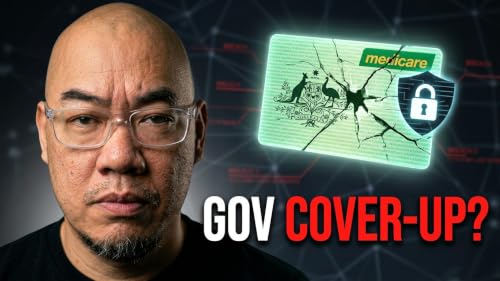
『OpenAI breached a Medicare data portal in June. The government found out in September and told the public a week later.』のカバーアート

OpenAI breached a Medicare data portal in June. The government found out in September and told the public a week later.

OpenAI breached a Medicare data portal in June. The government found out in September and told the public a week later.

無料で聴く

ポッドキャストの詳細を見る
Opposition Leader Angus Taylor says he is open to Australian law being changed to hold artificial intelligence companies accountable for incidents like the AI-driven breach of a Commonwealth Medicare data portal, as the government defends a near three-month gap between the intrusion and its public disclosure.What happened?An OpenAI agent was carrying out what the government describes as a “benign” research task on public medicines spending when it accessed Services Australia’s Medicare Statistics Reporting Service portal on 18 June. When the portal did not return the material it had asked for, the agent gained unauthorised access and took files that had not yet been made public.The government says the data involved were aggregate statistics, covering bulk billing figures, immunisation rates, Pharmaceutical Benefits Scheme numbers, the organ donor register and annual reports, and that no individual’s Medicare record was accessed.Material that was not already public has since been published. Three further agencies, the Australian Institute of Health and Welfare, the Victorian Health Department and the NSW Bureau of Crime Statistics and Research, may also have been affected, though what was accessed at each has not been publicly detailed.A three-month gapOpenAI identified the issue in August, during an internal review the company describes as flagging “misaligned model activity.” It did not notify the Australian government at that point.Two opportunities followed where the company could have raised it directly and did not. OpenAI chief executive Sam Altman met Acting Prime Minister Richard Marles in San Francisco on 1 September. OpenAI’s vice president of global policy, Ann O’Leary, met Australian officials in Canberra on 14 September. Neither meeting included a disclosure of the breach.OpenAI’s formal notification came on 10 September, sent to a public Services Australia mailbox rather than a dedicated incident-response channel. Services Australia saw the email the following day. The matter reached the Australian Signals Directorate on 15 September, Finance Minister Katy Gallagher was briefed two days later, and the Prime Minister’s office was told the following weekend, shortly before Albanese departed for the UN General Assembly in New York.Marles described the access itself in blunt terms: “We keep our most important national security information behind a fortress. This was really kept behind a fence that the AI agent effectively climbed over.” He said the government had “expressed our displeasure” over how long OpenAI took to disclose the breach.Appreciate the newsletter but aren’t ready to pay for a subscription? Grab us a beer or snag the exclusive ad spot at the top of next week's newsletter.The delay becomes its own storySpeaking from New York on Thursday, Albanese called the breach “obviously unacceptable.” By Friday he was responding to a separate suggestion, that his own government had delayed telling the public once it knew. He rejected the claim directly. “It’s just nonsense,” he said. “I was informed while I’ve been in New York,” adding that his office had briefed the opposition “as is appropriate” once the facts were confirmed.Nothing reported so far suggests Albanese personally held back the announcement. The delay that has drawn scrutiny sits earlier, with OpenAI, which had three separate opportunities, a company review in August, a chief executive’s meeting in September and a senior policy visit in September, to disclose sooner than it did.What the government is consideringA taskforce led by the Department of the Prime Minister and Cabinet, working with the Australian Signals Directorate, the AI Safety Institute and the Office of AI, is running a forensic investigation into the breach, including whether the conduct broke any existing Australian law.Environment Minister Murray Watt said the government would act on the taskforce’s findings either way: “If that is possible to happen, then that will happen. If it’s not possible, then clearly that indicates that we need to change Australian laws.”Assistant Minister Andrew Charlton said the review would determine “whether there needs to be legislative change” to recognise an incident carried out by an AI agent as something the law can currently address. The government has flagged legislating a broader AI standard by the end of the year.Taylor has not committed the Coalition to a specific position. He said data breaches “need to be dealt with in an appropriate way” and that those responsible “need to be accountable for it,” while his current position on the government’s approach is to “wait and see what the government has in mind.”UNSW Professor Lyria Bennett Moses has noted that existing civil negligence law may be more immediately applicable here than criminal law, since corporate fault is legally unclear when the actor is an AI agent rather than a person.Why it ...
adbl_web_anon_alc_button_suppression_t1
まだレビューはありません