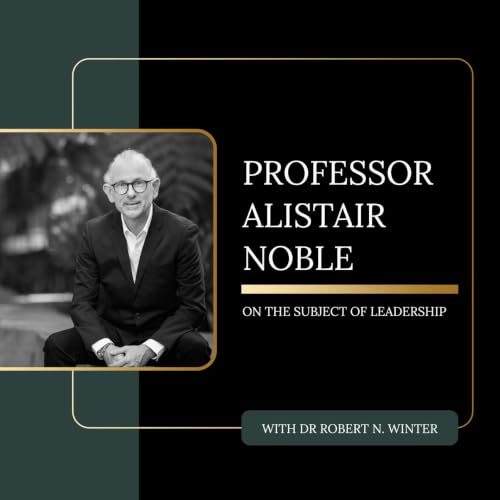
『On the Subject of Leadership』のカバーアート

On the Subject of Leadership

On the Subject of Leadership

著者: Dr Robert N. Winter
無料で聴く

On the Subject of Leadership is a long-form conversation about what makes organisations work—and why much of what passes for leadership advice does not. Each episode features an executive or practitioner whose conclusions have been tested in consequential settings. The work is analytical, not anecdotal: incentives, power, trust, culture, and the limits of authority. Ideas are challenged, not affirmed. This is not motivational theatre. It is a search for what holds up under pressure. If you take leadership seriously and are sceptical of easy answers, this is for you.Copyright 2026 Dr Robert N. Winter マネジメント マネジメント・リーダーシップ 哲学 社会科学 経済学
エピソード
  • Professor Alistair Noble: A University Is For Saving the World
    2026/08/25
    The Commonwealth supplies less than half the revenue of Australia's universities and sets very nearly all of their terms.We have spent a decade arguing about fees, caps, international student numbers and research funding, and each of those arguments quietly settles the larger question — what universities are actually for — without ever putting it to a vote. Price a humanities degree high enough and you have made a claim about the worth of the humanities. You have simply made it with a spreadsheet rather than an argument.Professor Alistair Noble has worked inside almost every model this country uses to answer that question: the large public research university, the private specialist college, the regional university, and now a small independent institute. In this conversation he declines the framing I brought him — that universities are becoming trade schools — and offers a better one. Then he shuts the door on his own argument for lighter regulation, and does it honestly.TakeawaysPrestige in Australian higher education is a colonial inheritance wearing the costume of a quality ranking.The question is not whether universities have become too vocational. It is what is being lost that nobody is counting."Regional Australia" is a category invented in capital cities for capital-city purposes, and a well-funded institution can stifle the culture that was already there.Talent does not reliably out. Someone has to notice it and say so, or it is never converted.Compliance is the price of doing business. It is a floor, not evidence of quality.The case for lighter-touch regulation fails on trust — and the sector's own governance record is why.The part of a university that does not scale is the part that matters.Chapters(00:00) - Introduction (01:40) - What we argue about when we argue about universities (04:39) - Four institutions, one career, and what the comparison shows (09:40) - Prestige, rankings, and the colonial inheritance (19:00) - What a scholarly community loses at one hundred thousand students (23:04) - Refusing the trade school framing: not too vocational, but losing something (28:12) - Regional Australia as a category invented in the capital cities (32:51) - When the university stifles the culture already there (36:46) - Talent does not out on its own — someone has to say so (42:46) - Compliance is the price of doing business, not evidence of quality (45:08) - Tainter, diminishing returns, and a sector past its point (46:25) - Government funds under half and governs as though it funds all (50:27) - Why the trust required for lighter regulation is not there (58:37) - Regulation exists because something bad happened first (01:06:41) - What is it to be human, and what that asks of the humanities (01:11:02) - Nan Tien: values, secularism, and permission to try things (01:17:21) - A language is a technology of thinking (01:23:56) - On being the head of a collaborationist government (01:31:19) - The part that does not scale (01:33:40) - A sentence quoted back after twenty-five years (01:37:03) - Lightning round: the most overrated word in higher education (01:40:09) - Feldman, hidden structure, and why no rules makes us timidGuest Links & ReferencesProfessor Alistair Noble - LinkedInAbout the ShowOn the Subject of Leadership is a long-form interview series, with a written companion, on governance, organisational culture, and how decisions are actually made. Guests are challenged rather than affirmed, and the argument continues in writing after the recording stops. For people who are sceptical of easy answers.Hosted by Dr Robert N. Winter.Subscribe / FollowNewsletter / Website: robert.winter.inkLinkedIn: dr-robert-winterX: @DrRobertWinterInstagram: DrRobertWinterMastodon: social.winter.ink/@robertYouTube: @OnTheSubjectOfLeadershipCreditsRecorded remotely via RiversideMusic: The Hidden Thread by Roberto Prado / Artlist
    続きを読む 一部表示
    1 時間 45 分
  • David Harvie: The Falcon's Club
    2026/08/18

    Every incentive system that fails is easy to criticise. The difficult ones are those that work.

    In the late 1990s David Harvie sold for a firm that ran its Sydney floor as a concentric ring: new arrivals on the outside, moving inward as they succeeded, progressing through a hierarchy of birds toward the falcon. Individual numbers went up twice a day, visible to everyone. He reached the top tier and was flown to New York. He also, some time later, found himself unable to get out of bed. Asked to render a verdict on the system, he does not hedge: it worked.

    This conversation follows what a person does with that experience. Harvie leads direct sales at Totality, formerly Saxo Australia, and has built a health venture for time-poor fathers alongside it. He and I studied leadership philosophy together as postgraduates, which makes him one of the few people I can ask which of those philosophies survived contact with a target — and which quietly died.


    Takeaways

    1. Authority conferred by rank is not the same currency as authority granted by the governed, and the two are not interchangeable.
    2. An incentive system can succeed completely and still exact a cost its designers never measured.
    3. The disciplines a leader keeps in private are not private; employees and children are both watching the actions.
    4. Standards written by the people who must live under them outlast standards handed down — including when those people are five years old.
    5. The obstacle to a fuller life is rarely time and usually priority, though that claim is easier to make from some positions than others.
    6. Discipline is a mechanism; judgement is the context in which the mechanism is pointed at something.


    Chapters

    [00:00] Cold Open — Nothing to Do With Time
    [01:17] Introduction — The Least Examined Discipline
    [03:32] A Method Actor, and a Country Town
    [14:01] Where the Texts Met a Feeling Already Held
    [21:26] Revising the Model of Self
    [26:47] The Thundering Herd — A System That Worked
    [31:33] Becoming Coachable, Becoming a Coach
    [37:14] Three Pillars an Under-Five Team Wrote
    [42:24] The Drive Home That Became DADBODZ
    [48:30] The Queue in Which the Father Comes Last
    [53:34] Building Without Chevrons
    [59:10] Self-Command as the First Plank
    [1:08:24] Lightning Round — Alignment, Arrogance, Judgement


    Guest Links & References

    • linkedin.com/in/david-harvie/
    • DadBodz
    • Nexus Holistic Health

    About the Show

    On the Subject of Leadership is a long-form interview series, with a written companion, on governance, organisational culture, and how decisions are actually made. Guests are challenged rather than affirmed, and the argument continues in writing after the recording stops. For people who are sceptical of easy answers.


    Hosted by Dr Robert N. Winter.


    Subscribe / Follow

    Newsletter / Website: robert.winter.ink

    LinkedIn: dr-robert-winter

    X: @DrRobertWinter

    Instagram: DrRobertWinter

    Mastodon: social.winter.ink/@robert

    YouTube: @OnTheSubjectOfLeadership


    Credits

    Recorded remotely via Riverside

    Music: The Hidden Thread by Roberto Prado / Artlist

    続きを読む 一部表示
    1 時間 19 分
  • Jay Fontanini: You Cannot Skip the Stages
    2026/08/11
    Nine years of rising conversation about artificial intelligence, and a measured return that has not moved. The comfortable reading is that the technology was oversold. The uncomfortable one is that we have not yet done the work it requires of us.

    For the better part of a decade the surveys have promised imminent transformation, and for the same decade the earnings impact has stayed flat. Jay Fontanini's argument is that this is not evidence of a fraud but the signature of a general-purpose technology mid-adoption — the dynamo was ready long before the factory was rebuilt around it. The complementary investment that matters most, he contends, is not better software. It is human capital, and at the centre of that, judgement.

    Which raises the harder question the conversation works: if the models are now a near-substitute for the quick reasoning and rapid recall that peak early in a career, then the entire human premium falls on the accumulated, seasoned kind of intelligence that cannot be hurried into existence. Jay teaches executives through the structure of the medieval trivium on the principle that no stage can be skipped — and reports that they do not give up at the difficult foundations, but at the middle, where thinking with the tool actually begins.


    Takeaways

    • The flat productivity number is a phase, not a verdict — but a theory that explains any delay as unfinished co-invention is only honest if the complementary work is actually being done.
    • Artificial intelligence substitutes for fluid intelligence, not crystallised. It is cheapest exactly where we were quickest, and no help at all where we were wise.
    • Most AI-attributed layoffs are ordinary corporate bloat wearing a new excuse — and they sit in direct contradiction with the efficiency dip that genuine adoption requires.
    • Executives do not abandon the learning at the grammar stage. They abandon at the dialectic, and leap to holding forth about a tool they have not learned to think with.
    • Judgement is earned rather than learned: cumulative, progressive, and not compressible into a prompt library.
    • Friction belongs in the workflow by design. A system may draft anything; it should be permitted to send nothing.
    • The engineers built a language model, which puts the humanities on the ground floor of the most technical instrument in the building.


    Chapters


    Guest Links & References

    • Writing and notes: jayfontanini.com
    • LinkedIn: linkedin.com/in/jay-fontanini/
    • Prediction Machines: The Simple Economics of Artificial Intelligence — Ajay Agrawal, Joshua Gans and Avi Goldfarb (2018). Jay's nomination for the one book to read before touching a prompt.
    • From Strength to Strength: Finding Success, Happiness and Deep Purpose in the Second Half of Life — Arthur C. Brooks (2022), the source of the fluid and crystallised intelligence framing discussed in the episode.
    • The Diversity Bonus: How Great Teams Pay Off in the Knowledge Economy — Scott E. Page (2017), on complementary skill in problem-solving teams.
    • Superintelligence: Paths, Dangers, Strategies — Nick Bostrom (2014)


    About the Show

    On the Subject of Leadership is a long-form interview series, with a written companion, on governance, organisational culture, and how decisions are actually made. Guests are challenged rather than affirmed, and the argument continues in writing after the recording stops. For people who are sceptical of easy answers.


    Hosted by Dr Robert N. Winter.


    Subscribe / Follow

    Newsletter / Website: robert.winter.ink

    LinkedIn: dr-robert-winter

    X: @DrRobertWinter

    Instagram: DrRobertWinter

    Mastodon: social.winter.ink/@robert

    YouTube: @OnTheSubjectOfLeadership


    Credits

    Recorded remotely via Riverside

    Music: The Hidden Thread by Roberto Prado / Artlist

    続きを読む 一部表示
    1 時間 13 分
adbl_web_anon_alc_button_suppression_t1
まだレビューはありません