『Missing Conversations』のカバーアート

Missing Conversations

Missing Conversations

著者: Altus Growth Partners
無料で聴く

How do you create extraordinary and meaningful outcomes that take care of people, your organization and the future you care about? We at Altus believe all results, those that you want and those that you don't, are generated by conversations. When conversations are missing, people and results suffer—learning to see the missing conversations is where to begin. Helping you and your teams have the right conversations with the right people to get the results you desire is what Altus is all about. Through in-depth interviews with incredible guests, we explore the power and practices of conversations. In each interview, you'll learn how to see the missing conversations to enhance your leadership influence and impact and ignite a world of difference, one conversation at a time. If you're aiming for bold change and growing your leadership, teams and organization to create extraordinary results, we want to talk to you! Schedule your confidential conversation. altusgrowth.com/contact.2023 経済学
エピソード
  • Episode #81: Responsible AI Transformation: How Forward-Thinking Leaders Are Redesigning Workflows and Elevating Human Potential
    2026/09/10
    How do forward-thinking leaders build a workforce resilient enough to thrive alongside rapid technological change? In this episode of Missing Conversations, hosts Dan Winter and Lynette Winter sit down with Kristi Conlon, a three-time Top 100 Learning Leader and ICF-credentialed executive coach. Drawing on 25 years of experience guiding Fortune 100 and high-growth companies through complex organizational shifts, Kristi explores how leaders responsibly navigate AI transformation, elevate team potential, and honor human dignity while driving business results. Moving beyond transactional training, Kristi shares practical wisdom on task-level workflow redesign, the power of supportive operational systems, and why cultivating high-trust environments rooted in leadership candor is essential for modern business adaptability. Listen in to discover how aligning your people, technology, and shared vision builds a dynamic workforce equipped to solve your toughest operational challenges Key Moments You'll Want to Hear 01:51: Why learning and development is shifting from HR silos into core business operations 04:43: How flawed operational environments neutralize high-performing employees and what to do to fix them 07:48: How leading organizations build experiential feedback loops over one-off training 11:34: Why senior leadership teams must model the continuous learning they expect from others 12:50: How to measure learning success: practice and application 14:26: Why standardized job rubrics unintentionally overlook individual gifts and emerging leadership talent 17:15: How empowering frontline experiment-driven learning drives organizational resilience 22:09: Building organizational standards through authentic employee commitment and good citizenship 25:30: AI Augmentation:Redesigning task-level workflows to elevate human potential instead of resorting to layoffs 30:40: Structuring adaptive teams around modern AI capabilities to solve complex challenges 34:04: Why executive candor and the courage to admit uncertainty accelerate organizational agility 35:55: High-trust workflows: Eliminating surveillance and fear to unlock performance management based on shared ownership 40:13: Why protecting human dignity, curiosity, and relationship-building remains a company's greatest competitive advantage By the end of this conversation, you'll hear answers to: How is the Chief Learning Officer role evolving in the age of AI? It starts by recognizing that developing human capacity isn't an isolated HR initiative. It belongs inside core business operations. Learning strategist Kristi Conlon shares that effective learning leaders are moving away from managing static course catalogs and stepping into the role of enterprise performance architects. Rather than delivering one-off events, they work directly within operational teams to analyze task-level workflows, design responsible AI augmentation, and open up clear pathways for talent mobility. When leadership views learning as a continuous process rather than a transactional checkbox, the focus shifts from managing training to expanding the collective capacity of the entire organization. Timestamps: 01:51–04:43, 25:30–29:45 How can executive teams integrate AI without eroding trust and culture? High-performing organizations integrate AI by viewing it as a tool for human elevation rather than a mechanism for workplace elimination. Kristi emphasizes that the most successful leaders avoid reactive layoffs and instead examine work at the task level, identifying where AI can remove low-value friction so teams can double down on uniquely human strengths like strategic judgment, empathy, and creative problem-solving. When leaders remove surveillance-driven fear, establish clear governance, and offer genuine reskilling pathways, employees stop viewing technology as a threat and begin using it to unlock new business value together. Timestamps: 25:30-35:00 Why does traditional training often fail to deliver real business outcomes? Performance improvement happens when leaders stop trying to fix system-level challenges with individual skill instruction. Drawing on proven performance frameworks, Kristi points out a fundamental truth: if you put a high-performing person into a broken operational system, the system will win every time. Training alone cannot overcome unclear expectations, unsupportive tools, or misaligned incentive structures. The best leaders look at the entire environment first, adjusting operational levers and fostering genuine psychological safety so that when people learn new skills, they have the support, permission, and context to apply them immediately. Timestamps: 02:47–07:48, 12:50–18:37 Training is an event, learning is a process—and that process includes practice, feedback, and actually learning from our mistakes on the job. ~ Kristi Conlon About Kristi Conlon Kristi Conlon is a learning and talent strategist working at the intersection of people,...
    続きを読む 一部表示
    44 分
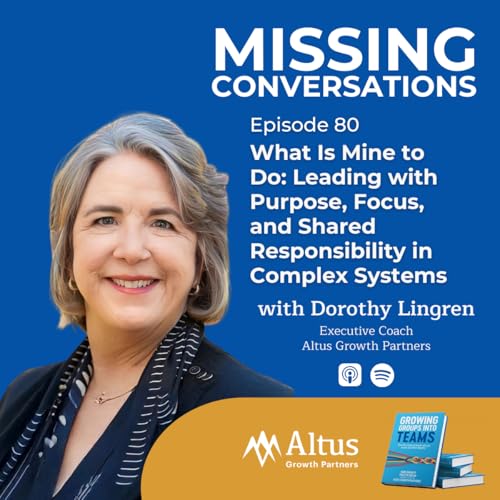
  • Episode #80: What Is Mine to Do: Leading with Purpose, Focus, and Shared Responsibility in Complex Systems
    2026/05/28
    One of ten children, Altus executive coach Dorothy Lingren grew up inside a large and complex family system. Her early lived experience of figuring out how to find her place, build relationships, and understand what made the whole thing work became the foundation for a career spent partnering with high-potential leaders and organizations navigating some of the most demanding environments in healthcare, government, and beyond. In this episode of Missing Conversations, fellow Altus executive coaches and hosts Amy Vodarek and Dan Winter sit down with Dorothy to explore why successfully navigating systems starts with the leader understanding who they are, how simulations like Breakthrough Learnings, Friday Night in the ER (https://www.blearning.com/fner), reveal what leaders do under pressure versus what they think they do, and what it takes to build teams and avoid burning out. If you feel like you're managing increasing complexity, this episode gives you practical ways to lead with greater purpose, sharper focus, and the one practice that makes both possible. Key Moments You'll Want to Hear 01:49: What growing up in a family of ten taught Dorothy about leading complex systems. 03:33: Three questions that reveal what every leader needs to see in themselves and others. 05:23: Why every systems change initiative has to start with who the leader is. 07:24: The one question that replaces overwhelm with purposeful, focused action. 12:01: What a healthcare simulation reveals about what leaders actually do under real pressure. 16:34: The moment leaders stop blaming the system and start seeing their own role in it. 20:11: What the most impactful leaders do when they stop trying to fix the people around them. 22:52: How to build leadership capacity when in complex environments. 26:41: Culture lives in the stories we tell. Here's how leaders begin writing new ones. 30:47: What it takes to lead teams through complexity. 35:40: The one practice Dorothy recommends for every individual, team, and organization to accept and work within the chaos. By the end of this conversation, you'll hear answers to: How do I lead effectively when my organization feels too complex to manage? Start with yourself before you try to change anything around you. Altus executive coach Dorothy Lingren, shares that the most clarifying question a leader in a complex system can ask is simply: what is mine to do here? Not everything. Not the whole system. Just what belongs to you right now. From there, Dorothy advocates for one meaningful action, not a sweeping initiative, but a single move you can try, learn from, and build on together with your team. Complexity doesn't shrink by pushing harder. It becomes navigable when leaders get honest about where their attention and energy actually belong. Timestamps: 07:24 How do I build a high-performing team that doesn't burn out under pressure? High-performing teams thrive when leaders stop measuring their team's success by individual accountability and start asking a different question altogether: what are we learning together, and how are we building something we all feel responsible for? Dorothy shares the story of a government client who stopped tracking individual deliverables and started asking what each person was learning from their partners. That one change, from accountability to curiosity, transformed how the whole team worked. High-performing teams aren't built by pushing people harder. They're built by creating conditions where people feel genuinely connected to a shared purpose and trusted to contribute their best. Timestamps: 22:52 How do leaders shift organizational culture when it feels stuck or misaligned? Altus executive coach Dorothy Lingren shares that culture lives in the everyday narratives leaders and teams carry about what's allowed, what's rewarded, and what's real. Her approach is to start small and stay curious. Pause a meeting, try a standing check-in, ask a question nobody's been asking. Each small experiment chips away at the old story and begins to write a new one. The leaders who change the culture most effectively are the ones willing to try something different, notice what happens, and invite their teams into that learning alongside them. Timestamps: 26:47 Resources Mentioned in This Episode Friday Night in the ER is a systems thinking simulation created and distributed by Breakthrough Learning — one of the tools Dorothy uses to help leadership teams see how complex systems actually behave under pressure, and where the real opportunities to lead differently live. Learn more at blearning.com/fner. Experiential and simulation-based learning is a thread that runs through much of the work Altus brings to leadership teams. If this conversation sparked your thinking, you'll also want to hear how Altus colleague Ryan Soares approaches adventure and experiential learning as a leadership development tool — and what happens when leaders are taken entirely out of their ...
    続きを読む 一部表示
    39 分
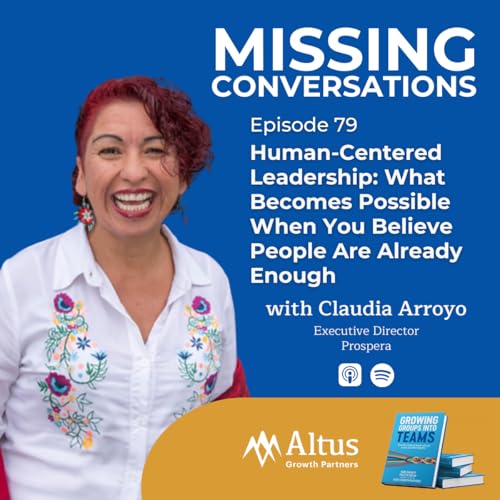
  • Episode #79: Human-Centered Leadership: What Becomes Possible When You Believe People Are Already Enough
    2026/05/21
    She was undocumented for 12 years. Now Claudia Arroyo is the Executive Director of Prospera, an organization building Latina economic power through entrepreneurship and leadership development. In this deeply human conversation with Altus executive coaches Eva Orbuch and Pam Fox Rollin, Claudia shows what becomes possible when you choose to give more light to your gifts than your burdens, and when you lead from the belief that the people around you are already powerful, capable, and enough. You'll hear how she turned to community when Prospera lost nearly a million dollars in funding, why collective breaks and radical self-care make her people more engaged and more creative, and how her Triangle of Sustainability keeps individuals, teams, and organizations healthy at the same time. This is a conversation about belonging, trust, and daring to unlearn what we've been taught so we can live more fully and help the people we lead do the same. Key Moments You'll Want to Hear 02:08: How one woman's immigrant story became a source of what's possible. 06:47: Why daring to unlearn what we've been taught reveals the power we already carry. 11:43: What it takes to show others that they are seen, heard, and belong. 18:15: The Triangle of Sustainability: a creative, relationship-centered approach to leadership. 23:20: From transactions to co-creation: engaging stakeholders as human partners. 27:36: Why collective breaks and radical self-care are essential to better performance. 34:06: How Claudia turned a $1M loss into a movement. 39:59: Why building trust on your team starts with trusting yourself first. By the end of this conversation, you'll hear answers to: How do you build a leadership culture where people feel like they truly belong? Belonging begins the moment someone feels genuinely seen and heard. Claudia describes how her own experience of being seen, first by her mother, then by the communities she worked alongside, taught her that belonging isn't a program or a policy. It's what happens when a leader listens fully, co-creates rather than directs, and trusts that every person on the team already has something essential to contribute. At Prospera, this shows up in how they write job descriptions, run focus groups, and invite program participants to sit at the hiring table. The result is a culture where people don't just show up. They bring everything they have. Timestamps: 12:13 What's a practical framework for keeping your team healthy without sacrificing organizational performance? Claudia introduces her Triangle of Sustainability, a three-part balance between what the individual needs, what the team needs, and what the organization needs. Most leadership cultures, she observes, center the organization and ask people to absorb the cost. Claudia flips this: when a team member needs to rest, she clears their priorities and sends them home for the week. The investment pays back in creativity, engagement, and renewed commitment. She's clear that this isn't generosity for its own sake. It's strategy. Creativity, she says, cannot find its way through a stressed amygdala. When people feel cared for, the organization performs. Timestamps: 18:15 How do you rebuild trust on a team, especially when it's been broken? Before a leader can build trust with a team, they have to trust themselves, their instincts, their worth, their inner voice. From there, trust becomes something you offer first, repeatedly, without guarantee of return. Claudia shares how people who have been hurt learn to protect themselves, and why patience is not weakness but wisdom. At Prospera, everyone tends to the organizational culture. And that shared responsibility, she says, is where trust actually lives. Timestamps: 40:28 We need to be seen. We need to be heard. We need to remember that we deserve (so that) we (know we) belong. ~ Claudia Arroyo About Claudia Arroyo Claudia Arroyo leads with her whole heart. As Executive Director of Prospera, she's building Latina economic power through entrepreneurship and leadership development. And she knows it's not just about business. It's about community. Culture. Love. The belief that when we lift each other up, we all rise. Her journey is rooted in lived experience. As an immigrant woman, she's faced the same challenges as the entrepreneurs she works alongside every day. That's why her approach is always strength-based—honoring the power, wisdom, spirit, and honesty that Latina leaders bring to the table. She doesn't just create programs; she nurtures spaces where people feel seen, heard, and capable of shaping the future. You can find her on LinkedIn at: https://www.linkedin.com/in/claudia-arroyo-prospera/. About Altus Growth Partners At Altus, we partner with CEOs and leadership teams who are serious about growth and willing to engage in new kinds of conversations to produce better results. We care deeply about helping leaders and teams collaborate more effectively, navigate complexity ...
    続きを読む 一部表示
    49 分
adbl_web_anon_alc_button_suppression_t1
まだレビューはありません