エピソード

  • The Great War Comes Home
    2026/06/11

    Today is Gustav’s story - the daily account of a grandfather living on the German homefront during World War I. While the glorious war starts as “the greatest time of my life”, he worries about his son Ludwig fighting on the front.


    IMAGE

    Picture from Gustav’s diary: Ludwig Schlott.


    BIBLIOGRAPHY

    Marshall von Hindenburg. Translated by F.A. Holt. Out of my Life. Cassell and Company, ltd. 1920

    Gustav Schlott memoirs. Deutsches Tagebucharchiv, DTA Reg.Nr. 3768, 1 translation by Robyn Thompson.

    続きを読む 一部表示
    57 分
  • Peace, Land, and Bread!
    2026/05/10

    Today we continue our conversation on life during the Russian Revolution and the Bolsheviks' ambitions for the country. Our primary account comes from Elfriede, a young woman living in Odessa, Ukraine when the revolution came. She describes the conflicts between the Reds and Whites, her stint as a typist for the infamous Cheka (secret police), and her eventual escape through Bulgaria.

    Bibliography

    Elfriede Becker memoirs, Deutsches Tagebucharchiv, DTA 4710-1, translation By Robyn Thompson

    Image

    Earliest flag of the Soviet Union, 1922-1923

    Gütersloh 1975, ISBN 978-3-570-01591-9, Public Domain

    続きを読む 一部表示
    40 分
  • An Escape From Russia
    2026/04/18

    What would you do if you woke up one day and suddenly found yourself an "enemy" of the people with whom you had grown up? In this episode, we follow the story of Anna's family - bourgeois Germans caught in Russia during World War I and the Russian Revolution.

    Bibliography

    "Anna's Memoirs", Deutsches Tagebucharchiv, DTA-368-1-2, Reg NR 418,1-2, Translation By Robyn Thompson

    "Who Needs the War? Alexandra Kollantai: Selected Articles and Speeches" Progress publishers, 1984. First printing 1915.

    "Apostles into Terrorists: Women and the Revolutionary Movement in the Russia of Alexander II." Vera Briodo, Maurice Temple Smith, 1977.

    "A People’s Tragedy: The Russian Revolution: 1891-1924", Orlando Figes, Penguin Books, 1988.

    "The Communist Manifesto", Karl Marx, Friedrich Engels, 1848

    Image
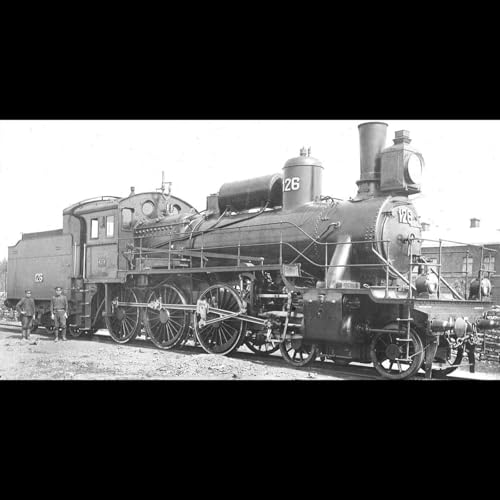
    Imperial Russian Railways series Б (B)
    Public Domain

    続きを読む 一部表示
    1 時間 13 分
  • Preserving the Past
    2026/04/08

    What's the difference between a diary and a memoir? In this episode, we take advantage of an opportunity to interview Christiane Weinzierl from the German Diary Archive in Emmendingen, Germany about diaries, memoirs, and the art and task of preserving the past.

    You can find out more about the archive at their website: https://tagebucharchiv.de

    続きを読む 一部表示
    41 分
  • The Last First Family of Russia
    2026/01/05

    The story of the last Tsar of Russia, Nicholas II, and his family.

    We discuss their early lives, marriage, and the challenges they faced, such as their son Alexei's hemophilia and the introduction of Rasputin into their lives. Following this, we cover the political turmoil and the unrest leading up to World War I, Nicholas's role in the war, and his eventual abdication. Both primary sources, Sophie and Pierre, provide firsthand accounts of the family's final days.


    Image

    Nicholas II of Russia with the family (left to right): Olga, Maria, Nicholas II, Alexandra Fyodorovna, Anastasia, Alexei, and Tatiana.

    Livadiya, Crimea, 1913.

    Portrait by the Levitsky Studio, Livadiya. Today the original photograph is held at the Hermitage Museum, St. Petersburg, Russia.


    Sources

    Buxhoeveden, Sophie. The Life and Tragedy of Alexandra Feodorovna, Empress of Russia. Original, 1928.

    Denikin, Anton. The Russian Turmoil; Memoirs: Military, Social, and Political. The Field Press Ltd. Windsor, London, 1922.

    Figes, Orlando. A People’s Tragedy: The Russian Revolution 1891-1924. Penguin Books, 1998.

    Gatrell, Peter. A Whole Empire Walking: Refugees in Russia During World War I. Indiana University Press, 1999.

    Gillard, Peter. Thirteen Years in a Russian Court. 1920, Wentworth Press.

    Hasegawa, Tsuyoshi. The Last Tsar: The Abdication of Nicholas II and the Fall of the Romanovs. Basic Books, 2024.

    Lenin, Essential Works of Lenin: ‘What is to be Done?’ and Other Writings. Ed. By Henry M. Christman. Dover, 1929.

    Massie, Robert K. Nicholas and Alexandra: The Classic Account of the Fall of the Romanov Dynasty. Random House Trade, 2000.

    “Nicolas’s Diaries” https://www.alexanderpalace.org

    Pipes, Richard. Three ‘whys’ of the Russian Revolution. A Vintage Original, 1995.

    Radzinsky, Edward. The Last Tsar: The Life and Death of Nicholas II. Anchor, 1973.

    “Russian Revolution,” https://alphahistory.com/russianrevolution/russian-revolution-quotations-rasputin

    Semertzides, Meletios. The Twilight of the Tsars: Russia’s Fall and the Birth of Revolution. Volume 3. Trade Paperback, 2025.

    Smith, Douglas. Rasputin: Faith, Power, and the Twilight of the Romanovs. Picador Farrar, Straus and Giroux New York, 2016.

    “The Nicky and Willy Telegrams (1914).” https://alphahistory.com/worldwar1/nicky-and-willy-telegrams-1914

    Wilhelm II. The Willy-Nicky Correspondence: Being the Secret and Intimate Telegrams Exchanged between the Kaiser and the Tsar. Forward by Theodore Roosevelt. Toronto, 1918.

    続きを読む 一部表示
    1 時間 40 分
  • Her Majesty's Drug Cartel
    2025/12/20

    That time China declared a war on drugs, and found themselves pitted against the narco traffickers of the 19th century - the British Empire. Welcome to the first Opium War.


    Image

    Commissioner Lin and the Destruction of the Opium in 1839.

    https://commons.wikimedia.org/wiki/File:Destruction_of_opium_in_1839.jpg


    Sources

    Chang, Hsin Pao. Commissioner Lin and the Opium War. The Norton Library. W.W. Norton and Company, inc. New York, 1970.

    Cree, Dr. Edward H. Naval Surgeon: The Voyages of Dr. Edward H. Cree, Royal Navy, as Related in his Private Journals, 1837-1856. Dutton Adult, 1982.

    Fu, Lo-shu (1966). A Documentary Chronicle of Sino-Western relations, Volume 1. p. 380

    Fairbank, John King. Trade and Diplomacy on the Chinese Coast, Vol. 1. The Opening of the Treaty Ports, 1842-1854. Harvard University Press, 1953.

    Farooqui, Amar. Smuggling as Subversion: Colonialism, Indian Merchants, and the Politics of Opium, Lexington, 2005.

    Fu, Lo-shu (1966). A Documentary Chronicle of Sino-Western relations, Volume 1. p. 380

    Haijian, Mao. The Qing Empire and the Opium War: The Collapse of the Heavenly Dynasty. English text edited by Joseph Lawson. Cambridge Univeristy Press, 2016.

    Letter to Queen Victoria. Chinese Repository, vol. VIII, no 10 (February 1940): 497-503. Internet Archive

    Levanthes, Louise. When China Ruled the Seas: The Treasure Fleet of the Dragon Throne, 1405-1433. Oxford University Press, 1994.

    Lovell, Julia. The Opium War: Drugs, Dreams, and the Making of Modern China. Picador, 2011.

    Morse, Hosea Ballou. The Trade and Administration of the Chinese Empire. London and New York, 1908.

    Morse. International Relations of the Chinese Empire, Vol. 1, Appendix A

    https://web.archive.org/web/20160502205830/http://chinaforeignrelations.net/node/247

    The Times (London). August 19, 1840, p. 3. [An account of the 1839 confinement of the foreign shipping at Whampoa by the surgeon of a detained ship, taken from The Times (London), August 19, 1840, pg. 3] in Hsin-pao Chang. Commissioner Lin and the Opium War. The Norton Library. W.W. Norton and Company, inc. New York, 1964.

    “Treaty of Nanking” https://worldjpn.net/documents/texts/pw/18420829.T1E.html

    Waley, Arthyr. The Opium War Through Chinese Eyes. Stanford University Press, 1958.

    Lin Zezu, Letter to Queen Victoria (1839) https://media.bloomsbury.com/rep/files/Primary%20Source%2013.0%20-%20Lin.pdf

    続きを読む 一部表示
    51 分
  • The Shanghai Refugees
    2025/12/08

    After Kristallnacht, there were few places still taking in Jews fleeing Nazi Germany. One of those was Shanghai, under Japanese occupation. When Japan entered the war as allies of Germany, the fate of these refugees hung in the balance.


    Photo

    The arrival of Jewish refugees from Austria in Shanghai. The refugees are disembarking from the Italian ship Conte Verde. 1938 December 14

    United States Holocaust Memorial Museum, courtesy of National Archives and Records Administration, College Park

    References

    German and Austrian Jewish Refugees in Shanghai

    Griffiths, James. Shanghei’s Forgotten Jewish Past in The Atlantic. 21 November 2013.

    Judgement of the International Military Tribunal for the Far East. Part B. Chapter VII: The Pacific War. November 1948 https://tile.loc.gov/storage-services/service/ll/llmlp/Judgment-IMTFE-Vol-II-PartB-Chapter-VIII/Judgment-IMTFE-Vol-II-PartB-Chapter-VIII.pdf

    Kozak, Warren. The Rabbi of 84th Street: The Extraordinary Life of Haskel Besser. Harper Perennial, 2005.

    Mitter, Rana. Forgotten Ally: China’s World War II, 1937-1945. Mariner Books, 2014.

    National Public Radio. “Where did 20,000 Jews hide from the Holocaust? In Shanghai”. 6 August 2023.

    Newman, Amy. The Nuremberg Laws: Institutionalized Anti-Semitism. Lucent Books Inc., 1999.

    “Polish Jewish Refugees in the Shanghai Ghetto, 1941-1945”. United States Holocaust Memorial Museum.

    “Proclamation of Restricted Zone in Shanghai for Refugees.” Issued 18 February 1943. From the USHMM special exhibition Flight and Rescue.

    “Research Starters: Worldwide Deaths in World War II”. The National World War II Museum: New Orleans.

    Reischauser, Edwin O. Japan: The Story of a Nation. 4th Edition. McGraw-Hill Publishing, 1964.

    Tennembaum, Baruch. “Feng-Shan Ho, Chinese Savior”. International Raoul Wallenberg Foundation”

    “Good-bye Mr. Ghoya pamphlet”. Accession number 1998.49.1. Friedrich Melchior Collection. United States Holocaust Memorial Museum, Washington D.C.

    RG-50.477.0391. Oral History Interview with Hans Arons. From the Bay Area Oral History Project donated to the United States Holocaust Memorial Museum, Washington DC

    RG-50.477.1231. Oral History Interview with Hella Levi. From the Bay Area Holocaust Oral History Project donated to the United States Holocaust Memorial Museum, Washington DC

    RG-50.462.0069 Oral History Interview with Walter Silberstein. Gift of the Gratz College Holocaust Oral History Archive. United States Holocaust Memorial Museum, Washington D.C.

    RG-50.462.0441. Oral History Interview with Willie Nowak From the Gratz College Oral History Archive donated to the United States Holocaust Memorial Museum, Washington DC

    続きを読む 一部表示
    1 時間 22 分
  • A Jew Who Stood Guard for Hitler
    2025/11/12

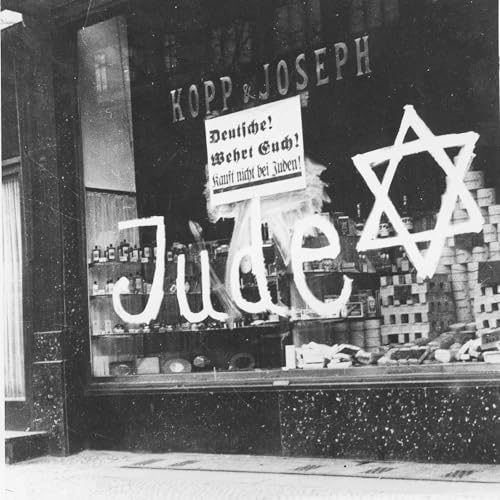
    We discuss the experiences of Edward Adler, a Jewish man in 1930's Germany, as he describes growing anti-semitism, being forced to build one of the first extermination camps, and his narrow escape after Kristallnacht. And that one time he was a kid and joined the Nazis - before they found out he was a Jew.

    Image
    Germany - a sign on a Jewish store: Protect Yourselves, Germans, Do Not Buy From Jews.
    Yad Vashem Archives
    Archival Signature: 3116/50

    Sources
    RG Number: RG-50.042.0003 Interview with Edward Adler. United States Holocaust Memorial Museum
    https://collections.ushmm.org/search/catalog/irn505557


    続きを読む 一部表示
    54 分