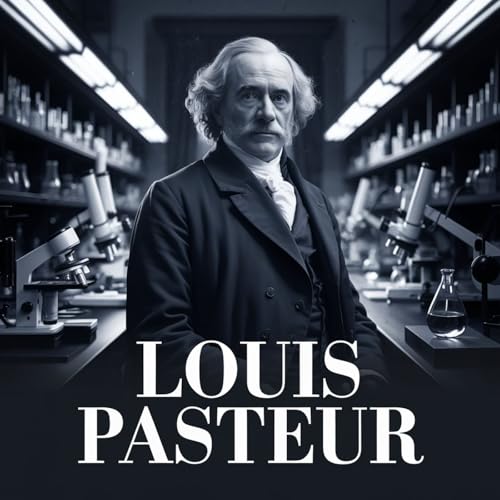
『Louis Pasteur』のカバーアート

Louis Pasteur

Louis Pasteur

著者: Podra Network
無料で聴く

今ならプレミアムプランが3カ月 月額99円

2026年5月12日まで。4か月目以降は月額1,500円で自動更新します。

概要

The man who conquered invisible killers — the discoveries and legacy of Louis Pasteur.Copyright Podra Network 科学
エピソード
  • Spontaneous Generation Dies: The Swan-Neck Flask Experiments
    2026/04/30
    In this episode of Louis Pasteur, Dr Sarah Quinn explores one of history's most decisive scientific experiments. Louis Pasteur's swan-neck flask experiments of the 1860s finally disproved the ancient theory of spontaneous generation, which held that life could arise from non-living matter. For over 2,000 years, from Aristotle onward, scientists believed that maggots, mold, and microorganisms could spontaneously emerge from decaying organic matter. When French naturalist Félix Pouchet published experiments in the 1850s seemingly supporting spontaneous generation, Pasteur designed an elegant counter-experiment. Using specially crafted flasks with curved, swan-like necks, Pasteur created sterile nutrient broths that remained open to air but protected from contamination. The curved necks trapped airborne microorganisms while allowing gases to pass through. The results were conclusive: sterile broths remained clear indefinitely, but immediately developed microbial growth when exposed to trapped contaminants. This groundbreaking work established that microorganisms come from pre-existing life forms, laying the foundation for germ theory and modern medicine. Some of Pasteur's original flasks remain sterile today, testament to his revolutionary methodology. Join us for this fascinating exploration of how one elegant experiment changed our understanding of life itself and transformed medical science forever.
    続きを読む 一部表示
    7 分
  • Mirror Images: Pasteur's Discovery of Molecular Chirality
    2026/04/23
    Discover how 25-year-old Louis Pasteur revolutionized chemistry and biology through his groundbreaking 1848 discovery of molecular chirality. This episode explores Pasteur's meticulous investigation of tartaric acid crystals, which led to the first understanding of mirror-image molecules and molecular handedness. Learn how Pasteur's patient observation and manual separation of crystals solved a puzzling optical mystery and established the foundation for stereochemistry. We examine the far-reaching implications of this discovery, from pharmaceutical development to enzyme function, and how it revealed fundamental principles about life's preference for specific molecular orientations. The episode highlights Pasteur's exceptional analytical skills and methodical approach that would define his legendary scientific career. Through this elegant discovery, we see how careful observation of seemingly minor anomalies can unlock profound scientific truths. Perfect for chemistry enthusiasts, students of scientific history, and anyone fascinated by molecular biology. Keywords: Louis Pasteur, molecular chirality, stereochemistry, tartaric acid, optical rotation, polarized light, crystallography, 19th century chemistry, scientific discovery, molecular handedness, racemic acid.
    続きを読む 一部表示
    5 分
  • The Fermentation Revolution: Wine, Beer, and Scientific Method
    2026/04/16
    Join Dr Sarah Quinn as she explores Louis Pasteur's groundbreaking fermentation research that revolutionized wine and beer production while establishing modern microbiology. In the 1850s, French wine and beer industries faced devastating spoilage problems that threatened entire regional economies. When local distillery owner sought Pasteur's help with failed fermentation, it sparked investigations that would transform both science and industry forever. Discover how Pasteur's microscopic observations revealed fermentation as biological process driven by specific microorganisms, not mysterious chemical decomposition as previously believed. Learn about his systematic experimental methodology that became model for modern scientific investigation, including controlled studies with sterile solutions and variable conditions. Explore the practical revolution that followed: pasteurization techniques, contamination prevention methods, and stable production processes that transformed wine, beer, dairy, and food industries. This episode examines how Pasteur bridged pure science with industrial application, showing rigorous scientific method could solve practical problems while advancing fundamental knowledge. His fermentation work laid crucial groundwork for germ theory of disease and established microorganisms as agents of natural change. Perfect for listeners interested in scientific history, industrial revolution, food science, and development of experimental methodology that continues guiding research today.
    続きを読む 一部表示
    5 分
まだレビューはありません