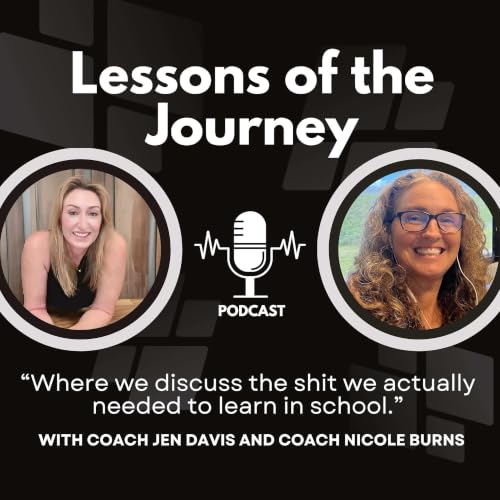
『Lessons of the Journey』のカバーアート

Lessons of the Journey

Lessons of the Journey

著者: Lessons of the Journey
無料で聴く

The Real Life Playbook

2025 Lessons of the Journey
個人ファイナンス 経済学
エピソード
  • Information Overload: What Constant Input Is Doing to Your Brain and Nervous System (66)
    2026/05/26

    In this episode, we explore information overload and why so many people today feel mentally exhausted, distracted, anxious, or unable to focus.

    If you’ve been struggling with overthinking, brain fog, constant scrolling, or the feeling that your mind is always “full,” this episode will help you understand what is actually happening inside your brain and nervous system.

    We are living in a constant stream of input—social media, notifications, news, podcasts, videos, opinions, and endless information. While this can feel like connection and productivity, it often leads to mental overload, attention fragmentation, and nervous system fatigue.

    In this episode, we break down the science behind what’s happening in your mind when you are exposed to too much information without enough space to process it.

    We explore research on attention residue by researcher Sophie Leroy, which shows that when we switch between tasks or streams of information, part of our attention remains stuck on what came before—reducing focus and increasing mental fatigue.

    We also look at findings on memory consolidation and wakeful rest (Wamsley, 2022), which show that the brain actually processes and organizes information most effectively during periods of quiet, rest, and reduced stimulation.

    This episode explores:

    • Why too much information leads to anxiety and brain fog
    • How social media and constant input affect attention span
    • What attention residue does to your focus and clarity
    • How information overload impacts the nervous system
    • Why rest and silence are essential for mental processing
    • The difference between consuming information and integrating it

    This is the second episode in a series:
    First, we explored how too many choices create overwhelm and decision fatigue.
    Now, we go deeper into how constant information exposure affects the brain and body.

    And in the next episode, we’ll explore how to clear mental clutter, regulate your nervous system, and create more clarity and focus in your daily life.

    Because the problem isn’t that you need more information.

    It’s that your brain hasn’t had enough space to process what it already has.

    #InformationOverload
    #MentalHealth
    #BrainHealth

    続きを読む 一部表示
    33 分
  • Too Many Choices? How Decision Overload Is Draining Your Mental Health (65)
    2026/05/19

    We live in a world with more choices than ever before—what to eat, what to watch, how to work, how to live, even who to become. On the surface, that sounds like freedom. But for many people, it feels like something very different: overwhelm, anxiety, and constant second-guessing.

    In this episode, we explore how too many choices and modern decision overload are quietly impacting our mental health. From everyday decisions like scrolling Netflix or shopping for groceries to bigger life choices around career, relationships, and identity—our brains are being pushed to process more options than ever before.

    We break down the science behind the Paradox of Choice, popularized by
    psychologist Barry Schwartz, and why having more options doesn’t actually make us happier. Instead, it often leads to decision fatigue, anxiety, and dissatisfaction—even after we make a choice.

    But this episode isn’t just about the problem.
    It’s about what to do with it.

    We explore how reconnecting with your values can become a powerful filter for clarity. When you know what actually matters to you, decision-making becomes simpler, faster, and far less emotionally draining. Instead of trying to evaluate every option, you begin to recognize what aligns—and what doesn’t.

    You’ll also be guided through a practical exercise to help you identify your values based on your real-life decisions, energy patterns, and lived experience—not theory.

    In this episode, you’ll learn:
    ● Why too many choices can increase stress instead of freedom
    ● How decision fatigue actually works in the brain
    ● Why we second-guess even good decisions
    ● How your values naturally simplify your options
    ● A simple exercise to clarify what actually matters to you right now
    ● How to make decisions with more ease, alignment, and self-trust

    If you’ve been feeling mentally cluttered, indecisive, or overwhelmed by the number of directions your life could go—this conversation will help you slow things down and come back to clarity.

    Because the goal isn’t to eliminate all choices.
    It’s to become someone who knows how to choose.

    If this episode resonates with you, subscribe for more conversations on mindset, clarity, nervous system awareness, and intentional living.
    Share this episode with someone who feels overwhelmed by too many options or stuck in overthinking—it might help them simplify what feels complicated right now.

    続きを読む 一部表示
    36 分
  • How Writing Helps Heal Trauma, Anxiety & Emotional Overload (64)
    2026/05/12

    We’re always told to process our emotions, but how does one actually do that?

    In this episode, we explore the science behind why writing can be one of the most powerful tools for emotional healing, stress relief, and trauma recovery, in other words, processing your emotions. Research shows that expressive writing and putting difficult emotions into words can help calm the nervous system, process unresolved experiences, and even improve mental and physical health.

    We dive into the neuroscience of expressive writing, how trauma and stress can become trapped in the mind and body, and why getting your thoughts out of your head and onto paper can create clarity, emotional release, and deeper self-awareness. Whether you’re navigating anxiety, burnout, grief, life transitions, or unresolved emotional pain, this conversation explores how writing can support healing and personal growth.

    In this episode, we discuss:

    ● The neuroscience of expressive writing and emotional processing

    ● How writing helps heal trauma and reduce stress

    ● Why expressive writing supports mental health

    ● The connection between the nervous system and emotional release

    ● Simple writing practices for healing and self-discovery

    ● Why putting emotions into words changes the brain

    If you’ve ever felt emotionally overwhelmed, stuck in overthinking, or unable to process what you’re carrying, this episode offers practical insight into how writing can become a tool for healing, resilience, and transformation.

    続きを読む 一部表示
    24 分
adbl_web_anon_alc_button_suppression_c
まだレビューはありません