エピソード

  • Ep. 16 - The Human Toolkit Lawyers Aren't Given
    2026/08/24

    In this episode of Lawyers as Healers, I’m joined by Holly Hedley, a specialist health, employment, privacy, and human rights lawyer from New Zealand.

    Holly is the founder of Dawn Legal and is completing a Borrin Foundation Women Leaders in Law Fellowship exploring trauma-informed legal practice for Aotearoa New Zealand.

    Our conversation explores Holly’s move from large-firm practice into her own practice, where she has more freedom to approach legal work in a compassionate, restorative, and human-centered way.

    We talk about gender expectations in law, parenting, birth trauma, vicarious trauma, and the often invisible weight lawyers carry from the work they do. Holly shares a powerful story about being stopped in her tracks by a memory from a difficult case while walking with her infant son — a moment that led her to ask deeper questions about trauma, legal work, and what lawyers absorb over time.

    A major theme of this conversation is that lawyers are often expected to be detached, rational, and unemotional. But that does not mean we are unaffected. Holly challenges the idea that good lawyering requires us to ignore our own humanity or the humanity of the people we serve.

    We also discuss what trauma-informed legal practice can look like in practical terms: understanding boundaries, knowing when to refer clients to other supports, creating space between difficult meetings, using language more carefully, and asking one simple question before sending a letter, submission, or judgment:

    How does this land?

    At its heart, this episode is about practicing law with clarity, compassion, and power — without pretending lawyers have to become therapists or stop being lawyers.

    As Holly puts it, maybe the invitation is simply to find the human way of lawyering that is truly yours.

    In this episode, we discuss:
    • Holly’s transition from large-firm practice to Dawn Legal
    • trauma-informed legal practice in New Zealand
    • gender expectations, parenting, and law firm culture
    • why trauma may appear in every area of legal practice
    • the myth of the detached lawyer
    • supervision, reflection, and better support for lawyers
    • boundaries between legal work and therapeutic work
    • writing with heart, clarity, and power
    Learn more about Holly’s work:

    Dawn Legal:
    https://www.dawnlegal.co.nz/

    Trauma-Informed Legal Practice project:
    https://www.dawnlegal.co.nz/trauma-informed-legal-practice

    Borrin Foundation Fellowship:
    https://www.borrinfoundation.nz/women-leaders-in-law-fellowship-for-holly-hedley/

    Heart-Centered Judgment:
    https://www.qlsproctor.com.au/2025/08/nz-judge-writes-letter-to-child-as-judgment/

    Guest

    Holly Hedley
    Founder, Dawn Legal
    Specialist health, employment, privacy, and human rights lawyer

    Host

    Dave Albrechta
    Mediator, coach, recovering litigator, and host of Lawyers as Healers

    Interested in coaching to transform your practice?

    Email dave@tallgrasscollective.org

    続きを読む 一部表示
    1 時間 3 分
  • Ep. 15 - Healing Lawyers, Healing the Law
    2026/08/17

    In this episode of Lawyers as Healers, I’m joined by Gina Steele, a lawyer-turned-coach who helps attorneys move from overwhelm and exhaustion toward fulfillment, energy, and meaningful impact in their careers.

    Before becoming a coach, Gina practiced law for nearly two decades, including work in patent litigation and patent prosecution. Her own experience with burnout eventually led to a serious health crisis — and then to a deeper exploration of mindfulness, neuroscience, nervous system regulation, and what it actually takes for lawyers to thrive.

    This conversation explores the connection between lawyer well-being and the larger role lawyers play in society. Gina makes a powerful point early in the conversation: we need to heal lawyers so lawyers can become better healers.

    We talk about how law school and legal practice often train lawyers into scarcity, competition, stress, and constant fight-or-flight. When lawyers are dysregulated, exhausted, and overwhelmed, they lose access to empathy, creativity, collaboration, and the fuller perspective needed to help clients make good decisions.

    Gina also shares practical tools for lawyers, including mindfulness, breathwork, movement, EFT tapping, orienting practices, and the importance of building regular habits that help regulate the nervous system.

    We also discuss the neuroscience of civility, why professionalism cannot just be a vague instruction to “be nice,” and how lawyers can learn to see conflict not as a fight, but as a call for collaborative problem-solving.

    At its heart, this episode is about why lawyer well-being is not separate from the future of law.

    It may be the foundation of it.

    In this episode, we discuss:
    • Gina’s path from law to coaching
    • law school, scarcity, and competition
    • burnout, stress, and Gina’s health crisis
    • mindfulness and nervous system regulation
    • why exhausted lawyers lose access to empathy
    • the neuroscience of civility
    • fight, flight, freeze, and legal practice
    • how lawyers affect the nervous systems of clients and colleagues
    • tools lawyers can use to regulate themselves
    • why conflict can be reframed as collaborative problem-solving
    • how coaching can help lawyers reconnect with meaning, values, and impact
    Learn more about Gina’s work:

    Steele Leadership:
    https://steeleadership.com/

    Email:
    gsteele@steeleadership.com

    Guest

    Gina Steele
    Lawyer, coach, and founder of Steele Leadership

    Host

    Dave Albrechta
    Mediator, coach, recovering litigator, and host of Lawyers as Healers.

    続きを読む 一部表示
    51 分
  • Ep. 14 - From Warrior to Healer: Rethinking Divorce Law
    2026/08/10

    In this episode of Lawyers as Healers, I’m joined by Nanci Smith, an attorney licensed in Vermont and New York and author of Untangling Your Marriage: A Guide to Collaborative Divorce.

    Nanci’s work focuses on promoting peaceful divorce practices and helping people move through one of the most painful transitions of their lives with more dignity, clarity, and humanity.

    Our conversation explores Nanci’s path from traditional litigation into collaborative divorce, including the moment she began questioning whether being known as a “barracuda” was really the identity she wanted as a lawyer. We talk about the emotional weight of family law, the limits of the adversarial system, and why divorce is not only a legal process, but also a financial and deeply emotional one.

    Nanci explains how collaborative divorce works, why it creates a different kind of container for conflict, and how lawyers, mental health professionals, and financial neutrals can work together to support families without immediately escalating to court.

    We also discuss lawyer identity, trust, ego, fear, apology, and the courage it takes to step away from the warrior model of lawyering.

    At its heart, this episode asks what might happen if more lawyers saw themselves not only as advocates, but as facilitators, peacemakers, and healers of human conflict.

    In this episode, we discuss:
    • Nanci’s path into law and family law
    • the moment she began questioning the “barracuda” identity
    • collaborative divorce as an alternative to litigation
    • why divorce involves legal, financial, and emotional realities
    • the role of mental health professionals and financial neutrals
    • lawyer ego, identity, and resistance to change
    • why people in conflict often need to be heard more than they need to fight
    • the power of apology, remorse, and acknowledgment
    • what gives Nanci hope about collaborative practice
    Learn more about Nanci’s work:

    Nanci Smith Law:
    https://nancismithlaw.com/

    Book:
    Untangling Your Marriage: A Guide to Collaborative Divorce

    Guest

    Nanci Smith
    Attorney, collaborative divorce practitioner, and author of Untangling Your Marriage

    Host

    Dave Albrechta
    Mediator, coach, recovering litigator, and host of Lawyers as Healers.

    続きを読む 一部表示
    1 時間 5 分
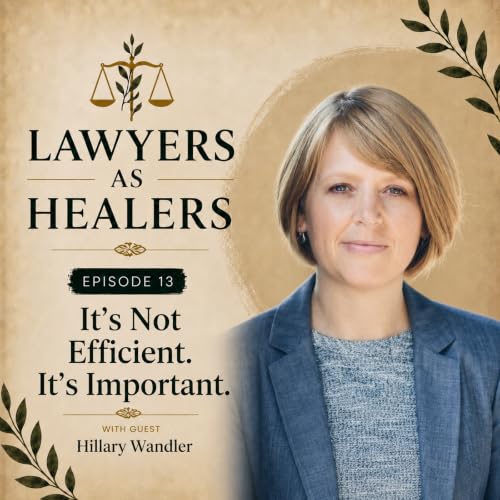
  • Ep. 13 - It's Not Efficient. It's Important.
    2026/07/27

    In this episode of Lawyers as Healers, I’m joined by Hillary Wandler, a lawyer, law professor, and director of the Veterans Advocacy Clinic at the University of Montana’s Alexander Blewett III School of Law. Hillary teaches legal analysis, legal writing, and veterans disability law, and her work sits at a powerful intersection: helping students learn the traditional tools of legal analysis while also asking how lawyers can remain connected to compassion, humanity, and the people they serve.

    Our conversation begins with Hillary’s path into law, including her early pull toward advocacy, her experience feeling like she had gotten on a professional “train” that was difficult to get off, and the moments that helped her realize traditional litigation was not fully aligned with who she was or why she entered the profession.

    We also talk about the culture of legal practice, the pressure to always be available, and the way the profession often moralizes efficiency and responsiveness. One of Hillary’s central reflections is that some things may not be efficient — but they are still important.

    A major part of the conversation explores Hillary’s work with Cognitively-Based Compassion Training, or CBCT®, a compassion training program developed at Emory University, and how that work has influenced her teaching, legal writing, and thinking about the formation of future lawyers.

    Hillary shares how she has brought more integrative and human-centered approaches into her legal writing classroom, including helping students compare a traditional client advice letter with one that is more compassionate, collaborative, and values-centered.

    We also discuss generative AI, legal education, and why the rise of AI may force lawyers to ask an essential question: If technology can do more of the technical work, where do human lawyers actually bring value? For Hillary and me, the answer kept coming back to the same place: Our humanity.

    In this episode, we discuss:
    • Hillary’s path into law and legal education
    • the professional “train” of legal achievement
    • the pressure to always be available
    • why the legal profession moralizes efficiency
    • necessary pain versus unnecessary pain in law
    • compassion in legal writing and client communication
    • Cognitively-Based Compassion Training
    • integrative law in the classroom
    • generative AI and the future value of human lawyers
    • what gives Hillary hope about the next generation of lawyers
    Learn more about Hillary’s work:

    University of Montana profile:
    https://umimpact.umt.edu/en/persons/hillary-wandler/

    University of Montana — Alexander Blewett III School of Law:
    https://www.umt.edu/law/

    CBCT® — Cognitively-Based Compassion Training through Emory University:
    https://compassion.emory.edu/cbct-compassion-training/

    Guest

    Hillary Wandler
    Professor of Law and Director of the Veterans Advocacy Clinic
    Alexander Blewett III School of Law, University of Montana

    Host

    Dave Albrechta
    Mediator, coach, recovering litigator, and host of Lawyers as Healers.

    続きを読む 一部表示
    1 時間 22 分
  • Ep. 12 - The Intersection of Intuition and Law
    2026/07/20

    In this episode of Lawyers as Healers, I’m joined by Jason Ciofalo, also known as Jason Zuk, The Social Psychic.

    Jason is both a licensed attorney and an intuitive psychic medium whose work sits at the intersection of logic, intuition, personal transformation, and consciousness. His website describes him as an attorney licensed in five states, an intuitive psychic medium, and host of The Social Psychic Radio Show.

    This conversation explores a tension many lawyers and professionals experience in different ways: the tension between the analytical identity we build for the outside world and the deeper intuitive parts of ourselves that often get pushed aside.

    Jason shares the story of his first major mediumship experience, why he kept his legal and intuitive work separate for years, and what it has been like to navigate both identities publicly. We also talk about fear, ego, caregiving, cancer, burnout, self-care, professionalism, and why lawyers may become better advocates when they are more connected to their own humanity.

    A central theme in this conversation is that clients are not just files, facts, or legal problems. They are people. And when lawyers are more grounded, calm, intuitive, and compassionate, they may be better able to see the human being in front of them.

    Whether you approach these ideas through psychology, spirituality, intuition, or simply learning to listen more deeply to yourself, this episode is ultimately about becoming more honest about who we are, how we serve, and how we want to move through the world.

    In this episode, we discuss:
    • Jason’s path from traditional legal practice to becoming publicly known as The Social Psychic
    • the tension between analytical legal training and intuitive knowing
    • why Jason kept his legal and intuitive work separate for many years
    • fear, ego, and professional identity in the legal field
    • how caregiving and cancer survivorship reshaped Jason’s understanding of purpose and calm
    • why “powering through” is not always the healthiest response to burnout
    • how lawyers can better see clients as human beings rather than files
    • the importance of boundaries with aggressive opposing counsel
    • intuition, compassion, and self-awareness as tools for more human lawyering
    • what it might mean for lawyers to become healers of human conflict
    Learn more about Jason’s work:

    The Social Psychic:
    https://www.thesocialpsychic.com/

    The Social Psychic Radio Show on Spotify:
    https://open.spotify.com/show/2BvbfY5CpkPwMOpHogUT28

    LinkedIn:
    https://www.linkedin.com/in/jason-zuk

    Instagram:
    https://www.instagram.com/the_social_psychic/

    Ciofalo Law Firm:
    https://www.ciofalolaw.com/

    Guest

    Jason Ciofalo / Jason Zuk
    Attorney, intuitive psychic medium, life coach, and host of The Social Psychic Radio Show.

    Host

    Dave Albrechta
    Mediator, coach, recovering litigator, and host of Lawyers as Healers.

    続きを読む 一部表示
    45 分
  • Ep. 11 - From Extraction to Stewardship: What Forests Taught Me About the Legal System
    2026/07/06

    In this solo reflection, Dave returns from a 30-day van trip with his family through the American West, the Pacific Northwest, and Vancouver Island. Along the way, time spent among Sequoias, Redwoods, coastal rainforests, clear-cut forests, and recovering ecosystems sparked a deeper reflection on the legal system and the role lawyers play in human conflict.

    Standing among ancient trees and witnessing the visible consequences of extraction, Dave began seeing parallels between ecological destruction and the way the legal system often handles conflict. When a system is driven primarily by money, speed, efficiency, and winning, it can become very good at extraction—and very bad at stewardship.

    This episode explores what happens when conflict becomes a commodity, when clients become cases, when opposing parties become obstacles, and when lawyers move from one dispute to the next without fully seeing what is left behind.

    Just as damaged ecosystems can recover, species can return, and communities can begin repairing what was lost, Dave asks whether the legal profession may also be living in an age of restoration. More lawyers are asking different questions. More are exploring mediation, restorative practices, collaborative law, trauma-informed lawyering, coaching, emotional intelligence, and more human-centered ways of working with conflict.

    In this episode:
    • Reflections from a 30-day family van trip through the Pacific Northwest and Vancouver Island
    • What old-growth forests, clear-cuts, and ecological restoration reveal about systems
    • The difference between extraction and stewardship
    • How the legal system commodifies conflict
    • Why the consequences of legal conflict are often harder to see than environmental damage
    • What lawyers may leave behind after a case ends
    • Aldo Leopold’s land ethic and what it might teach lawyers
    • The hidden emotional and relational costs of litigation
    • Why lawyers should see themselves as stewards of human communities
    • The possibility of restoration within the legal profession
    続きを読む 一部表示
    40 分
  • Ep. 10 - What Clients are Really Looking For
    2026/06/08

    What are people really looking for when they call a lawyer?

    In this episode, I sit down with my former colleague Jane Lutz, who spent years serving as the first point of contact for clients at our law firm. With a background in human development and psychological services, Jane brought a perspective that was very different from the traditional legal mindset.

    Together, we explore what clients are actually experiencing when they enter the legal system, why so many people arrive in a state of crisis, and how the emotional realities of conflict are often overlooked in legal practice.

    Jane shares her observations from listening to hundreds of people tell some of the most painful stories of their lives. We discuss why clients often expect the legal system to provide healing, closure, and validation, why litigation can become emotionally exhausting, and what lawyers miss when they focus only on legal problems instead of the whole person.

    This conversation also explores lawyer burnout, client burnout, the limits of what litigation can provide, and why truly helping people may require a broader view of conflict and healing.

    In this episode:
    • What clients expect when they call a lawyer
    • Why people often just want to be heard
    • The emotional toll of litigation
    • Lawyer burnout and client burnout
    • Why money rarely provides complete resolution
    • The difference between solving a legal problem and helping a human being
    • How lawyers can begin seeing clients as whole people
    • What it means to become a healer of human conflict
    続きを読む 一部表示
    55 分
  • Ep. 09 - The Soul-Crushing Cost of Adversarial Thinking
    2026/06/01

    In this episode, I sit down with attorney, mediator, facilitator, and peacemaker Andy Kull to explore what becomes possible when lawyers move beyond purely adversarial ways of thinking.

    Listen to learn more about Andy's journey from commercial litigator to peacemaker, Together, we explore the distinction between adversarial and relational thinking, why so many lawyers experience burnout, and how the legal system teaches us to listen to respond instead of listening to understand.

    We also discuss the "art of peacemaking" and Andy's powerful principle of being tough on the issue while remaining gentle on the person.

    Whether you're a lawyer, mediator, leader, or someone navigating conflict in your own life, this conversation offers a thoughtful exploration of how understanding, curiosity, and human connection can transform the way we approach disagreement.

    In this episode:
    • Why Andy left traditional litigation after 15 years;
    • Adversarial vs. relational thinking;
    • The connection between conflict, stress, and nervous system regulation;
    • The cost of being trained to only listen to respond instead of gaining understanding;
    • Why peacemaking is an art;
    • What it means to be "Tough on the issue, gentle on the person";
    • Burnout, happiness, and the limits of the thinking mind; and
    • What becomes possible when lawyers see themselves as healers of human conflict.
    続きを読む 一部表示
    52 分