エピソード

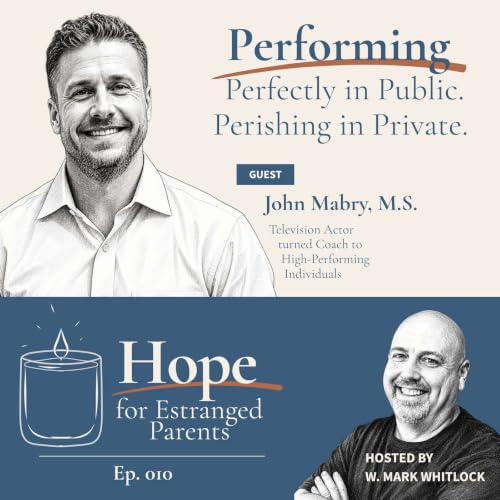
  • 010 Performing Perfectly in Public. Perishing in Private. With Guest, John Mabry
    2026/10/28
    Episode SummarySome of the strongest people we know are performing perfectly in public while perishing in private. John Mabry, a self-described comeback extraordinaire, tells his story: a car wreck that took a friend and his leg, a brother lost to an overdose, and an addiction that cost him his marriage and his children’s trust. He shares what brought him back and how he helps others do the same.About John MabryJohn Clint Mabry, is a self-described comeback extraordinaire, a speaker and coach who works with high-influence, high-profile people who are performing perfectly in public while perishing in private. Born and raised in a Christian family in Texas, John graduated from Baylor University, where he was a communications major on an athletic scholarship.A car wreck during his senior year took the life of a friend and led to the amputation of his leg below the knee. John went on to earn a graduate degree in counseling in San Diego, work for the Challenged Athletes Foundation, and serve as a technical consultant and “stump double” on the first TV show about the war in Iraq. His screen credits include Superbad and NCIS.Years of addiction followed, and he lost his marriage, his job, and, for a time, the trust of his three children. Through Celebrate Recovery and a Christ-centered twelve-step group, John found sobriety and rebuilt those relationships. Today he coaches clients through his ninety-day Hero Initiation. You can find him at JohnMabryConnects.com and on Instagram at JohnMabryConnects.Full Episode SummaryMeeting John (0:58)Estranged parents carry sadness and depression that stretch over years. So today we cross-train with someone who has lived through his own long road back. John calls himself a comeback extraordinaire, and he starts with a Texas childhood, a grandfather who was a pastor, and a life that looked perfect through his senior year at Baylor.Seven Seconds (4:14)On the way home from a cruise with friends, a tire blew out and the car rolled. John crawled out, went back in to help, and watched a friend die. He describes the terror, being forgotten on the roadside, and two and a half hours without pain medicine. I connect that moment to the violence many of us feel when a relationship is suddenly severed.The First Comeback (10:48)After fourteen procedures, John chose amputation. Talking with other amputees gave him the confidence to do it, and he walked at graduation six weeks later. Then came San Diego, a counseling degree, and a double life of pills and drinking behind a polished public image.Performing in Public, Perishing in Private (13:55)John worked for the Challenged Athletes Foundation, which has been a blessing to my own family through my son Zion’s Paralympic journey. He also worked in Hollywood as a technical consultant and body double. The facade held until it didn’t.Losing Everything (20:09)John found his brother dead from an overdose, a man who never shared the silence that was killing him. Later John lost his home, wife, kids, and job. A twelve-year-old son who smelled alcohol on his breath and called his mother changed everything. Seeing himself through his child’s eyes sent him to recovery.Rebuilding Trust (26:06)A Navy SEAL friend told John to start with a shower. From there came Celebrate Recovery, a year in a room with nine other men, and doing exactly what the court required. John had to accept that his children were right to draw boundaries, and he leaned on accountability partners instead of walking it alone. He says he had to rebuild trust with himself first.Recovery Groups and Shame (31:24)I share what circles like Celebrate Recovery, Samson Society, and Adult Children of Alcoholics and Dysfunctional Families have meant to me. John explains how saying his moral inventory out loud to a stranger loosened shame’s grip. Shame likes the dark, and it keeps coming back like soap scum in the shower.The Hero Initiation (38:06)John closes with his ninety-day program built on four daily practices: a little honesty, exercise, rest, and openness. It begins with a seven-minute daily check-in.Closing Prayer (42:00)After ten seconds of stillness, John prays for estranged families and for anyone who needs to hear that a comeback is possible.Resources MentionedJohnMabryConnects.com and JohnMabryConnects on Instagram, Facebook, and TikTokJohn Clint Mabry on IMDb“Footloose,” Baylor Magazine (2006), a profile of John’s story, published under the name Clint MabryCelebrate Recovery, a Christ-centered twelve-step program for any hurt, habit, or hang-upSamson Society, a recovery fellowship for menAdult Children of Alcoholics and Dysfunctional FamiliesChallenged Athletes FoundationSoberlink, the remote breathalyzer service John used during court-ordered monitoring
    続きを読む 一部表示
    44 分
  • 009 Seeing God's Plan through our Sanctification with guest Steve Camp
    2026/10/21
    Singer-songwriter and pastor Steve Camp talks about “He Covers Me,” the 1986 song that has been a part of my faith journey since coming to Christ in 1984. Steve explains how the song grew out of Romans 5 and the truth that grace abounds more than sin. He unpacks what sanctification is and how it works day by day, tells the story of his divorce, his nine-year wait, and his marriage to Cindy, and shares the song “Head of a Broken Home.” He closes with candid thoughts on parenting adult children (forgiveness, repentance, and an open door at home), then prays for estranged families.EVERY WEEK, receive more help, hope, and encouragement for estranged parents. Subscribe to my weekly newsletter.We long to pray for you and your beloved stranger. If you are an estranged parent, please let us know your estranged child's name. We will pray, add the name to our prayer wall, and pray regularly. [LINK]About Steve CampSteve Camp was born April 13, 1955, in Wheaton, Illinois, to Christian parents, and professed faith in Jesus by about age five. As a young believer, he was befriended by Larry Norman, who advised him on singing and songwriting, and was encouraged by Keith Green to commit more fully to ministry through music. He studied musical composition and theory at Roosevelt University and business law and music at the College of DuPage.Steve’s recording career began in the 1970s. He signed with Myrrh Records in 1977 and released his debut album, Sayin’ It with Love, in 1978. He was also known for causes beyond the stage. In 1985, he organized CAUSE, a project of about 90 Christian artists, to record “Do Something Now,” with proceeds going to Compassion International. The effort earned him the NARAS President’s Merit Award in 1986. He wrote “Martin,” a tribute to Martin Luther King Jr. that was performed by Shirley Caesar and won a Grammy. On Reformation Day, October 31, 1998, he issued his own 107 Theses, modeled on Martin Luther’s Ninety-five Theses, calling for reform in the Christian music and publishing industries. The same year, at the invitation of Dr. John MacArthur, he became an associate pastor at Grace Community Church.Today, Steve pastors a church in Florida and continues to produce music.Learn more at RealSteveCamp.com.The Story Behind “He Covers Me”Steve says most of his songs begin with a portion of Scripture, and this one came from the closing verses of Romans 5, where, as Paul puts it, where sin abounded, grace superabounded. He recalls a saying shared by Reformation-era and Puritan heroes that he and Cindy admire: we are great sinners, but Jesus is a far greater Savior. Grace does not only save us. Romans 5:2 says we stand in grace, and 2 Timothy 2:1 shows Paul urging a frightened Timothy to be empowered by grace from a Roman prison, shortly before his own execution.What Sanctification MeansSanctification carries three senses in Scripture, and each means “set apart.” He walks through them:Set apart at salvation. Citing 1 Peter 1:2 and 1 Thessalonians 4, he says we are set apart from lawlessness to righteousness and from death to life. We have died once to the penalty of sin.Set apart day by day. In real-life terms, we die daily to the power of sin. Citing John 17:17, he says that as we take in Scripture, it molds us after Christ, and the Lord shapes us into His image with His nail-scarred hands.Set apart in glory. Citing 1 Thessalonians 5 and 1 Corinthians 13, he says being fully sanctified “in soul, mind, and body” is not this life. It is glorification, when we see Him and are like Him.When trials, tragedy, or tribulation come, Steve says one of the first responses should be to come before the Lord in brokenness and say that He has allowed this trial to touch a part of our lives in order to conform us further to Christ. He points to Joseph, who endured and trusted God through the process: what they meant for evil, God meant for good.“Head of a Broken Home”Mark introduces another song about the family side of divorce and remarriage. It comes from Steve’s record dedicated to John Piper and his work on the chief end of man, which is to glorify God by enjoying Him forever, and it was not supposed to be on the record. Steve tells the story: at midnight, he was mixing the final mix of an independent project with his engineer, Terry Christian. Terry, not a believer at the time, who knew Steve’s former wife, heard the new song, got through the first verse with tears in his eyes, and set up a microphone and piano so Steve could play it live. Then he said, “That’s going on this record.” The song is called “Head of a Broken Home.”Trusting a Sovereign GodMark says these stories reflect the core ideas behind his online work and his book. First, we must trust a sovereign God, whose plan is perfect, including His plan for reconciliation, whether on this earth or in eternity. Second, God loves our children infinitely more than we do, and loves us as parents ...
    続きを読む 一部表示
    34 分
  • 008 God's Sovereign Care for our Estranged Children with guest Rex Schnelle
    2026/10/14
    Mark Whitlock talks with Nashville guitarist and worship leader Rex Paul Schnelle about his new album, Psalms, Hymns, and Spiritual Songs, and its two Psalm 139 songs. They explore God’s inescapable presence, honest prayer, church as a place of healing for estranged parents, and Rex’s two-minute daily devotionals, then close in prayer.Because God relentlessly pursues us and our estranged children, Psalm 139’s honest prayer, “Search me, O God,” turns brokenness into sacred space where healing and reconciliation can begin.Thanks for visiting Hope for Estranged Parents. Subscribe to receive new posts and support the work.About RexRex Paul Schnelle is a Nashville guitarist, producer and songwriter with more than 30 years in Music City, including studio work for Jim Brickman, Trace Adkins and Kelsey Ballerini, a Sony ATV writer/artist deal, and the acclaimed rock album Illumination with Phil Keaggy. A veteran of Philip Sandifer’s band and the CCM group Rushca, he is now worship leader and elder at Crossroads of the Nations Church in Cool Springs, Tennessee, and the artist behind Psalms, Hymns, and Spiritual Songs (2026).Find Rex’s Sacred Space Devotionals every day at facebook.com/rexpaul.SummaryMark Whitlock welcomes longtime friend Rex Paul Schnelle, a Nashville guitarist, songwriter, producer, and worship leader, to talk about his new album, Psalms, Hymns, and Spiritual Songs, featuring Eric Johnson and Phil Keaggy. The project grew out of a crisis of purpose. Moved by the hymn “Take My Life,” he decided to create exclusively for God, repurposed his social media, and joined the staff of Crossroads of the Nations, a multicultural church in Cool Springs, Tennessee, as worship leader and elder. Writing hymns for his congregation, and setting new music to old lyrics such as “Jesus, Lover of My Soul,” became the seed of the record. Mark urges estranged parents to stay plugged into a church, since everyone there has blown it.A demo from Mike Sayers, reworked with Phil Keaggy, became the album’s opening song, followed by his own “Search Me, Lord, and Know My Heart.” Mark applies the psalm to estranged parents: God pursues us, and he also pursues our adult children wherever they are, even when parents cannot call, text or visit. Rex adds that crying out for help is itself a sign God is at work, and he urges parents to make the Lord their portion, where peace and healing fuel reconciliation.They also look at the psalm’s sudden turn from anger to “search me.” Drawing on Tim Keller, Rex explains that the gospel holds justice and mercy together, freeing believers to be ambassadors of reconciliation without being responsible for the response. Rex then describes his two-minute daily devotionals, posted six days a week since April 2024 without a miss, built on a short Scripture, a brief prayer and the idea of sacred space. He closes by praying Psalm 139’s final verses over estranged families.Scripture ReferencesPsalm 1392 Corinthians 3:17–18 (Rex’s life verse: “with unveiled face, beholding the glory of the Lord, are being transformed”)Acts 26 (Paul before Festus: “not only you, but everyone who hears me… except for these chains”)Psalm 88 (a psalm that does not resolve) and Psalm 145 (where that thought is finished)The Lord’s Prayer (the pattern for Rex’s devotional prayers)QuotedPsalm 16:11 (”fullness of joy… at your right hand are pleasures evermore”)Psalm 22:3 (God inhabits the praises of his people, the “sacred space” idea)John 14:15–23 (”if you love me, you will obey me… we will come and make our home with you”; the Helper)1 Corinthians 12:3 (no one can say “Jesus is Lord” except by the Holy Spirit)Ephesians 2:1 (dead in trespasses and sins)1 Peter 5:7 (casting our cares on him because he cares for us)2 Corinthians 5:20 (ambassadors of reconciliation)Romans 6:23 (the wages of sin is death; the gift of God is eternal life)Psalm 147:3 or Isaiah 61:1 (he binds the brokenhearted)John 7:38 (rivers of living water flowing from within)Psalm 51:10 (”create within us clean hearts, renew within us steadfast spirits”)Romans 8 (”nothing will separate us”; life to our mortal bodies)Other Works MentionedPsalms, Hymns, and Spiritual Songs, Rex Paul’s new album (2026), with Eric Johnson and Phil KeaggyIllumination, Rex Paul and Phil Keaggy (about 2019)Randy Stonehill tribute record, There’s a Rainbow Somewhere (Rex and Phil Keaggy played on a track; title not given)“Search Me, Lord” (Rex’s song from Psalm 139)“Cathedral of the Heart” (album track)Psalm 139“Jesus, Lover of My Soul”Rex’s two-minute daily devotionalsCrossroads of the Nations Church and its free English-language classes, Cool Springs, TennesseeMark’s Substack, where the devotions, prayers, readings, and movie and music reviews live.
    続きを読む 一部表示
    31 分
  • 007 Building Empathy for Our Estranged Children with guest Kyle Turner
    2026/10/07
    Episode SummaryHow do you build empathy for a child who has cut you off? Kyle Turner is a licensed professional counselor who has spent more than 20 years working with estranged parents and estranged adult children. He joins Mark Whitlock to look at what may be going on in the hearts of our beloved strangers. Kyle walks through five self-examination questions drawn from The Anatomy of Peace. He explains why validation isn't the same as agreement and shows the difference between a healthy boundary and an ultimatum. He also shares what estranged children have told him in counseling, and he offers hope to parents who are still waiting, along with permission to grieve.Reach Mark at hopeforestrangedparents.comReach Kyle at kyleturnercounseling.comWe pray for every estranged child and parent. If you would like for us to pray by name, please leave a comment or send a private message at Mark's website.About Kyle TurnerKyle Turner has worked as a counselor in the Nashville area for longer than 20 years. He works with individuals dealing with the effects of trauma, couples in crisis, and families struggling to connect.One of Kyle's favorite parts of his work is watching the tragedies of life become resilience, character, and hope in his clients' lives. He considers it an honor and a privilege to help people find their way out of dark places and toward hope.His approachKyle's approach to counseling is practical and personal. His clients describe his style as conversational rather than clinical, and he agrees. He tries to be himself in sessions and lets his clients be themselves. He provides individual, marital, and family counseling, drawing on Internal Family Systems (IFS), eye movement desensitization and reprocessing (EMDR), and cognitive behavioral therapy (CBT).Resources MentionedThe Anatomy of Peace: Resolving the Heart of Conflict by the Arbinger Institute (Kyle names C. Terry Warner as the main mind behind it). Mark recommends the audiobook.John and Julie Gottman's "Four Horsemen" research, plus their videos on YouTubeBoundaries, by Henry Cloud and John TownsendMatthew 7:3–5, the speck and the plankMark's recent devotional on the plank-and-eye principle, "What's in My Eye?"Mark's earlier interview with betrayal counselor Kirsten Samuel, "How Children React ot Hard News"Hope for Estranged Parents: wmarkwhitlock.substack.comPrayer offer: Mark and Heather pray for every parent who shares their story with them.FULL EPISODE SUMMARYStart with Your Own Heart Kyle starts with The Anatomy of Peace from the Arbinger Institute. The book's main idea is that conflict starts in the heart, before any words are spoken. A "heart at war" turns the other person into an object: the jerk, the problem, the ungrateful kid. A "heart at peace" sees them as someone who matters just as much as we do. In estrangement, Kyle says, conflict is a given, so the work begins with us. How is my heart toward my child right now?Five questions for self-examination Kyle paraphrases five questions from the book:How are you hurting? What are your struggles?How have I added to that pain?How have I hurt you in the past? (Is there a pattern?)What am I doing now that gets in the way of resolution? How am I "warring" with you?What should I be doing now? Then do it.If we answer the first four honestly, Kyle says, our hearts should be at or near peace, and the fifth question points to the next step.Why Looking Inward is so Hard Mark connects this to Jesus's teaching in Matthew 7 about the speck and the plank, which is also the subject of a recent devotion of his. Kyle explains that our view is limited. We know our own hurt, we dig in on our side of the coin, and above all we want to be heard. When we don't feel heard, we get defensive.SEE THE DEVOTIONAL, "WHAT'S IN YOUR EYE?"When You Don't Know What You Did Many parents tell Mark they have no idea what caused the rift. Kyle suggests asking for outside perspective. Trusted friends and family, or even your child's close friends, may be able to shed light on what you can't see.When You Feel Falsely Accused Kyle introduces the "Four Horsemen" from relationship researchers John and Julie Gottman. One of the four is defensiveness, which usually shows up in response to criticism. The antidote is to "own what you can own," even if that isn't the whole thing. He tells the Gottmans' lunch story to show how a gentle "I" statement and a small act of ownership can calm a tense moment. The formula is: "I feel this when you do this, and I'd really like it if…"Preparing for the Coffee Meeting If a reconciliation meeting happens, walk in with your heart as close to peace as possible. The goal of a first meeting isn't to settle everything. It's to make the time safe for both of you. Be willing to go first in being vulnerable: "I'm glad we're here. I love you. Let's catch up."When the Conversation Takes a Hard Turn Mark describes an email from a father whose son brought a harsh letter listing his accusations. Kyle ...
    続きを読む 一部表示
    36 分
  • 006 Encouragement for Weary Estranged Parents with guest Dr. Bob Reccord
    2026/09/30
    When the road is long, and the silence is heavy, we need someone to put an arm around our shoulders. Pastor, author, and ministry leader Bob Reccord has walked through a runaway child and his wife’s cancer. On this episode, he walks with us down the road of estrangement using the Scriptures as signposts along the way. He helps us see that silence does not mean God is absent. And, he offers us two questions that can shape what’s ahead.About Bob ReccordDr. Bob Reccord and his wife, Cheryl, founded and lead Total Life Impact. Bob is a frequent speaker at men’s conferences, marriage conferences, and wild game dinners. He was tapped by Bill McCartney to give the evangelistic presentation at all of the Promise Keepers events in 2006. He is a past president of Hope for the Heart, the Plano, Texas, ministry featuring the work of June Hunt.Many of us know Bob as the founding president of the Southern Baptist Convention’s North American Mission Board. Under his leadership, the volunteer base grew by thousands, and millions more dollars flowed to disaster relief.Bob’s own story began with hardship. His mother died when he was eleven months old, and his alcoholic father did not want him or his brothers. He was passed from home to home before being adopted. Above all, Bob is an encourager, the kind of person you leave feeling a couple of inches taller.Bob and Cheryl are available for speaking and ministry opportunities. Contact them at Total Life Impact’s website.Bob’s ResourcesEnding the Cycle of Father WoundsBob Reccord with Rick FowlerEven unintentional Father Wounds can follow us from one season of life to the next. Bob Reccord carried them himself and is determined to end the cycle. Whether you’re a father, stepfather, or grandfather, discover practical steps to identify, heal, and prevent these wounds.Available hereMade to CountBob Reccord and Randy SingerWe all long to leave the world and the people in it better than we found them. Made to Count confronts the fear that our lives won't matter. Reccord and Singer share eight biblical principles and true stories to help you discover His specific plan for you. The book uses the DiSC inventory methodology to assist the process.Available hereEpisode SummaryDr. Bob Reccord puts his arm around our shoulders and shepherds us down the road. He reminds us there is real hope.He walks us through Isaiah 43:1–3. God calls us by name, holds us in His hand, and promises to be with us in deep water and fire.I asked Bob about the labels we carry, the hurtful ones that stick to our hearts. He pointed us to Psalm 139. Only the Lord sees us for who we really are, and there is nowhere we can go that He isn’t already there.I confessed that as estranged parents, we often want to give up. Bob shows us our fears in John the Baptist’s story. When John was sitting in prison, he sent word to Jesus asking whether He was really the Messiah. Jesus didn’t rebuke him. He pointed to the evidence and said that the one who does not fall away is blessed. God is still trustworthy when the circumstances don’t meet our timetable.Bob pulls back the curtain on the story of his estranged child. And then he walks us through his wife’s cancer diagnosis.With his child, he had a choice: set the record straight and be right, or pursue a relationship that needed restoring. Today they have a “fabulous” relationship.Bob said most “why” questions won’t be answered this side of eternity. Two “what” questions are essential: Lord, what do You want me to learn in this? and What do You need to change in me through this? I’ve found that those questions are where healing starts for parents like us.Bob pointed us to David and Absalom in Psalms 3 and 55, and to Jeremiah 33:3, where God invites us to call on Him in our hurt. He also took us to Psalm 19, which shows what Scripture does for a hurting soul. His last passage was Philippians 4:6–7, written by a man in prison.Bob closed by praying for parents, grandparents, and siblings. Silent does not mean absent.Scripture PassagesPsalm 3Psalm 19:7–11Psalm 55Psalm 139Proverbs 22:6Isaiah 43:1–3Jeremiah 33:3Matthew 11Luke 15Philippians 4:6–7Music licensed through Soundstripe. Code: ZKI2EA2KWKSK7WEI
    続きを読む 一部表示
    46 分
  • 003 How Children React to Hard News with guest Kirsten Samuel
    2026/08/21

    We talk with author and betrayal coach Kirsten Samuel about what happens to children when a marriage betrayal is disclosed and why those emotions can surface later as distance or estrangement. We wrestle with truth-telling, daily choices to love, and how surrender replaces control when you cannot fix what is broken.

    • Kirsten’s story of discovering her husband's pornography at the 25-year mark.
    • The first steps after disclosure and why “this does not have to be fatal.”
    • Why what you tell your children depends on age, relationship, and unity.
    • Refusing to use honesty as a weapon and avoiding “I’m sorry, but.”
    • Creating stability through vulnerability and ongoing access to questions.
    • Recovery as a spiral rather than a straight line.
    • A season of estrangement and the discipline of not forcing contact.
    • Choosing love as an act of the will while still naming pain.
    • Staying allies as spouses and remembering who the real enemy is.
    • Surrendering control and letting go of image management.


    You can schedule a free coaching session on Kirsten's website.


    続きを読む 一部表示
    50 分