エピソード

  • Long-Distance Caregiving: Can AI Help?
    2026/10/05

    Caring for an aging parent from another state can feel like a second job. Jill Sumner has spent 20+ years in senior care and population health, yet when her own parent began showing signs of memory loss, she still felt like a failure. She ended up juggling AirTags, a medication dispenser, motion sensors, and a smart display, and switching between all of them to see how her parent was doing. This week, Jill and health tech entrepreneur Ernie Ianace join Amy to talk about why caregiving technology is so fragmented, whether AI can actually help, and what every family should ask before trusting a tool with a parent's health data.

    In this episode:

    • Jill's story of caring for a parent with memory loss from afar, and why working in senior care didn't make it easier
    • The sandwich generation squeeze: kids, a job, and aging parents at once
    • Three problems Ernie sees over and over: too many disconnected systems, data locked in silos, and tools seniors won't keep using
    • What "agentic AI" means in plain English
    • Why general-purpose AI isn't built for health information, and why purpose-built, private systems matter
    • What to demand from any caregiving tech: a written promise not to use or share your data, strong security, and a clear answer on how your information is used
    • Why Jill's Medicare Advantage plan didn't have the dementia care program she enrolled for, and how to verify before you commit
    • How to find local resources, and how to ask whether a referral service is neutral or paid by the facility
    • Why a local geriatric care manager can make a big difference
    • Jill's advice for long-distance caregivers: keep trying
    • What aging well means to each guest

    Guests:

    Jill Sumner is the Founder and Principal of Lyle Health Advisors. She has more than 20 years of experience in payer and provider organizations, with a focus on long-term care, special needs plans, and value-based care. Connect with Jill at Jill Sumner | LinkedIn

    Ernie Ianace is Co-Founder and CEO of CareAlly, an AI orchestration platform for institutional healthcare, and Co-Founder and Chief Commercial Officer of InsightAlly.ai.

    Learn more at AI Family Engagement for Senior Living | AgeWell | CareAlly

    Want more on Medicare, Medicare Advantage, and special needs plans? Listen to our Medicare Month series, earlier in the feed.

    This episode is sponsored by Naborforce, which connects older adults with vetted, caring neighbors for rides, errands, companionship, and check-ins. Learn more at naborforce.com.

    Follow How to Age Well with Amy Kaszak on Instagram @howtoagewell_podcast

    Hosted on Acast. See acast.com/privacy for more information.

    続きを読む 一部表示
    31 分
  • What Is Assisted Living? Signs It's Time and How to Know.
    2026/09/28

    Assisted living sits in a confusing middle space — not independent living, not skilled nursing — and most families don't know what it actually includes, what it costs, or how to know when the time is right. This week, Amy sits down with gerontologist and licensed assisted living administrator Jennifer Yañez-Pryor to break down what assisted living really looks like day to day, what drives the wide range in cost, and how to check whether a facility is actually safe before you move a loved one in.

    In this episode:

    • What assisted living actually looks like day to day, and how personalization helps the transition
    • Whether couples can move in together, and what happens if one partner later needs memory care
    • How assisted living differs from independent living and skilled nursing
    • Why the cost of assisted living varies so widely by state and by facility, and what's usually included vs. billed extra
    • Signs it may be time to consider a move — and the risk of moving in too early
    • How to check whether a facility is safe using state inspection reports (and the limits of online reviews)
    • Where the industry is headed, including new technology and evolving regulation


    Guest: Jennifer Yañez-Pryor is the graduate program director for the Department of Gerontology at Virginia Commonwealth University and a licensed assisted living administrator in Virginia since 2014. She co-hosts the Aging for All podcast.


    Episode Sponsor: Need some neighborly help? Visit On-demand, trusted home help for Seniors | Naborforce


    Resources mentioned:

    CareScout Cost of Care Survey: https://www.carescout.com/cost-of-care

    Eldercare Locator (find your local Area Agency on Aging): https://eldercare.acl.gov

    Virginia Assisted Living Facility Search: https://www.dss.virginia.gov/facility/search/alf.cgi

    NAB (National Association of Long Term Care Administrator Boards): https://www.nabweb.org

    Aging for All podcast: https://blogs.vcu.edu/pryorjm/

    Follow How to Age Well with Amy Kaszak on Instagram @howtoagewell_podcast Instagram

    Hosted on Acast. See acast.com/privacy for more information.

    続きを読む 一部表示
    35 分
  • Medicare's Best-Kept Secret-Special Needs Plans
    2026/09/21

    If you or someone you love is managing a serious chronic condition, living in a nursing facility, or juggling both Medicare and Medicaid, there's a corner of Medicare Advantage built specifically for you — and almost nobody knows it exists. In the fourth episode of the Medicare Survival Guide series, Amy sits down with Mike Cheek, President and CEO of the SNP Alliance, to demystify Medicare Advantage Special Needs Plans (SNPs). They break down the three types of SNPs (chronic condition, institutional, and dual-eligible), who qualifies for each, the "extra, extra" benefits that go beyond regular Medicare Advantage plans — from grocery assistance to in-home personal care — and why SNPs come with enrollment flexibility most people don't realize they have.


    IN THIS EPISODE

    00:00 – Intro & why SNPs matter

    01:21 – Meet Mike Cheek, President & CEO of the SNP Alliance

    02:12 – What is a Medicare Advantage Special Needs Plan?

    02:58 – The three types of SNPs: chronic condition, institutional, and dual-eligible

    05:26 – C-SNP eligibility: which chronic conditions qualify

    07:18 – D-SNP eligibility: partial vs. full dual (Medicare + Medicaid)

    09:55 – I-SNP eligibility: nursing home and assisted living settings

    11:16 – Coordinating Medicare and Medicaid benefits together

    13:32 – Individualized care plans and building your own care team

    16:35 – "Extra, extra" benefits: groceries, chores, housing help & more

    21:23 – A word from our sponsor, Naborforce

    22:34 – Enrollment periods: why SNPs don't wait for fall open enrollment

    28:01 – Enrolling in a SNP as a new Medicare beneficiary

    29:10 – Using Medicare Plan Finder to find plans in your area

    31:01 – How common are SNPs? (and where they're hard to find)

    33:38 – Getting help from your SHIP or Area Agency on Aging

    34:08 – Common mistakes: choosing the right SNP for your needs

    39:14 – What's next for SNPs at the federal level

    41:05 – Closing thoughts


    ABOUT MIKE CHEEK

    Mike Cheek is President and CEO of the SNP Alliance, the national organization representing Medicare Special Needs Plans. He previously served as Senior Vice President for Reimbursement and Market Strategy at the American Health Care Association/National Center for Assisted Living (AHCA/NCAL), and as Director of Medicaid Long Term Care for the District of Columbia's Medicaid agency. Mike has also worked with three state government associations focused on Medicaid, developmental disabilities, and aging, and spent several years as a consultant at The Lewin Group and Avalere Health advising states, health plans, and long-term care providers.


    RESOURCES MENTIONED

    • SNP Alliance — https://www.snpalliance.org

    • Medicare Plan Finder — https://www.medicare.gov/plan-compare

    • State Health Insurance Assistance Program (SHIP) — https://acl.gov/programs/connecting-people-services/state-health-insurance-assistance-program-ship

    • Eldercare Locator / Area Agency on Aging — https://eldercare.acl.gov


    This episode is brought to you by Naborforce, connecting older adults with compassionate, vetted neighbors for rides, companionship, and everyday help. Learn more at naborforce.com.


    Follow How to Age Well with Amy Kaszak:

    Instagram: instagram.com/howtoagewell_podcast/

    LinkedIn: linkedin.com/in/amy-kaszak-6702963/


    Hosted on Acast. See acast.com/privacy for more information.

    続きを読む 一部表示
    41 分
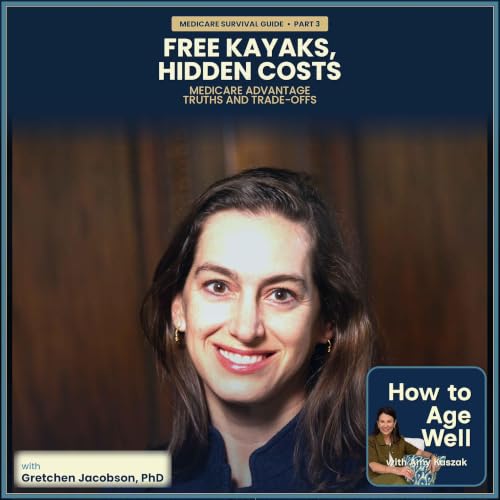
  • Free Kayaks, Hidden Costs: Medicare Advantage Truths and Trade-Offs
    2026/09/14

    Over half of everyone on Medicare is now enrolled in a Medicare Advantage plan — roughly 35 million people. In this third episode of the Medicare Season Survival Guide series, Amy sits down with Medicare policy expert Gretchen Jacobson, PhD (Commonwealth Fund) to cut through the TV ads and "$0 premium" promises and explain what Medicare Advantage actually is, how it works, and the trade-offs involved — from prior authorizations to the truth about extras like dental care, transportation, and in some cases, even kayaks.

    KEY TAKEAWAYS

    • Medicare Advantage plans are private insurance plans paid by the federal government — and private plans have been part of Medicare almost since it began in 1965.

    • Despite the original promise of cost savings, Medicare Advantage has never cost the federal government less than original Medicare.

    • Extra benefits (dental, vision, hearing, transportation, even sports equipment) can be genuinely valuable — but about 1 in 3 people in Medicare Advantage say they didn't use any of their plan's extra benefits last year.

    • Medicare Advantage plans use managed care tools — provider networks, referrals, and prior authorization — that original Medicare doesn't require.

    • A "$0 premium" plan still means you pay your Part B premium; it just means no additional premium on top of that.

    • You cannot pair a Medigap plan with Medicare Advantage.

    • Long-term care isn't covered by Medicare Advantage (or original Medicare) — only short-term, rehabilitative nursing home stays are.

    • You keep the same rights and appeal protections under Medicare Advantage as under original Medicare.

    • Plans and provider networks can change every year — review your plan each Open Enrollment, even if you're happy with it.

    • Gretchen's checklist: confirm your doctors/hospitals are covered, check drug coverage and costs, verify the extras are ones you'll use, and look at the out-of-pocket limit.

    IN THIS EPISODE

    00:00 Welcome — why this episode matters before the ads start

    00:59 Meet Gretchen Jacobson, PhD

    02:44 What is Medicare Advantage, in plain English?

    03:38 A brief history: private plans since the 1970s

    04:30 Did Medicare Advantage deliver on its cost-control promise?

    06:10 The "extras": dental, vision, hearing... and kayaks

    08:52 Prior authorizations and referrals: the real trade-off

    09:44 Weighing the trade-offs: who is MA right for?

    11:32 Why your county matters — plans vary by geography

    13:10 Part D and drug coverage inside MA plans

    15:49 The truth about "$0 premium" plans

    18:36 Surprising stat: 1 in 3 never use their extra benefits

    19:33 Can you pair Medigap with Medicare Advantage?

    20:33 Hidden costs: long-term care and cost-sharing

    22:29 When Medicare Advantage really doesn't make sense

    23:35 Where to get unbiased help: your SHIP

    25:22 Buyer beware: how brokers get paid

    27:56 Can you switch plans if you feel misled?

    28:48 Gretchen's pre-enrollment checklist

    30:36 The "hustle factor" no one can easily measure

    31:18 Why plans and networks change every year

    33:53 Gretchen's #1 piece of advice for families

    34:59 Amy's closing thoughts: it's a set of trade-offs

    RESOURCES MENTIONED

    • Commonwealth Fund: Medicare Advantage Policy Primer — https://www.commonwealthfund.org/publications/explainer/2024/jan/medicare-advantage-policy-primer

    • State Health Insurance Assistance Program (SHIP) — https://acl.gov/programs/connecting-people-services/state-health-insurance-assistance-program-ship

    • Learn more about Gretchen's work or get in touch — https://www.commonwealthfund.org/person/gretchen-jacobson

    THIS EPISODE IS BROUGHT TO YOU BY

    Naborforce — connecting older adults with kind, vetted neighbors who help with rides, errands, companionship, tech help, and more. Learn more at naborforce.com

    FOLLOW HOW TO AGE WELL WITH AMY KASZAK

    Instagram: instagram.com/howtoagewell_podcast/

    Amy on LinkedIn: linkedin.com/in/amy-kaszak-6702963/


    Hosted on Acast. See acast.com/privacy for more information.

    続きを読む 一部表示
    36 分
  • Direct Primary Care--Your Medicare Survival Guide Part 2
    2026/09/07


    If you've ever felt rushed through a seven-minute appointment, struggled to find a doctor who accepts Medicare, or waited weeks to be seen, this episode is for you. Part 2 of our Medicare Month series explores direct primary care (DPC), a fast-growing membership model where you pay your doctor directly for unlimited primary care, with no insurance billing, no co-pays, and a real relationship with your physician.

    Amy's guest is her dad, Dr. Crawford Allison, a family physician with more than 40 years of experience in the U.S. Army, rural Texas, and Waco. After three decades of fee-for-service medicine, he founded Patient First Direct Primary Care in Waco to bring back the personal, relationship-based care he grew up with. Together they break down how DPC works alongside Medicare, what it costs, how to find and vet a practice, and why--in addition to being a great option for Medicare enrollees-- it also can be a fit for early retirees, working adults, and employers too.

    IN THIS EPISODE, YOU'LL LEARN

    • What direct primary care is and how it differs from concierge medicine

    • How DPC works with Medicare Parts A, B, and D (you keep all of your coverage)

    • What a membership typically covers, and what still gets billed to Medicare

    • What DPC costs compared with concierge care

    • How to find a DPC practice near you and what to look for before you join

    • Why DPC pairs well with high-deductible plans and early retirement

    • The 2026 change that lets you pay DPC fees with your HSA

    • How employers are using DPC as an employee benefit

    TIMESTAMPS

    00:00 – Why DPC belongs in your Medicare decision

    02:26 – What is direct primary care, and where did it start?

    04:44 – 3,193 DPC practices and counting

    05:52 – The moment Dr. Allison knew there had to be a better way

    07:09 – Concierge medicine vs. DPC, and how Medicare direct contracting works

    09:25 – A relationship with a doctor, not a health system

    10:28 – What DPC costs, and access by phone, text, and video

    11:30 – "If I get sick, who's responsible?"

    12:29 – Recap: what you keep under Medicare and what the membership covers

    15:45 – No visit limits, home visits, and nursing home check-ins

    16:40 – Same-day care and what patients say they love most

    18:15 – A word from Naborforce

    18:50 – Where to start: DPC Frontier and the practice mapper

    20:20 – How to vet a DPC practice: credentials, free visits, and money-back trials

    23:07 – Ask for the "what's covered" list

    24:50 – Early retirees, high-deductible plans, and the uninsured

    27:11 – New for 2026: paying your DPC membership with an HSA

    28:20 – Employers, DPC benefits, and workers' comp first aid

    30:41 – What's next for direct primary care

    31:20 – Key takeaways

    RESOURCES MENTIONED

    • Patient First Direct Primary Care (Waco, TX) – Dr. Allison's practice: https://www.patientfirstdirect.com

    • Meet Dr. Crawford Allison: https://www.patientfirstdirect.com/dr-crawford-allison/

    • DPC Frontier – find a direct primary care practice near you: https://www.dpcfrontier.com

    • DPC Alliance – standards and information on direct primary care: https://www.dpcalliance.org

    SPONSOR

    This episode is sponsored by Naborforce, connecting older adults with vetted, caring companions for rides, errands, tech help, and more. Learn more at https://naborforce.com

    FOLLOW HOW TO AGE WELL WITH AMY KASZAK

    • Instagram: https://instagram.com/howtoagewell_podcast/

    • Amy on LinkedIn: https://linkedin.com/in/amy-kaszak-6702963/


    Hosted on Acast. See acast.com/privacy for more information.

    続きを読む 一部表示
    33 分
  • Your Medicare Season Survival Guide Part 1
    2026/08/31

    YOUR MEDICARE SEASON SURVIVAL GUIDE: PART 1 — ORIGINAL MEDICARE


    Medicare touches nearly 70 million Americans, but it's shockingly easy to get lost in its rules, deadlines, and penalties. This episode kicks off a 4-part Medicare Month series to help you navigate it with confidence.


    Amy sits down with Diane Omdahl, RN, MS — a registered nurse and Medicare expert with more than 30 years of experience, co-founder of 65 Incorporated and creator of the i65 Medicare guidance software. Diane breaks down the basics of Original Medicare: what it covers, who qualifies, the enrollment windows that can make or break your budget, and the penalties that follow you for life if you miss them.


    In this episode, you'll learn:

    • What Medicare is and how it differs from Medicaid

    • Who qualifies for Medicare and at what age

    • What Original Medicare covers — and the big things it doesn't

    • The ABCs (and D) of Medicare: Parts A, B, C, and D explained

    • Why your Initial Enrollment Period matters and how to calculate yours

    • The late enrollment penalties that can follow you for life

    • What Medicare actually costs — because "zero premium" doesn't mean free

    • Where to find free, unbiased help if you get stuck


    Timestamps:

    00:00 – Why Medicare matters and what this series will cover

    02:32 – What is Medicare, and how is it different from Medicaid?

    03:33 – Who qualifies for Medicare, and at what age?

    04:38 – What Medicare covers — and what it doesn't

    05:47 – The ABCs (and D) of Medicare: Parts A, B, C, and D explained

    09:08 – How to enroll in Medicare and your additional coverage options

    11:08 – Your Initial Enrollment Period and how to calculate it

    13:15 – Late enrollment penalties and what triggers them

    17:29 – What Medicare actually costs — zero premium doesn't mean free

    21:25 – Where to find free, unbiased help (SHIP counselors)

    25:18 – The biggest tip Diane gives every new Medicare enrollee

    27:02 – Open enrollment: what current beneficiaries need to do every year

    34:12 – Key takeaways


    Resources mentioned:

    • 65 Incorporated — unbiased, expert Medicare guidance from Diane and her team: https://www.65incorporated.com

    • Free Medicare Initial Enrollment Period Calculator: https://www.65incorporated.com/when_can_i_sign_up_for_medicare/

    • State Health Insurance Assistance Program (SHIP) — free, unbiased Medicare counseling in your state: https://acl.gov/programs/connecting-people-services/state-health-insurance-assistance-program-ship


    This episode is sponsored by Naborforce, connecting older adults with vetted, caring companions for rides, errands, tech help, and more. Learn more at naborforce.com.


    Follow How to Age Well with Amy Kaszak:

    Instagram: instagram.com/howtoagewell_podcast/

    Amy on LinkedIn: linkedin.com/in/amy-kaszak-6702963/

    Hosted on Acast. See acast.com/privacy for more information.

    続きを読む 一部表示
    35 分
  • The Owner's Manual for Your Brain:
    2026/08/24

    What if the key to your next chapter isn't something new you need to learn, but something you were born with and simply forgot to use?


    In this episode, Amy sits down with Betsy Wills, co-founder of YouScience and author of Your Hidden Genius, to explore the science of aptitudes: the innate, hardwired abilities that shape how you think, solve problems, connect with others, and find joy. Unlike skills or interests, aptitudes don't change after age 17, which means they're just as relevant at 30 as they are at 60, 70, and beyond.


    Betsy breaks down what aptitudes actually are, how they're measured, and why understanding yours can unlock new hobbies, deepen relationships, and give you a fresh sense of purpose in this stage of life.


    WHAT WE COVER

    - What aptitudes are and how they differ from personality tests like Myers-Briggs or StrengthsFinder

    - Why aptitudes are set by age 17 and never change, even as skills and interests do

    - The difference between "generalists" and "specialists," and what that means for your relationships and career

    - Why so many people mistakenly believe they're "not a numbers person" or "not creative"

    - How understanding your aptitudes can point you toward new hobbies in retirement

    - Real stories: a bond trader turned volunteer EMT, and a graphic designer turned quilter

    - New tools that connect your aptitude results to local classes, clubs, and travel opportunities

    - How sharing your results with a spouse, partner, or adult children can build empathy and understanding

    - The story of Betsy's daughter, and the danger of pigeonholing kids based on early interests


    TIMESTAMPS

    00:00 - Introduction to aptitudes and why they matter for aging well

    02:32 - What aptitudes are (and how they differ from self-reported personality tests)

    03:56 - There are 52+ aptitudes, from spatial ability to hue discrimination

    08:54 - Generalists vs. specialists: what your score means for work and relationships

    11:42 - Numerical reasoning and letting go of "I'm not a math person"

    13:37 - Spatial ability, space planning, and matching hobbies to your wiring

    14:49 - How Betsy started YouScience and why she wrote Your Hidden Genius

    17:22 - Purpose, cognitive health, and why aptitudes matter more as we age

    18:12 - Story: a bond trader's forced retirement leads to a new life as a volunteer EMT

    20:10 - Story: a graphic designer rediscovers her tactile aptitude through quilting

    23:08 - New tools connecting your results to local hobbies, clubs, and travel

    25:41 - Using your results to understand your spouse, partner, or adult children

    28:23 - Betsy's daughter, the "future orthodontist" who became a linguist at Amazon

    31:00 - Final thoughts and how to get started


    RESOURCES MENTIONED

    - Your Hidden Genius by Betsy Wills: https://www.yourhiddengenius.com

    - YouScience aptitude assessment: https://www.youscience.com

    - Your Hidden Genius book on Amazon: https://www.amazon.com/Your-Hidden-Genius-Science-Backed-Uncovering/dp/0063289873


    THIS EPISODE IS SUPPORTED BY

    Naborforce, connecting older adults with compassionate neighbors for rides, errands, companionship, and everyday support.

    Learn more at https://www.naborforce.com


    CONNECT WITH AMY

    Instagram: https://www.instagram.com/howtoagewell_podcast/

    LinkedIn: https://www.linkedin.com/in/amy-kaszak-6702963/

    Hosted on Acast. See acast.com/privacy for more information.

    続きを読む 一部表示
    33 分
  • Dementia Doesn't Wait
    2026/08/17


    Dementia doesn't wait until you're ready. It doesn't show up with a manual, and it doesn't care how busy your life already is. Every family should have this conversation before a crisis, not during one. In this episode, Amy sits down with Dayna Steele, a Hall of Fame rock radio legend turned nationally recognized dementia advocate, for a practical, no-nonsense look at what to do now: the early signs of dementia families often overlook, the questions every family should answer while everyone is still healthy, and simple daily habits that support brain health at any age. Dayna also shares "the Talk," her free 30-question guide built for exactly this, a tool for having the hard conversation early, whether or not dementia has entered the picture yet.

    Dayna cared for her own mother through Alzheimer's, chronicling the journey in real time on Facebook, then turning that painful, beautiful experience into a book and a stage play, The Woman in the Mirror, now earning glowing reviews at the 2026 Edinburgh Festival Fringe. Her honesty is startling: the signs she missed, the guilt she carried, the humor that kept her afloat. "Whatever you're doing is right. Period."

    This is not just a conversation. It's preparation, permission, and power. Above all, Dayna's message is simple: you are not alone.

    In this episode you'll learn:

    [02:32] From Houston rock radio legend to leading dementia advocate, Dayna's unlikely path

    [05:21] How Facebook unexpectedly became Dayna's support group

    [07:20] The earliest signs of dementia families often overlook

    [09:03] The moment in Vegas that revealed her mother couldn't remember their shared past

    [11:20] "The Talk," the free 30-question guide every family should have before a crisis hits, not after

    [15:50] The guilt of moving a parent, and the messy, unpredictable reality of dementia behavior

    [20:03] How her mother's story became the stage play The Woman in the Mirror

    [23:48] Understanding dementia as an "umbrella" that covers Alzheimer's, Lewy body, vascular, and more

    [27:04] Practical brain-health habits you can start today, no matter your age

    About Dayna Steele:

    Dayna Steele is a Rock Radio Hall of Famer, author, and nationally recognized dementia advocate. After caring for her mother through Alzheimer's, she wrote Surviving Alzheimer's with Friends, Facebook, and a Really Big Glass of Wine and created The Woman in the Mirror, an award-winning stage play based on her family's story, now earning glowing reviews at the 2026 Edinburgh Festival Fringe. She's also the host of the #survivingalzheimers podcast.

    Resources Mentioned:

    Dayna's Website: https://www.daynasteele.com

    The Talk (free resource): https://www.daynasteele.com/the-talk

    Dayna's Book: https://www.amazon.com/Surviving-Alzheimers-Friends-Facebook-Really/dp/1519370849

    The Woman in the Mirror (tickets & info): https://www.daynasteele.com/play

    #survivingalzheimers Podcast: https://www.daynasteele.com/survivingalzheimerspodcast

    Connect with Dayna Steele:

    Instagram: https://www.instagram.com/daynasteele/

    LinkedIn: https://www.linkedin.com/in/daynasteele

    Facebook: https://www.facebook.com/daynasteele/

    This episode is sponsored by Naborforce, connecting older adults with caring, vetted neighbors for rides, company, and everyday help. Learn more at https://www.naborforce.com

    Connect with Amy Kaszak:

    LinkedIn: https://www.linkedin.com/in/amy-kaszak-6702963/

    Instagram: https://www.instagram.com/amykaszak/

    How to Age Well Instagram: https://www.instagram.com/howtoagewell_podcast/

    Topics: Alzheimer's, dementia, dementia caregiving, caregiver support, early signs of dementia, family conversations, The Woman in the Mirror, Dayna Steele, brain health, caregiver burnout, memory care, aging well


    Hosted on Acast. See acast.com/privacy for more information.

    続きを読む 一部表示
    33 分