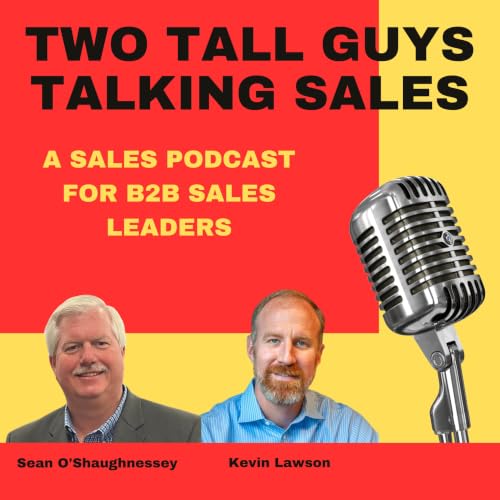
『Hit 120% of Quota: Manage Your Sales Territory Like a Business』のカバーアート

Hit 120% of Quota: Manage Your Sales Territory Like a Business

Hit 120% of Quota: Manage Your Sales Territory Like a Business

無料で聴く

ポッドキャストの詳細を見る

【Amazonプライム会員限定】今ならプレミアムプランが4か月 月額99円。

10月19日まで。※適用条件あり
What if the biggest obstacle to hitting your sales quota isn't your territory, your product, or even your competition, but the way you manage yourself? In this episode of Two Tall Guys Talking Sales, Kevin Lawson and Sean O'Shaughnessey challenge sales professionals to stop thinking only like employees and start managing their territories like businesses. They break down the numbers every seller should know, explain why CRM discipline directly affects sales success, and show how average deal size, selling effort, close rates, and opportunity quality should drive daily decisions. For B2B sellers who want stronger business acumen, better sales processes, faster pipeline velocity, and more predictable revenue, this episode offers a practical framework for becoming the manager your territory needs. Key Topics Discussed Being Your Own Sales Manager — Not Just Your Own Boss (00:00) Kevin and Sean draw an important distinction between thinking like a business owner and actually managing yourself like one. Sean introduces the idea of treating your sales territory as your own franchise: the company provides the products and infrastructure, but you are responsible for how effectively that territory produces revenue. That mindset changes sales management from something your VP of Sales does to you into something you actively do for yourself. Define What a Successful Day Looks Like Before It Starts (02:48) Before the first call, email, meeting, or prospecting activity, Sean argues that a salesperson should know exactly what must happen for the day to count as successful. Sometimes that means completing an important proposal or responding to customer questions. Other days require prospecting, building pipeline, or starting new conversations. Effective sales strategies start with consciously allocating limited time and attention to the activities that matter most. Know Your Numbers—and Manage Beyond 100% of Quota (03:56) Kevin connects strong sales management to systems and controls: the system determines how the work gets done, while the controls tell you whether it is working. Sellers should know their quota, compensation structure, average deal size, close rate, customer concentration, territory concentration, and other performance metrics. More importantly, Kevin makes the case for planning toward 120% of quota rather than 100%, because salespeople can't fully control when complex deals close. That buffer is risk management, not optimism. Understand the True Cost of Winning a Deal (07:01) Sean goes beyond average deal size and introduces the idea of the "average transaction"—the total selling effort necessary to create that deal. How many meetings were required? How much time did those meetings consume? Did the opportunity begin through a referral, inbound inquiry, networking connection, or cold prospecting? When sellers understand the actual investment required to generate revenue, they can begin making better ROI decisions about where their selling time belongs. If the current activity model mathematically cannot produce quota attainment, working harder is not the answer. The assumptions or sales processes need to change. CRM Data Hygiene as a Competitive Advantage (10:41) CRM administration is often treated as an annoying non-selling activity. Kevin challenges that assumption directly. Good CRM data helps sellers understand where deals stall, where they lose, how often opportunities convert from particular stages, and whether the next step actually advances the buying process. Better information creates better coaching, stronger opportunity qualification, and potentially significant sales productivity gains. In that sense, reducing sales administrative burden should never mean eliminating the information needed to manage the business intelligently. The Next Step Must Describe Progress—not Just Another Meeting (13:22) "Schedule another meeting" is not a meaningful next-step opportunity. A legitimate next step describes what needs to be accomplished: confirm several requirements before preparing a proposal, identify the economic buyer, re-scope the solution, or determine whether a proof of concept makes sense. That level of specificity creates accountability and helps sellers manage complex deals based on evidence, not enthusiasm. Key Quotes Kevin Lawson (00:00): "Being your own manager is not the same as being your own boss." Sean O'Shaughnessey (02:12): "You are a franchisee of your territory, selling those products… You own it. You need to run it." Kevin Lawson (05:50): "You should always be planning to exceed your quota, not just hit it, 'cause you're managing risk." Sean O'Shaughnessey (09:23): "If you cannot make your number by working hard and doing all the things correctly… then you gotta change some of those assumptions." Kevin Lawson (11:16): "If you're in the camp of saying, 'I don't wanna put information in my CRM,' you're gonna get outsold by your competition." Additional Resources B2B ...
adbl_web_anon_alc_button_suppression_t1
まだレビューはありません