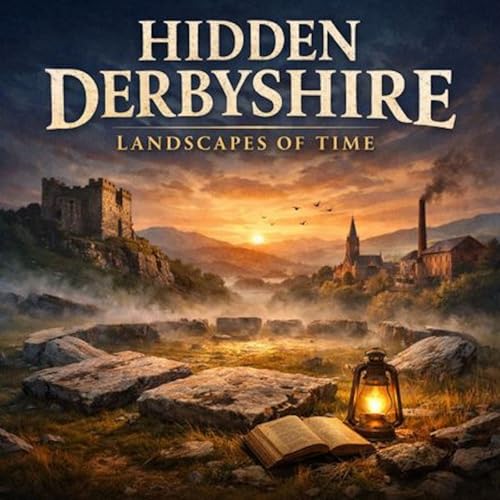
『Hidden Derbyshire - Landscapes of Time』のカバーアート

Hidden Derbyshire - Landscapes of Time

Hidden Derbyshire - Landscapes of Time

著者: Nine Ladies Productions
無料で聴く

概要

Hidden Derbyshire is a documentary storytelling podcast exploring the places where history, folklore, and landscape intersect.

Across ten episodes, we travel from prehistoric stone circles to plague villages, Norman fortresses, industrial mills, mass trespass protests, and drowned towns — uncovering how each site shaped the people who lived here, and how their stories still echo in the hills.

There are no interviews, no experts, and no academic lectures. Just atmosphere, archaeology, and narrative — told on foot, in the landscape, and through time.

Whether you know Derbyshire well or not at all, you’ll find something here that surprises you. Because this county isn’t just picturesque — it’s strange, it’s old, and it’s still talking.

Series One: Landscapes of Time

New episodes weekly. Subscribe wherever you get your podcasts.

All rights reserved.
旅行記・解説 社会科学
エピソード
  • Cromford: The Mill That Invented Time
    2026/01/27

    On the banks of the Derwent, Richard Arkwright built a new kind of landscape — one powered not by feudal obligation or aristocratic prestige, but by water, machinery, capital, and the disciplined management of time.


    Cromford became the first successful water-powered cotton spinning mill in the world and the prototype for the factory system. It redefined labour, reshaped community, and turned time into currency — influencing the Industrial Revolution from Derbyshire to Lancashire, New England, and beyond.


    *Hidden Derbyshire: Landscapes of Time*

    A documentary storytelling podcast about the places where history, folklore, and landscape intersect.

    **Core Historical & Industrial Sources**


    * **Fitton, R.S. & Wadsworth, A.P.** (1958). *The Strutts and the Arkwrights, 1758–1830.*

    — Foundational industrial history; strong Cromford material.

    * **Chapman, Stanley** (1970). *The Early Factory Masters.*

    — Context for Arkwright as system-builder.

    * **Ashton, T.S.** (1948). *The Industrial Revolution (1760–1830).*

    — Classic overview; Cromford as early case.


    **Arkwright & Factory System Studies**


    * **Birch, Alan** (1967). *The Economic History of the British Iron and Steel Industry.*

    — Broader industrial context; useful for mechanisation culture.

    * **Mantoux, P.** (1928). *The Industrial Revolution in the Eighteenth Century.*

    — Still standard for mechanisation & proto-factory detail.

    * **Wyatt, M.** (2016). *Richard Arkwright: Cotton King.*

    — Modern biography; myth vs reality of “invention.”


    **Labour, Time & Social Change**


    * **Thompson, E.P.** (1967). *Time, Work-Discipline and Industrial Capitalism.*

    — Crucial for “factory time” as social innovation.

    * **Honeyman, Katrina** (2007). *Child Workers in England, 1780–1820.*

    — Cromford as case for child/women labour regimes.

    * **Joyce, Patrick** (1980). *Work, Society and Politics.*

    — Factory labour, discipline & industrial identity.


    **Derwent Valley & UNESCO Context**


    * **Derwent Valley Mills Partnership** (UNESCO Management Plans, 2001–present).

    — Essential documentation for heritage framing.

    * **English Heritage Industrial Records**

    — Building phases, machinery layouts, archaeological notes.

    * **UNESCO World Heritage Dossier (2001)**

    — Recognises Cromford as precursor of modern factory system.


    **Economic & Global Dimensions**


    * **Hudson, Pat** (1986). *The Genesis of Industrial Capital.*

    — Links networks, finance, and cotton industry.

    * **Riello, Giorgio** (2010). *Cotton: The Fabric that Made the Modern World.*

    — Global context; Cromford as seed of industrial cotton capitalism.


    ### **Consensus Statements**


    Most industrial historians agree:

    ✔ Cromford was the first **successful water-powered factory system**

    ✔ Arkwright’s significance = **organisation + labour discipline**, not invention

    ✔ Factory time replaced agricultural time — fundamental social shift

    ✔ Derwent Valley influenced global industrialisation

    ✔ UNESCO inscription justified on system innovation, not architectural beauty


    **Open Interpretive Questions**


    Still debated:

    • Extent of coercion vs opportunity in mill labour recruitment

    • Degree of “paternalism” in Arkwright’s worker housing

    • Whether Cromford or Belper should wear the “prototype” crown

    • How far Cromford shaped US & Indian cotton industry through diffusion


    **Accessible Public Sources**


    For non-specialist audiences & visitors:


    * Cromford Mills visitor centre & interpretation

    * Derwent Valley Mills WHS publications

    * Masson Mills exhibits

    * BBC industrial heritage features

    * Peak District tourism literature (condensed but accurate)


    **Useful On-Site Interpretation Notes**


    Visitors can observe:


    * Mill 1 & Mill 2 footprints

    * Water management infrastructure (leats, wheel pits)

    * Workers’ cottages & urban layout

    * Cromford canal & transport infrastructure

    * Clock discipline remnants (bells, routine markers)


    Support this podcast at — https://redcircle.com/hidden-derbyshire-landscapes-of-time/exclusive-content
    続きを読む 一部表示
    6 分
  • Peveril Castle: Stone, Feudalism & the View from the Edge
    2026/01/27

    High above Castleton, the ruins of Peveril Castle overlook the Hope Valley — a fortress less defined by battles than by law, revenue, and administration. Built in the aftermath of the Norman Conquest, Peveril became a centre of feudal authority: managing land, lead, markets, and justice from a vantage point designed for visibility and control.


    In this episode, we explore how Peveril Castle governed more through paperwork than warfare, how its power declined without drama, and how the Romantic age transformed a legal instrument into a picturesque ruin with one of the most commanding views in Derbyshire.


    *Hidden Derbyshire: Landscapes of Time*

    A documentary storytelling podcast about the places where history, folklore, and landscape intersect.

    **Primary Archaeology & Landscape Sources**


    * **Barnatt, John** (1990). *The Henges, Stone Circles and Ringcairns of the Peak District*.

    — Includes Nine Ladies & Stanton Moor cairn complex.

    * **Barnatt & Collis (eds.)** (1996). *Barrows in the Peak District*.

    — Covers cairns, ring cairns, typology, and landscape sequencing.

    * **Barnatt & Smith** (2004). *The Peak District: Landscapes Through Time*.

    — Essential landscape archaeology context.

    * **Derbyshire Archaeological Journal** (19th–20th c. volumes).

    — Antiquarian field notes, early measurements, cairn mapping.

    * **Historic England Scheduling Notes** — Nine Ladies + King Stone + associated cairns.

    — Official designation, context, and landscape assessment.


    **Chronology Notes**


    * Assigned to **Late Neolithic / Early Bronze Age (c. 2200–1500 BC)** via:

    ✔ comparative typology of small stone circles

    ✔ proximity to round cairns (Bronze Age funerary)

    ✔ absence of later intrusive features

    * No major excavation; dating remains inferential not direct.


    **Comparative Monument Clusters**


    Useful parallels for scale & function:


    * **Merry Maidens** (Cornwall)

    * **Bodmin Moor Circles** (Cornwall)

    * **Burnmoor Circles** (Cumbria)

    * **Rollright Stones** (Oxfordshire)

    — Most share folklore of petrification, dancing, or taboo-breaking.


    **Folklore & Victorian Reimagining**


    * Christian petrification legend (19th c.) attested in:

    — **Glover, S. (1829). *History of Derbyshire*.**

    — regional antiquarian society papers

    * Victorian Druid revival influence:

    — “sabbath dancers”, “fiddler/king stone” motif

    — aligns Nine Ladies with pan-British folklore template


    ### **Modern History: Quarry Dispute & Protest**


    * Quarry expansion proposals (late 20th–early 21st c.) led to:

    ✔ long-term protest camp

    ✔ treehouses & makeshift dwellings

    ✔ collaboration between druids, environmentalists, walkers & locals

    ✔ protracted planning & legal process

    * Reported in:

    — Local & regional press (Derbyshire Times, Peak Advertiser)

    — BBC regional coverage

    — Archaeology & heritage advocacy (Council for British Archaeology)

    — Heritage conservation casework files (Historic England, NPA)


    **Consensus Statements**


    Most archaeologists agree:

    ✔ Nine Ladies belongs to prehistoric ritual landscape of Stanton Moor

    ✔ Cairns → funerary; circle → ceremonial

    ✔ King Stone = outlier marking threshold/procession

    ✔ Folklore overlays are post-medieval & Victorian

    ✔ Monument significance = cumulative, not singular


    **Open Interpretive Questions**


    Still debated or unknown:

    • Function: ritual vs procession vs social gathering

    • Astronomical or calendrical alignments (inconclusive)

    • Relationship between cairns & circle (sequence/ritual choreography)

    • Why small-scale circles persist across Britain despite regional variation


    **Accessible Public Sources**


    For general audiences:


    * Peak District National Park Heritage Pages

    * Friends of the Peak District / CPRE materials

    * Buxton Museum Prehistory collections

    * Visitor guides for Stanton Moor & Nine Ladies

    * Local walking books (often surprisingly well researched)


    Support this podcast at — https://redcircle.com/hidden-derbyshire-landscapes-of-time/exclusive-content
    続きを読む 一部表示
    7 分
  • Haddon Hall: Stone, Marriage & Power
    2026/01/22

    Haddon Hall stands above the River Wye as one of England’s finest surviving medieval houses. From the Peverils to the Vernons and the Manners, the hall became a stage for marriage, inheritance, religion, decline, restoration, and romantic reinvention.


    In this episode, we explore how Haddon survived where so many great houses fell: not through war or wealth, but through neglect — entering a long sleep that preserved its medieval fabric into the modern age.


    *Hidden Derbyshire: Landscapes of Time*

    A documentary storytelling podcast about the places where history, folklore, and landscape intersect.

    **Primary Historical & Architectural Sources**


    * **Girouard, Mark** (1978). *Life in the English Country House.*

    — Foundational for understanding domestic aristocratic spaces.

    * **Thompson, M.W.** (1994). *The Medieval Hall: The Basis of Secular Architecture.*

    — Explains hall typology, hierarchy, and evolution.

    * **Pevsner, Nikolaus & Williamson, E.** (2002). *The Buildings of England: Derbyshire.*

    — Architectural survey; essential entry for Haddon.

    * **Country Life Archives** (1900s–1930s).

    — Photography + restoration notes for Haddon’s revival period.


    **Dynastic & Genealogical Context**


    * **Vernon Family Papers** (16th–17th c.) — private archives (access varies).

    * **Manners Family Records** — link to Belvoir Castle and dukedom.

    * **G.E. Cokayne** (1910). *Complete Peerage.*

    — Standard reference for noble lineage + inheritance patterns.


    **Dorothy Vernon Legend & Interpretation**


    * **Roberts, Leah** (1989). *Dorothy Vernon: Legend, History & Performance.*

    — Examines the romantic myth vs documentary evidence.

    * **Victorian Retellings** (19th c.) in novels, theatre, & poetry.

    — Romantic nationalism strongly shaped Haddon’s public memory.


    **Restoration & Romanticism**


    * **Jenkins, Simon** (2003). *England’s Thousand Best Houses.*

    — Contextualises Haddon within heritage tourism & preservation.

    * **Mandler, Peter** (1997). *The Fall and Rise of the Stately Home.*

    — Key text for aristocratic decline + heritage revival.

    * Gothic revival literature & art influenced perception of Haddon (e.g. **Ruskin**, **Scott**, **Turner** indirectly).


    **Religious & Reformation Context**


    * **Haigh, Christopher** (1993). *English Reformations.*

    — Domestic religion & pragmatic adaptation.

    * **Walsham, Alexandra** (2016). *The Reformation of the Landscape.*

    — Memory, sacred space, & post-Reformation domestic piety.


    **Consensus Statements**


    Historians broadly agree:

    ✔ Haddon is one of the most complete medieval domestic survivals in England

    ✔ Marriage/inheritance shaped ownership (Peveril → Vernon → Manners)

    ✔ Dorothy Vernon legend = cultural invention, not archival fact

    ✔ “Long Sleep” (18th–19th c.) preserved medieval fabric

    ✔ Victorian restoration shaped modern reception


    ### **Open Interpretive Questions**


    Still debated:

    • How much of the Dorothy Vernon narrative reflects Jacobean marriage politics vs Victorian myth-making?

    • Did the Manners deliberately curate “medieval authenticity,” or simply avoid modernization due to cost/practicality?

    • Was neglect preservation by accident or by quiet strategy?


    **Accessible Public Sources**


    For non-specialist listeners & visitors:


    * Haddon Hall official guidebooks & tours

    * Belvoir Castle guides (dynastic link)

    * Heritage tourism publications

    * BBC & Country Life features

    * Derbyshire heritage trails + tourism board notes

    * Peak District NPA cultural guides


    **Useful On-Site Interpretation Notes**


    Visitors can observe:


    * Great Hall hierarchy

    * Medieval kitchens & bakehouse range

    * Chapel stained glass (early)

    * Long Gallery (Elizabethan)

    * Gardens & terraces (restored)

    * Visible masonry phases (12th–17th c.)


    Support this podcast at — https://redcircle.com/hidden-derbyshire-landscapes-of-time/exclusive-content
    続きを読む 一部表示
    7 分
まだレビューはありません