エピソード

  • 9/11 at 25: Part 2 (Interview with Lieutenant General Michael Fenzel)
    2026/09/11

    At 8:46 this morning a bell rings in lower Manhattan and somebody starts reading names. It takes most of four hours to get through them. They’ve done this every year for twenty-five years, and every year there are fewer people standing there who remember the sound the first one made.

    Twenty-five years ago at 8:46, my brother was at his desk in the White House, finishing a memo. He thought the memo was going to be the most important thing he did that year.

    This is Part 2 of my interview with my brother, Lieutenant General Michael Fenzel (USA, Ret.). Part 1 stayed in the summer of 2001 and ended when the phone on that desk rang. This one picks it up where that day began.

    Michael was thirty-four, an Army major on the counterterrorism staff, the most junior man in every room he walked into that day. When the complex was evacuated, I went with everyone else. He stayed. Where he went and what he was handed over the next eighteen hours on those 18 acres is his to tell, and he tells it plainly, the way soldiers tell things they’ve decided to stop carrying alone.

    We built this in two parts because September 11th was never the ending of anything. For the people in those rooms it was the first day. Everything that we now call the war on terror, the longest war this country has fought, started for Michael before lunch, and it didn’t let go of him for twenty years. Iraq. Afghanistan, three times. A battalion on the Pakistan border. A chair, near the very end, across a table from the men who had spent years trying to kill his soldiers. He was in the room on the first day and he was in the room when we tried to end it, and there aren’t many people alive who can say both.

    He’s my brother, which meant I could ask him what that costs. I could ask him about the soldiers he lost, who he still thinks about every day. I could ask him what he wants his own kids to understand about that Tuesday when they’re old enough to ask, and I could sit there while he decided how to answer.

    There is a story in the middle of this hour that he’s never told outside a handful of people who were in the room. I was one of them. I told him he didn’t have to. But he told it anyway.

    Support the show

    Learn • Serve • Lead • Remember

    🎧 Never miss an episode—subscribe on YouTube or grab the RSS.

    Follow & join the conversation ➔ @HeroesPath on X, Instagram, LinkedIn • #HeroesPathPodcast

    続きを読む 一部表示
    58 分
  • 9/11 at 25 (Part 1: Before the Day): A Conversation with Lieutenant General Michael Fenzel (USA, Ret.)
    2026/09/11

    This is Part 1 of a two-part interview with my brother, Lieutenant General Michael Fenzel, U.S. Army, Retired. We called it “Before the Day” on purpose.

    Catastrophe has a way of making everything that preceded it look obvious. Once you know what happened, the warnings get louder and the missed chances get bigger, and the people who were there start to look like they should have seen it. But the people inside the national security system in the summer of 2001 were living in the present tense. They had bosses and meetings and intelligence reports and a dozen problems that looked urgent because some of them were. What they did not have was the morning of September 11, and everything that began with it.

    So Michael and I spend Part 1 in that world. He talks about becoming a soldier and finding out what fear actually is, and about the strange confidence that comes from learning that panic is optional. He talks about mentors, about rooms full of very smart people, and about what it takes to move a room when nobody in it works for you. He talks about the difference between having authority and having credibility, and about a threat that was visible and serious and still very hard to turn into action.

    He’s my brother, which changes an interview. I suppose there were questions I could ask that another interviewer would never think of, and answers I understood before he finished them. The conversation wanders into our parents, football, old commanders, and the plain fact that two brothers once walked into the White House every morning convinced they were already having the most remarkable professional experience of their lives. But they had no idea what was coming. Nobody did.

    Part 1 ends when the phone on his desk rings the morning of September 11, 2001. I’m going to leave that account to him.

    Part 2 comes out tomorrow, Friday, September 11. It goes where you think it goes and then keeps going, through Iraq and Afghanistan and a story Michael has never told outside the handful of people who were in the room. He’s been carrying it for twenty-five years. So have I.

    There’s a reason we waited twenty-five years to have this conversation.

    Support the show

    Learn • Serve • Lead • Remember

    🎧 Never miss an episode—subscribe on YouTube or grab the RSS.

    Follow & join the conversation ➔ @HeroesPath on X, Instagram, LinkedIn • #HeroesPathPodcast

    続きを読む 一部表示
    23 分
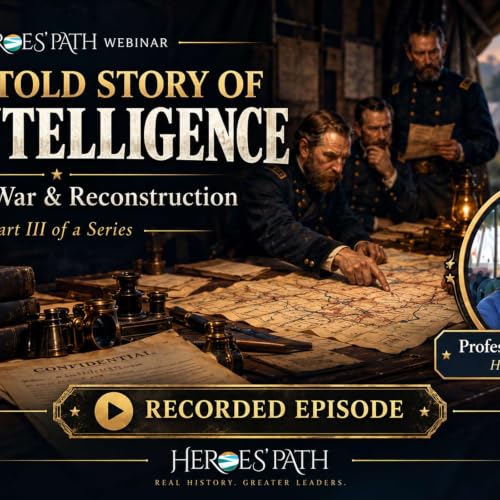
  • The Untold Story of U.S. Intelligence, Part III: The Civil War & Reconstruction (A Heroes' Path Webinar with Jeff Steinberg)
    2026/09/09
    Here’s a fact I did not know until last Thursday night: in 1863, at the height of the Civil War, a foreign navy sailed into New York and San Francisco carrying sealed orders. Those orders, if opened, would have placed the entire fleet under the command of Abraham Lincoln.It was front-page news in every major paper on both coasts. Then it vanished from the story we tell ourselves about the war.That’s one of perhaps a dozen moments in this session where I found myself saying, out loud, “I had no idea.” If you’ve followed the first two parts of Jeff Steinberg’s series, you know that’s the whole point. Jeff goes past the textbook version and into the letters, the reports, the newspaper archives, and comes back with something richer and stranger every time.Part III is the strongest yet. It’s also the one with the hardest lesson.A war on two frontsWe think of the Civil War as North versus South. Jeff makes the case that it was something bigger: the third and final war for American independence. While the armies fought in Virginia and along the Mississippi, a second, quieter war was being waged across the Atlantic, where Britain and France were actively looking for a pretext to break the Union apart and reclaim a foothold in North America.The Union’s answer was a spy network run out of embassies in London, Liverpool, Brussels, and St. Petersburg, staffed by diplomats who were not really diplomats. On the other side, the Confederacy’s man in London was running a shadow navy out of British shipyards. His name will surprise you. So will his nephew’s.I won’t spoil how the European front was won. But it involved an abolitionist ambassador, a Russian tsar, and a conversation that may have shaped the timing of the Emancipation Proclamation.The First All-Source Intelligence Organization in American HistoryBack home, the early war went badly, and Jeff is unsparing about why. The Union commander was relying on a private contractor for his intelligence, and that contractor kept telling him what he wanted to hear. Opportunities to end the war early were thrown away on the basis of enemy troop counts that were pure fiction.What replaced that was built by a New York lawyer almost nobody has heard of. In a matter of months he assembled scouts, cavalry, balloons, signal corps, systematic prisoner debriefings, and a small team of analysts cross-checking every source against every other. It was the first time an American army could truly see the battlefield in front of it, and Jeff walks through exactly how that edge decided Gettysburg.The most important source in that network wasn’t a balloon or a cavalry scout. It was the men and women the Confederacy had enslaved. One Confederate general wrote a bitter letter to Jefferson Davis describing what he called an “omnipresent spy system” that his army had no way to guard against. Jeff reads it aloud during our webinar. Listen for it.And then there’s the woman in Richmond, and the freed slave she placed inside the Confederate White House. I’ll leave that one entirely to Jeff.What Happens When You Throw It All AwayWithin a year of Appomattox, the Union Army went from two million soldiers to 54,000. The intelligence bureau that won the war was dismantled. The men who built it went on to build railroads and run ports. We had done exactly the same thing after the Revolution, and we were about to pay for it exactly the same way.Into that vacuum came the Klan, an insurgency across the South, and a decade-long fight to hold Reconstruction together with a fraction of the tools the country had just proven it knew how to build. Jeff traces that fight through the Freedmen’s Bureau, which quietly became something more than a relief agency, through the first presidential impeachment, and finally to the election of 1876, where a backroom deal ended Reconstruction and the promise of equal citizenship for the better part of a century.He closes with two chapters I’d never encountered: a team of former Union and Confederate officers sent, together, to stand up a West Point on the Nile, and a retired president’s world tour that was something other than a vacation.Why it’s Worth your HourHeroes’ Path tells stories about people who did the hard, often invisible right thing under pressure. This session is full of them: a consul in Liverpool, an ambassador in St. Petersburg, a lawyer who became a spymaster, a railroad engineer who became another, a woman in Richmond, and thousands of people who never wore a uniform and are buried today under headstones that read simply Citizen.It’s also a story about a republic that keeps deciding it doesn’t need to see clearly, and what fills the void when it makes that choice. That pattern doesn’t end in 1876. Jeff and I touch on where it shows up again in the twentieth century, and he gives a preview of what’s coming in Part IV.Give it an hour. Then let us know what struck you most.Support the showLearn • Serve •...
    続きを読む 一部表示
    1 時間 3 分
  • Heroes' Path Dispatch (Labor Day 2026)
    2026/09/07

    Scaffolding Without a Building

    Happy Labor Day! If you build things, teach kids, drive trucks, grow food, patch people up, write code, stand a post — today is yours. This show, and this page, exist for one reason: because every headline we cover eventually lands on the people who get up and do the work. Today we say it plainly. Thank you.

    The gas under your road trip today is the most expensive Labor Day fuel ever recorded in America: $4.14 a gallon, breaking a record that had stood since 2012, and diesel, the fuel hiding inside the price of everything that moves on a truck, hit an all-time high. That didn’t happen by accident. It happened because, half a world away, the United States Navy started sinking oil tankers — and because Iran, for the first time in history, fired ballistic missiles at an American aircraft carrier.

    And here is the strange, whiplash truth of these eleven days: in the very same weekend, the most serious peace effort of the Ukraine war quietly took flight. Two American envoys sat with Putin for three hours on Friday and with Zelensky on Saturday. It was the first time this administration has worked both capitals in one trip. This morning, Jeff Steinberg and I recorded the whole story: the war that came back, the peace that might be real, and your wallet standing between them.

    A Few Things You’ll Only Hear in This Episode

    The secret truce nobody announced. For three days around the envoys’ visit, Russia and Ukraine quietly stopped striking each other’s capitals. Nobody held a press conference. We explain why that silence is the single most honest signal in this entire peace effort — and what to watch to know if it holds.

    Why we’re hopeful AND patient. Putin says “there is a chance.” Two days earlier he called Ukraine a terrorist entity. Jeff walks through what we think he’s actually doing — running war and diplomacy in parallel — and why, until someone solves the Donbas problem, this week’s diplomacy is scaffolding without a building.

    The two wars are now one war. The Financial Times reports, from leaked documents, that the missiles Iran fired at our carrier come from a program secretly built with Russian help. The same week our envoys shook Putin’s hand. We connect those dots carefully, and honestly.

    Four words from the Fed. “We have work to do.” The new chairman may raise your interest rates NEXT WEEK: we tell you what Friday’s inflation report decides, and what it means if you’re carrying a mortgage or shopping for one.

    A citizen’s checklist. The first midterm ballots went out Thursday into open legal chaos. No politics — just the five-minute checklist we’d give our own families for making sure the vote you cast is the vote that counts.

    And we take a moment for the giants we lost this week, including Alan Greenspan, at one hundred, before ending, as always, with some light.

    25 Good Minutes

    Every story on the Dispatch has to survive two questions asked out loud — So what? and Now what? — plus a discipline most shows won’t attempt: we make predictions, and then we score them on the air. Two weeks ago we told you September would arrive as a collision — the war clock, the stranded sanctions bill, the Fed — and this episode, we grade that call in front of you. No doom theater, no team jerseys, and when a claim comes from a single source, we say so. Twenty minutes, and you’ll understand the week better than people who watched cable all weekend.

    If This is Your First Time Here

    Heroes’ Path is where we make sense of a noisy world together — the events that actually reach your kitchen table, explained plainly by people who’ve spent their lives in uniform and in the arena. Subscribing is free, takes ten seconds, and puts the Dispatch in your inbox every week before the headlines catch up.

    And if the Dispatch is useful to you, do one thing for us this holiday: forward this to one person at your cookout who’d appreciate it. That’s how this community grows — one trusted hand-off at a time.

    Enjoy the day you’ve earned. Hold your people close and Happy Labor Day!

    Support the show

    Learn • Serve • Lead • Remember

    🎧 Never miss an episode—subscribe on YouTube or grab the RSS.

    Follow & join the conversation ➔ @HeroesPath on X, Instagram, LinkedIn • #HeroesPathPodcast

    続きを読む 一部表示
    28 分
  • Fat Man and Little Boy: The Decisions. The Science. The Consequences
    2026/08/22

    We Weren't There

    Eighty-one years ago this month, a young colonel named Paul Tibbets took off from a small island in the Pacific, in a bomber he'd named after his mother, and dropped the first atomic weapon ever used in war. Three days later, another crew did it again over Nagasaki. And the deadliest war in human history came to an end.

    I always thought I understood that decision: whether we should have used the bomb. I've heard the debate over many dinner tables and in many classrooms. Turns out I understood almost none of it.

    My friend Colonel Gerry Tertychny does. Last week he sat down with us and walked, step by careful step, from Pearl Harbor to Hiroshima. It wasn't the version I half-remember from school, but the real one: The strategy. The science. The man who had to choose, and the much younger men who had to carry it out.

    He never tells you what to think. He just shows you how hard it really was — and how easy it is, from a safe seat in 2026, to forget that we weren't there.

    Give it an hour. It stayed with me, and I think it'll stay with you.

    Support the show

    Learn • Serve • Lead • Remember

    🎧 Never miss an episode—subscribe on YouTube or grab the RSS.

    Follow & join the conversation ➔ @HeroesPath on X, Instagram, LinkedIn • #HeroesPathPodcast

    続きを読む 一部表示
    1 時間 17 分
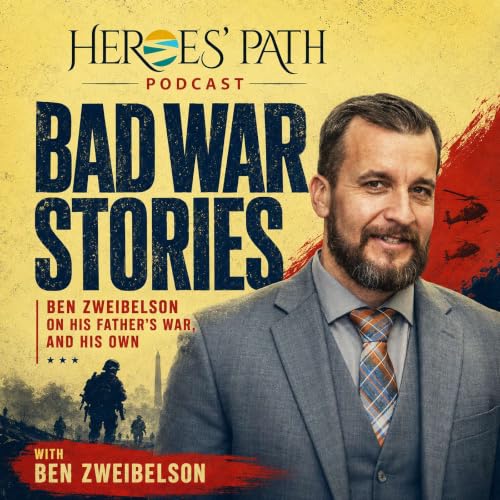
  • Bad War Stories: Ben Zweibelson on His Father's War, and His Own
    2026/08/22
    Ben Zweibelson was the kid in high school who was always drawing. Then his father died, the money ran out, and a National Guard recruiter at a Connecticut county fair offered him a way to pay for college. He took it — and he stayed for twenty-two years, four combat tours in Iraq and Afghanistan, four Bronze Stars, and the Ranger tab. Along the way the Army also gave him three master's degrees and, on the GI Bill, a doctorate in philosophy.Ben is what that advice looks like when somebody actually takes advantage of all the opportunities that military service offers.But this conversation isn't really about a career. It's about a cigar box.Ben's father, Irving, was a 22-year-old Ashkenazi Jew from New York, blind in one eye, who was turned away by the Marines and the Navy before the Army took him. He served in Panama and West Africa. He came home, locked the war away, and never spoke of it again. Ben describes sitting at the dinner table at ten years old — full of The A-Team and Platoon — asking his father whether he'd ever killed anyone, and hearing the man's Parkinson's-stricken hand shake so hard that his wristwatch knocked against the underside of the table. "I had poked the bear, and I didn't understand."His father died when Ben was seventeen. "If you lose somebody that young," he says, "you spend the rest of your life searching for a ghost you'll never catch."Bad War Stories — his fifth book, and nothing like the four that came before it — is his answer to that silence. He calls it an anti-memoir: written in the third person, refusing the heroics and the veneer that make war legible to Hollywood, humanizing everyone in the frame including the adversaries and the civilians. Every event in it is real. He fictionalized only the names.Along the way, we get the stories that don't make the official record: the live-agent chamber at Fort McClellan and the atropine pen he jammed into a training dummy backwards — a secret he admits he has never told anyone until this episode. The white van he parked in a Special Forces unit's drop zone at Fort Polk, three kilometers from anywhere, ending their pre-deployment validation. The four men he dedicated the book to — a high school wrestling coach, two friends' fathers, and a Special Forces colonel who protected him decades later — who between them filled a hole his own father couldn't.And there's the harder material, too: what the institution does to curious people, why Ben thinks we are training to win a war that may never come, and what he wants his three sons to have when he's gone.The last question we asked stopped him. He admitted he'd been dreading it since he saw it on our list.We planned on thirty minutes. We went an hour, and we easily could have kept going. That's why we're going to have him back with us in October.IN THIS EPISODEHow an art student ended up in an infantry battalion — and whether an artist sees a battlefield differentlyFort McClellan, the Chemical Corps, and a live-agent story Ben has never told publiclyLady Luck and the Grim Reaper — "sometimes they switch spots"Irving Zweibelson: the one-eyed volunteer the Marines and Navy turned awayThe dinner table question, and the sound of a wristwatch under the woodWhy Bad War Stories is an anti-memoir, not an anti-war memoirHollywood's war as simulacra — "a copy without an original"The four men in the dedication, and the search for a father figureCreative curiosity, drones, AI, and the conflict we may already have lostWriting as a way through: Ben's advice for any veteran with a story and a blank pageABOUT BEN ZWEIBELSONDr. Ben Zweibelson is Director of the Strategic Innovation Group at U.S. Space Command. He previously spent seven years as the lead design educator for U.S. Special Operations Command through the Joint Special Operations University. A retired U.S. Army infantry officer, he served 22 years with four combat deployments to Iraq and Afghanistan, earning four Bronze Star Medals, the Combat and Expert Infantryman's Badges, the Ranger tab, and Master Parachutist, Pathfinder, and Air Assault badges.He holds a BA in Fine Arts from the University of Connecticut, three master's degrees (Louisiana State University, Air Command and Staff College, and the U.S. Army School of Advanced Military Studies), and a doctorate in philosophy from Lancaster University in the UK. He has lectured at multiple war colleges, at Yale and Johns Hopkins, and to organizations including IBM. He lives in Colorado Springs with his wife and three sons.Ben appears here as a private citizen and author. His views are his own and do not represent the U.S. government, the Department of Defense, or any organization with which he is professionally associated.GET THE BOOKSBad War Stories (Helion & Company, 2026)Amazon — https://www.amazon.com/Bad-War-Stories-Ben-Zweibelson/dp/1804519421Helion & Company (UK) — https://www.helion.co.uk/military-history-books/bad-war-stories-.phpCasemate (US distributor)...
    続きを読む 一部表示
    59 分
  • Heroes' Path Dispatch (August 14, 2026)
    2026/08/15
    The War Moved Closer

    For the past two weeks, no American bombs have fallen on Iran.

    And yet the consequences of the war have kept moving.

    Fewer ships are moving through the Strait of Hormuz, but the effects are traveling far beyond it. They’re beginning to register in fuel prices, shipping and insurance costs, the jobs market, fertilizer supplies, food prices, and even the holiday merchandise being ordered now for November and December.

    That widening circle of consequences is the thread Jeff Steinberg and I follow in this week’s Heroes’ Path Dispatch.

    Eleven days ago, we were watching for an agreement that might reopen the Strait and begin cooling the crisis. That agreement never materialized. Shipping remains severely constrained, Iran has hardened its position, and the economic effects are beginning to travel well beyond the Persian Gulf.

    But this episode is really about something larger.

    News arrives as a series of disconnected alarms. A refinery is struck deep inside Russia. Ebola spreads. Congress leaves Washington. Vaccine policy changes. An earthquake devastates part of Colombia.

    The useful question is rarely just what happened?

    It’s: What connects these events? What happens next? And when does something happening 6,000 miles away begin changing life at home?

    Jeff is particularly good at spotting the second and third consequences, the ones that seldom make the first headline.

    Near the end of our conversation, we turn toward several signals I think are worth watching very carefully over the next few weeks: fuel availability, grocery prices, holiday shipping, the Colorado River allocation decision, the labor market, and the increasingly fragile mathematics surrounding the national debt.

    The shooting may be quieter right now, but the story is not.

    Watch or listen to this week’s Heroes’ Path Dispatch with Jeff Steinberg.

    Then keep an eye on the ships going through Hormuz.

    And keep an eye on the sign at the corner.


    Support the show

    Learn • Serve • Lead • Remember

    🎧 Never miss an episode—subscribe on YouTube or grab the RSS.

    Follow & join the conversation ➔ @HeroesPath on X, Instagram, LinkedIn • #HeroesPathPodcast

    続きを読む 一部表示
    20 分
  • The Heroes' Path Dispatch (August 4, 2026)
    2026/08/05

    A war can be thousands of miles away right up until your water stops running.

    This week on The Heroes’ Path Dispatch, Jeff Steinberg and I talk Iran, oil, cyberattacks, NATO, Ebola, the Colorado River, and one rocket that finally stopped exploding long enough to do its job.

    Different stories. Same question:

    How much strain can a system take before ordinary people get the bill?

    Watch this week's Heroes' Path Dispatch: The Brink, the Bargain & the Home Front.

    Because the world has a habit of showing up at your kitchen table without knocking.

    https://open.substack.com/pub/heroespath/p/the-heroes-path-dispatch-47d?r=ky3s5&utm_campaign=post&utm_medium=web&showWelcomeOnShare=true

    #HeroesPath #Dispatch #Iran #Ebola #Colorado #Minnesota #Subversion #Sabotage #Terrorism #War #Cyberattacks #Washington #NATO #Poland #Russia #Update #News

    Support the show

    Learn • Serve • Lead • Remember

    🎧 Never miss an episode—subscribe on YouTube or grab the RSS.

    Follow & join the conversation ➔ @HeroesPath on X, Instagram, LinkedIn • #HeroesPathPodcast

    続きを読む 一部表示
    23 分