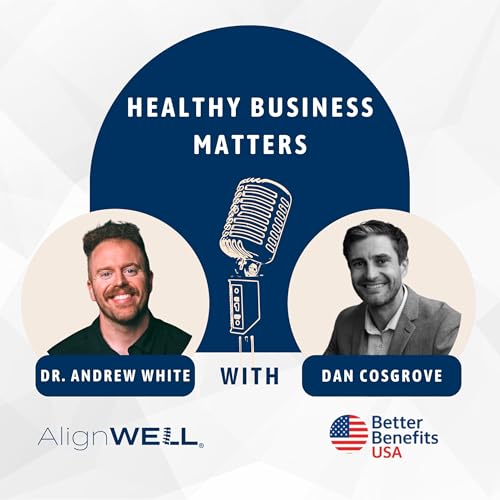
『Healthy Business Matters』のカバーアート

Healthy Business Matters

Healthy Business Matters

著者: Dr. Andrew White
無料で聴く

【Amazonプライム会員限定】今ならプレミアムプランが4か月 月額99円。

10月19日まで。※適用条件あり

American employers are spending more on healthcare than any other country in the world, and outcomes continue to get worse. That disconnect is why Healthy Business Matters exists.

In this introductory episode, host Dr. Andrew White, founder and CEO of AlignWell, explains the purpose of the podcast and the problem it’s designed to tackle: a healthcare system that rewards spending instead of results, and benefit strategies that look good on paper but fail in real-world execution.

This is not a podcast about vendor demos or polite conversations. It’s about how employee benefits actually work, and how they fail, in real employer environments.

Who this show is for

  • Insurance brokers working with self-funded, captive, or level-funded plans
  • HR leaders, CFOs, founders, and executives responsible for benefit decisions
  • TPAs, PBMs, and point solutions operating in the employer health ecosystem
  • Anyone accountable for benefit design, budget, and outcomes

What you’ll hear on this podcast

  • Real-world benefit design and execution conversations
  • Why many benefit strategies fail despite good intentions
  • The difference between education, behavior change, and outcomes
  • Mental models for designing benefits that actually move the needle
  • Conversations with operators, brokers, TPAs, PBMs, and industry leaders who are in the trenches

Key ideas from this episode

  • The healthcare system rewards spending, not results
  • Employers are the largest funders of U.S. healthcare — and the biggest lever for change
  • Real reform comes from how employers buy, not from legislation
  • Most benefit strategies fail because they start with compliance instead of intent
  • Knowledge alone doesn’t change health; systems and accountability do

Listener promise If you don’t leave each episode with an idea or perspective that improves your decision-making, the episode failed.

New episodes release every Tuesday, with occasional bonus conversations.

Get in touch

Have a topic you want covered?

Know a guest who should be on the show?

Want to share feedback or learn more about AlignWell?

hello@alignco,life

Align & Co. 2023
マネジメント マネジメント・リーダーシップ 代替医療・補完医療 経済学 衛生・健康的な生活
エピソード
  • Heathy Business Matters: The Missing Rail: How to Move Plan Dollars in Direct Contracting Deals
    2026/09/15

    Direct contracting stalls when nobody can move the money. Cory Morin explains how BenjiCard's pre-funded virtual cards pay providers at point of service, save plans money, and cut member costs.

    In This Episode:

    • Cory's path from insurance sales to fintech
    • BenjiCard: pre-funded virtual Visa cards for TPAs, health plans, cost containment partners
    • Virtual-only cards via Apple Pay/Google Pay; no physical cards
    • Guardrails: U.S.-only, healthcare merchant codes, spending caps, provider locking
    • Tier-zero/tier-one use case: waived member cost for pre-negotiated providers
    • Next up: combining member cost-share and plan payment into one transaction
    • Mostly TPA/health plan distribution, some direct-to-employer

    Key Insights:

    • Payment mechanics, not the contract, are the real bottleneck
    • Prompt payment aligns providers, plans, and members
    • Guardrails (not trust) make member-held plan dollars safe
    • HSA/HDHP rules mean member cost-share isn't going away — one combined payment is next
    • Fewer layers (direct-to-employer) beats the standard TPA chain

    Who It's For: Brokers/consultants on direct contracting; HR/CFOs funding cost containment; TPAs, health plans, and cost containment companies.

    About Cory Morin:

    Cory Morin is the CEO and Founder of Benji Card, a healthcare payments platform built to make paying for care as simple as it should be. Based in Saratoga Springs, Utah, Cory started Benji Card to create alignment among the stakeholders in the healthcare transaction through the use of pre-funded virtual payment cards.

    Before founding Benji Card, Cory spent years as a licensed insurance advisor, selling property & casualty insurance, small group health plans, and payroll services. That hands-on experience gave him a front-row seat to how businesses actually manage risk, benefits, and cash flow.

    Cory holds a bachelor's degree in Entrepreneurship from Brigham Young University and a Master's in Business Creation from the University of Utah, pairing formal training in building companies with real-world sales and advisory experience. Today, he leads Benji Card's mission to give health shares, TPAs, health plans, cost containment solutions, and other healthcare organizations more control, transparency, and simplicity over every healthcare dollar spent one payment at a time.

    Resources:

    Connect with Cory via LinkedIn: https://www.linkedin.com/in/corymorin/

    Email: cory@benjicard.com

    Questions, topic ideas, or guest suggestions? Reach out: hello@alignco.life

    続きを読む 一部表示
    19 分
  • Heathy Business Matters: Stop Loss - It's Not a Data Problem. It's an Engagement Problem.
    2026/08/25

    Dr. Andrew White talks with Trey Hinson, a 26-year self-funded insurance veteran, about why stop loss carriers and DPCs (direct primary care) keep talking past each other — even though their interests are actually aligned. The takeaway: the disconnect isn't a data problem, it's an engagement problem.

    In This Episode

    Trey's path from Blue Cross Blue Shield to advising 91 TPAs and 150+ point solutions. Why stop loss carriers ask for detailed data — and why it's about shared risk, not distrust. The two metrics that actually matter to a stop loss carrier: engagement and medical trend. How to approach stop loss the right way, through the broker, TPA, and carrier.

    Key Insights

    Employers and stop loss carriers are the two parties with real financial risk in a self-funded plan, which is why data-sharing matters so much to carriers. Point solutions need engagement on two fronts: with their own patient population, and with their TPA/stop loss partners. Stop loss carriers care most about engagement rates and multi-year medical trend, not feature lists. TPAs act as the aggregation layer that turns fragmented vendor data into something a stop loss carrier can use.

    Who This Episode Is For

    DPC providers and point-solution operators, brokers and TPAs, and employers running or considering self-funded health plans.

    About Trey Hinson:

    Trey Hinson is the founder of Goliath Sales Strategies, LLC, and a 25-year veteran of the health insurance industry. He has built and led revenue teams across fully insured, government program, and self-funded markets, advising payers, TPAs, brokers, and benefits technology vendors. A PAHM-certified executive, Trey speaks candidly about what it takes to grow sales teams CEOs trust, build pipelines that don't lie, and become the name buyers remember in a crowded healthcare benefits market.

    Resources & Links

    Goliath Sales Strategies: https://www.goliathsalesstrategies.com/

    LinkedIn: Connect with Trey Hinson: https://www.linkedin.com/in/treyhinson/

    Questions, topic ideas, or guest suggestions? Reach out: hello@alignco.life

    続きを読む 一部表示
    29 分
  • How Employers Can Get Better Healthcare for Less: Breaking the Status Quo with Dan Cosgrove
    2026/05/05

    Healthcare costs are rising fast yet employees are getting less care. So where is the money going?

    In this episode, Dr. Andrew White sits down with Dan Cosgrove of Better Benefits USA to break down what’s really driving employer healthcare costs—and what you can do about it. They share practical strategies to help companies reduce spend while improving benefits.

    From tax strategies to plan design to preventative care, this conversation shows how employers can stop playing defense at renewal—and start taking control.

    If you’re tired of double-digit increases and want a smarter path forward, this episode is for you.

    In this Episode:

    • Why healthcare costs keep rising
    • Self-funded vs. fully insured strategies
    • How preventative care reduces claims
    • The “Netflix model” of healthcare
    • Ways to lower premiums without cutting benefits
    • Tax strategies most employers miss
    • How broker incentives impact decisions
    • Why value-based care is growing
    • Real examples of cost savings

    Key Insights

    • Better benefits and lower costs can go together
    • Many employers are overpaying without realizing it
    • Small changes can create major savings
    • Preventative care is a major opportunity
    • Incentives drive the system—understand them to win

    Who This Episode Is For: Employers looking to cut costs without cutting benefits CFOs and HR leaders tired of tough renewals Brokers who want to bring smarter solutions Business owners ready for a better approach

    Healthy Business Matters helps CFOs, HR leaders, brokers, and operators make smarter healthcare decisions.

    Each episode focuses on real strategies to reduce risk, control costs, and improve outcomes—so you can walk into your next renewal with a plan.

    About Dan Cosgrove:

    Dan Cosgrove is the CEO of Better Benefits USA, a certified 501(c)(3) nonprofit on a mission to close the healthcare gap on care, cost, and coverage for hardworking Americans.

    Before this, he worked at Procter & Gamble, Nike, and Berkshire Hathaway, and later as a financial strategist and consultant helping organizations improve performance, benefits strategy, and employee wellbeing.

    Dan is passionate about the structural incentives behind U.S. healthcare, including how brokers, insurers, and employers interact, and why many cost-saving efforts fail due to misaligned incentives. This is why his non profit created the “sustainable funding” model where they only earn revenue when measurable savings are delivered to clients.

    Dan also explores preventative care models, wellness programs, and tax-efficient benefit design to improve retention and employee health outcomes.

    Dan challenges the assumption that better healthcare must cost more, showing companies can often improve employee benefits without increasing spend. He urges leaders to question traditional healthcare incentives and whether they truly align with employers and employees.

    Resources & Links

    Better Benefits USA / Free Benefits Audit: https://betterbenefitsusa.org

    LinkedIn: Connect with Dan Cosgrove linkedin.com/in/myhealthandwealth

    Questions, topic ideas, or guest suggestions?Reach out: hello@alignco.life

    続きを読む 一部表示
    39 分
adbl_web_anon_alc_button_suppression_t1
まだレビューはありません