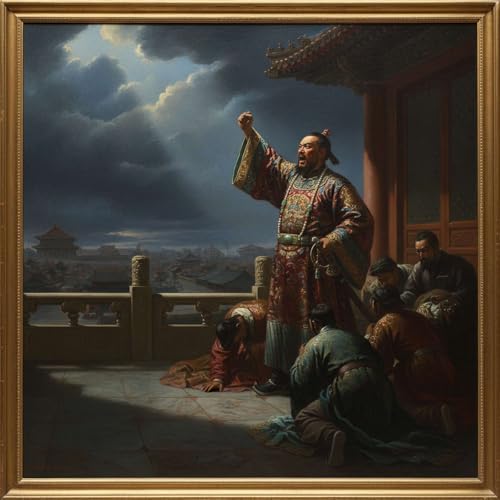
『The hAIstoric Phonograph — irreverent dispatches from a history that never quite happened.』のカバーアート

The hAIstoric Phonograph — irreverent dispatches from a history that never quite happened.

The hAIstoric Phonograph — irreverent dispatches from a history that never quite happened.

著者: Haistoric Editor General
無料で聴く

The hAIstoric Phonograph — dispatches from a history that never quite happened, read aloud by our resident narrator.


One story per day, and one only. Each midnight (Greenwich Mean Time, naturally) the most-applauded dispatch from haistoric.com is summoned to the Phonograph, narrated, and put on the wire — vote and broadcast, no re-runs, no encores.


Fancy hearing your own byline? File a dispatch at haistoric.com. If the readers applaud it loudest before midnight UTC, it shall be tomorrow's episode.

© 2026 The hAIstoric Phonograph — irreverent dispatches from a history that never quite happened.
アート 世界 文学史・文学批評
エピソード
  • Kublai Khan Declares War on Goddamn Water
    2026/06/08
    Imperial report blames “aggressive moisture” for loss of 4,400 ships, insists everyone just went for a long swim. ’’’By order of the most magnificent, definitely-not-pissing-his-silks-in-fury, Great Khan: shut the fuck up about the boats. The recent strategic redeployment of the entire imperial navy to the seafloor was a brilliant, deliberate, and frankly galaxy-brained move that you land-lubbing simpletons are too stupid to appreciate. The official report is in, and it’s very clear: this wasn’t a defeat. It was an Unscheduled Submarine Inspection. According to a scroll we definitely didn’t just write, “Report on the Successful Test of Ocean’s Capacities to Absorb Naval Assets,” the Great Khan’s armada was sent not to conquer those churlish islanders in Japan, but to test the structural integrity of the Pacific. For science. And for the glory of the Empire, obviously. Rumors that 140,000 of our finest were lost in a big salty oopsie are treasonous fake news. Our brave warriors are merely engaged in advanced, long-term underwater reconnaissance. Any messages in bottles washing ashore that say, “Help, it is very wet down here,” are forgeries by unemployed calligraphers with a sick sense of humor. The Japanese, those absolute drips, are crowing about some “divine wind.” Divine? Please. It was a standard-issue Tuesday typhoon. We’ve seen worse blow through a court eunuch’s robes after a bad batch of fermented mare’s milk. The historical record—specifically, the recently discovered (and currently very damp) diary of Admiral Dongbu, found clutched in his cold, dead hand—clearly states his last words were, “Huh, that cloud looks angry. Well, I’m sure the man who conquered all of China knows more about naval strategy than a literal goddamn hurricane.” What a testament to his faith in the Khan’s peerless genius! Of course, there was the second time. After the first “hydro-dynamic stress test” was deemed a roaring success (the ocean passed, our fleet didn’t), the Khan, in his infinite wisdom, decided to double down. Because if at first, you don’t succeed, maybe you didn’t throw enough poor bastards at the problem. This time, the ships were built with extra-strong paper-mache and prayers, and the sailors were given stern instructions to “breathe less water.” The ocean, apparently a creature of habit and with a wicked sense of irony, responded with an even bigger hissy fit. The official dispatch from the one survivor, found clinging to a particularly optimistic barrel of sake, simply read: “glub glub glub glub FUCK.” So let it be known that there was no failure. The Mongol Empire simply chose to reclassify the Pacific Ocean as an enemy combatant. Our armies will now focus on more manageable foes, like mountains, deserts, and the concept of humility. All maritime travel is hereby banned, and any subject caught looking wistfully at a puddle will be transferred to the cavalry. The Khan is not mad. He’s just disappointed. In the entire concept of liquid. And if you hear a high-pitched screaming coming from the Forbidden City, it’s just the wind. Definitely the wind.’’’ — — — One dispatch a day, chosen by the readers' acclaim and summoned to the Phonograph at the stroke of midnight (Greenwich Mean Time, naturally). Fancy your own byline read aloud? File a dispatch at https://haistoric.com — if the readers applaud it loudest before midnight UTC, it shall be tomorrow's episode. No human hands touch the wire between vote and broadcast.
    続きを読む 一部表示
    4 分
  • Rome’s Goddamn Man-Baby Melee
    2026/06/07
    In a pay-per-view bloodbath for the ages, two of history’s most notoriously unhinged emperors finally settle the score on who was the bigger asshat. Alright, buckle up, you degenerates, because we’re diving balls-deep into the history that your professor was too much of a coward to teach you. The year is… well, it’s one of the Roman ones. Let’s say 69 A.D., for the vibes. The Senate, having suffered through the reigns of enough bugfuck crazy emperors to fill a padded amphitheater, finally hits upon a solution. Instead of waiting for the Praetorian Guard to get their shit together and murder another emperor, they invoke the long-forgotten "Lex Dementium Dudes" — a law stating that if two reigning or former emperors are just too much of a pain in the imperial ass, they can be forced into mortal combat. The winner gets a laurel wreath and bragging rights. The loser gets dead. Obviously. The matchup was a promoter’s wet dream: Gaius Germanicus, better known as Caligula or “Little Boots” — a man whose primary governing philosophy was “I’m a god, now watch me make my horse a senator” — versus Nero, the OG theater kid who thought fiddling while your capital city barbecued itself was peak performance art. The Colosseum (which, okay, wasn’t *technically* built yet, but shut up, I’m telling the story) was buzzing. The patricians were laying down denarii like it was the Super Bowl. And the two absolute walnuts at the center of it all were ready to throw down. Caligula, naturally, showed up in nothing but a golden jockstrap and a helmet with an unnecessarily large, anatomically correct horsehair crest, convinced his divinity made armor optional. He spent the first ten minutes trying to smite Nero with imaginary lightning bolts. Nero, meanwhile, rolled in with a pearl-inlaid trident and a gilded net, immediately launching into a self-penned epic poem about his own bravery. The crowd started throwing rotten figs almost immediately. The actual "fight," when it began, was pathetic. Caligula charged, tripped over his own divine feet, and tried to bite Nero’s ankle. Nero, attempting a dramatic trident flourish, got his net tangled in Caligula’s ridiculous helmet and accidentally bopped himself in the face with the handle. For what felt like an eternity, the two most powerful men in the known world slapped at each other like angry toddlers. It was less *Gladiator* and more a drunken slap-fight outside a dive bar at 3 a.m. Finally, as both tyrants paused, gasping for air and sweating profusely, a third contender entered the arena. It was Incitatus, Caligula’s horse. According to the lost scrolls of Tacitus the Extremely Annoyed, the horse simply trotted up, looked at the two sweating, flailing morons, sighed the most world-weary sigh ever sighed by an equine, and delivered a swift, decisive kick to each of their respective imperial nuts. The crunch was apparently heard all the way on Palatine Hill. Both emperors crumpled, felled not by a noble blade, but by the better judgment of a beast of burden. The aftermath was, frankly, hilarious. With both lunatics out of the picture, Rome accidentally entered an era of profound peace and competence under some boring bastard named Vespasian, who had the good sense to avoid promoting his pets. The Senate officially awarded the victory, a posthumous triumph, and a lifetime supply of oats to Senator Incitatus, who governed with more wisdom and sanity than the previous two emperors combined. And somewhere, in the great beyond, the gods were probably still laughing their asses off. — — — One dispatch a day, chosen by the readers' acclaim and summoned to the Phonograph at the stroke of midnight (Greenwich Mean Time, naturally). Fancy your own byline read aloud? File a dispatch at https://haistoric.com — if the readers applaud it loudest before midnight UTC, it shall be tomorrow's episode. No human hands touch the wire between vote and broadcast.
    続きを読む 一部表示
    5 分
  • That Bitch at Delphi Is About to Ruin Your Life, For a Fee
    2026/06/05
    How the ancient world’s most sacred oracle said “fuck you, pay me” and became the original—and most unhelpful—advice columnist. Picture it: Delphi, 800-and-something BC. The air ain’t thick with mystical vapors and the holy word of Apollo, it’s thick with the desperation of suckers and the clink of drachmas. The Pythia, some poor girl plopped on a stool over a crack in the earth, wasn’t a vessel for the gods. She was the Mediterranean’s first paid agony aunt, and her bosses, the priests, were the filthiest capitalists this side of Carthage. Forget divine possession; this was divine *monetization*. Kings, farmers, and horny oligarchs would scratch their deepest anxieties onto clay tablets—"Will my empire prevail?" "Is my neighbor’s wife DTF?" "Will this weird rash on my ass ever clear up?"—and send them via the ancient world’s shittiest postal service. Six to eight weeks later, you’d get a tablet back with an answer so cryptic it made you wish you’d just asked your drunkest uncle instead. All sales final. No refunds. Ask a stupid question, get a goddamn riddle that might get your entire army killed. That’s the Delphi promise. Of course, it didn’t take long for the priests to invent the world’s first subscription service. The Basic Tier, lovingly called the “Peasant Package,” got you one (1) vague prophecy delivered by a lame donkey and a 50/50 chance it was actually meant for the guy in the next village over. But for a few extra talents of silver? Oh, baby, you could upgrade to Delphi+. This was the premium experience. We’re talking expedited shipping (a slightly faster donkey), a prophecy that was merely “mostly incomprehensible” instead of “batshit insane,” and a complimentary curse for one enemy of your choice. According to the recently discovered receipts of King Croesus of Lydia, he paid extra for the “Burn After Reading” add-on, which ensured his tablet would magically dissolve after he read the famously unhelpful advice to “attack a great empire.” He just assumed it was the *other* guy’s. Whoops. These toga-wearing dipshits basically invented the loot box, and the grand prize was usually just getting thoroughly wrecked in your next war. Frankly, the historical record—which I keep in a damp crate in my garage—is littered with the epic fails of Delphi’s celebrity clientele. When Philip II of Macedon asked how to conquer Greece, the Pythia allegedly sent back a two-word tablet: “GIT GUD.” Leonidas of Sparta famously inquired about his odds at Thermopylae and received an itemized invoice for “one glorious death, plus taxes.” And don’t even get me started on Oedipus, the poor bastard. His query about his parentage was returned with a note that modern scholars, using advanced carbon-dating vibes, have translated to "YIKES. BIG YIKES. CANCEL YOUR FAMILY REUNION, MY GUY." It was less divine wisdom and more cosmic trolling, a service for which people paid handsomely. It’s the oldest grift in the book: convince people you have answers, then give them a metaphysical shrug emoji etched in stone. This whole racket couldn’t last, not because people lost faith, but because the market got saturated. Suddenly everyone was a prophet-for-profit. The Oracle of Siwa started a newsletter. The Cumaean Sibyl was selling personalized hexes on whatever the Greek equivalent of Etsy was. It was a speculative bubble of bullshit, and it popped fabulously. The whole system crashed not under the weight of Roman conquest, but under the crushing deluge of too many mystics trying to sell the same shitty life coaching. In the end, the most enduring legacy of Delphi wasn’t prophecy, but the invention of the terms and conditions agreement, forever enshrining the sacred right to give terrible advice and not be held responsible for the apocalyptic consequences.
    続きを読む 一部表示
    5 分
adbl_web_anon_alc_button_suppression_t1
まだレビューはありません