エピソード

  • Helen Zhang on Turning Coffee Waste Into High Value Ingredients!
    2026/09/23

    Coffee manufacturers pay millions to dispose of waste that still holds most of its value. Helen Zhang built a company on that gap. She is CEO and Founder of Coffee Elf Inc., which pulls oil from commercial coffee grounds to make a premium emollient for hair care and skincare, and presses grounds with cork and peanut shell into vegan leather for promotional merchandise. Helen traces the path from a kitchen project at Columbia that nearly set off her neighbors' smoke complaints to early commercial partners, and to donating profit back to nonprofits serving women coffee farmers in Kenya, Ethiopia and Colombia.


    Chapters:

    00:00 Welcome to Green Shoots and Big Shifts

    00:54 Meet Helen Zhang and what Coffee Elf does

    01:43 The kitchen project that nearly burned down an apartment

    03:16 Discovering coffee's hidden chemical value

    03:47 Coffee waste as a commercial problem

    04:54 Growing up in an entrepreneurial family

    07:16 The bigger vision: a waste to value engine

    09:37 Inside the product line: emollient and vegan leather

    12:08 Replacing palm oil with coffee oil

    13:16 Giving back to women coffee farmers

    17:00 Material innovation beyond plastic

    18:38 Safety, silicones and clean beauty

    20:35 Milestones ahead: hair care and the ASI supply chain

    22:00 How to partner with Coffee Elf

    24:24 Sustainability and profitability together

    28:22 Advice for founders building in this field

    30:46 One word to leave listeners with


    Learn more about Coffee Elf Inc.:

    Website - https://thecoffeeelf.com


    Follow the host, Reetu Gupta here:

    LinkedIn - https://www.linkedin.com/in/guptareetu/

    続きを読む 一部表示
    32 分
  • Efficiency First: How Weber State University Cuts Carbon and Costs -- Justin Owen
    2026/09/16

    Weber State University set a carbon neutral target of 2040 and has spent 15 years working toward it with efficiency, electrification, and renewable sourcing. Justin Owen, Director of Utilities and Sustainability at Weber State University, walks through the specifics: half the campus electrified, two and a half megawatts of solar, ground source wells under parking lots, and a revolving loan fund now generating around $3 million in cost reduction. He is a Weber State alum who started as an hourly student worker, and he explains why housing sustainability inside facilities changed what the team could get done.


    Chapters:

    00:03 Welcome to Green Shoots and Big Shifts

    00:54 Weber State's carbon neutral goal for 2040

    01:40 Campus size and location in Ogden, Utah

    01:55 Justin's path from pre med to sustainability

    03:20 Early adopters: the 2007 climate commitment

    04:31 The president signs on, facilities figures it out

    05:14 Measuring the baseline and finding low hanging fruit

    05:57 The central heating problem and electrification

    07:26 How ground source fields work at Weber State

    08:58 Life cycle, learning environment, and per room thermostats

    11:15 Win wins: comfort, cost, and getting occupants on board

    11:56 The internal revolving loan fund

    13:27 Producing two thirds of campus electricity and avoiding easy undos

    14:55 Efficiency first, then electrification, then renewables

    16:29 Getting stakeholders and finance on board

    17:53 Sustainability housed inside facilities management

    21:24 Students and interns in sustainability work

    23:31 Rescuing leftover food and campus engagement

    24:15 What's next: onsite battery storage and a campus microgrid

    25:36 Focus and avoiding distraction in sustainability programs

    26:19 One word: hope

    27:05 A investment problem, not a technology problem


    You can follow Justin Owen here:

    LinkedIn - https://linkedin.com/in/justinrowen


    Learn more about Weber State University:

    Website - https://weber.edu


    Follow the Green Shoots & Big Shifts Podcast here: https://www.linkedin.com/company/green-shoots-big-shifts/

    続きを読む 一部表示
    28 分
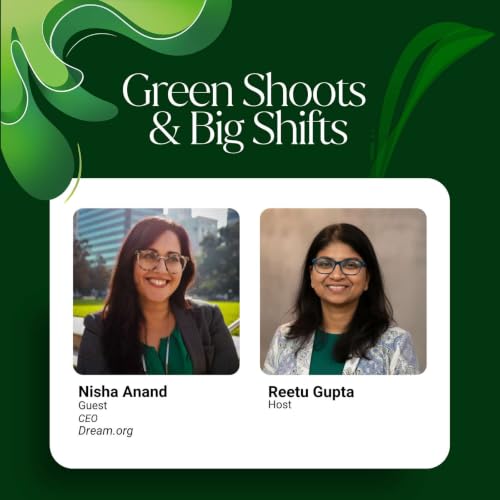
  • Green Jobs, Second Chances, and Policy - Nisha Anand, Dream.org
    2026/09/09

    Nisha Anand, CEO of Dream.org, ran the playbook to help pass a legislation, which has seen 60,000 people return from prison. She grew up as the daughter of Indian immigrant parents in Atlanta, learned to be the bridge early, and now builds tables wide enough to make change that lasts.


    Nisha explains:

    • Growing up a self-described misfit in Atlanta and turning bridge building into a career
    • Why durable policy comes from including the most excluded voices, not checking a box
    • How the First Step Act brought 60,000 people home from prison
    • Green for All's origin: Van Jones training Oakland youth to install solar panels
    • Solving poverty and pollution at the same time instead of one at a time
    • The Green Reentry cohort, training people coming home from prison for green jobs
    • Working with unlikely allies, from libertarians to military bases facing rising water
    • Common values under criminal justice reform: second chances, dignity, shrinking a bloated system
    • Making nuance cool again and practicing self-curiosity while doom scrolling
    • Connecting siloed solutions from conferences into full city-wide plans
    • What gives her hope: her kids, the next generation, and science that is bigger than us

    00:00 Welcome to Green Shoots and Big Shifts

    00:44 Introducing Nisha Anand, CEO of dream.org

    01:21 From Atlanta misfit to activist and bridge builder

    02:52 Justice at scale: legislation and the First Step Act

    03:51 Building a big table and why it makes policy durable

    04:41 Beyond tokenism: inviting the blind spots you cannot see

    06:16 Green for All's origins with Van Jones and Oakland solar

    07:47 Green infrastructure, reentry, and green jobs today

    10:03 Equity as the door that opens for everyone

    11:57 Practices and challenges of building broad coalitions

    15:56 Common values behind unlikely allies

    17:36 Making nuance cool again and modeling curiosity

    19:00 Self-curiosity: asking why you react the way you do

    21:33 What the podcast reveals: hope in science and startups

    23:00 Connecting the dots across silos and conferences

    25:28 What keeps Nisha going: her kids and the next generation

    28:00 One word to leave with: perseverance


    Learn more about dream.org:

    Website - https://dreamcorps.us

    続きを読む 一部表示
    28 分
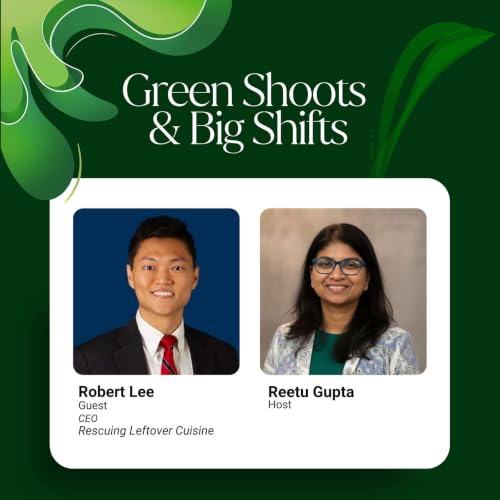
  • 40% of Our Food Is Wasted! -- Robert Lee, Rescuing Leftover Cuisine
    2026/09/02

    Forty percent of the food produced in the United States gets thrown out, and the nutrition in a third of that waste is enough to end food insecurity. Robert Lee, founder of Rescuing Leftover Cuisine, left a finance job at JP Morgan to close that gap. He grew up as the second son of Korean American parents who struggled with food access, joined a student club at NYU that carried leftover dining hall food to shelters, and built that idea into an organization now rescuing food across all 50 states.


    Chapters:

    00:00 Welcome and show intro

    01:00 Robert's journey and what inspired RLC

    02:46 What Rescuing Leftover Cuisine does

    03:33 Scaling carefully and sustainable growth

    06:03 Where RLC operates today

    07:00 The scale of food waste

    08:33 A food rescue story that stuck

    10:02 How to donate food and how pickup works

    10:58 Partners, shelters, and a school program

    12:33 Launching the Every Bite app in Boston

    13:33 What's next and making food rescue the standard

    15:35 Advice for starting small and taking action

    17:53 How Robert thinks about impact

    19:53 One word to leave listeners with


    Learn more about Rescuing Leftover Cuisine:

    - Website - https://rescuingleftovercuisine.org

    - Download the Evrybite App: https://www.evrybite.com/download-evrybite


    続きを読む 一部表示
    21 分
  • Can Data Drive Impact? Insights from Nelli Garton of Tablecloth.io
    2026/08/26
    In this episode of *Green Shoots & Big Shifts*, host Reetu Gupta welcomes Nelli Garton, the founder of Tablecloth.io, to discuss the transformative power of data in driving sustainability efforts. Nelli shares her inspiring journey from the world of philanthropy and academia to launching a company dedicated to helping organizations effectively measure and understand their impact. With nearly a decade of experience, she highlights the evolution of her mission and the importance of making data-driven decisions in both non-profit and private equity sectors. The conversation delves into the challenges and surprises of pivoting from a philanthropic focus to working with private equity, emphasizing the need for organizations to integrate sustainability into their core values. Nelli also explores the role of Artificial Intelligence in sustainability and the critical importance of building trust within organizations as they navigate these changes. The episode wraps up with a powerful message about the collective responsibility we share in shaping a sustainable future, urging listeners to embrace the possibilities that lie ahead.
    • (00:00) - - Intro to Green Shoots & Big Shifts
    • (01:23) - - Welcome to Nelli Garton
    • (02:45) - - Nelli's Journey in Sustainability
    • (06:12) - - Transition to Private Equity Focus
    • (10:15) - - Data-Driven Decision Making
    • (14:40) - - Working with Clients and Projects
    • (18:30) - - Connecting Data to Sustainability
    • (24:05) - - Long-Term Client Relationships
    • (28:40) - - The Role of AI in Sustainability
    • (32:15) - - Challenges and Opportunities with AI
    • (37:10) - - Exciting Future for Sustainability
    • (41:30) - - Activating Change in Communities
    • (45:00) - - Closing Thoughts on Possibility
    • (46:15) - - Thank You and Farewell
    sustainability, data, impact investing, ESG, climate change, private equity, decision making, AI, community development, transformation
    続きを読む 一部表示
    31 分
  • The Future of Carbon Fiber: Turning CO2 waste into Gold - Aaron Fitzgerald
    2026/08/19

    In this episode of Green Shoots & Big Shifts, host Reetu Gupta sits down with Aaron Fitzgerald, the founder of Mars Materials, Inc. PBC, to discuss innovative approaches to sustainability and climate change. Mars Materials is pioneering a transformative method of producing carbon fiber and water treatment chemicals from waste materials (i.e. carbon dioxide), instead of traditional fossil fuels. This not only creates valuable materials but also serves as an effective means of carbon sequestration, addressing both environmental concerns and market demands.

    Aaron shares his inspiring journey from working on Capitol Hill to becoming a serial entrepreneur focused on carbon dioxide removal. He discusses the challenges and triumphs of building a startup in the climate tech space, emphasizing the importance of resilience, community, and the need for market-based solutions to combat climate change. The conversation highlights the growing demand for sustainable materials and how Mars Materials is positioned to meet that demand while making a significant impact on the environment.

    • (00:00) - - Introduction to the Podcast
    • (01:30) - - Welcoming Aaron Fitzgerald
    • (02:15) - - Overview of Mars Materials
    • (04:45) - - Motivation Behind Mars Materials
    • (07:30) - - Technology Insights: Carbon Fiber Production
    • (10:15) - - The Role of Acrylonitrile in Production
    • (12:00) - - Environmental Concerns with Traditional Processes
    • (14:30) - - Rising Demand for Carbon Fiber
    • (17:00) - - Aaron's Journey as a Founder
    • (20:00) - - Lessons from Previous Startups
    • (24:00) - - Impact of Personal History on Career
    • (27:30) - - Key Pivotal Moments in Entrepreneurship
    • (31:00) - - Exciting Future Projects for Mars Materials
    • (35:15) - - Funding and Support for Mars Materials
    • (38:00) - - Commercialization and Market Validation
    • (41:00) - - Diverse Applications of Products
    • (44:00) - - Collaboration Across Geographies
    • (47:30) - - The Importance of Subsidies in Climate Tech
    • (50:00) - - Final Thoughts: Optimism in the Climate Space
    • (52:30) - - Closing Remarks and Thank You
    • (00:00) - - Introduction to the Podcast
    • (01:30) - - Welcoming Aaron Fitzgerald
    • (02:15) - - Overview of Mars Materials
    • (04:45) - - Motivation Behind Mars Materials
    • (07:30) - - Technology Insights: Carbon Fiber Production
    • (10:15) - - The Role of Acrylonitrile in Production
    • (12:00) - - Environmental Concerns with Traditional Processes
    • (14:30) - - Rising Demand for Carbon Fiber
    • (17:00) - - Aaron's Journey as a Founder
    • (20:00) - - Lessons from Previous Startups
    • (24:00) - - Impact of Personal History on Career
    • (27:30) - - Key Pivotal Moments in Entrepreneurship
    • (31:00) - - Exciting Future Projects for Mars Materials
    • (35:15) - - Funding and Support for Mars Materials
    • (38:00) - - Commercialization and Market Validation
    • (41:00) - - Diverse Applications of Products
    • (44:00) - - Collaboration Across Geographies
    • (47:30) - - The Importance of Subsidies in Climate Tech
    • (50:00) - - Final Thoughts: Optimism in the Climate Space
    • (52:30) - - Closing Remarks and Thank You
    sustainability, carbon fiber, innovation, climate change, entrepreneurship, waste-to-product, polyacrylamide, carbon dioxide removal, market demand, resilience
    続きを読む 一部表示
    30 分
  • Nature as a Valued Asset Driving GDP? Insights from Jeremy McKane of OCN.ai
    2026/08/12

    In this episode of *Green Shoots & Big Shifts*, host Reetu Gupta sits down with Jeremy McKane, the CEO of Ocean Currency Network (OCN.ai), a pioneering organization focused on marine conservation and the economic valuation of our oceans. Jeremy shares his inspiring journey from artist to entrepreneur, illustrating how his passion for the ocean evolved into a mission to protect 30% of the world's oceans by 2030. Through innovative approaches to ocean conservation, he emphasizes the need for a collective effort—what he calls a "Justice League"—to safeguard this vital ecosystem.

    The conversation delves into the alarming statistic that only about 2.7% of the oceans are fully protected, highlighting the disconnect between policy and enforcement. Jeremy discusses the importance of recognizing the ocean's inherent value, not just as a resource, but as a critical component of our planet's health and our survival. With fascinating anecdotes and actionable insights, this episode serves as a call to action for listeners to rethink their relationship with the ocean and embrace a more sustainable future.

    • (00:00) - - Introduction to the Podcast
    • (01:30) - - Meet Jeremy McKane
    • (02:45) - - Ocean Conservation Goals Explained
    • (05:10) - - The Value of a Healthy Ocean
    • (08:00) - - Jeremy’s Artistic Journey
    • (10:15) - - Importance of Marine Protected Areas
    • (12:30) - - Understanding "Paper Parks"
    • (15:00) - - The Role of Collaboration in Conservation
    • (17:45) - - The Financial Value of Nature
    • (20:30) - - Nature on the Balance Sheet Concept
    • (23:15) - - The Need for Ecosystem Health
    • (26:00) - - The British Virgin Islands Project
    • (28:45) - - Shifts in Financial Perspectives
    • (32:00) - - Community Collaboration for Ocean Protection
    • (35:15) - - The Vision for Future Initiatives
    • (38:30) - - Final Thoughts and Closing Remarks
    • (00:00) - - Introduction to the Podcast
    • (01:30) - - Meet Jeremy McKane
    • (02:45) - - Ocean Conservation Goals Explained
    • (05:10) - - The Value of a Healthy Ocean
    • (08:00) - - Jeremy’s Artistic Journey
    • (10:15) - - Importance of Marine Protected Areas
    • (12:30) - - Understanding "Paper Parks"
    • (15:00) - - The Role of Collaboration in Conservation
    • (17:45) - - The Financial Value of Nature
    • (20:30) - - Nature on the Balance Sheet Concept
    • (23:15) - - The Need for Ecosystem Health
    • (26:00) - - The British Virgin Islands Project
    • (28:45) - - Shifts in Financial Perspectives
    • (32:00) - - Community Collaboration for Ocean Protection
    • (35:15) - - The Vision for Future Initiatives
    • (38:30) - - Final Thoughts and Closing Remarks
    ocean, conservation, sustainability, collaboration, marine protection, Ocean Currency Network, nature valuation, biodiversity, ecosystem, change agents
    続きを読む 一部表示
    31 分
  • Bringing Joy to Sustainable Fashion: Veena Jayadeva, CEO, Kareena's Closet
    2026/08/05

    In this episode of *Green Shoots & Big Shifts*, host Reetu Gupta welcomes Veena Jayadeva, the founder of Kareena's Closet, to discuss her inspiring journey from international development to pioneering a sustainable fashion platform. Veena's deep-rooted commitment to sustainability and women's empowerment shines through as she shares her experiences working with microfinance initiatives aimed at uplifting women across the globe. Her passion for social impact led her to create Kareena's Closet, which offers a peer-to-peer platform for renting and reselling South Asian formal wear, thus addressing the pressing issue of overconsumption in the fashion industry, particularly within the South Asian community.

    Veena elaborates on the cultural pressures surrounding traditional celebrations, where the expectation to wear something new for every occasion has contributed to wasteful consumption. By fostering a community-centered approach, Kareena's Closet not only provides affordable fashion alternatives but also supports local designers and small businesses, creating an ecosystem of sustainability. Throughout their conversation, Reetu and Veena emphasize the importance of redefining fashion choices as an opportunity for joy, creativity, and community connection, rather than mere consumerism.


    Learn more about Kareena's Closet here : https://www.kareenascloset.com/

    • (00:00) - - Introduction to the Podcast
    • (01:15) - - Meet Veena Jayadeva
    • (02:30) - - Veena's Journey in Sustainability
    • (05:45) - - Transition to Entrepreneurship
    • (08:00) - - Introduction to Kareena's Closet
    • (10:00) - - Addressing Overconsumption in Fashion
    • (12:30) - - The Role of Microfinance in Empowering Women
    • (14:45) - - Ecosystem of Women Entrepreneurs
    • (18:00) - - The Importance of Cultural Change
    • (20:15) - - Stories of Joy and Transformation
    • (23:30) - - The Art of Draping Saris
    • (26:15) - - Expanding the Concept of Sustainability
    • (29:00) - - Community Engagement and Education
    • (32:30) - - Future Vision for Kareena's Closet
    • (35:00) - - The Importance of Natural Fabrics
    • (37:00) - - Addressing Textile Waste and Landfills
    • (40:00) - - Final Thoughts on Authenticity and Joy
    • (42:15) - - Closing Remarks and Takeaways
    • (00:00) - - Introduction to the Podcast
    • (01:15) - - Meet Veena Jayadeva
    • (02:30) - - Veena's Journey in Sustainability
    • (05:45) - - Transition to Entrepreneurship
    • (08:00) - - Introduction to Kareena's Closet
    • (10:00) - - Addressing Overconsumption in Fashion
    • (12:30) - - The Role of Microfinance in Empowering Women
    • (14:45) - - Ecosystem of Women Entrepreneurs
    • (18:00) - - The Importance of Cultural Change
    • (20:15) - - Stories of Joy and Transformation
    • (23:30) - - The Art of Draping Saris
    • (26:15) - - Expanding the Concept of Sustainability
    • (29:00) - - Community Engagement and Education
    • (32:30) - - Future Vision for Kareena's Closet
    • (35:00) - - The Importance of Natural Fabrics
    • (37:00) - - Addressing Textile Waste and Landfills
    • (40:00) - - Final Thoughts on Authenticity and Joy
    • (42:15) - - Closing Remarks and Takeaways
    sustainability, microfinance, entrepreneurship, community, fashion, South Asian, rental, resale, ecosystem, social impact
    続きを読む 一部表示
    33 分