『Yoga Teacher Tips: Essential Conversations for Yoga Teachers』のカバーアート

Yoga Teacher Tips: Essential Conversations for Yoga Teachers

Yoga Teacher Tips: Essential Conversations for Yoga Teachers

著者: Monica Bright Yoga Teacher Trainer
無料で聴く

【Amazonプライム会員限定】今ならプレミアムプランが4か月 月額99円。

10月19日まで。※適用条件あり

Your podcasting resource for answering the questions you have about teaching, offering inspiration for you to question more of what you've been taught, and pushing you to lean into your continuing education.


Each week, I bring you the questions and concerns that live just beneath the surface of your teaching, along with real answers, tools, and strategies you can use in your very next class.


This is not a typical yoga teacher podcast.


I teach science-backed, currently researched strategies drawn from years of continuing education, and I will invite you to question some of what you were taught.


Whether you are a new teacher looking for support or you've been teaching for years, but you still have questions, you're in the perfect place!


About the host: I'm Monica, I've been in the yoga world since 1993 and teaching for more than 14 years, with over 2000 hours of training focused exactly where teachers need it: anatomy, sequencing, injuries, pain science, the nervous system, and the movement modalities that support them. Before yoga, I spent my career in education, traveling the country mentoring school teachers in Illinois, Florida, Texas, and New Jersey, and that background shapes how I teach teachers now. I've also worked through my own injuries from my practice, and collaborate with Physical Therapists, which is a large part of why I do this work. Today I teach students and private clients who are living with pain, I lead corporate classes tailored to specific populations, and I founded the Teaching Students with Injuries mentorship, where teachers learn to serve the students who need them most and are already coming to their classes.


Subscribe and I'll share the experiences, the best tips, the strategies that work for teaching the actual students who come to your classes.


This podcast is for you if you find yourself asking questions like:


Why is sequencing important in yoga?
How does my sequencing affect the students in my classes?
How can I use props intelligently to enhance my student's practice?
Can I incorporate different movement modalities into my classes, and why would I want to?


How important is it to learn and understand anatomy and human movement?
Why is it important to learn about anatomy and physiology?
What are the benefits of studying human anatomy?
How do I remember anatomy without memorizing every muscle?
How do I explain anatomy to students without sounding clinical?
What's the fastest way to learn what I missed in my 200 hour training?


Why should I understand my student's experience when they have pain and injuries?
Can I have a positive effect on a student who is in chronic pain, and how?
How do nervous system states appear in my students, and what should I understand beyond the sympathetic and parasympathetic states?
How do I regulate nervous systems?
Can trauma cause chronic physical pain?
How does trauma affect students in yoga?


What do I do when a student says their wrists hurt in yoga?
Should students with shoulder pain do chaturanga?
Is pigeon pose bad for the hips?
What poses should I avoid with sciatica?
How do I know if it's SI joint pain or something else?
Is my student's back pain from a disc issue, and does that matter in class?
What's the difference between a strain, a sprain, and a tear?


Is teaching students with injuries outside my scope of practice?
What can I legally say to a student about their injury?
When should I refer a student to a physical therapist?
How do I work with a student's physical therapist?
Do I need special insurance or a waiver to teach injured students?


Host name: Monica Bright, M.Ed., E-RYT - 2000hrs

© 2026 Yoga Teacher Tips: Essential Conversations for Yoga Teachers
エクササイズ・フィットネス フィットネス・食生活・栄養 マネジメント・リーダーシップ リーダーシップ 経済学 衛生・健康的な生活
エピソード
  • Ep 143: Interoception: Teaching Students How to Feel What's Happening Inside
    2026/09/21

    Interoception is the sense of the internal state of the body: your heartbeat, breath, hunger, temperature, muscular effort, tension, and pain. It sits alongside exteroception, our perception of the outside world, and proprioception, our sense of where the body is in space. Every person has a different level of interoceptive awareness, and the good news is, it is a trainable skill. A yoga class is one of the best environments there is for developing it. This episode defines interoception clearly, explains why it matters especially for students managing pain or injury, and gives you specific, usable strategies for building it into any of your classes.

    • Why Interoception Matters
    • Five Ways to Teach Interoception
    • Questions for Teachers to Consider
    1. How much time do I actually leave for students to notice anything?
    2. Am I being specific about what to notice?
    3. Does my language invite curiosity or evaluation?
    4. Have I told students that not noticing much is okay?
    5. And how confident do I feel when a student tells me what they noticed?

    Your Scope of Practice

    Yoga Journal article: Yoga Teachers, Here's How to Support Students With Injuries Without Giving Medical Advice

    Teaching interoception often leads students to disclose more about what they are experiencing, which can raise questions about where a teacher's role ends. My article in Yoga Journal addresses this directly.

    Click HERE to send me a text & let me know your thoughts on this episode!

    Support the show

    Let's connect:

    • Check out my website: Enhanced Body
    • Connect with me on Instagram & Threads @monicacbright
    • Wanna work together? Book a Discovery Call
    • YouTube: Yoga with Monica Bright
    • Join my Newsletter for teachers below!

    Want me to discuss a topic? Click HERE to submit it!

    Become a supporter of the Essential Conversations for Yoga Teachers Podcast! Starting at $3/ month.

    続きを読む 一部表示
    22 分
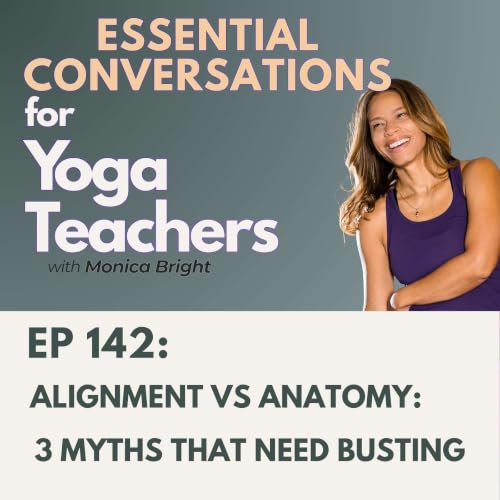
  • Ep 142: Alignment vs Anatomy: 3 Myths That Need Busting
    2026/09/14

    When we were taught to cue a movement or a yoga asana, we were led to believe that every student could perform it with enough effort or practice. But sometimes a student cannot do what is being cued, not because of a lack of flexibility or effort, but because their skeletal anatomy does not allow for it. This episode busts three common anatomy myths that shape the way we cue, covering the knee, the ankle, and the hip, so that you can cue and visualize the various skeletal differentiations in mind rather than an idealized generic body type.

    Listen as I cover:

    • Alignment vs Anatomy
    • Myth One: The Knee Being Only a Hinge Joint
    • Myth Two: Ankle Positioning vs Ankle Range of Motion in Standing Poses
    • Myth Three: Every Student's Hip Can Achieve the Same Range and Movement

    When you teach as if everyone shares the same anatomy, it sets some students up to fail at something never possible for their skeleton. Understanding anatomy allows you to work with (and teach) the real bodies in front of you.

    Related Episode

    Ep 134: How A Student's Neutral Alignment Should Affect the Cues You Use

    Coming Soon: Anatomy Refresh Mini Course

    Across these anatomy-focused episodes, one thing keeps coming up: teachers are hungry for a real anatomy foundation that most trainings never provided. That's why I'm creating the Anatomy Refresh mini course, a low-cost, approachable way to strengthen your understanding of the structures that matter most in your teaching, so everything discussed on the podcast clicks into place, and you can cue with confidence. More details coming soon.

    Free Resource

    Sequencing for Students with Injuries

    If you want help building classes that develop strength and functional capacity safely, especially for students with injuries or limitations, download the free Sequencing for Students with Injuries guide.

    Click HERE to send me a text & let me know your thoughts on this episode!

    Support the show

    Let's connect:

    • Check out my website: Enhanced Body
    • Connect with me on Instagram & Threads @monicacbright
    • Wanna work together? Book a Discovery Call
    • YouTube: Yoga with Monica Bright
    • Join my Newsletter for teachers below!

    Want me to discuss a topic? Click HERE to submit it!

    Become a supporter of the Essential Conversations for Yoga Teachers Podcast! Starting at $3/ month.

    続きを読む 一部表示
    25 分
  • Ep 141: Movement Skill: Falls, Injuries, and How You Can Help
    2026/09/07

    There is a reason the social media challenge around sitting down and standing up from the floor without using your hands has caught on: the ability to get up and down from the floor is one of the most protective, trainable skills a person can maintain as they age. In this episode, I will cover the sobering statistics on falls among older adults, why falls so often become life-threatening, the research behind the sitting-rising test, and concrete, non-fear-based ways yoga teachers can weave this vital skill into classes for students of every age.

    This is a personal story for me, as my mother and grandmother both suffered from the effects of falling. It initiated my curiosity and started my research on why falling can be so catastrophic and life-altering.

    • Why Understanding This Matters
    • The Research and the Sitting-Rising Test
    • How to Talk About The Skill Without Inducing Fear
    • Five Ways to Weave It Into Your Teaching

    Free Resource

    Sequencing for Students with Injuries

    If you want help building classes that develop strength and functional capacity safely, especially for students with injuries or limitations, download the free Sequencing for Students with Injuries guide.

    Journal Article:

    Sitting-Rising Test Predicts Long-Term Mortality Risk

    A 12-year study of over 4,000 adults found that poor performance on a basic sitting and rising test was strongly linked to increased risk of death from natural and cardiovascular causes.

    Source: European Journal of Preventive Cardiology

    Click HERE to send me a text & let me know your thoughts on this episode!

    Support the show

    Let's connect:

    • Check out my website: Enhanced Body
    • Connect with me on Instagram & Threads @monicacbright
    • Wanna work together? Book a Discovery Call
    • YouTube: Yoga with Monica Bright
    • Join my Newsletter for teachers below!

    Want me to discuss a topic? Click HERE to submit it!

    Become a supporter of the Essential Conversations for Yoga Teachers Podcast! Starting at $3/ month.

    続きを読む 一部表示
    23 分
adbl_web_anon_alc_button_suppression_t1
まだレビューはありません