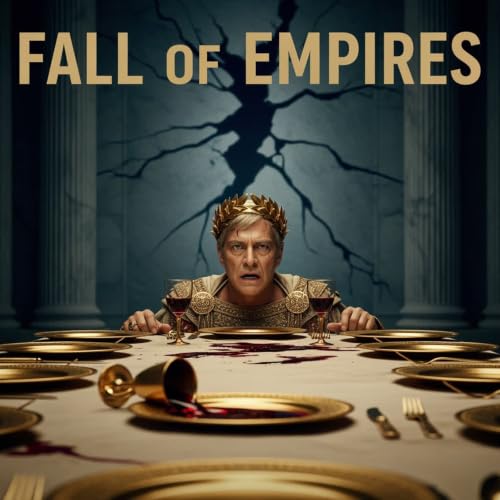
『Empires - The Fall』のカバーアート

Empires - The Fall

Empires - The Fall

著者: OBOMEDIA ENTERTAINMENT
無料で聴く

Empires do not fall in a day, but there is always a day when the fall begins. A border garrison that goes unpaid, an heir who dies too soon, a rumor in the capital that turns into a mob. This show tells the true stories of how empires collapse, one at a time.

Each episode reconstructs one imperial collapse in full, cinematic detail: the empire at its height, the crack nobody took seriously, the decisions that widened it, and the final days when the center could no longer hold. No host chatting between clips, no panel debating theories. Just one complete story, narrated start to finish, built from chronicles, administrative records, and the accounts of the people who watched their world end.

You will walk through empires that rotted from the treasury outward, dynasties that survived invasions but not their own families, and capitals that went from the center of the world to ruins within a generation. Some episodes follow a single catastrophic year; others trace a century of slow unraveling to the moment it became unstoppable. All of them treat fallen empires as what they really are: warnings written in stone.

If you are drawn to the history of empires told like a slow-burning thriller, this is built for you. New episodes drop regularly, each one a self-contained collapse worth understanding. Subscribe now so the next of the fallen empires lands the moment it goes live.Copyright OBOMEDIA ENTERTAINMENT
世界
エピソード
  • The Montana clause that forced a state to face its future
    2026/09/02
    Young Montanans sued their state over a 1972 constitutional promise. What will a courtroom do with climate science and that phrase?

    The Montana clause that forced a state to face its future

    In this episode, we follow the legal and scientific path that brought climate accountability into a Montana courtroom. The story traces how decades-old science, constitutional language from 1972, and a new litigation strategy converged - and asks whether courts can close the gap between knowledge and legal duty.

    Person: Plaintiffs - sixteen young people, youngest two years old when case filed
    Date: Case filed March 2020; documents entered May 9, 2023
    Location: Montana, United States; related precedent in the Netherlands
    Constitutional text: Article II, Section 3 - duty to maintain and improve a clean and healthful environment for present and future generations
    Precedent: Urgenda (Netherlands) - courts enforcing treaty obligations against government emissions shortfalls

    - Lawyers shifted strategy from seeking new laws to enforcing existing constitutional and human-rights provisions.
    - Urgenda showed courts could convert scientific consensus into enforceable legal duties without new legislation.
    - Montana’s Article II, Section 3 explicitly mentions protection for "present and future generations" and had never been used in climate litigation before.
    - Sixteen youths framed their claim around specific state policies, notably a provision barring agencies from considering greenhouse gas impacts.
    - Internal corporate science, uncovered in unrelated cases, demonstrated industry knowledge of climate risks decades earlier and reshaped courtroom narratives.

    To listen to this podcast ad-free and access premium episodes, try our subscription with a 14-day free trial at obomedia.com.

    © 2026 OBOMEDIA. All rights reserved.
    This episode and its content (audio, text, and related materials) are the exclusive property of OBOMEDIA and are protected by applicable copyright laws. Reproduction, distribution, editing, or commercial use, in whole or in part, without prior written permission from OBOMEDIA is prohibited. For permissions, licensing, and business inquiries: business@obomedia.com.
    続きを読む 一部表示
    14 分
  • The coins Ismail struck that morning never proved he was divine
    2026/09/02
    A teenage fugitive in Tabriz strikes coins in his name-can a Sufi brotherhood become an empire without collapsing?

    The coins Ismail struck that morning never proved he was divine

    In this episode, we follow how a small Sufi lodge in Ardabil transformed over two centuries into a state when a teenage Ismail seized Tabriz in 1501. We trace the decisions, marriages, alliances and bloodshed that pushed the Safaviyya from prayer circles to kingship and ask what risks their religious claims created for the new polity.

    Person: Ismail
    Date: Summer of 1501
    Location: Tabriz
    Origin: Ardabil Sufi lodge (Safaviyya)
    Followers: Qizilbash (Oghuz Turkic clans)

    - A Sufi brotherhood founded in Ardabil gradually expanded across Iran, Syria and Asia Minor over roughly 150-200 years.
    - Leadership passed through marriage and spiritual succession from Zahed Gilani to Safi al-Din Ardabili, reshaping the order’s identity.
    - Shaykh Junayd shifted the order from quiet mysticism to territorial ambition, provoking expulsion and military alliances.
    - Strategic marriages linked the Safavids to Turkomans and Byzantine-descended nobility, entwining spiritual authority with regional power.
    - By 1501 a teenage Ismail, hidden since childhood and hailed as divine by his Qizilbash, entered Tabriz, minted coins in his name, and declared a state religion.

    To listen to this podcast ad-free and access premium episodes, try our subscription with a 14-day free trial at obomedia.com.

    © 2026 OBOMEDIA. All rights reserved.
    This episode and its content (audio, text, and related materials) are the exclusive property of OBOMEDIA and are protected by applicable copyright laws. Reproduction, distribution, editing, or commercial use, in whole or in part, without prior written permission from OBOMEDIA is prohibited. For permissions, licensing, and business inquiries: business@obomedia.com.
    続きを読む 一部表示
    20 分
  • The editor's 1883 name change erased Kubrat's Byzantine childhood
    2026/09/02
    A medieval Bulgar confederation collapses and five sons scatter across Eurasia - one group's steppe burial rites turn up in 7th‑century Italy.

    The editor's 1883 name change erased Kubrat's Byzantine childhood

    In this episode we follow archaeological and textual clues that trace a 7th‑century Bulgar world from the Pontic steppe to the Italian Apennines. We revisit the sources and a single 1883 editorial change that reshaped Kubrat’s recorded childhood - what does the record really support about his ties to Byzantium?

    Person: Kubrat
    Event: collapse of Old Great Bulgaria and dispersal of his sons
    Location: Vicenne‑Campochiaro, Molise, Italy; Mala Pereshchepina, Ukraine; Phanagoria (presumed)
    Date: circa 630-668 CE
    Author: Hermann Zotenberg (editorial change in 1883)

    - Excavations at Vicenne‑Campochiaro revealed 130 burials including thirteen horse interments following steppe nomadic rites.
    - Grave goods at Mala Pereshchepina (found 1912) included gold, silver, and seals identifying a nomad king consistent with Kubrat.
    - Old Great Bulgaria was a confederation formed c.630-635 by uniting Onogur Bulgars, Kutrigurs, and Utigurs under Kubrat.
    - Byzantine Emperor Heraclius granted Kubrat an honorary patrician title, acknowledging a new power on the northern frontier.
    - In 1883 Hermann Zotenberg altered the name Qetrades to Kubrat in John of Nikiu’s text, the lone basis for the story of Kubrat’s Byzantine upbringing.

    To listen to this podcast ad-free and access premium episodes, try our subscription with a 14-day free trial at obomedia.com.

    © 2026 OBOMEDIA. All rights reserved.
    This episode and its content (audio, text, and related materials) are the exclusive property of OBOMEDIA and are protected by applicable copyright laws. Reproduction, distribution, editing, or commercial use, in whole or in part, without prior written permission from OBOMEDIA is prohibited. For permissions, licensing, and business inquiries: business@obomedia.com.
    続きを読む 一部表示
    19 分
adbl_web_anon_alc_button_suppression_t1
まだレビューはありません