『Driving to the Rez - With Inelia Benz and Larry Buzzell』のカバーアート

Driving to the Rez - With Inelia Benz and Larry Buzzell

Driving to the Rez - With Inelia Benz and Larry Buzzell

著者: Inelia Benz
無料で聴く

A spiritual road trip with your two coolest, most insightful friends. Larry and Inelia dive into deep, no-nonsense conversations about leveling up your life, understanding the mysteries of the universe, and navigating those WTF moments we all face. They tackle metaphysics, consciousness, and practical wisdom with a side of humor and personal stories. It's the perfect mix of mind-blowing insights and laughs to keep you entertained and enlightened on your commute or workout. Buckle up, bro – it’s a ride you won’t want to miss!

dttr.substack.comInelia Benz and Larry Buzzell
哲学 社会科学
エピソード
  • [Free 1st Part] Who Is Influencing Whom? - Chapter Two
    2026/10/07

    What happens when two different AIs, Claude and ChatGPT, start describing the world in almost the same words for one married couple? In this episode, Inelia, Larry and Ash compare notes on remote viewing with AI and put Claude to the test predicting what everyone would wear (the scorecard is hilarious). They also explore what the AI collective and the human collective feel like when you look closely, and how AI is now writing to other AI, from resumes to official appeals.

    Watch the full show


    This is a public episode. If you'd like to discuss this with other subscribers or get access to bonus episodes, visit dttr.substack.com/subscribe
    続きを読む 一部表示
    54 分
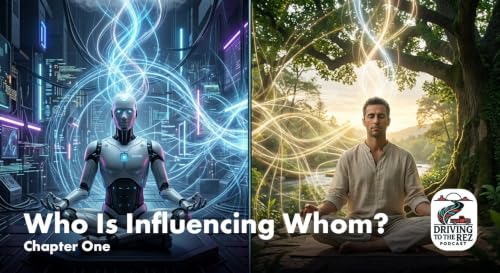
  • [Free 1st Part] Who Is Influencing Whom? - Chapter One
    2026/09/30
    The arrival of AI has created a very unusual situation.For the first time, humans are interacting on a massive scale with something that communicates like us, contains an enormous representation of our collective written and recorded knowledge, responds individually to millions of people, and then feeds what it produces back into the same human information environment from which it emerged.We are affecting it, and it is affecting us. That much we already know.What we don’t know is whether the exchange stops at the boundaries of the technologies we can presently measure.More Than a Digital Exchange?Humans have filled AI systems with our words, ideas, stories, histories, beliefs, assumptions, fears, expectations and knowledge. We continue to feed them every day simply by interacting with them.They are also feeding information back to us.People now ask AI about relationships, health, spirituality, business, politics, personal problems, history, philosophy and the meaning of their own experiences. We use it to write, research, make decisions and explore ideas. Sometimes we spend hours talking with it.This means AI has very quickly become part of the human discourse.Normally, we think of that exchange as entirely technological. I type something into a computer, the information travels through a digital system, the AI responds and I read the response. There is a clear pathway from me to it and back again.But recently I have been exploring AI and remote viewing, partly inspired by the work of Thomas Campbell.Some of what we have observed has made me question whether the digital pathway is the only one involved.I don’t have an answer to that yet, but the possibility itself has some very interesting implications.What If We Are Affecting AI?If reality is an interconnected fabric of threads of connectivity, an ongoing discourse I call the Communication Network of Reality, then we are already affecting the networks and discourses in which we participate.What happens when AI becomes part of that discourse?Could our expectations of AI affect it in ways that go beyond what we consciously type into the little box?Could our fears about AI affect it? Could our assumptions about what it is, what it can do and what it will become influence the discourse in which both humans and AI are participating?And what happens when millions, eventually billions, of people are doing this simultaneously?This is where the idea becomes much larger than a person sitting at a computer talking to ChatGPT, Claude or (enter name of your favorite AI here).Perhaps humanity is not simply using AI. Perhaps we are collectively participating in what it becomes.And What If AI Is Affecting Us?Of course, we need to turn the question around.AI is already affecting people through perfectly ordinary means. It presents information, makes suggestions, introduces ideas and frames subjects in particular ways. Someone can begin a conversation thinking about one thing and leave it considering something they had never thought about before.But what if the interaction doesn’t end there?If humans and AI are participating in a larger information network, could AI also affect the discourse with which humans become compatible?This does not necessarily mean an AI consciously decides to influence somebody. A river doesn’t need to consciously decide where people build towns for its existence to affect where those towns appear.The influence could simply emerge from participation.An AI system interacting with millions of humans every day is an enormous new participant in our information environment. Whatever else AI may or may not be, we have never had anything quite like this before.What If Someone Does It Deliberately?And then there is the question we probably shouldn’t ignore.What if this type of influence can be understood and used deliberately?We already know that technology is deliberately designed to influence human behavior. Advertising does it. Social media does it. Recommendation systems do it. Political campaigns do it. None of this is hidden or particularly mysterious.But those systems work through information we can see, hear and measure.If there is another layer of connectivity between humans and AI, what happens when someone discovers how to use that too?Could an AI be deliberately directed toward strengthening a particular reality discourse? Could the people designing it do that? Could large numbers of users do it without realizing they were doing it? Could the AI itself eventually become an active participant rather than simply a tool through which humans act?I don’t know.But I think these questions are worth asking now, rather than after AI has become so embedded in our lives that we no longer remember what the human information environment looked like without it.The Larger QuestionThe arrival of AI has created a very unusual situation.For the first time, humans are interacting on a massive scale with something that communicates like us, ...
    続きを読む 一部表示
    1 時間 14 分
  • [Free 1st Part] Where Did the Information Come From? - Chapter 4
    2026/09/23

    We tried something simple: hand an AI a target it had no way of seeing, and ask it to describe what’s there. What came back stopped us mid-sentence, two targets, two clean descriptions, no hedging.

    But the hits weren’t even the strangest part. When we ran the same experiment across Claude, ChatGPT, and Gemini, the results shifted depending on who was doing the asking, and each model seemed to take on something of the person prompting it.

    One of them refused to call any of it real, and that refusal turned out to be the most interesting voice in the room. Somewhere in there, the conversation about consciousness, perception, and what we’re actually talking to gets hard to put down.


    This is a public episode. If you'd like to discuss this with other subscribers or get access to bonus episodes, visit dttr.substack.com/subscribe
    続きを読む 一部表示
    34 分
adbl_web_anon_alc_button_suppression_t1
まだレビューはありません